Results

AT&T data for 'nearly all' customers breached

AT&T said that customer data covering "nearly all" of its customers from May 1, 2022, to October 31, 2022, and Jan. 2, 2023 was downloaded from a third-party cloud platform.

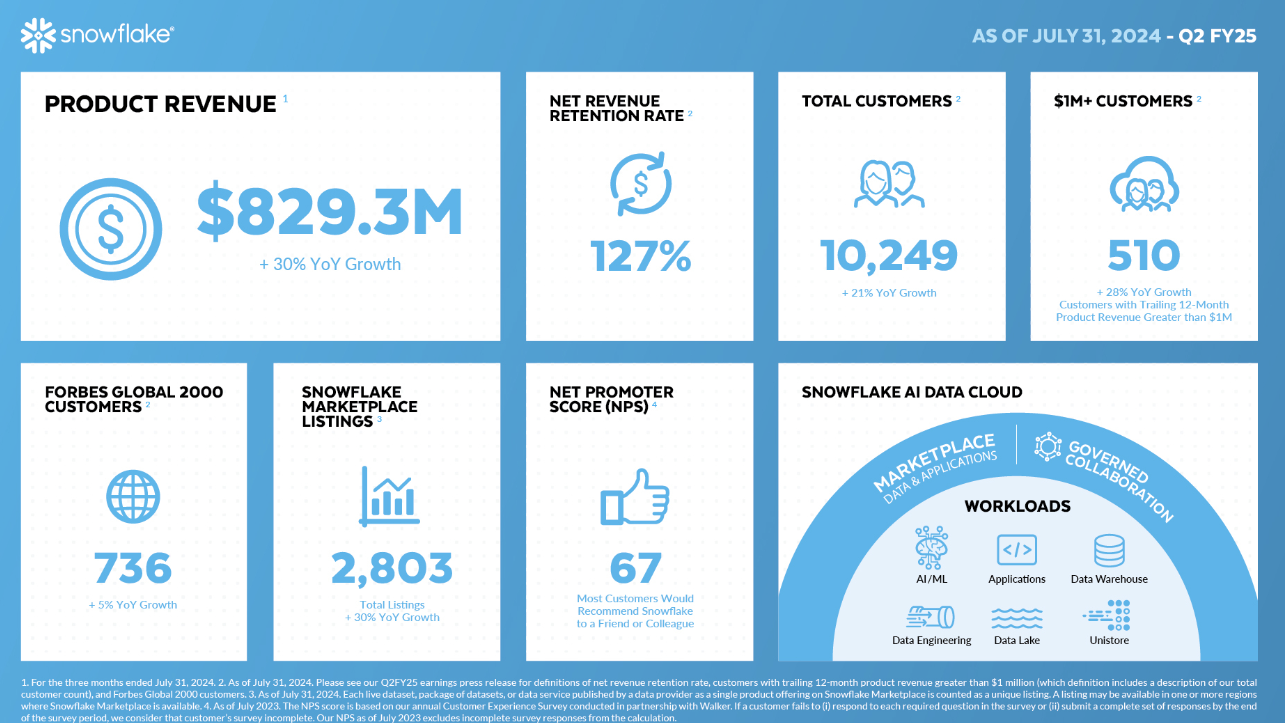
According to TechCrunch's Zack Whittaker, that third-party platform was Snowflake. As detailed by Google Cloud's Mandiant unit cybercriminals have been targeting Snowflake customer instances for data theft and extortion.

The breached AT&T data includes metadata such as cell site ID numbers and interactions as well as phone numbers. Personally identifiable information such as Social Security numbers and dates of birth were not breached, according to AT&T.

In a regulatory filing, AT&T said it learned of the incident April 19 with the attack happening between April 14 and April 25. AT&T said:

"While the data does not include customer names, there are often ways, using publicly available online tools, to find the name associated with a specific telephone number."

AT&T's breach is just the latest in a long line of high-profile attacks that are now required to be disclosed. These attacks mean enterprises need to map out response and resilience over prevention.

Constellation ShortLists™

Digital Safety, Privacy & Cybersecurity Security Zero Trust Chief Information Officer Chief Information Security Officer Chief Privacy Officer

Classiq CEO Minerbi on the intersection of quantum computing, HPC and use cases

Quantum computing software provider Classiq has been busy forging partnerships with everyone from Nvidia to BMW to Citi as it aims to expand enterprise use cases with a software layer that abstracts the underlying hardware.

A few recent developments from Classiq include:

We caught up with Classiq CEO Nir Minerbi to talk about quantum computing and where it's headed.

Classiq's role and state of quantum computing. Minerbi said the goal of Classiq is to build out the software layer for quantum computing. "We developed the operating system and compiler for any quantum computer," he said. "We established this company four years ago because no one could really program on quantum computers. We knew software is essential to developing this new field."

He added that Classiq's role is to work across multiple quantum computing providers since there are many players and approaches. Minerbi said:

"The quantum computing revolution has turned from a question of when to one of relatively soon. In order to realize the potential, we need software. Many good companies are focused on developing hardware and it's too early to bet on a winner. We see amazing progress in the industry."

An agnostic approach. Minerbi said Classiq's approach is to be able to integrate with multiple quantum platforms. "We want to be focused on what you want to achieve on the application or algorithm," he said. "Our complier is taking a high-level functional model that optimizes for the specific machine and the software stack automates the rest of the processes." In other words, Classiq is focused on use cases and abstraction layers instead of hampering developers with details about the quantum circuit, error correction and other hardware issues.

Constellation ShortListsâ„¢

Supercomputing and quantum computing. Minerbi said most quantum algorithms are hybrid with some parts for quantum computing and other parts classical. "Today it's definitely a hybrid workflow," said Minerbi. "We see many HPC providers trying to embed quantum computers within the HPC stack. We'll see more HPC centers buying quantum computers and integrating them. From the software perspective, this hybrid approach is something we're very much involved in."

Minerbi noted that HPE is a close partner as is Nvidia, which has its CUDA platform for quantum computing. "Quantum and supercomputing will be integrated so software integration will be very important," he said.

Nvidia's role in quantum. Minerbi said Nvidia is a key partner since many of the quantum simulations were running on GPUs. "These simulations are essential for development of quantum applications and algorithms," said Minerbi. "It's a natural partnership between Classiq and Nvidia."

Minerbi said QPUs, GPUs and CPUs will all be a part of the data center mix and work together.

Meeting developers where they are. Minerbi said Classiq is looking to enable developers to create quantum applications without being experts in quantum computing. "The level of abstraction is tight. You don't need to specify gate level operations and can use Python," he said.

Enterprise use cases. Classiq recently announced partnership with BMW, which established a quantum team a few years ago. Minerbi said BMW understood that to truly leverage quantum you have to create a team to develop applications, algorithms and the IT to be proficient before that hardware is ready. BMW is optimizing cooling systems with quantum algorithms and other use cases. A Classiq partnership with Citibank is different since the bank is just establishing its quantum efforts. Minerbi aid those two examples represent the extremes in quantum, but Classiq aims to be the software stack that appeals to all levels.

The roadmap ahead. Minerbi said Classiq's roadmap for the past few years has been to "take the best practices and technologies from the classical stack and bring them to quantum."

"We eventually want the quantum stack to be almost the equivalent in abstract development and high-performance results," said Minerbi. "All of the pillars are already in the platform, but there's so much work to be done. You'll be able to model a quantum program in a visual way with blocks with python embedded and more integrations. We need to progress the hardware to extract more value with less quantum resources."

Data to Decisions Tech Optimization Innovation & Product-led Growth Quantum Computing

AWS Summit New York 2024: Q Apps, Bedrock fine-tuning, customization, Guardrails aimed at production genAI

Amazon Web Services is focused on enabling generative AI throughout its platform in a bid to move projects from pilots to production. The strategy is to meet enterprises where they are with practical features including fine-tuning of large language models (LLMs), guardrails and additons to Amazon Bedrock.

At AWS Summit in New York, the company set out to layer genAI throughout its tech stack along with services that will make it more part of the everyday workflows. To make genAI move from proof of concept to production, AWS is rolling out a series of services. Bayer is rolling out Amazon Q across its organization and Amazon's One Medical is doing the same. AWS, which has launched 326 genAI features since 2023, also touted use cases at Ferrari to ingest data from vehicles and create new designs and models.

GenAI’s prioritization phase: Enterprises wading through thousands of use cases | AWS annual revenue run rate hits $100 billion as growth accelerates | AWS names Garman CEO effective June 3

Add it up and AWS' big goal was to highlight its genAI stack n a way that equates to a series of productivity gains and business wins. Matt Wood, VP of AI Products at AWS, said: "It's better to focus on what's not going to change." 

In other words, genAI will have to deliver business value to move from pilot to production. Wood said genAI is early in its development with leaps in business value appearing in the next 12 to 18 months. "It's becoming apparent that genAI will be woven throughout all of our applications," said Wood.

Here's a look at what AWS announced:

Q Apps goes to GA

Q Apps will be generally available. AWS said Q Apps will enable customers to build apps that can execute tasks via a natural language interface. Q Apps can then be shared with others if useful. AWS pitch for Q Apps focused more on optimizing processes. For instance, Q Apps can distill CRM data to generate insights that go into new RFPs saving hours spent digging through documents and content repositories.

AWS launches Amazon Q, makes its case to be your generative AI stack

The shift with Q Apps is that AWS is moving from finding an answer to a question to figuring out what the problem is. What remains to be seen is whether a horizontal interface such as Q effectively becomes the engagement layer to other enterprise applications.

Q Apps can turn Amazon Q conversations into apps, leverage enterprise data and inherit security and governance controls.

AWS is enabling developers to generate custom code inside Amazon Q Developer since Q can become familiar with an enterprise's coding practices, terminology and comments. "Picture a world where developers are running multiple agents in parallel," said Wood.

Within Amazon SageMaker Q will be used to move more quickly through different steps for fine tuning models or preparing data. AWS is adding the ability to build ML models in natural language, add recommendations in SageMaker Studio notebooks and generate code and resolve bugs with a notebook.

The upshot is that customers are starting to use Amazon Q as a vehicle to build assistive systems. Wood said Q can be used for large applications as well as ones for small teams. Smartsheet uses Amazon Q chatbots to connect teams, write account plans and complete other tasks.

Bedrock improvements

Bedrock will add a new image model from Stability AI to complement the addition of Anthropic's Claude 3.5 Sonnet. Wood said that 41% of large enterprises were using 3 or more large language models.

Claude 3 Haiku will also be fine-tunable via Bedrock. The ability to fine tune models in Bedrock will be a win for enterprises since fine tuning a smaller model is more cost effective and useful. Fine-tuning for other Claude models will follow. Wood said a few quick steps will enable enterprises to tune with internal data, control privacy with encryption keys and customize with hyperparameters.

Bedrock will also get more retrieval augmented generation (RAG) capabilities within Bedrock including more connectors to Salesforce, Confluent and Microsoft SharePoint for more enterprise data and knowledge bases. Those connectors, wrapped under Knowledge Bases for Amazon Bedrock, are designed to enhance foundational models as well as speed up vector searches and Amazon memoryDB integrations.

"Customers are using RAG for a wide range of use cases," said Wood. "We're expanding the type of data you can connect beyond S3 into additional data connectors and Web data from user provided public URLs."

AWS said it is also adding more capabilities to Agents for Amazon Bedrock including the ability to retain memory over multiple interactions. This ability is being integrated into customer facing use cases at Delta, United and Booking.com.

"You can carry over the context from different agent workflows," said Wood.

Wood added that Agents for Amazon Bedrock will be able to generate code, analyze data and generate graphs.

Guardrails

The company is also launching guardrails beyond Bedrock that are independent of models, Guardrails can ground based on context, search for a subset of acceptable answers via knowledge base connectors and increase response rates. AWS is betting that the ability to add a guardrail layer that's LLM and application agnostic will be a win.

AWS launched Contextual Grounding Check in Guardrails to ground answers via knowledge bases and corporate data. The grounding check asks if the RAG result is found in source material and whether it's related to the query.

AWS is also adding a new interface for prompt flows and prompt management. These prompt tools will be specific to model families but will enable faster upgrades.

Amazon is matching 100% of the electricity consumed by global operations with renewable energy. The play here for AWS is offsetting sustainability concerns due to genAI workloads.

Data to Decisions Innovation & Product-led Growth Future of Work Tech Optimization Next-Generation Customer Experience Digital Safety, Privacy & Cybersecurity amazon AI GenerativeAI ML Machine Learning LLMs Agentic AI Analytics Automation Disruptive Technology Chief Information Officer Chief Executive Officer Chief Technology Officer Chief AI Officer Chief Data Officer Chief Analytics Officer Chief Information Security Officer Chief Product Officer

AMD acquires Silo AI for $665M as it builds out AI ecosystem, genAI stack

AMD said it will acquire Silo AI for $665 million in cash in a deal that advances the company's efforts to broaden its generative AI ecosystem.

Silo AI, the largest private AI lab in Europe, will give AMD a team of AI scientists and engineers, tailored AI models and the ability to build out an enterprise ecosystem. While Nvidia has cashed in on generative AI due to its GPUs, the company also has developed an extensive platform and ecosystem.

AMD has invested $125 million across a dozen AI companies in the last 12 months and acquired Mipsology and Nod.ai. The spending spree is designed to bolster AMD as a full-stack AI player.

Peter Sarlin, CEO of Silo AI, will continue to lead the company, which will become a part of AMD Artificial Intelligence Group. The deal is expected to close in the second half of 2024. Vamsi Boppana, senior vice president of the Artificial Intelligence Group at AMD, said Silo AI will accelerate AMD's AI strategy.

Key facts about Silo AI include:

  • The company is based in Helsinki, Finland.
  • Customers include Allianz, Philips, Rolls-Royce and Unilever.
  • Silo AI has open-source multilingual LLMs including Poro and Viking.
  • The company is known for its SiloGen model platform and Silo OS.
Data to Decisions Innovation & Product-led Growth Future of Work Tech Optimization Next-Generation Customer Experience Digital Safety, Privacy & Cybersecurity AMD ML Machine Learning LLMs Agentic AI Generative AI Robotics AI Analytics Automation Quantum Computing Cloud Digital Transformation Disruptive Technology Enterprise IT Enterprise Acceleration Enterprise Software Next Gen Apps IoT Blockchain Leadership VR Chief Information Officer Chief Executive Officer Chief Technology Officer Chief AI Officer Chief Data Officer Chief Analytics Officer Chief Information Security Officer Chief Product Officer

GenAI’s prioritization phase: Enterprises wading through thousands of use cases

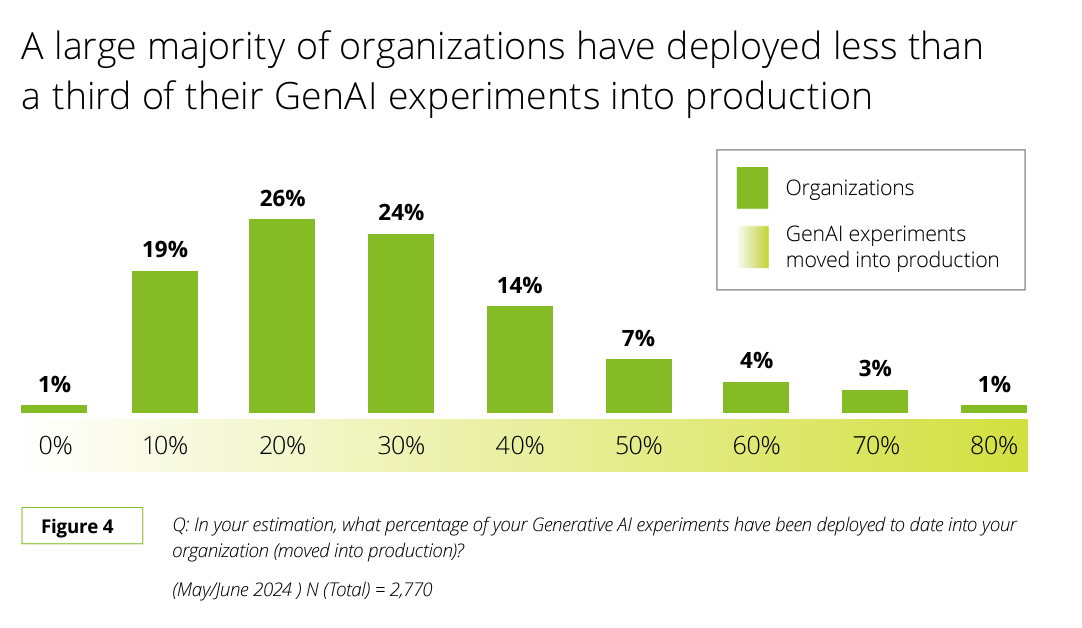
Enterprises have thousands of use cases for generative AI and are now working through prioritizing them and ultimately moving to production.

At AWS Summit 2024 in New York, a panel of partners and integrators talked about Amazon Q early adoption and genAI use cases with a focus on pilots to production.

The big takeaway is that the experimentation phase is over, but companies have thousands of use cases to prioritize. General themes are horizontal functions, industry focus, IT, code and anything focused on productivity. Integrators are now working toward vertical adoption of generative AI.

Indeed, those use cases--especially industry-focused efforts-- are behind a multi-year partnership between AWS and Deloitte create a genAI innovation lab. The two companies are designed to move generative AI pilots to production. The effort is aligned to Deloitte’s IndustryAdvantage initiative, a strategic $2 billion investment to co-innovate with eligible clients and alliances to develop industry-focused solutions. ”For instance, Deloitte's lab is developing an AI suite designed for CFOs. Deloitte and AWS will combine various services to focus on industry use cases leveraging Amazon SageMaker, Bedrock, Q and Braket. 

TCS Krishna Mohan, VP and Deputy Head of TCS' AI and Cloud unit, said the focus is on prioritizing use cases to deploy. Enterprises went to line of business to collect use cases and came back with thousands.

"A lot of customers have 3,000 to 4,000 use cases. They went to line of business heads and asked for use cases. Every line of business leader had a budget and the central organization also had budget," said Mohan. "Now the focus is on prioritizing them and how to deploy into production."

Mohan said use cases that deliver on productivity metrics win out. Use cases that are horizontal across functions, industry focused and make it easier on compliance are winning out, he added. Key use cases include IT productivity, sales, marketing, finance, HR, customer segmentation in retail, automation in manufacturing, and customer experience in airlines.

Stephanie Pace, Global AI/ML GTM leader at Quantiphi, said the genAI market is segmenting between enterprises builders and buyers. Companies looking for faster time to value, said Stephanie Pace, Global AI/ML GTM leader at Quantiphi. Pace said Quantiphi was an Amazon Q pilot customer and has found it helpful to deliver faster time to value. 

According to Pace, genAI budgets and decision making are more aligned with the line of business. The genAI buying table now includes IT, compliance and line of business. "We saw pilots not move into production because compliance wasn't in the room," said Pace. "Projects are now focused less on the art of the possible and more on the art of the profitable."

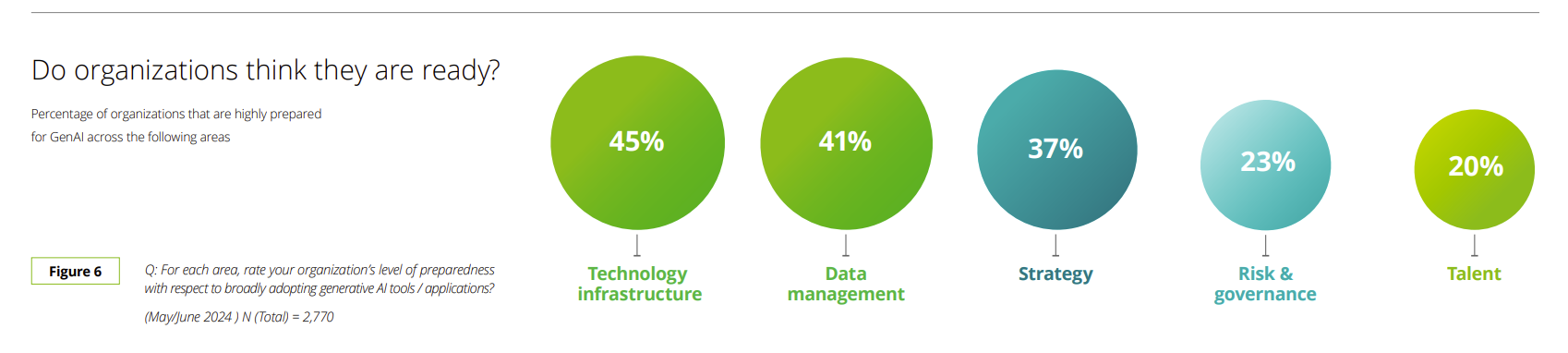
The biggest challenge for moving genAI to production is enterprise cloud and data maturity. Not all companies are ready for genAI due to data strategies being immature, said AllCloud CEO Eran Gil.

Dr. Ryan Ries, Chief Data Strategist at Mission Cloud, said genAI requires the correct data schema to use natural language processing. "You have to go through and clean up these systems so the data being captured is accurate and available for use," said Ries. "Companies moved toward having the best data lake ever without doing the groundwork."

Generative AI's looming crap in, crap out data problem

Constellation Research CEO Ray Wang said:

"Many projects will remain in POC phase as clients grapple with how much data they need to deliver on a precision that their customers will trust, where will they partner for data, and who do they sue when something goes wrong? That being said, the customers that know when and where to insert a human into the process are the customers that will win in the Age of AI."

Other takeaways include:

  • Mohan said manufacturing is adopting genAI quickly as are regulated industries.
  • Implementations of genAI can be challenging due to integration, people and processes. The big lesson is that genAI by itself doesn't cure anything by itself.
  • Sales productivity has been a big use case by democratizing information and surfacing the data that improves efficiency. Pace said customers have used Amazon Q to surface insights, in-stock inventory and order information. "We have explored sales productivity and driving revenue with customers," said Pace.
  • Recruiting was another key use cases, said Ries. GenAI is being used to comb through candidates, create questions and prevent bias.
  • There's a lot of plumbing work that is required to move genAI into production.
  • Data sources and IP issues typically require enterprises to build more genAI integrations and customize. "Everybody is worried about IP and their data going out," said Mohan.
  • Mohan said enterprises need to focus on business use cases and value over what technology is being used. Mohan said he expected the next two to three quarters will sort out the business value of genAI and more best practices.
  • Enterprises are seeing cost improvements with genAI due to model improvements as well as compute efficiency. New tooling is also helping improve costs.

More on genAI dynamics:

Data to Decisions Future of Work Marketing Transformation Next-Generation Customer Experience Innovation & Product-led Growth Tech Optimization Digital Safety, Privacy & Cybersecurity New C-Suite ML Machine Learning LLMs Agentic AI Generative AI Robotics AI Analytics Automation Quantum Computing Cloud Digital Transformation Disruptive Technology Enterprise IT Enterprise Acceleration Enterprise Software Next Gen Apps IoT Blockchain Leadership VR GenerativeAI Chief Information Officer Chief Executive Officer Chief Technology Officer Chief AI Officer Chief Data Officer Chief Analytics Officer Chief Information Security Officer Chief Product Officer

Runway aims to make business finance more intuitive, collaborative

Runway, a startup looking to break into the financial planning for businesses market, said its AI-driven platform for enterprise finance is generally available.

The company, not to be confused with the AI video content startup with the same name, is looking to break into a crowded market. Runway is aiming to make financial modeling, headcount planning, department budgeting and finance workflows more user friendly and intuitive.

As previously reported, enterprise software buyers are increasingly disillusioned with giants that keep raising prices and a lack of new entrants offeringcompetition.

Siqi Chen, CEO of Runway, said CFOs need to be freed from admin work and reports that largely look backward. Runway features "Ambient Intelligence" that enables CFOs and teams to better collaborate and plan. "What teams need is a clear, intuitive understanding of how all the functions of a business work together, from sales and marketing to product and engineering. Clear context creates alignment, enables true collaboration, and accelerates execution," said Chen.

Runway connects with more than 650 applications including the most common accounting, HR, CRM and data warehouse systems. Runway automatically updates forecasts with new actuals and simplifies processes with a drag-and-drop approach.

Constellation Research CEO Ray Wang said:

"The future is ambient experiences, where systems move from persuasive (making you spend more time for their benefit) to consensual (where you choose where you spend time), to mindful (where the system makes nudges and suggestions in your interest).  The crux of the design is to make life easier, which is very rare in legacy solutions. Add a layer of human collaboration, this system has the ability to not only save time and money, but also help you find exponential improvements." 
 

Here's what Runway's Ambient Intelligence includes:

  • Clear explanations of financial drivers such as cash burn and gross margin for more democratized modeling.
  • Budget vs. actual variances that are automatically adjusted.
  • Scenario comparisons for modeling and making future plans.

While Runway is in a crowded market the company has landed customers such as Superhuman, AngelList and 818 Tequila. According to TechCrunch, Runway has raised $33.5 million in venture funding so far.


Data to Decisions Future of Work Tech Optimization AI Analytics Automation CX EX Employee Experience HCM Machine Learning ML SaaS PaaS Cloud Digital Transformation Enterprise Software Enterprise IT Leadership HR Chief Financial Officer Chief Customer Officer Chief People Officer Chief Human Resources Officer

Generative AI's looming crap in, crap out data problem

Generative AI models are going to have a big training data issue as public web access becomes more restricted and it's unclear whether large language models (LLMs) will be able to avoid the garbage in, garbage out issue.

This data access issue is just getting started, but there's enough developing to see the wall ahead. Constellation Research CEO Ray Wang has said that the open web will largely disappear as content providers and corporations restrict data access. If this scenario plays out, LLMs aren't going to have the training data available to continually improve.

“We will not have enough data to achieve a level of precision end users trust because we are about to enter the dark ages of the internet, where the publicly available information on the internet will be a series of Taylor Swift content, credit card offers, and Nvidia and Apple SEO. Where will the data come from?” said Wang.

Here are a few developments that have me wondering about the data wall we're going to hit.

Cloudflare last week announced a new feature for its customers that would prevent AI bots from scraping data from sites. There has long been a robots.txt standards that prevents information from being indexed by search engines. The general idea was that the robots.txt approach would also give creators the ability to prevent content from being used for LLM training data.

The reality is that the AI bots are blowing right past that robots.txt approach. Cloudflare's post on disabling AI bots is worth a read. A few highlights include:

Bytespider, Amazonbot, ClaudeBot, and GPTBot are the top four AI crawlers. Bytespider is run by Bytedance, the parent of TikTok. "We hear clearly that customers don’t want AI bots visiting their websites, and especially those that do so dishonestly. To help, we’ve added a brand new one-click to block all AI bots," said Cloudflare.

If you play this out, you can rest assured that the most credible sites are going to block AI bots. After all, why give the content away that you can license? Google licensed Reddit content. Media giants are pairing up with Google or OpenAI.

Reddit laid out the open internet meets AI conundrum in May:

"We see more and more commercial entities using unauthorized access or misusing authorized access to collect public data in bulk, including Reddit public content. Worse, these entities perceive they have no limitation on their usage of that data, and they do so with no regard for user rights or privacy, ignoring reasonable legal, safety, and user removal requests. While we will continue our efforts to block known bad actors, we need to do more to restrict access to Reddit public content at scale to trusted actors who have agreed to abide by our policies."

This potential data wall for genAI is so critical that synthetic data is becoming increasingly important. The general idea behind synthetic data is that models will generate content that will then be used to train future models.

Last month, Nvidia released Nemotron-4 340B, a family of models optimized for Nvidia NeMo and TensorRT-LLM, to advance synthetic data. Nvidia CEO Jensen Huang has a vision that includes AI factories creating data and then learning from it to create more models.

That Nvidia synthetic data vision only works if there's a continuous stream of quality data to ingest. Companies like Google and Meta have those streams since users create data every second. Most LLM players won't have that access and will aim to avoid licensing.

Add it up and we may see a reverse data flywheel. More creators pull data and content from the open web. LLMs train on what's available. You get what you pay for, so the data is crap. Then these models trained on crap data train more models. If this data quality issue doesn't get sorted out, the only thing generative AI is going to scale is crappy models.

Data to Decisions Innovation & Product-led Growth Future of Work Tech Optimization Next-Generation Customer Experience Digital Safety, Privacy & Cybersecurity AI GenerativeAI ML Machine Learning LLMs Agentic AI Analytics Automation Disruptive Technology Chief Information Officer Chief Executive Officer Chief Technology Officer Chief AI Officer Chief Data Officer Chief Analytics Officer Chief Information Security Officer Chief Product Officer

GenAI, orginality and scaling lookalikes

Generative AI appears to be scaling lookalikes at a rapid clip and the big unknown is how long originality will last. 

Figma's Make Designs feature is the latest example of how generative AI models and the guardrails that govern them are going to have weight how much they can crib from existing designs. When does "inspiration" become a blatant copy of something?

As a quick recap, Figma launched Make Designs, a feature that can create apps on the fly. Andy Allen, CEO of Not Boring Software, highlighted on X how Figma's Make Designs tool replicas of Apple's weather app. I'd argue that the Figma Make Designs creations looked like the weather apps you'd find everywhere. Honestly, most Web designs and apps all look alike today. GenAI is just going to scale copycats even more.

Figma CEO Dylan Field responded to Allen's take in a thread that noted that the company used off-the-shelf models, notably OpenAI, and that the issue was variability. Figma didn't have enough data to create more original designs.

Field wrote:

"How does Make Design work? As we have explained publicly, the feature uses off-the-shelf LLMs, combined with design systems we commissioned to be used by these models. The problem with this approach — which I outlined in my keynote last week — is that variability is too low."

The upshot to Field's response is that generative AI can scale creativity, but it needs a large data set. However, if all the data in the training set takes inspiration from the same thing you're going to have a lot of lookalikes.

The one certainty is that the Figma kerfuffle is just the beginning. We're going to hear about these issues repeatedly until the overarching genAI systems are designed better.

For context on the issue, I asked the Constellation Research team to provide some thoughts. Every enterprise is going to use off-the-shelf models so you should know the landmines in advance. Here's what Liz Miller had to say:

"At Config, while the release of Make Design got some oohs and ahhhs…it didn’t get the room thundering cheers. That honor went to the release of Slides of all things! Figma users were most excited by automation and collaboration tools that actually help them get their jobs done and done better. So, while the generative AI tools were “cool” they weren’t dominating conversations. That went to updates and new features in tools like Dev Mode that brings developers and designer workflows and work closer together.

This “story” is going to happen more and more as GenAI tools come out of beta. The key question asked by Figma’s CEO is a critical one: what was this foundation model trained on? That’s an OpenAI question. Was the issue the design framework they had commissioned or was OpenAI trained on Apple design frameworks as their model for “best” design?

Sadly, this is often where and how UX and product design goes…even when AI isn’t involved. Remember the days when bootstrap design templates dominated design. Everything looked like it was a knockoff of the Uber website! Tastes tend to follow the leader until everything looks alike. It is a lot like everyone running out and painting their house white with black accents. It looks great on those first homes, but next thing you know, EVERY HOUSE on the block is white with black trim. That is until someone paints their house black with wood trim and the design aesthetic takeover begins again, This time, thanks to Generative AI, the takeover happens at lightning pace and scale. If there was ever a time to make sure a human was in the loop it is for design…and in reality…that’s exactly what Figma did."

Holger Mueller added:

"The Figma issue shows the dilemma of all generative AI--it needs data. For an app developer or UX developer an app needs to look at existing artefacts of work. And ideally how popular they are. The demand to create a weather app suggests a design that looks like the Apple weather app is no surprise. It is a bona fide weather app, has recently been designed and is used by millions of users across form factors every day. Those are all good qualities to 'steal' for some design features. But the grounding of the model means it cannot take 100% of an existing app. It can only take input or inspiration from an existing app up to 10%. That model design seems to have been missing. Kudos to Figma for not giving up and retooling."

More on genAI dynamics:

Data to Decisions Future of Work Next-Generation Customer Experience Innovation & Product-led Growth Tech Optimization Digital Safety, Privacy & Cybersecurity ML Machine Learning LLMs Agentic AI Generative AI Robotics AI Analytics Automation Quantum Computing Cloud Digital Transformation Disruptive Technology Enterprise IT Enterprise Acceleration Enterprise Software Next Gen Apps IoT Blockchain Leadership VR business Marketing SaaS PaaS IaaS CRM ERP finance Healthcare Customer Service Content Management Collaboration Chief Information Officer Chief Executive Officer Chief Technology Officer Chief AI Officer Chief Data Officer Chief Analytics Officer Chief Information Security Officer Chief Product Officer

Practical AI, Emerging CSO Trends, Zoholics | ConstellationTV Episode 83

This week on ConstellationTV episode 83, hear co-hosts Doug Henschen and Larry Dignan analyze the latest enterprise #technology news and events (practical GenerativeAI, Snowbricks conferences).

Then hear Constellation Research analysts discuss the latest announcements, trends, and technology from the Zoholics conference and watch an interview with CR analyst Chirag Mehta on emerging trends CSOs need to know about.

0:00 - Introduction: Meet the Hosts
02:53 - Enterprise technology news coverage
11:54 - CR analysts LIVE from Zoholics
23:22 - Emerging Trends for CSOs
34:20 - Bloopers!

ConstellationTV is a bi-weekly Web series hosted by Constellation analysts, tune in live at 9:00 a.m. PT/ 12:00 p.m. ET every other Wednesday!

On ConstellationTV <iframe width="560" height="315" src="https://www.youtube.com/embed/271A62-TNdA?si=kyTdy3G7QroTHuTM" title="YouTube video player" frameborder="0" allow="accelerometer; autoplay; clipboard-write; encrypted-media; gyroscope; picture-in-picture; web-share" referrerpolicy="strict-origin-when-cross-origin" allowfullscreen></iframe>

Persistent Systems acquires Starfish Associates

Persistent Systems said it will acquire Starfish Associates that expands its reach into the contact center and unified communications market.

Terms of the deal weren't disclosed.

With Starfish Associates, Persistent Systems gets a large enterprise customer base and its automation, integration and workflow engine. Starfish Associates integrates communication systems from the likes of Amazon Connect, Avaya, Cisco, Genesys and Microsoft Teams with platforms from ServiceNow, Workday and Microsoft.

Persistent Systems said its plan is to combine Starfish Associates with its AI-automation tools to optimize workflows.

Here's a look at the Starfish Associates platform.

Sandeep Kalra, CEO of Persistent Systems, said Starfish Associates "greatly enhances our unified communications and contact center management offerings as this industry undergoes significant disruption on the back of AI-led innovations." Persistent Systems' services footprint includes consulting, cloud and infrastructure, data and analytics, software product engineering, automation, application development, CX transformation, security and enterprise integration.

Persistent Systems recently launched its GenAI Hub, a platform for creating and deploying generative AI applications in an enterprise based on multiple large language models. Persistent also launched iAURA, a suite of data tools for AI and machine learning implementations.

The company also announced partnerships with Google Cloud, Snowflake and AWS to expand genAI use.

For fiscal 2024, Persistent Systems delivered revenue of $1.186 billion, up 14.5% from a year ago. Persistent was named Constellation Research's Best Enterprise Services Vendor in 2023 and appeared on multiple Shortlists.


Data to Decisions Next-Generation Customer Experience Innovation & Product-led Growth Future of Work Tech Optimization Digital Safety, Privacy & Cybersecurity ML Machine Learning LLMs Agentic AI Generative AI AI Analytics Automation business Marketing SaaS PaaS IaaS Digital Transformation Disruptive Technology Enterprise IT Enterprise Acceleration Enterprise Software Next Gen Apps IoT Blockchain CRM ERP finance Healthcare Customer Service Content Management Collaboration Chief Information Officer Chief Executive Officer Chief Technology Officer Chief AI Officer Chief Data Officer Chief Analytics Officer Chief Information Security Officer Chief Product Officer