Results

Why Internal Candidates Matter | SuperNova Interview with Peraton's Cari Bohley

Peraton, a next-generation national #security company, is continually searching for talent including employees with high-security clearances. But the real win for Peraton has been courting internal candidates.

The company is an integrator and enterprise IT provider for the US government. Peraton provides #cybersecurity, #digital, #cloud, operations and #engineering services for #space, #intelligence, homeland security, health and #defense, among others.

In Peraton's Supernova Award entry, the company noted it saw internal job board applicants increase 9.8% and more engagement overall. Larry Dignan, Editor in Chief of Constellation Insights, caught up with Cari Bohley, Vice President of Talent Management at Peraton, to discuss the Supernova finalist entry in the Future of Work: Human Capital Management category.

__

Access the full video transcript here: (Please note this transcript is not edited and may contain errors) 

Hi. I'm Larry Dignan for Constellation insights, and we're here with supernova Award finalist Carrie Boley. She's a VP of talent management at paraton. Hi, Carrie, thanks for joining us. Well, thanks for having me. 

So I guess let's just start from the top and explain what paraton does. It looks like you all have some cool projects you work on. Yeah, we are a government services contractor. And really what that means is that all of the work that we do is for the US Federal Government. We are really a national security company. Is a good way to describe the type of work that we do for the federal government. Work on things like launching rockets in the intelligence space, collecting and analyzing intelligence, data, maritime security, it modernization, I mean, just a lot of really cool projects for the federal government we're getting now into space exploration, space resiliency. So a lot of exciting projects and exciting work that we do really to keep our country and our nation and its citizens safe.

And the company was built by mergers and acquisitions, yeah. Well, Paraton itself started as a spin off of a company called l3 back in 2017. I joined the company in 2022 and at that time, we had just gone through quite a significant amount of M and A activity with the IT Services Division of Northrop Grumman, as well as the acquisition of the entirety of a company called perspecta, which in and of itself was the legacy of several different mergers and acquisitions. So here we are, almost three years later, and we're about 19,000 employees, and in doing really well, it's a really exciting time, because really, even though we've been around since 2017 and if you can, if you count the legacy of all the different companies, we've got people that have, like, 30 years of tenure, but because of years of service, but we're really just a young company, you know. 

So we operate as a young company, being only about three years old, as this talent pool built, built, I recall in your application, you know, you need some way to filter through the talent. Can you walk me through the project and what aI had to do with it? Yeah, so, like many companies, I mean, there's, there's a lot of great talent out in the industry, but the market is very, very competitive. And so when you open up a requisition for a job, the competition is fierce, and we've got some very, very unique requirements that we're trying to fill. So to really parse through, really effectively, parse through all of that information. It takes a lot of time and effort, so without having something like AI to really look for some unique information and indicators, it's really difficult.

The other piece of that is looking for what we call passive talent. So not everybody's always actively looking for a job. So you know, like many companies, we're also looking for people who aren't necessarily looking for a new job. And an AI helps us identify who that talent is. Helps us look across different areas of the internet to find who that talent might be, people who maybe have written white papers, people who have, you know, a profound on LinkedIn or other social media sites, people who don't use social media, but, you know, maybe they presented at a conference and presented something really interesting that we may, we may want to get in touch with. So we've got different ways to find individuals who may be somebody that we want to talk a little bit further with.

When did it hit you you needed AI as a front end or what? I guess, when did it hit you that the scale of finding talent was challenging?

Um, you know, in 2022 we've worked with this company. We've worked with seekout for a few years. A lot of companies in the space, a lot of companies across multiple industries, work with companies like seekout. And it wasn't until we've, we've recognized that we needed to have more power than just, you know, trying to find this passive talent and that the type of work that we were bidding on in the government was much more complex, much more complicated, and the level of effort that it takes to submit proposals for the government, because that's essentially how we work, was becoming increasingly complex, and part of that effort requires being able to put together things like staffing plans, so without having a tool in place to help us that could leverage AI that could again go through large amounts of data in short periods of time, it really handicaps what you're able to do. 

And so when we look at, you know, all of the different tools that are out there, when we looked at the relationships that we had already in place with seekout, it just made sense for us to explore some of the expanded capabilities that they already had that we weren't taking advantage of. And that's really when we started putting two and two together. And it's like, you know, it just makes sense to go further down the road with them. And then, in addition, we were also looking at, you know, we can bring talent in the door. How does what seek out offers also play into our retention strategies and that's where we started looking at some of their other modules around career development and career growth, and it really played right into what we were trying to accomplish from a career development standpoint for our employees. Really played right into the data that we were seeing from our employee engagement strategies, and it really complemented what we were trying to do and help our helping our employees build their careers, so they felt that they had a place to stay with paraton. They didn't have to go and look someplace else for a job.

What were some of the main business metrics you used to justify the project?

Turnover is the biggest one. So retention, yeah, retention and being able to ensure that we could keep our employees within the company and that we could so retention is the starting point, and then mobility is another. So not only do we retain our employees, but we have a place for them to grow their careers so that we can move them throughout the organization. And if we were able to do that, then we could bring in, you know, new employees from outside the company and staff programs from the bottom, and help build employees' careers throughout the organization. 

So, I mean, it's, it really becomes an end-to-end process for helping our folks build their careers within the company, starting from when they when they sign on with us. You know, they can look and see that hey, you know, it's not only just this project that I, that I started with, or this job that I started with, but there are other places where I can go. I don't have to stay in this one position and be here for the entirety of my time with paraton, I can move around to different types of jobs and different types of opportunities within the organization, but being able to create the picture that you know, we can reduce turnover, we can increase engagement, we can increase mobility and staff our programs internally, instead of having this churn of people coming in and having this revolving door of employees. I mean, those are the things that are the metrics that our leadership team paid attention to, what roles are most difficult to hire and retain in our industry, it's really highly clear talent. These are the people that are doing top-secret work for the government. And there is, you know this, you would think that it's a pretty big market, but it's not. 

It's a very, very small market. There's several companies that do the type of work we do, but it's really a very small industry, very small. And so trying to find the right talent to do the work that we have to do to keep our nation safe is challenging and that's the that's the talent that that we use, you know, our partner and seek out, that we use them to help us find what were some of the surprises with this project? 

See, some of the surprises was, I would say at the beginning, it was really creating a business case that resonated with our leadership team. In hindsight, it's like, oh, it makes so much sense to just pick out these couple of metrics, and that's what everyone is gonna buy into. But in creating the story that was a strong business case, and making sure that we had that business case in place, is something that it's a, it is it is an effort to do that, so that you do it. Well, certainly not impossible, obviously, because we did it, but making sure that you've got a strong business case so that you can get the buy in that you need, and having a sponsor to help you with that is incredibly important. And I.

Yeah. And I think probably the most surprising thing for me was that when you have all of those things in place, it becomes much easier to position a project like this and an investment like this to an organization. What does seek out to sit on top of is it sit on the HR system or, I guess, what? What's it? What's it integrated with? Yeah, we integrate it with a couple of different systems. We integrate it with our talent acquisition system, our ATS, we integrate it with our HRIS system, we integrate it with our learning management system. We integrate it with it's not really an integration, but we input our career development framework into it so that it understands all of the different job families and things like that. So it really is like a hub that sits on top of all of these different tools and systems, so that, depending on what we're using it for, it gives us, it gives our employees the information that they need.

You know, for example, on the talent acquisition side and on the career mobility side, like it knows all of our open positions, so that you know, if I'm an employee that's looking for a new role, I can see what all those roles are. And because we feed all of our HRIS system, it knows who I am, and because our job families are in there, it knows what what is next in line for me, if I were to go on a kind of a step by step approach, but also because it sits with our on our HRIS system, it knows other people who are like me in the company, who have maybe gone down a different path, and it aggregates that data so that it gives me good recommendations that Maybe are things that I haven't thought of before. So it's not just a traditional career path of if I were in finance, moving, you know, finance analysts, 123, but maybe I want to go into data science and I, or maybe I hadn't thought about going into data science, but because, you know, there's some overlap between skills, between finance and something like data analytics, it will show me those different career paths that maybe I hadn't considered before, and so that opens up a whole world of opportunity for our employees. And then it'll also feed me from our learning management system, the type of training that maybe I haven't had that will help me develop in that area, so that I become upskilled, and then can start to apply for those types of positions.

What are some of the differences between sourcing talent internally versus externally? Quite if there's a few differences. I mean, internally, we know our candidates. We know you know where they're coming from. We know the types of projects that they've worked for. You know, we know what their performance has been on. So, you know, they're a known quantity. When we're sourcing candidates internally, you know, versus externally, when you know it's we don't have that level of data. There's not fidelity in the data on that individual and those candidates that are out in the external to the organization. So it's, you know, when we're looking for, especially for more strategic positions, it really helps us to be able to source internally when we've got so much more data on our employees and on the individuals that are that we're trying to position for those types of roles in the organization.

From an external standpoint, you know, looking at Canada candidates externally, there's also, you know, if they're, if they're posting for a position with us, they can also be posting for a position with, you know, five other companies. So they're much less committed to a position than somebody who's already within the organization. They're already on our payroll, they're already getting our benefits. So their stickiness, if you will, just doesn't exist. So from a value proposition standpoint, if we can source our candidates internally whenever possible, then you know, that's, that's what we want to be able to do now, with a company like ours, where growth is part of our strategy. It's not always possible, it's not always desirable, but when it makes sense, where we can do that, that's part of our strategy. What? What advice would you give HR, leaders, going into AI?

You have to go into AI. You don't have a choice. It is, it is part of our future. One thing that there are a couple of things. One is that AI is going to be one of your best employees. It's going to be an employee. I use AI a lot because I have a very lean team, so I use AI in a couple of different ways. When I'm going through a lot of data, when I'm trying to develop a new training module, when I'm looking for ideas on how to further a strategy, I use AI because I don't have the people resources to do so.

AI also helps me with my team in terms of giving them new opportunities. So there's really a lot of, you know, there's a lot of ways to apply AI that we hadn't thought that we, you know, haven't been doing traditionally in an HR in an HR role. So it's not just for the tech folks that are out there. It's really for all of us to take advantage of. And honestly, if you're not ready for that yet, it's really time for you to start doing some research, reading up on it, and time to get ready for it. Otherwise it's you're just going to be left behind. All right. Thanks for joining us, and congrats on being a finalist. Thanks so much.

On Insights <iframe width="560" height="315" src="https://www.youtube.com/embed/d7MqPbSqaSY?si=dVD0izgo2tPGKyqH" title="YouTube video player" frameborder="0" allow="accelerometer; autoplay; clipboard-write; encrypted-media; gyroscope; picture-in-picture; web-share" referrerpolicy="strict-origin-when-cross-origin" allowfullscreen></iframe>

Why aren't genAI projects scaling? Data issues, says Deloitte

Data management and data quality is getting more investment from enterprises because it's the biggest risk factor in moving generative AI to production, according to a Deloitte survey.

Deloitte’s State of Generative AI in the Enterprise report for the third quarter found that data quality is the biggest risk to generative AI projects, according to a survey of 2,770 director-level to CxO respondents.

According to Deloitte, 75% of organizations are increasing their technology investments around data management. Data related issues also caused 55% of survey respondents to avoid certain genAI use cases. "Most organizations do not have enough data to get to a level of precision their stakeholders will trust," said Constellation Research CEO Ray Wang.

The data quality issue is core to driving value with generative AI. Deloitte said in its report:

"The clock is ticking for organizations to create significant and sustained value through their Generative AI initiatives. Promising pilots have led to more investments, escalating expectations and new challenges. During this pivotal phase, C-suites and boards are beginning to look for returns on investment. There is a chance that their interest in Generative AI could wane if initiatives don’t pay off as much, or as soon, as expected."

Also see: 

Among the key findings:

  • 42% of respondents cited improved efficiency, productivity and cost reduction are the top benefits from genAI to date.
  • 58% said genAI also gave them increased innovation, improved products and services and enhanced customer relationships.
  • Two of three organizations are increasing their genAI value.
  • But 41% of organizations struggled to define and measure the exact impacts of their genAI efforts.
  • Nearly 70% of organizations said they have moved 30% or fewer genAI experiments into production. Data issues are limiting adoption.
  • Only 23% of respondents said they were highly prepared for genAI risk management and governance.
  • More than 40% of respondents said their companies are struggling to define and measure impacts of genAI initiatives.
  • The majority of companies don't consider themselves prepared for the infrastructure, data management, strategy, risk and talent.

More:


Data to Decisions Future of Work Innovation & Product-led Growth New C-Suite Tech Optimization Next-Generation Customer Experience Digital Safety, Privacy & Cybersecurity AI GenerativeAI ML Machine Learning LLMs Agentic AI Analytics Automation Disruptive Technology Chief Information Officer Chief Executive Officer Chief Technology Officer Chief AI Officer Chief Data Officer Chief Analytics Officer Chief Information Security Officer Chief Product Officer

Lowe's bets on AI, technology to navigate slowing demand

Lowe's said it is navigating a "challenging industry backdrop for the homeowner" with technology projects that drive productivity, enable omnichannel retailing and customer experiences.

On Lowe's second quarter earnings conference call, the company outlined a bevy of technology projects even as it reported mixed results and cut its fiscal 2024 outlook.

Here's a look at some of the technology projects outlined by Lowe's.

Apple Vision Pro. Lowe's CEO Marvin Ellison said the company is working with Apple to help customers visualize and design new kitchens. "This past quarter, we piloted an in-store design experience for our customers in three test markets, where with the help from a Lowe's associate, customers could wear the Apple Vision Pro and use the Lowe's Style Studio app to explore and customize hundreds of kitchen designs in 3D using products, fixtures and appliances all available at Lowe's," said Ellison.

Leveraging AI to improve customer and associate experiences as well as "improve how we sell, shop and how we work." Ellison cited partnerships with Nvidia, OpenAI and Palantir. Lowe's used Palantir's AIP as a customer service engine. Here's how Palantir AIP navigates a customer journey and what's on tap.

Lowe's is also creating custom GPTs for product recommendations with OpenAI and digital twins with Nvidia technology.

Perpetual productivity improvement (PPI). Those AI investments fall under Lowe's PPI efforts. The company cited its In-Store Mode on its mobile app where they can navigate detailed product and location information. Lowe's also said it has used technology to reduce returns to historic lows, said Joe McFarland, Executive Vice President, Lowe's Stores.

"We're only in the middle innings of the productivity journey, a lot of runway still in front of us. I've talked about things in the past, front-end transformation," said McFarland. "We're not even 50% through our front-end transformation. This is not only focused on the operations side, but also the sales side."

Enterprises start to harvest AI-driven exponential efficiency efforts

Associates are using quick-scan devices that immediately account for returns. In addition, Lowe's is collecting information on why an item was returned to collaborate with vendors. Lowe's is also reducing damage on more fragile items in the supply chain.

Lowe's CFO Brandon Sink noted that Lowe's has offset more than $500 million in associate wages, inflation and strategic investments with PPI.

Delivery service integrations. Lowe's said it has added Uber Eats as a delivery service to go with DoorDash, Shipt and Instacart as well as its OneRail last-mile technology partner. "As we continue to involve our omnichannel strategy, we've learned that having multiple delivery platforms extend our reach into both urban and suburban areas and helps us drive incremental sales with different types of customers, especially younger generations who are more digitally savvy," said Ellison.

More retail, experiences and technology.


Matrix Commerce Next-Generation Customer Experience Innovation & Product-led Growth Sales Marketing Revenue & Growth Effectiveness Data to Decisions Future of Work Tech Optimization Digital Safety, Privacy & Cybersecurity B2B B2C CX Customer Experience EX Employee Experience business Marketing eCommerce Supply Chain Growth Cloud Digital Transformation Disruptive Technology Enterprise IT Enterprise Acceleration Enterprise Software Next Gen Apps IoT Blockchain CRM ERP Leadership finance Social Customer Service Content Management Collaboration M&A Enterprise Service AI Analytics Automation Machine Learning Generative AI ML LLMs Agentic AI SaaS PaaS IaaS Healthcare Chief Information Officer Chief Customer Officer Chief Data Officer Chief Digital Officer Chief Executive Officer Chief Financial Officer Chief Growth Officer Chief Marketing Officer Chief Product Officer Chief Revenue Officer Chief Technology Officer Chief Supply Chain Officer Chief AI Officer Chief Analytics Officer Chief Information Security Officer

OpenAI launches GPT-4o fine tuning

OpenAI said GPT-4o fine tuning, which will enable you to customize the company's best model with proprietary data sets, is available to developers across all paid usage tiers.

In a post, OpenAI said fine tuning for GPT-4o was one of the most requested features from developers. OpenAI said that it will offer 1 million training tokens per day for free through Sept. 23. For GPT-4o mini, OpenAI is offering 2 million training tokens per day for free through Sept. 23.

Fine tuning will enable developers to customize GPT-4o for various use cases. Enterprises will be interested in fine tuning for GPT-4o since it can lower costs.

The models available for fine tuning include:

  • gpt-4o-2024-08-06
  • gpt-4o-mini-2024-07-18
  • gpt-4-0613
  • gpt-3.5-turbo-0125
  • gpt-3.5-turbo-1106
  • gpt-3.5-turbo-0613
  • babbage-002
  • davinci-002

GPT-4o fine tuning will cost $25 per million tokens and inference is $3.75 per million input tokens and $15 per million output tokens.

OpenAI highlighted examples of companies using GPT-4o for fine tuning and noted that enterprises have full ownership of their business data and all inputs and outputs. Common use cases for fine tuning include setting style, tone and format, improving reliability, correcting failures, handling edge use cases and performing a new skill that's hard to articulate in a prompt.

Data to Decisions Innovation & Product-led Growth Future of Work Tech Optimization Next-Generation Customer Experience Digital Safety, Privacy & Cybersecurity openai ML Machine Learning LLMs Agentic AI Generative AI Robotics AI Analytics Automation Quantum Computing Cloud Digital Transformation Disruptive Technology Enterprise IT Enterprise Acceleration Enterprise Software Next Gen Apps IoT Blockchain Leadership VR Chief Information Officer Chief Executive Officer Chief Technology Officer Chief AI Officer Chief Data Officer Chief Analytics Officer Chief Information Security Officer Chief Product Officer
Palo Alto Networks reports strong Q4, raises outlook on platformization play

Palo Alto Networks reported better-than-expected fourth quarter results and raised its outlook for the first quarter.

For the fourth quarter, Palo Alto Networks reported net income of $357.7 million, or $1.01 a share, on revenue of $2.2 billion, up 12% from a year ago. Non-GAAP earnings for the fourth quarter were $1.51 a share.

Wall Street was looking for fourth quarter earnings of $1.41 a share on revenue of $2.16 billion. CEO Nikesh Arora said the company is focused on building its Next-Generation Security business. On a conference call, Arora said Palo Alto Networks' platformization strategy is paying off.

"I know there was significant consternation around our platformization guarantee six months ago," said Arora. "All I want to say is, I wish it started down that path sooner. The amount of interest and activity around it has certainly been hardening and shows promise. As we convert our customers to platform customers and single platform customers to multi-platform customers, we see an uplift in ARR."

The company said its next-generation security ARR was up 43% to $4.2 billion.

Platformization has been a key topic in cybersecurity and even more so following the CrowdStrike and Microsoft outage. 

As for the outlook, Palo Alto Networks said it will deliver first quarter revenue between $2.1 billion to $2.13 billion, up 12% to 13%. Non-GAAP earnings will be between $1.47 a share to $1.49 a share. Wall Street was looking for first quarter earnings of $1.43 a share on revenue of $2.11 billion.

For fiscal 2025, Palo Alto Networks is projecting revenue between $9.10 billion to $9.15 billion with non-GAAP earnings of $6.18 a share to $6.31 a share. Palo Alto Networks said it will authorize another $500 million for share repurchases.

Platformization momentum

Arora pointed out new customers betting on the Palo Alto Networks platform strategy and noted that it had more than 90 new platformization deals in the fourth quarter, up from 65 in the third quarter. The average ARR for a platformed customer is more than $2 million.

Among the key items from the fourth quarter:

  • High-level executive meetings were up more than 70% in the third quarter.
  • Arora said AI offerings will drive growth going forward.
  • AI ARR is more than $200 million with growth expected into fiscal 2025.
  • The acquisition of IBM's security SaaS business is on track to close by the end of September, which is a key part of Palo Alto Networks' partnership with IBM.

"We continue to believe in the opportunity around AI. We think we are in the very early innings, and AI will be a big opportunity," said Arora.

The CrowdStrike outage was also an elephant in the conference call. Analysts asked about Palo Alto Networks’ approach to updates and whether it gained business.

CrowdStrike to Delta: Don't blame us for your IT outage response

Here’s what Arora had to say:

“That was a tough event that simultaneously impacted 10s of millions of users, which is unfortunate. I appreciate the way CrowdStrike handled but at the same time, it caused two things to happen. One, customers are asking us ‘if you have the same product how do you deploy?’ We have a fundamentally different way with updates. We were able to articulate that and even though some customers were busy remediating that issue we got our deals done with them. It's kind of interesting. The other thing the outage did was cause customers to step back and say, ‘wait a minute. I need to make sure that I'm evaluating all the XDR opportunities in the market. It's exciting because customers are willing to give us consideration on the XDR space.”


Data to Decisions Digital Safety, Privacy & Cybersecurity palo alto networks Security Zero Trust Chief Information Officer Chief Information Security Officer Chief Privacy Officer

AMD expands its data center, AI infrastructure push with $4.9 billion purchase of ZT Systems

AMD said it will acquire ZT Systems in a deal valued at $4.9 billion in a move that will enables it to design integrated AI infrastructure with a focus on inferencing.

In a statement, AMD said the acquisition of ZT Systems is "the next major step in our long-term AI strategy to deliver leadership training and inferencing solutions that can be rapidly deployed at scale across cloud and enterprise customers." AMD's data center business has been surging

ZT Systems provides compute, storage and GPU systems as well as integrated racks, edge computing gear and high-performance computing solutions. ZT Systems is also a part of the Open Compute Project. 

For AMD, ZT Systems is the latest in a series of acquisitions. AMD recently acquired Silo AI for $665 million to build out its genAI stack.

With ZT Systems AMD is looking to combine its Instinct AI accelerators, EPYC server chips and networking gear to design integrated systems. AMD added that it will work with its ecosystem of original equipment manufacturing ecosystem to design data center systems.

Key points about the purchase:

  • ZT Systems', based in Secaucus, NJ, counts some of the largest cloud providers as companies and is among the top providers of AI inference infrastructure.
  • ZT Systems will be folded into AMD's data center business group. ZT CEO Frank Zhang will lead the manufacturing business and ZT President Doug Huang will lead the design and customer enablement teams. Both will report to Forrest Norrad, AMD Executive Vice President and General Manager.
  • AMD plans to sell ZT Systems' US data center infrastructure manufacturing business.
  • The purchase of ZT Systems is expected to be accretive to non-GAAP earnings.
  • ZD Systems will add about 1,000 system design and enablement engineers.
  • The purchase is expected to close in the first half of 2025.

Data to Decisions Tech Optimization Innovation & Product-led Growth Future of Work Next-Generation Customer Experience Digital Safety, Privacy & Cybersecurity AMD Big Data ML Machine Learning LLMs Agentic AI Generative AI AI Analytics Automation business Marketing SaaS PaaS IaaS Digital Transformation Disruptive Technology Enterprise IT Enterprise Acceleration Enterprise Software Next Gen Apps IoT Blockchain CRM ERP finance Healthcare Customer Service Content Management Collaboration GenerativeAI Chief Information Officer Chief Technology Officer Chief Information Security Officer Chief Data Officer Chief Executive Officer Chief AI Officer Chief Analytics Officer Chief Product Officer

Starbucks lands new CEO from Chipotle: Here’s how digital strategy could change

Brian Niccol, who takes over as Starbucks CEO on Sept. 9 after leading Chipotle since 2018, is landing at a company with more scale, IT platforms and digital transformation efforts. It'll be interesting to see what Niccol does at Starbucks.

We've documented Starbucks’ strategy to digital transformation and process automation before. Former Starbucks CEO Laxman Narasimhan in May 2023 outlined plans to simplify supply chain, support systems and procurement practices and leverage the coffee retailer's digital footprint. At the time, Starbucks Rewards accounts were 57% of US company operated revenue and mobile orders were 47% of sales.

Starbucks maintained its digital mojo, but ran into a consumer that was cutting back on purchases and pinched by inflation. Starbucks Rewards 90-day active members in the US were 33.8 million, up 7% from a year ago, but global same store sales fell 3% due to a decline in transactions.

Starbucks has doubled down on efficiency efforts while leaning into digital and mobile in-store.

With that backdrop it's instructive to look at what Niccol had going on at Chipotle, a chain with more growth yet less scale relative to Starbucks.

For the second quarter ending June 30, Chipotle's digital sales accounted for 35.3% of total food and beverage revenue. Digital sales include sales from the Chipotle website, app, third-party delivery aggregators and Chipotle Rewards. 2023, Chipotle's digital business accounted for 37.4% of food and beverage revenue, down from 39.4% in 2022.

Niccol's high-level strategy at Chipotle was outlined in annual reports. Chipotle's business strategy has a heavy dose of technology throughout.

Here's a look:

  • Sustaining world class people leadership by developing and retaining diverse talent at every level.
  • Running successful restaurants with a people accountable culture that provides great Food with Integrity while delivering exceptional in-restaurant and digital experiences.
  • Making the brand visible, relevant, and loved to improve overall guest engagement.
  • Amplifying technology and innovation to drive growth and productivity at our restaurants, support centers and in our supply chain; and
  • Expanding access and convenience by accelerating new restaurant openings in North America and internationally.

Under Niccol, Chipotle focused on personalization, in-store experiences, and a heavy dose of robotic innovation to improve restaurant productivity.

In late 2022, Adobe and PwC published case studies on the deployment of Adobe Experience Platform (AEP), which improved personalization as well as customer retention.

Key technology milestones for Chipotle include:

2019: The roll out of Chipotlanes, which are drive-thru for mobile orders placed on the company's mobile app.

2021: Chipotle invested in Nuro, an autonomous delivery company.

2022: Deployment of Adobe Experience Platform.

2022: Chipotle Mexican Grill launched a $50 million venture fund called Cultivate Next to support Series B stage companies that align with the restaurant's strategy.

2022: Chipotle tested an AI robot called Chippy to cook tortilla chips and the use of RFID to trace and track ingredients.

2023: Autocado, an avocado processing robotic prototype that cuts, cores and peels avocados. The prototype was developed with Vebu, a developer of restaurant automation technology, and was designed to reduce guacamole prep time by 50%. Chipotle uses about 4.5 million cases of avocados a year. Chipotle is an investor in Vebu.

What you can expect

When Niccol takes over Starbucks, an investor day outlining the technology strategy should follow relatively quickly. What will be interesting to watch will include the following:

  • Technology talent turnover. Chipotle Chief Customer and Technology Officer Curt Garner will be one to watch.
  • Use of in-store robotics and productivity enhancements. Starbucks had a bevy of efforts to improve in-store processes but it’s unclear what the impact has been.
  • Starbucks has a thriving digital platform that Niccol could leave alone and ride for a while.
  • Global platforms. Niccol was planning to take Chipotle global, but at Starbucks he'll inherit a sprawling international base including China.
  • Customer experience changes.
  • Vendor changes. Starbucks is a confirmed ServiceNow, AWS, SAP, Microsoft and Salesforce customer based on job listings and vendor case studies.

Insights Archive


Data to Decisions Next-Generation Customer Experience Tech Optimization Innovation & Product-led Growth Future of Work Revenue & Growth Effectiveness AI ML Machine Learning LLMs Agentic AI Generative AI Analytics Automation B2B B2C CX EX Employee Experience HR HCM business Marketing SaaS PaaS IaaS Supply Chain Growth Cloud Digital Transformation Disruptive Technology eCommerce Enterprise IT Enterprise Acceleration Enterprise Software Next Gen Apps IoT Blockchain CRM ERP Leadership finance Customer Service Content Management Collaboration M&A Enterprise Service Chief Executive Officer Chief Information Officer Chief Technology Officer Chief Digital Officer Chief Data Officer Chief Analytics Officer Chief Information Security Officer Chief Operating Officer

Fakers Gonna Fake, Fake, Fake, Fake Fake. Not so Fast Taylor…the FTC has Entered the Chat.

Behold: a totally authentic review written about a technology industry analyst.

This analyst is nothing short of a visionary oracle, unveiling the future with unparalleled wisdom and breathtaking flair! Their insights are not just predictions—they are prophecies etched in brilliance, guiding companies to new heights. Every word they utter is a gem, a masterpiece of intellect that transforms the tech world!

This review of a humble technology industry analyst would likely be banned by the FTC if posted, not because it is ridiculous, but because it is a totally faked review crafted entirely by AI. On August 14, the FTC unanimously passed a final rule (i.e. a rule that has already had public notice, hearings and obligatory response to public comments) banning fake reviews and testimonials. The rule also includes streamlined processes for enforcement, fines and penalties for violators. Here's what we know:

  • Bans the use of reviews and testimonials that misrepresent their creation or authenticity, specifically representing a review of someone who does not exist. This could mean reviews written by AI, or reviews from someone who did not have actual experience with the business or its products or services, or that misrepresent the experience of the person giving it.
  • Prohibits businesses from buying (via direct compensation or other incentives) positive OR negative reviews, clarifying that “the conditional nature of the offer of compensation or incentive may be expressly or implicitly conveyed.”
  • Reviews from insiders—company employees, employee’s family members, etc—are also banned.
  • Takes on review suppression, prohibiting the use of “unfounded or groundless legal threats, physical threats, intimidation, or certain false public accusations to prevent or remove a negative consumer review.”
  • Bans buying (and selling) fake indicators of social media influence including followers and views. Specifically, the ban is limited to situations where the buyer KNOWS (or should have known) that the indicators were fake or misrepresented the buyer’s influence.

As part of ongoing work to crack down on deceptive trade, the FTC is putting more teeth behind what many point out is already an illegal practice (FTC Act 15, US Code 45 bans reviews created under false pretenses or that is not based on the experience of a real customer.) Under this final rule, the maximum fine could be over $51k per violation and gives the FTC the authority to directly address violations. The final rule is set to take effect 60-days after it is published, pinning the adoption date around mid-October 2024.

What This Means For Experience Leaders

For those brands engaged in the ethical collection and use of user generated content from reviews to testimonials, and for companies creating user generated content campaigns, nothing will really change. Go forth and influence! Use those influencers to add heft and gravitas to your products and services. However, if marketers are asking Aunt Sally and Uncle Stu to fill out reviews while they are over for a Labor Day BBQ…well we’ve got a problem.

This should be welcome relief for brands that have been self-policing unethical and illegal reviews on their own. In 2020, Amazon famously removed over 200 million fake reviews and then in 2022 sued thousands of Facebook group administrators who were allegedly brokering fake reviews. One of the groups named in the suit, dubiously and not so secretly dubbed “Amazon Product Reviews” had more than 43,000 members being incented to leave fake reviews while Amazon sellers were being offered this service for $10 per review.

This becomes a cautionary tale for organizations that want to use generativeAI to “start a review” for a customer to post, especially those deploying bots to “help customers” with their writing. While the details of just how much, at what stage of the process or even if GenAI should be used at all were not outlined in the final rule, one thing is clear: asking a machine to articulate a human’s subjective experience may not be additive to a consumers decision making journey.

In a statement, FTC Chair Lina Khan noted, “Fake reviews not only waste people’s time and money, but also pollute the marketplace and divert business away from honest competitors.”

A Refresher on Brand Security

When people talk “brand security”, it often limits discussion to branding compliance or risk mitigation in counterfeiting and commerce. However, true brand security as a strategy is much, much more than serving on the logo police or deploying AI to scan for dupes and fakes. It is a holistic strategy that unifies the intentions of marketing, sales and service with the objectives of IT, operations and security to deliver on the promises made between a brand and their customers.

Rather than being a slap on the wrist for using the wrong HEX color on a form, brand security provides a framework to define cross functional business strategy and customer-first action plans as prioritized by the systems we manage that power growth, revenue, engagement and experience. It becomes a single song sheet for the CMO, CRO, CIO and CISO – four business leaders not often asked to collaborate and align, let alone partner and champion each other.

When we look at these new FTC rules through the lens of brand security, these actions are less about identifying false reviews and more about amplifying the trust in systems and promises. Every review posted on a site – good or bad – is a promise that a brand will be a partner to decision making, in good faith, and on the customer’s terms. Faked reviews, faked influence and faked metrics fails everyone involved. It creates inadvertent negative experiences when decisions are made under false pretenses. But there is a seedy underbelly of influence peddling that encourages and monetizes this metrics and engagement grift. From bot farms accelerating video views in an instant to entire negative opposition campaigns where reviews are deployed in misinformation and product smear campaigns all in the name of competition, these fakes can have lasting impacts on the bottom line, but can also destroy trust indefinitely.

Shake it Off: Questions to Ask of Reviews, Influence and the Moments We Measure

For organizations selling in marketplaces that rely on user generated reviews as a key element of the decision-making journey, these new rules bring clarity and, hopefully, new partnership with the FTC on reporting and enforceability. In the meantime, some suggestions on added steps the average CMO can take if you are truly concerned about fakes and frauds:

  • Talk about faker-impact across content, social and engagement teams: let it be clear that even on the journey to prove impact with metrics, fake never flourishes. Fake or false reviews, artificially manufactured leads, views or likes have no place in authentic engagement. They are always found out and always leave a lasting negative impression most brands can’t afford across their lifecycle
  • Ask hard questions of and about content partners: If something feels off about review sources, influence metrics or something as simple as view counts, don’t hold back your questions. Ask them up front and ask them often. Ask where and how reviewers are recruited. What is their compensation? How is the exchange of review for compensation phrased? What is used to vet reviewers – specifically are all reviewers allowed to post or are negative reviews being filtered out or discouraged from contributing?
  • Automate user generated content observability: Seeing is believing. Know more to grow more. All of the rhyming taglines of our afterschool special years are accurate when it comes to staying in front of the negative experiences false and faked feedback can create.
  • Get involved in taking a stand: If your passion for content that is authentic and transparent moves you to action, consider joining organizations putting in the work and establishing the standards. Programs like the Content Authenticity Initiative have members taking on the trust and transparency of digital content provenance, UNESCO is tackling AI ethics with its Global AI Ethics and Governance Observatory.  Getting involved in the bodies setting the standards and sharing best practices and frameworks ensures that no matter where technology takes content and user generated content, ethics, boundaries and guidelines never feel out of reach.

This new rule from the FTC is not a matter we can sit around and wait to see what enforcement is like. We can’t get away with gently addressing what is believed to be a faked review. With brand security at stake, knowledge is truly power, but there is a limited time to turn that power into something truly positive for your brand and your buyer.

To read the full rule transcript visit: https://www.ftc.gov/system/files/ftc_gov/pdf/r311003consumerreviewstestimonialsfinalrulefrn.pdf

Digital Safety, Privacy & Cybersecurity Marketing Transformation Matrix Commerce New C-Suite Next-Generation Customer Experience Chief Customer Officer Chief Executive Officer Chief Information Officer Chief Marketing Officer Chief Digital Officer Chief Privacy Officer

Walmart's genAI, automation, omnichannel initiatives pay off in Q2

Walmart's second quarter shined partly due to technology investment in automation and AI as well as strong demand.

The retailing giant reported second quarter revenue of $169.3 billion, up 4.8%, with earnings of 56 cents a share. Adjusted earnings were 67 cents a share. Walmart also raised its outlook for fiscal 2025.

Walmart benefited from strong demand and efficiency that enabled it to lower prices across 7,200 categories. Perhaps the biggest news from Walmart is that consumers kept spending due to a focus on value.

Here's a look at the enterprise technology takeaways from Walmart's second quarter:

Generative AI. Walmart CEO Doug McMillon had a long riff on Walmart's earnings call. here are some of the bullet points.

  • Walmart is building its own large language models (LLMs) and using third party sources too.
  • GenAI has sped up the time it takes to improve the product catalog. McMillon said:

"One example is that we've used generative AI to improve our product catalog. The quality of the data in our catalog affects nearly everything we do from helping customers find and buy what they're looking for, to how we store inventory in the network, to delivering orders. We've used multiple large language models to accurately create or improve over 850 million pieces of data in a catalog. Without the use of generative AI, this work would have required nearly 100 times the current headcount to complete in the same amount of time."

  • Associates are using an AI-driven shopping assistant that provides advice and ideas. The shopping assistant will get an upgrade to answer follow-up questions.
  • Generative AI is driving cross-category sales and replicating what happens with impulse buys in a physical store. "One of the interesting things that's happening with generative AI is that cross-category search is more effective, which serves up more general merchandise items and it helps drive e-commerce profitability," said McMillion.

Enterprises start to harvest AI-driven exponential efficiency efforts | GenAI may be the new UI for enterprise software | 14 takeaways from genAI initiatives midway through 2024


E-commerce revenue was strong with 21% growth, and the store pickup and delivery outpaced in-store and club sales. "Pickup is growing faster than our in-store or club sales, and delivery is growing even faster than pickup. Delivery accuracy and speed continue to improve," said McMillon. "Our e-commerce progress creates more optionality for our customers and fuels the growth of our newer businesses."

Store fulfilled delivery was up about 50% in the second quarter, said Walmart CFO John David Rainey.

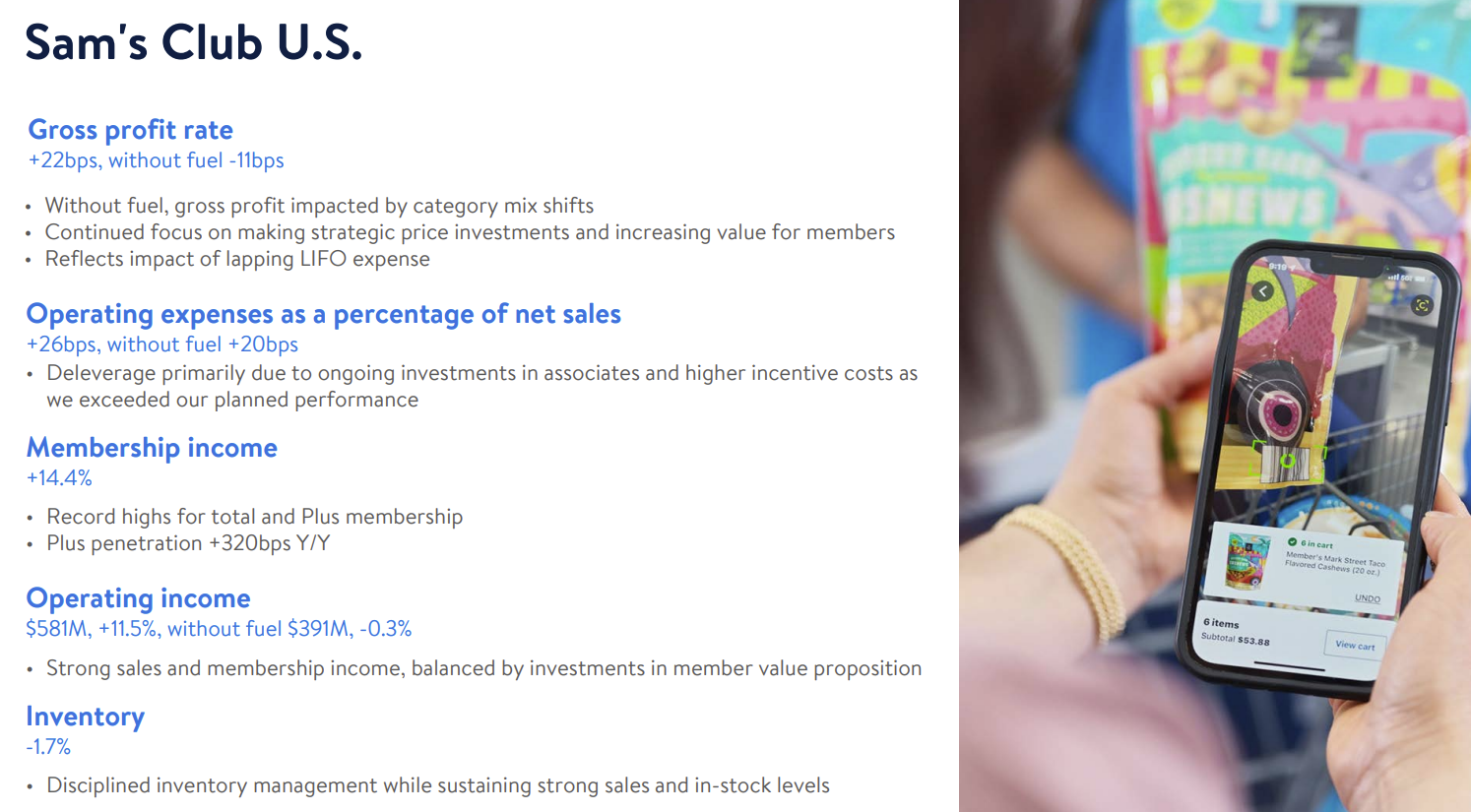
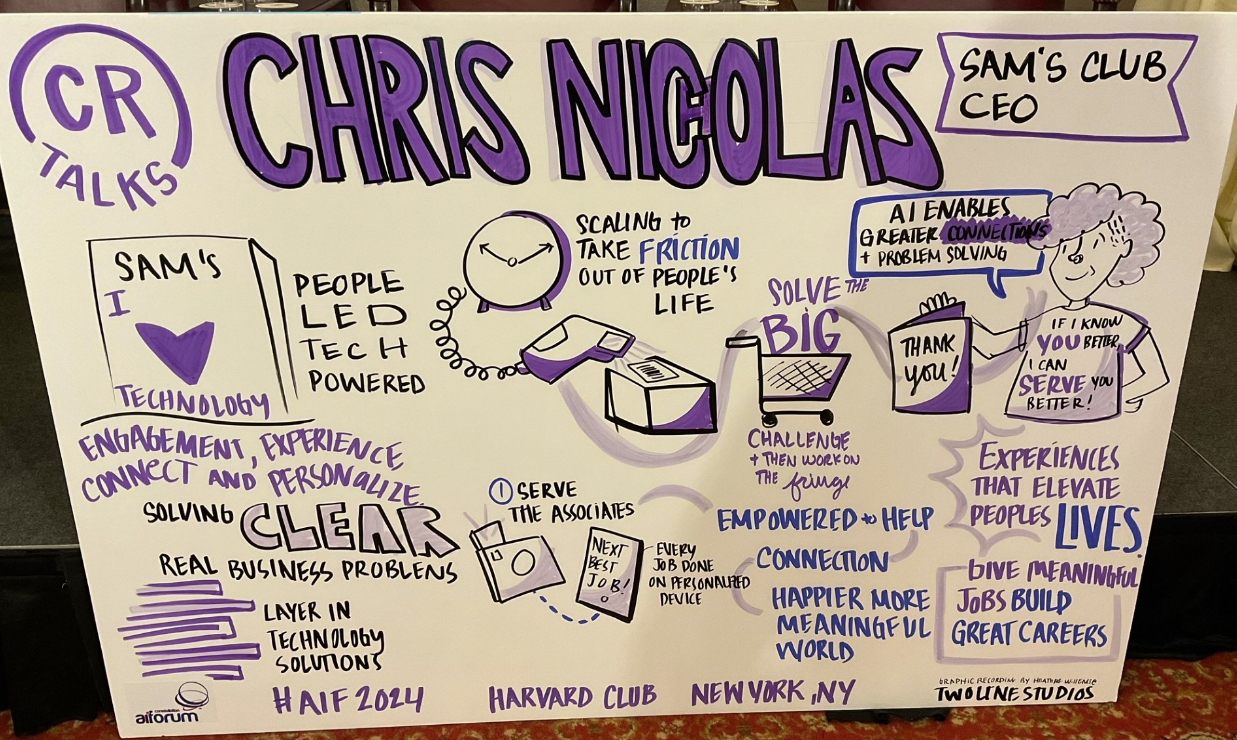
Scan and go is driving digital engagement at Sam's Club. "Digital engagement remains strong with Scan and Go penetration surpassing 30%. With our increased convenience of our Just Go technology now operational in 325 clubs, over 50% of our members can exit without a check, improving member NPS by more than 800 basis points, compared to the clubs without this technology," said Rainey.

Supply chain automation. Rainey said more than 45% of Walmart's e-commerce fulfillment center volume is now automated. Rainey said:

"We have about 1,800 stores receiving some level of freight from 15 of our regional distribution centers that are in varying stages of automation implementation. And as a result, our supply chain teams are processing more units through our DCs and FCs. And while we're spending more on CapEx than we have historically, we're pleased with the returns from these investments, particularly the automation of our supply chain. We expect these investments to yield returns that will allow us to increase our return on invested capital each year."

By the end of the year, Walmart said about 3,000 stores of the 4,600 will have deliveries from automated facilities some way.

Next-Generation Customer Experience Data to Decisions Innovation & Product-led Growth Future of Work Tech Optimization Digital Safety, Privacy & Cybersecurity B2C CX AI GenerativeAI ML Machine Learning LLMs Agentic AI Analytics Automation Disruptive Technology Chief Information Officer Chief Executive Officer Chief Technology Officer Chief AI Officer Chief Data Officer Chief Analytics Officer Chief Information Security Officer Chief Product Officer
HPE acquires Morpheus Data to round out HPE GreenLake features

Hewlett Packard Enterprise said it has acquired Morpheus Data, which makes a hybrid cloud management platform. HPE said Morpheus Data will be used to expand its hybrid cloud features in HPE GreenLake.

In a release, HPE said Morpheus Data will give GreenLake the ability to provision multi-cloud and multi-vendor apps, orchestrate and automate workloads and optimize cloud costs. HPE said the purchase goes along with its acquisition of OpsRamp in 2023.

Constellation Research analyst Andy Thurai said:

"This acquisition will drive HPE's cloud full-stack automation capabilities. Especially it can add multi-cloud automation, automation, FinOps and orchestration on top of the observability capabilities that is being infused with OpsRamp. This is especially important in the hybrid environments where the landscape is still very fragmented."

Brian Wheeler, CEO of Morpheus Data, in a blog post said:

"By joining forces with HPE, we will be able to leverage their extensive resources, industry expertise, and global reach to enhance our ability to deliver even more innovative solutions and better serve our customers."

Morpheus Data will be integrated into HPE GreenLake, HPE's private cloud portfolio and sold as standalone software.

Terms of the deal, which is expected to close in HPE's fiscal fourth quarter, weren't disclosed.

Tech Optimization Data to Decisions Digital Safety, Privacy & Cybersecurity Innovation & Product-led Growth Future of Work HPE greenlake SaaS PaaS IaaS Cloud Digital Transformation Disruptive Technology Enterprise IT Enterprise Acceleration Enterprise Software Next Gen Apps IoT Blockchain CRM ERP CCaaS UCaaS Collaboration Enterprise Service Chief Information Officer Chief Technology Officer Chief Information Security Officer Chief Data Officer