


Results
Globally Renowned Innovation Pioneers – Connected Enterprise 2018
Globally Renowned Innovation Pioneers – Connected Enterprise 2018
On <iframe src="https://player.vimeo.com/video/299775218?badge=0&autopause=0&player_id=0&app_id=75194" width="1920" height="1080" frameborder="0" title="Globally Renown Innovation Pioneers" allow="autoplay; fullscreen" allowfullscreen></iframe>Future of CX and Commerce – Connected Enterprise 2018
Future of CX and Commerce – Connected Enterprise 2018

Cindy Zhou is a practicing CMO. Prviously, she was Vice President and Principal Analyst at Constellation Research covering Digital Marketing Transformation and Sales Effectiveness. With over 18 years of practitioner experience in corporate marketing, product marketing, product management, and sales operations, Zhou has spearheaded marketing transformation at multiple technology companies. She advised Constellation’s clients on strategies to light-up demand generation, prove revenue contribution, and maximize sales productivity. Prior to joining Constellation, Zhou was Global Senior Vice President of Marketing and Sales Operations at BackOffice Associates, a global provider of data quality and information governance solutions to the Fortune 1000 and SAP SolEx partner. Before…...
Read moreData-Driven Innovation – Connected Enterprise 2018
Data-Driven Innovation – Connected Enterprise 2018

Doug Henschen is former Vice President and Principal Analyst where he focused on data-driven decision making. Henschen’s Data-to-Decisions research examines how organizations employ data analysis to reimagine their business models and gain a deeper understanding of their customers. Henschen's research acknowledges the fact that innovative applications of data analysis requires a multi-disciplinary approach starting with information and orchestration technologies, continuing through business intelligence, data-visualization, and analytics, and moving into NoSQL and big-data analysis, third-party data enrichment, and decision-management technologies. Insight-driven business models are of interest to the entire C-suite, but most particularly chief executive officers, chief digital officers,…...
Read moreCustomer Engagement is Necessary Nice or Not – Connected Enterprise 2018
Customer Engagement is Necessary Nice or Not – Connected Enterprise 2018
On <iframe src="https://player.vimeo.com/video/299767872?badge=0&autopause=0&player_id=0&app_id=75194" width="1920" height="1080" frameborder="0" title="Customer Engagement Necessary Nice or Not" allow="autoplay; fullscreen" allowfullscreen></iframe>Fireside Chat with Capgemini's Olivier Zitoun – Connected Enterprise 2018
Fireside Chat with Capgemini's Olivier Zitoun – Connected Enterprise 2018
On <iframe src="https://player.vimeo.com/video/299765605?badge=0&autopause=0&player_id=0&app_id=75194" width="1920" height="1080" frameborder="0" title="Capgemini's Olivier Zitoun" allow="autoplay; fullscreen" allowfullscreen></iframe>Vint Cerf, Wendy Hall & Tim Berners-Lee Join to Issue Wake-Up Call to Global Tech Industry on December 10
Vint Cerf, Wendy Hall & Tim Berners-Lee Join to Issue Wake-Up Call to Global Tech Industry on December 10

Aubrey (Levinstone) Coggins manages Constellation's marketing and communications programs and is the producer of DisrupTV, a weekly Web series on innovation and the enterprise. She previously served as a senior manager of corporate communications at Egnyte and held account roles at Access Communications and The Hoffman Agency. Born and raised in Texas, she received a bachelor's degree in Public Relations from The University of Texas at Austin – Hook ‘em! ...
Read moreWhat does the future of the Internet look like? Is it a force for good?
In early 2019, half of the world will be online. This inflection point marks an extremely important moment for examining the unfinished work of the Internet and discussing the community norms, human rights and social contracts required in this exponential digital era.
On December 10, on the 70th Anniversary of the United Nations' Declaration of Human Rights, Internet and technology pioneers Vint Cerf, Wendy Hall and Tim Berners-Lee, along with key visionaries and positive change agents, will convene to reflect on the past three decades and pave the path for the future of the Internet, determining what it means for connected societies and those yet to be connected. These are some of the smartest minds of the past and future getting together in one room to make a stand on what our future holds!
“We have watched the Internet evolve over 35 years of operation and now have a unique opportunity to apply what we’ve learned to frame the next thirty years of the Internet arc,” said Vint Cerf, chair of the People-Centered Internet coalition. “We must help the next generation assure that the Internet remains an accessible, affordable and inclusive infrastructure for good.”
The event is called “Our People-Centered Digital Future.” Check out the conversation already taking place - #OurDigitalFuture.
Some of the topics will include:
- How historic notions of human rights translate to the digital world
- How identity and personal data transcend national boundaries
- How to avoid the threat of digitally enabled tyrannies
- How to work toward more people-centered societies
- How to create a benevolent distribution of power in a digitally connected world
This event aligns with the mission of the People-Centered Internet coalition (PCI), which aims to ensure that the Internet continues to improve people’s lives and livelihoods, and the WebFoundation, which works for a world where everyone has the same rights and opportunities online.
Portions of the event will be globally live streamed through YouTube. The day will close out with a special VIP gala celebrating the launch of the PCI Challenges, which looks to recognize those groups and communities working to build a more benevolent digital future.
Intereted in attending and being part of this historic event? Want to sponsor or be involved? Reach out to us!
For more information, visit: https://www.constellationr.com/events/PCDF
Get RAD with IBM Notes and Domino v10
Get RAD with IBM Notes and Domino v10
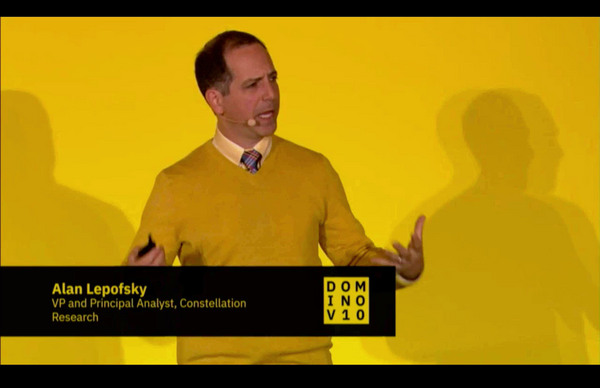

Alan Lepofsky - VP and Principal Analyst, Constellation Research. With almost two decades of experience in the collaboration software industry, Lepofsky helps organizations improve the way their employees work together to get their jobs done. Lepofsky’s primary research area The Future of Work, focuses on: integrating collaboration and business processes (Purposeful Collaboration), structuring work via Social Task Management, leveraging analytics and digital assistants to work more productively, the strategic impact of mobile computing on business transformation, and measuring workforce culture based on Digital Proficiency instead of age. Twitter: @alanlepoLinkedIn: https://ca.linkedin.com/in/alanlepo , Title: Big IdeasIntelligent Collaboration: The Intersection of…...
Read moreOn Oct 10th IBM announced the release of IBM Notes and Domino v10. Get it, v10 on 10/10? Nice how that works in either MM/DD or DD/MM format. Anyway, as you probably know I started my technology career at IBM as a Lotus Notes administrator and developer using v2 back in 1994. So being part of the v10 launch event in Frankfurt Germany had personal meaning to me both as an analyst and as an ex-Lotus employee. You can read more about the release in this blog post from IBM GM Bob Schultz.
Notes/Domino has had a challenging journey to get to v10. Back in the early 2000s Microsoft made a huge push with Outlook/Exchange and SharePoint to migrate customers, and that took a large toll on IBM’s customer base. At the same time, IBM itself inflicted some wounds, rebranding the product several times, causing confusion on the technology side between Domino and WebSphere, and being unclear on commitment and vision between Domino and other platforms like IBM Connections.
Fast-forward to 2018, and things are more positive around Notes/Domino than they have been in many years. Around the end of 2017 IBM and HCL announced a partnership where the two organizations will share various responsibilities for the future development, marketing and sales of Notes/Domino and its associated products. The momentum for v10 began at IBM Think in earlier 2018, and the partnership seems to be working quite well, as in less than a year HCL has delivered v10 with several features that appeal to end-users, application developers, and system administrators. Similarly, IBM and HCL have continued to engage with customers, business partners and prospects in several ways including:
- A new marketing website named Destination Domino
- Online “jams” where people could engage with IBM and HCL executives, developers and product managers
- A live tour of HCL’s offices for 100 of the top Notes/Domino customers and partners
- A new online community for feature requests
- A lot of social media branded originally under #Domino2025 and now the #DominoForever hashtag
MyPOV
With V10, IBM is refocusing on what made Lotus Notes a valuable business tool in the first place, rapid application development (RAD). While the market has evolved the term RAD to the more trendy "low-code platforms” the value proposition remains the same today as it was decades ago; enabling organizations to develop, test and deploy applications quickly with minimal involvement from IT services. With V10 IBM has announced that Notes applications will be able to run on mobile devices such as iPads, and that web developers will be able to use modern programming frameworks like node.js.
In the video below I provide an overview of several of the new features, discuss the target audiences, as share my thoughts around the challenges and opportunities IBM has with Domino v10.
I'd like end this blog post by calling attention to one of the more interesting customer stories I've ever heard. While at the launch event I met with members of the Polish Medical Air Rescue organization. This group uses helicopters to transport people in dire medical conditions. They use a Domino application in their command centre to manage the process, so as they said: "Domino is used here to help us save lives." They are excited about v10 because they believe the new application development features will allow them to speed up their process by 30 seconds, which translates to a helicopter being 3km closer to the patient. That's amazing. I look forward to hearing an update from them next year.
Future of Work
Market Maker 1:1 Fireside Chat with Michael J. Saylor, CEO of MicroStrategy
Market Maker 1:1 Fireside Chat with Michael J. Saylor, CEO of MicroStrategy
On <iframe src="https://player.vimeo.com/video/298501459?badge=0&autopause=0&player_id=0&app_id=75194" width="1920" height="1080" frameborder="0" title="Market Maker 1:1 Fireside Chat with Michael J. Saylor, CEO of MicroStrategy" allow="autoplay; fullscreen" allowfullscreen></iframe>Market Move - IBM buys RedHat, A bold move for hybrid cloud and PaaS
Market Move - IBM buys RedHat, A bold move for hybrid cloud and PaaS

Holger Mueller is VP and Principal Analyst for Constellation Research for the fundamental enablers of the cloud, IaaS, PaaS and next generation Applications, with forays up the tech stack into BigData and Analytics, HR Tech, and sometimes SaaS. Holger provides strategy and counsel to key clients, including Chief Information Officers, Chief Technology Officers, Chief Product Officers, Chief HR Officers, investment analysts, venture capitalists, sell-side firms, and technology buyers. Coverage Areas: Future of Work Tech Optimization & Innovation Background: Before joining Constellation Research, Mueller was VP of Products for NorthgateArinso, a KKR company. There, he led the transformation of products to the cloud and laid the foundation for new Business Process as a…...
Read moreOn Sunday afternoon, October 28th 2018, IBM reported that it has reached a definitive agreement to buy all issued and outstanding common shares of Red Hat for $190.00 per share, which values the acquisition at roughly $34B. That will make it the 4th largest technology acquisition in history (trailing Dell buying EMC by an order of magnitude and close to the Qualcomm acquisition of NXP ($38B) and Avago's acquisition of Broadcom ($37B). It's the largest software only acquisition in software history.

The press release can be found here, it is too long to dissect completely in our customary style, so let's look at the key news bits:
MyPOV – Agreed, easily so far the largest acquisition of the year.
MyPOV – Can anyone spell Kubernetes? That's the main platform for portability and both vendors know it and have their respective offerings between IBM Cloud Private and Red Hat Cloud Platform supporting Kubernetes. Both vendors also have OpenStack assets, but that's a market segment that is not doing well for all parties involved (vendors and enterprises) from an original promise and potential perspective..
MyPOV – Certainly hybrid cloud is the next generation computing platform. But counting Linux related revenues is a stretch -so we need to look into more details (that IBM may not offer, at least has not offered them yet).
MyPOV – Well, now we know why IBM has been unusually non-acquisitive for the last few years. It's a much larger acquisition, actually the largest IBM has ever made and good to see that it will be not only cash flow, but also gross margin accreditive (as an aspiration).
MyPOV – This is key for IBM to even come close at recovering the acquisition price. Given IBM's positive track record with open source, this is a not an unrealistic outcome for IBM to achieve
MyPOV – Probably the most important immediate news fact. IBM will do good at not 'breaking' Red Hat, and starting as a separate unit is a good start. With Whitehurst reporting directly to Rometty, Red Hat will have a voice at the executive table. The challenge for Whitehurst will be to keep employees motivated, deliver on roadmap and try to keep negative "IBMization" effects away from Red Hat as much as possible. Keeping partners will be a key challenge in the first weeks.
Let's look at the implications that this acquisition has for the different constituents of the cloud market:
But the really tricky question is on the platform partner side. Red Hat has built a 'Switzerland' position vis a vis what are (or were?) IBM's competitors, starting with AWS (see here) as well as Microsoft (see here) and Google (see here). If these vendors assume IBM is making the right bets – they will look for repeating similar acquisitions (e.g. Suse, Canonical etc.). Once that happens, we will see a resurgence of on premise server OS war. Not to forget that hardware partners like Cisco, Dell, HPE, Intel and Lenovo now have to factor in that the new Red Hat is also selling hardware (Power). This will mean a lot of lunches, dinners and events for partner managers to chart the strategies for their respective enterprises, and CxOs need to pay attention to how this unfolds.
On the concern side, Red Hat's problem was that on-premises servers were shrinking. This is why the vendor made new bet, in the container platform and PaaS (with OpenShift). Some investments fizzled for a number of reasons that are not in Red Hat's control (like e.g. OpenStack). But Red Hat executives were very clear that they have understood the underlying shrink / growth mechanics: The new bets need to make up and do more than what Red Hat loose in on premise revenues. Not an easy feat. With IBM as an owner, Red Hat gets more scale and a huge sales force (and services bench). Maybe funds for more bets. But for now, IBM first needs to clarify what is right for customer in the not so few areas of overlap between what IBM offers and what Red Hat offers. That this isn't easy and does not have to go well – just look at the IBM CMS vs IBM's acquisition of SoftLayer.
But overall congrats to Rometty and her team, a bold move for hybrid cloud and maybe even for PaaS. If IBM manages to keep the partnerships in place and let potential AWS / Microsoft / Google ambitions on owning the on-premises OS ease – this can be a very good move. If IBM can ever make the $34B back – is something I doubt at the moment. But it's only a few hours – more coming in the next days- stay tuned.
- Most significant tech acquisition of 2018 will unlock true value of cloud for business
MyPOV – Agreed, easily so far the largest acquisition of the year.
- IBM and Red Hat to provide open approach to cloud, featuring unprecedented security and portability across multiple clouds
MyPOV – Can anyone spell Kubernetes? That's the main platform for portability and both vendors know it and have their respective offerings between IBM Cloud Private and Red Hat Cloud Platform supporting Kubernetes. Both vendors also have OpenStack assets, but that's a market segment that is not doing well for all parties involved (vendors and enterprises) from an original promise and potential perspective..
- Deal accelerates IBM's high-value business model, making IBM the #1 hybrid cloud provider in an emerging $1 trillion growth market
MyPOV – Certainly hybrid cloud is the next generation computing platform. But counting Linux related revenues is a stretch -so we need to look into more details (that IBM may not offer, at least has not offered them yet).
- Acquisition will be free cash flow and gross margin accreditive within 12 months, accelerate revenue growth and support a solid and growing dividend
MyPOV – Well, now we know why IBM has been unusually non-acquisitive for the last few years. It's a much larger acquisition, actually the largest IBM has ever made and good to see that it will be not only cash flow, but also gross margin accreditive (as an aspiration).
- IBM to maintain Red Hat's open source innovation legacy, scaling its vast technology portfolio and empowering its widespread developer community
MyPOV – This is key for IBM to even come close at recovering the acquisition price. Given IBM's positive track record with open source, this is a not an unrealistic outcome for IBM to achieve
- Red Hat to operate as a distinct unit within IBM's Hybrid Cloud team
MyPOV – Probably the most important immediate news fact. IBM will do good at not 'breaking' Red Hat, and starting as a separate unit is a good start. With Whitehurst reporting directly to Rometty, Red Hat will have a voice at the executive table. The challenge for Whitehurst will be to keep employees motivated, deliver on roadmap and try to keep negative "IBMization" effects away from Red Hat as much as possible. Keeping partners will be a key challenge in the first weeks.
Implications, Implications …
Let's look at the implications that this acquisition has for the different constituents of the cloud market:
Implications for IBM customers
Likely no immediate impact for IBM customer and no immediate action items. IBM customers should start the conversation on what the largest acquisition in software history brings to them. What Red Hat assets and services can make IBM's cloud offerings better? Actively plan for a 'blue sky' session with your team on what it maybe worth to influence on, what to do first and what later. CxOs should find Red Hat know-how in house, and if not available, through their peers and their executive team's network, to establish potential benefits that are coming from the acquisition - always from their enterprises' perspective.Implications for Red Hat customers
While IBM is saying clearly that Red Hat will operate separately – as an IBM division, Red Hat customers need to make sure their enterprise can remain successful on Red Hat. As always with acquisitions the customers of the acquired party need to seek immediate re-assurance on important roadmap items, not only from Red Hat, but more importantly with IBM. Only when an acquirer knows where the porcelain is in the shelves, they can make a desired planned effort not to brake it. In the longer run, CxOs need to think of what benefits can be derived from the IBM ownership – think financial stability, reach, support and services. It's different to be the 3B or so small battleship, then dealing with the same battleship as part of a large fleet of vessels. Understand the course, investment plans and new roadmaps asap.Implications for partners
For software partners there is likely no immediate impact. For Red Hat services partners it will be key to seek reassurances that Red Hat will keep them around… the IBM consulting bench that can work in the Red Hat space is (with expected training) potentially 2-3 times larger than all the consultants in the RedHat ecosystem… For IBM service partners, consider the opportunity to add a Red Hat practice, before the joint offering brings in another services firm.But the really tricky question is on the platform partner side. Red Hat has built a 'Switzerland' position vis a vis what are (or were?) IBM's competitors, starting with AWS (see here) as well as Microsoft (see here) and Google (see here). If these vendors assume IBM is making the right bets – they will look for repeating similar acquisitions (e.g. Suse, Canonical etc.). Once that happens, we will see a resurgence of on premise server OS war. Not to forget that hardware partners like Cisco, Dell, HPE, Intel and Lenovo now have to factor in that the new Red Hat is also selling hardware (Power). This will mean a lot of lunches, dinners and events for partner managers to chart the strategies for their respective enterprises, and CxOs need to pay attention to how this unfolds.
Implications for competitors
On premise computing is seeing a resurgence, in short due to cloud skepticism, security, data residency and performance concerns. When even cloud 'native' vendors like AWS and Google are bolstering their on premises capabilities, then there is something going on. In fact, Constellation research shows that the next generation computing platform is a continuous computing platform that allows seamless workload portability for enterprises. It now comes back how much IBM competitors are willing to compete for the OS on-premises enterprise servers – or see IBM as the new 'Switzerland' of on premise OS. Key to watch for CxOs in the next months.MyPOV
Just when the short uptake at IBM in terms of revenue growth started to stall again, IBM pulls out the largest acquisition of the year, and the largest in software history. If IBM manages to handle this right, it will spark investor confidence in the vendor, and longer term gives IBM the opportunity to give the vendor what it set our 30+ years ago: Own the on-premises server operating system – remember OS/2? Sometimes history gives you another chance.On the concern side, Red Hat's problem was that on-premises servers were shrinking. This is why the vendor made new bet, in the container platform and PaaS (with OpenShift). Some investments fizzled for a number of reasons that are not in Red Hat's control (like e.g. OpenStack). But Red Hat executives were very clear that they have understood the underlying shrink / growth mechanics: The new bets need to make up and do more than what Red Hat loose in on premise revenues. Not an easy feat. With IBM as an owner, Red Hat gets more scale and a huge sales force (and services bench). Maybe funds for more bets. But for now, IBM first needs to clarify what is right for customer in the not so few areas of overlap between what IBM offers and what Red Hat offers. That this isn't easy and does not have to go well – just look at the IBM CMS vs IBM's acquisition of SoftLayer.
But overall congrats to Rometty and her team, a bold move for hybrid cloud and maybe even for PaaS. If IBM manages to keep the partnerships in place and let potential AWS / Microsoft / Google ambitions on owning the on-premises OS ease – this can be a very good move. If IBM can ever make the $34B back – is something I doubt at the moment. But it's only a few hours – more coming in the next days- stay tuned.