


Dell Technologies courts on-premises AI workloads from workstation to data center
Dell Technologies is pushing on-premises AI and finding interested enterprises as they struggle to keep token costs down. The company launched Dell Deskside Agentic AI, a set of workstations that offer a sandbox to securely test and optimize AI before blowing through tokens.
The company also launched Dell AI Factory with Nvidia updates along with AI infrastructure designed to improve agentic AI economics and the cost that goes with it.
At Dell Technologies World, the company said it has had more than 320 releases since the Dell AI Factory with Nvidia launched two years ago. More than 160 of those releases have rolled out in the last year.
The big theme from Dell Technologies is focused on leveraging AI agents yet providing predictable costs. To that end, Dell's plan is to create a continuum of AI infrastructure from Deskside Agentic AI to its Dell AI Factory with Nvidia.
- Constellation ShortList™ AI Factory Providers
- Nvidia launches Nemotron 3 open models to enable multi-agent systems
- Nvidia GTC 2026: Nvidia launches NemoClaw, eyes to pair with DGX Spark, DGX Station
- Nvidia GTC 2026: Nvidia’s hardware strategy goes beyond GPU in AI inference pivot
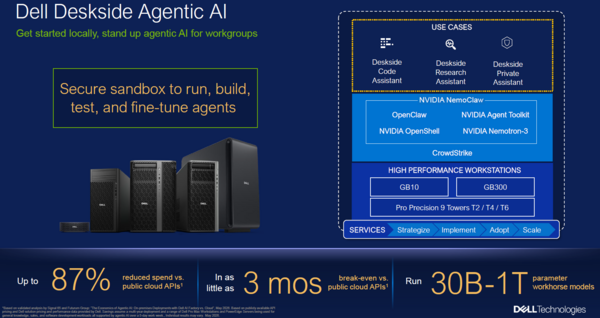
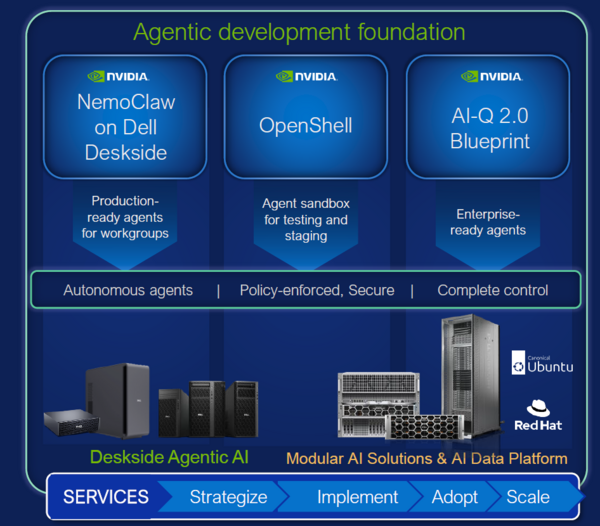
Dell's headliner at Dell Technologies World is the Dell Deskside Agentic AI. The workstations come packaged with Nvidia NemoClaw, which launched at Nvidia GTC 2026, OpenClaw, Nvidia OpenShell, Nvidia Agent Tookit and Nvidia Nemotron-3. The systems, secured by CrowdStrike, enable developers to run 30B to 1T parameter models.
On the Dell AI Factory with Nvidia front, the company announced Dell AT Data Platform advances with data orchestration and new storage systems, next-gen cooling designed for Nvidia Vera Rubin NVL72 and new racks.
On-prem AI momentum
Sam Grocott, Senior Vice Preesident of Products at Dell Technologies, said on an analyst briefing that the Dell AI Factory with Nvidia now has more than 5,000 customers globally and while many of those customers would be deemed hyperscalers or sovereign nations there's a growing base of enterprises too.
"On-prem matters more than ever and it's being driven by driven by sovereignty, security, performance, and increasing costs, and how you take advantage and take control of the token economics," said Grocott.
Those economics are becoming more of an issue as enterprises are being hit with token bills higher than expected. AI inference costs are surging and customers are looking to optimize with context layers, private label silicon, model routing and yes, on-premises AI.
- AI inference costs are going to be a big concern: What's the fix?
- Where’s tokenomics for the rest of us?
Indeed, Dell outlined how Eli Lilly forged a 15-year partnership with the company powering AI-driven drug discovery and manufacturing. Eli Lilly runs LillyPod, a system of more than 1,000 GPUs fed by nearly 2TB/second of read bandwidth from Dell Storage.
The company also cited Samsung Electronics for its semiconductor design operations and Mistral AI as customers.
"Samsung is moving from an automated manufacturing and AI-driven factory, to real-time and decision-making. We're powering the compute, storage, data movement underneath the digital twins, real-time analytics, agentic AI that monitors their operations, it catches anomalies, and tunes processes autonomously," said Grocott.
Jon Siegal, Senior Vice President of Dell Technologies Client Solutions Group, said enterprise IT leaders are excited about the benefits of agentic AI, but have concerns about costs. Utilizing workstations can keep costs in check.
According to Siegal, Dell Deskside Agentic AI customers can run on-premises AI infrastructure with open-weight models and see up to an 87% lower spend vs. public cloud APIs over two years. The break-even point on Dell Deskside Agentic AI vs public cloud APIs is as little as three months.
"Many have learned this one the hard way, whether it's hitting token limits or the surprise cloud bills. Even though cost per token itself is coming down, super users are burning through tokens at such a high rate that they have sticker shock, you know, from the cloud bills," said Siegal, who noted that Dell has also learned the hard way as a developer blew through 1 billion tokens in 24 hours and a $3,400 cloud bill. "We think a lot of customers are going to give this a real, real attention here as they explore what to do next with Agentic AI."
- AI Forum 2026: "There are claws everywhere now"
- LittleHorse’s McNealy on Business-as-Code, AI agents, orchestration
Security and data sovereignty are also driving on-premises AI. "The bottom line is that enterprises are looking for a safer, more cost-effective way to bring agentic AI to their company," said Siegal.
A barrage of product updates
In addition to the Dell Deskside Agentic AI, the company outlined a bevy of updates. Here's a look.
Dell AI Data Platform with Nvidia gets updates to its Data Orchestration Engine with new agents and blueprints designed for genAI, physical AI and AI agents. An update to the Data Analytics Engine now provides up to 6x faster SQL queries and 12x faster vector indexing. Objectscale on-premises object storage is also updated.
Dell PowerRacks for compute, networking and storage. Dell Technologies introduced a series of PowerRacks designed and sized for AI environments and optimized for GPUs. By providing racks for compute, storage and networking, Dell Technologies said it can deliver, deploy and get enterprises in production in six hours.
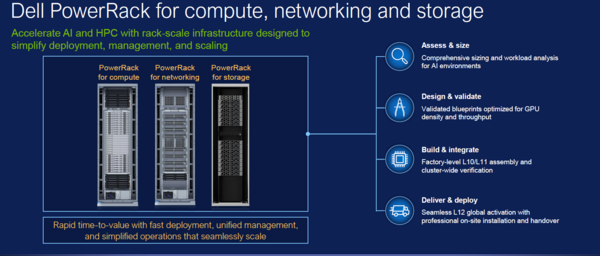
Components include:
- Dell PowerRack for Networking, which has a factory-integrated networking rack of Dell PowerSwitch SN6600-LD that can provide more than 800 Tbps switching capacity.
- Dell Exascale Storage, which is a rack that includes software defined systems for AI, HPC and enterprise workloads. The rack added Dell PowerFlex block storge with more efficiency and independent scaling for enterprises. The storage version of Dell PowerRack is a 4-in-1 systems that can support 245TB of all-flash drives.
- For the compute PowerRack, Dell's PowerCool CDU C7000 has twice the cooling capacity in a 4U footprint.
Dell OpenManage and Integrated Rack Controller, which provides unified management, expanded telemetry and automated response. The system can detect leaks in less than 7 seconds and take automated action in less than 3 seconds.
Dell Technologies also said it has partnered with Google Cloud, Palantir, SpaceX, Hugging Face, ServiceNow and Reflection to enable sovereign AI infrastructure deployments.
Larry Dignan is Editor in Chief of Constellation Insights at Constellation Research, where he leads editorial coverage focused on enterprise technology, digital transformation, and emerging trends shaping the future of business. He oversees research-driven news, analysis, interviews, and event coverage designed to help technology buyers and vendors navigate complex markets with clarity and context. ...
Read morePublished
Author
