


Certinia launches Veda AI agent suite
Certinia launched Veda, an intelligent operations engine that is a suite of AI agents and actions that sit on top of its professional services automation (PSA) platform.
With the launch of Veda, Certinia is looking to move from workflow automation to autonomy and create a results engine for professional services. Veda delivers governed and deterministic outcomes as it leverages context from Certinia's Professional Services (PS), Customer Success (CS), and Financial Management (FM) cloud services.
Certinia is built on top of the Salesforce platform.
DJ Paoni, CEO of Certinia, said in an analyst briefing that Veda is designed to address four big pillars facing services-based enterprises. Paoni said AI-first is the default enterprise strategy and customers are looking for more than add-on features. In addition, services are transforming from billable hours to outcome-based economics that require more visibility. Meanwhile, software value is shifting toward results over licenses and innovation cycles are compressed.
"We've moved past experimentation. Organizations are no longer looking at AI just as features. They're looking for an AI-first foundation, and AI has become the primary interface for how work gets done," said Paoni.
Certinia's Raju Malhotra, Chief Product & Technology Officer, said on a briefing that Veda is embedded in its Salesforce-native stack and combines proprietary context and domain models based on margins, projects, utilization and customer service metrics. Reasoning power comes from a set of LLMs that are grounded in Certinia data and agents that can work within Salesforce, Slack, Microsoft Teams and where work happens.
- Certinia’s AI agent strategy kicks off with staffing, customer success
- Future of Staffing: How Siemens Leverages AI and Certinia
- Constellation ShortList™ Services-Centric Cloud ERP
- Constellation ShortList™ Enterprise Cloud Finance
- Constellation ShortList™ Customer Success Software
Veda has been used with 20 lighthouse customers that have compressed workflows from hours and days to minutes across several workflows. "We are investing in the agent orchestration, agent to agent and multi-agent orchestration," said Malhotra. "We're also really thinking long and hard about the human-agent collaboration and trust and governance remains a central part of our thesis, as part of our capabilities."
Early use case for Veda include:
- Services estimation for pre-sales with scoping, summarization and estimates based on structured and unstructured data.
- Resource and staffing management with a resourcing agent that drafts staffing plans and uses business policies for planning.
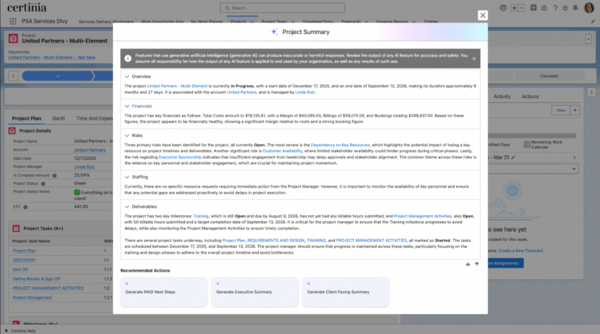
- Project and delivery management with agents that use transcripts to generate structured risk and issue lists and next-step recommendations.
- Utilization with agents that pre-builds timesheets and compares scheduled vs. actual activities.
- Customer success with auto-generated success plans from Veda.
- Business reviews that are auto generated based on activities, risk, expansion, usage and project outcomes.
- Agent collaboration and work reallocation across channels.
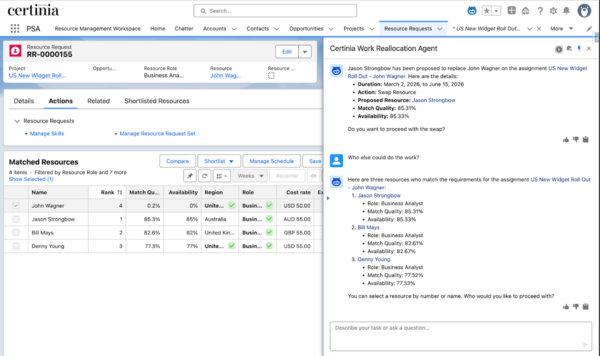
Key takeaways on Veda's architecture:
- Veda takes a hybrid approach where specialist AI agents bring reasoning and judgment and execution to services operations and collaborate with human experts.
- Veda is purpose-built and domain specific. Each specialist AI agent is grounded and permissioned for a distinct functional domain.
- Veda includes two integrated layers. One layer uses generative AI to surface insights and synthesize information. The other layer includes specialized AI agents designed to execute tasks and orchestrate workflows.
Certinia said Veda is an add-on for $30 per user per month for all agentic capabilities. The add-on to existing Certinia licenses includes current Veda agents, more than 64 intelligent actions and future agents. AI infrastructure usage is tied to Salesforce Agentforce and Flex Credit plans.
Larry Dignan is Editor in Chief of Constellation Insights at Constellation Research, where he leads editorial coverage focused on enterprise technology, digital transformation, and emerging trends shaping the future of business. He oversees research-driven news, analysis, interviews, and event coverage designed to help technology buyers and vendors navigate complex markets with clarity and context. ...
Read morePublished
Author
