


Canva revamps its platform with Canva AI 2.0
Canva has rearchitected its visual communication platform that layers AI, including a set of its own foundational models, throughout the creativity process and expands into workflows. Formally, Canva launched Canva AI 2.0 and has evolved from a presentation and image generation tool to a work canvas.
At its Canva Create event in Los Angeles, Canva said Canva AI 2.0 is its most significant evolution since launching in 2013 when it aimed to take on desktop design software with simplicity and a browser.
The launch of Canva AI 2.0 is notable since it highlights how the company has leveraged its own frontier AI lab. Canva acquired Leonardo AI in 2024 for image generation models and the investment have resulted in a major platform reinvention.
Canva has its own team of more than 100 researchers in its CORE (Canva Original Research and Exploration) unit to create foundational models focused on design. Canva said it is training, evaluating and advancing models and deploying them in as little as a month.
- Canva acquires Simtheory, Ortto
- Canva Shakes Up MarTech Market with 2 AI and Automation Picks Ups
- Constellation ShortList™ GenerativeAI Applications for Content Generation (Image, Video)
The company's approach to differentiation and focusing on purpose-built AI may provide a good blueprint to SaaS companies overall. SaaS vs. foundational model companies isn't zero sum and Canva may have a blueprint that includes AI as part of a differentiated experience.
Models built into Canva AI 2.0 include:
- Canva Proteus, which is designed for style transfer, is 2x faster and 23 cheaper.
- Canva Lucid Origin, which generates images 5x faster and 30x cheaper than foundational models.
- Canva I2V, which cost effectively turns images into video.
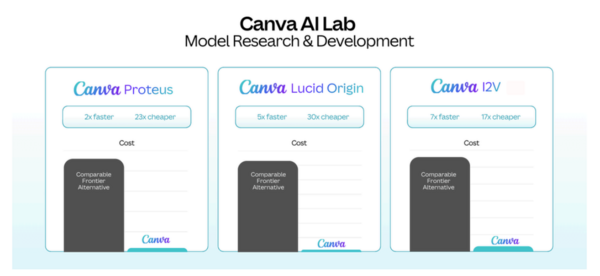
The company added that it is building a vertically integrated AI stack including self-hosted training, scaled reinforcement learning and optimized inference infrastructure.
Canva launched the following as part of Canva AI 2.0, which is in research preview. Canva AI will be available across Canva's Visual Suite and can be used for presentations, documents, spreadsheets and social media posts.
- Conversational design, which starts the design process from prompts or dictation. Describe an idea, goal or structure and Canva AI creates a design for editing to start the creative process.
- Agentic orchestration. Once a conversation is started, Canva will leverage its suite of tools and coordinate in multiple formats designed for various channels.
- Object-based intelligence, which enables you to edit elements such as an image, headline or font individually without changing everything else. The feature is powered by Canva's Design Model to address editing layers. That feature sounds small but is a big deal to anyone who asks for a tweak from a model and gets a whole new design. If Canva AI 2.0 can save you 10 prompts with your favorite LLM it's a win.
- Living memory that is persistent and understands your work, brand and style across projects. Customers can personalize with existing designs in a custom memory library and about me profile.
Those core features are designed to ride along with new workflows being added to the Canva platform. The company rolled out a series of connectors for Gmail, Google Drive and Calendar as well as Zoom and Slack.
In addition, a scheduling feature enables Canva customers to set tasks once and Canva AI will run automatically in the background. Scheduling enables Canva AI to produce a batch of social content overnight, scan emails and create briefing documents for meetings. Web research can also be scheduled to run in the background and be added to designs.
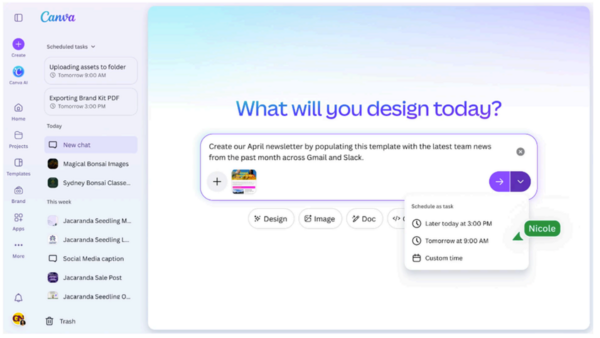
Other additions to Canva's platform include:
- Canva said that its brand intelligence tools adopt styles for designs and adopts them.
- The company also launched Canva Code 2.0 with HTML importing where you can describe an idea and build experiences across devices.
- Sheets AI that can spin up a spreadsheet for tracking budgets with real data.
- Template library scaling via Canva AI 2.0.
- The ability to import AI-generated artifacts into Canva for further editing and collaboration.
Constellation Research's analysis
Liz Miller, a Constellation Research analyst, is at Canva Create and provided the following analysis.
"This is a big move for Canva. Canva is not bolting on AI to its tools, but shifting to put AI in front. The tools almost become the secondary thought. You work with and through the AI and refine and update with the tool.
A couple highlights for me that really stood out as smart:
Scheduler. Sure, you can tell the AI what to do, but telling the AI WHEN you want something done is more important. You can pull research on market shifts at 2 am and provide a brief for recommended social campaigns that can play off of the news from yesterday.
Object Based Intelligence. One of the issues when an LLM app creates an image or an asset, is that the asset is flat. You want to change one aspect or element; you change and run the edit on the WHOLE design and get a WHOLE new image. Because the way Canva ingests assets it can identify layers at ingest so that a flat image becomes layered. You can just update the text without updating the entire asset.
Work Connectors. This expands the surface of work that Canva can draft on and impact.
Overall, I stand by what I said when Canva’s most recent acquisition announcement hit: Canva is less interested in becoming a tool innovation machine. Instead, the company is focused on the work and democratizing the work with the tools. It is not democratizing tools so you can work. This is the same culture they are bringing to AI. AI is not the focus because the work because of AI is the focus.”
Canva's early investment in Leonardo wasn’t just to have a frontier model that was an early (and remains a) standout in image generation. Canva also got a research team that served as the foundation for the AI strategy we see today."
Larry Dignan is Editor in Chief of Constellation Insights at Constellation Research, where he leads editorial coverage focused on enterprise technology, digital transformation, and emerging trends shaping the future of business. He oversees research-driven news, analysis, interviews, and event coverage designed to help technology buyers and vendors navigate complex markets with clarity and context. ...
Read morePublished
Author
