


Boomi World 2026: Lessons learned from four customers
Boomi customers are increasingly using the company's platform as more than a narrow integration platform and focusing on AI agent use cases.
Perhaps the biggest lesson from customers at Boomi World 2026 is that the enterprises that showed the most traction started with concrete operational pain points, built reliable data and integration foundations, and then used AI agents to remove repeatable work or improve customer-facing processes.
- Boomi World 2026: Trends to know
- The AI world according to Boomi CEO Steve Lucas
- Boomi to buy Lunar.dev, eyes intelligent prompt and model routing
- Boomi builds out data-to-agent platform, says welcome to headless party
Here's a look at the customer lessons.
HNL Lab Medicine
Eric Rounds, VP of Information Services & Technology at HNL Lab Medicine, integrated more than 20 platforms and more than 200 workflows across the technology stack within 6 months.
Systems included Epic and multiple siloed platforms. "We had issues moving the data between the environments. And it was just very challenging for us," said Rounds. "We would build some integrations, but it would be standard coding, you know, the old legacy way to do it, scripting. And it just was not working for us. It was not efficient."
HNL Lab Medicine is planning to expand and forge partnerships and will need to integrate with larger health systems. To expand, Rounds said the company needed to make a platform bet going forward.
He said:
"Look at the problem first, and don't worry about the technology. Just focus on the problems and use cases and the things you want to solve, and then the technology will fill in the gaps there for you."
Post Consumer Brands (Post Cereal)

Post is a 100-year-old company that has shifted from organic growth to acquisitions. Many of those purchases are partial brand purchases instead of full companies.
As a result, the integration of these partial acquisitions can be tricky. In those deals, the seller often continues to run the original systems. Post's priority is not to immediately migrate everything, but quickly land data in Post's systems so the business can act. "Our biggest value is quickly getting the data into our systems so our business can drive synergies from those acquisitions," said TK Balaji, CIO of Post Cereal Brands.
Boomi serves as an abstraction layer across a best-of-breed SaaS landscape. "We have chosen a path of using SaaS applications to enable things faster and when you're working with multiple SaaS applications, integration is key," said Balaji.
Going forward, Post is using Boomi Master Data Hub to bring master data together, cleanse it and share across systems. The next focus is an event-driven architecture. AI will ultimately come into the mix. "My biggest advice is really focus on data, discipline and decisions, and let AI find its way in," said Balaji. "I think AI has the ability to remove all those repeatable, mundane tasks, and lets us focus on what is more important, where we can add value to the business."
Multiquip (MQ)
Multiquip, an equipment manufacturer that produces machinery that requires extensive documentation and support, has to navigate unstructured documents that slow down support.
"We have a diverse customer base from small corporations to mom and pops to large corporations," said Michael Hanken, SVP of IT, Multiquip. "We pride ourselves on good support."
MQ is using Boomi with AI agents to work across the documentation and turn the content into something that can be queried and actionable for support workflows.
Hanken said MQ initially thought it could take its PDFs, create a process and pass to a vector database and be done. "We had massive hallucinations that just didn't work," he said.
MQ had to get deterministic. Hanken said:
"We changed that to put it in an authoring system, database driven. With Boomi we have all the connections to move from a probability driven system like a vector database, to deterministic system with hard queries to really make sure you get the right answer."
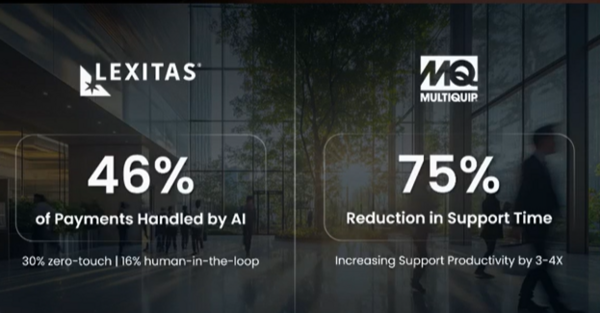
The company cut support times by 75% for industrial equipment using Boomi Agent and Agentstudio.
MQ shifted to a database-driven authoring system and a deterministic hard query logic to reduce uncertainty.
Hanken said you need to focus on outcomes. "This was an ideal case for us right now. We get better customer experiences and revenue," said Hanken. "This isn't about innovation as much as it is creating revenue. Have a clean use case. You need technical skills but also organizational changes."
"The biggest risk of AI is not doing it. We believe AI can level the playing field for us," he said.
Lexitas
Lexitas, which provides court reporting, medical records and process serving, has a Lockbox and Cash Application that matches payments to the right customer, matches invoices and ensures accuracy before posting to the accounting system.
The process is heavily manual and requires an entire team of accountants. John Baker, CIO and CISO, Lexitas, used Boomi AI agents to automate the manual work and leverage a human to do a final check before posting. Specifically, Lexitas used Boomi Agentstudio, Control Tower and security and governance.
Lexitas said the project started with a Boomi agentic workshop and working with a combined accounting, IT and security team. The mission was to get comfortable with the process, how it's secured and accuracy.
Baker said:
"We put it in production earlier this year, been a few months now, and amazing results so far. We're looking at about 46% of that process now is handled by the agents. That's about 30% fully automated, and about another 16% that the agent does, wraps it with a bow and says, human probably ought to do one check on it before it's actually posted into the accounting system."
With the process now automated, Baker said there's interest from other teams in using AI agents. The game plan is to have a rolling list of processes prioritized by returns and keep expanding use cases. Phase two of Lexitas' AI agent rollout will focus on credit card payments, a second bank lockbox and additional accounting use cases.
Larry Dignan is Editor in Chief of Constellation Insights at Constellation Research, where he leads editorial coverage focused on enterprise technology, digital transformation, and emerging trends shaping the future of business. He oversees research-driven news, analysis, interviews, and event coverage designed to help technology buyers and vendors navigate complex markets with clarity and context. ...
Read morePublished
Author
