


SaaS under the microscope: How to evaluate your vendor
Software as a service companies are being repriced, re-evaluated and rethought as analysts, investors and customers wonder how AI agents will affect the category. CxOs need to go through the same exercise to ensure they don't get stuck as enterprise software is disrupted.
Simply put, it was a horrible week for enterprise software. In a nutshell, Anthropic and OpenAI with their AI coding and team of agents could render SaaS obsolete. Wall Street freaked and the debate on LinkedIn and elsewhere ensued. At Cisco AI Summit 2026, Marc Andreessen, General Partner of Andreessen Horowitz, summed it up. "We're in a baby in the bath water moment right now," said Andreessen. "If you talk to hedge fund managers, they're just selling all their software, just under the theory that they want to get out of the way of the AI freight train."
To illustrate how the freight train is rolling, OpenAI launched OpenAI Frontier, which builds and manages AI agents, and GPT-5.3 Codex. Anthropic, which accelerated the SaaS wipeout with legal plugins to Cowork, launched Opus 4.6 and took aim at more work tasks.
Indeed, here’s a selection of software vendor 5-year returns through Thursday.
- Salesforce down 21%.
- ServiceNow down 12%.
- Workday down 40%.
- Adobe down 45%.
Andreessen added that the market is "overdoing it a bit," but also noted that investors should discern between a software company that's a system of record vs. merely a productivity app. He added that behavior doesn't change overnight either and enterprise software is very sticky.
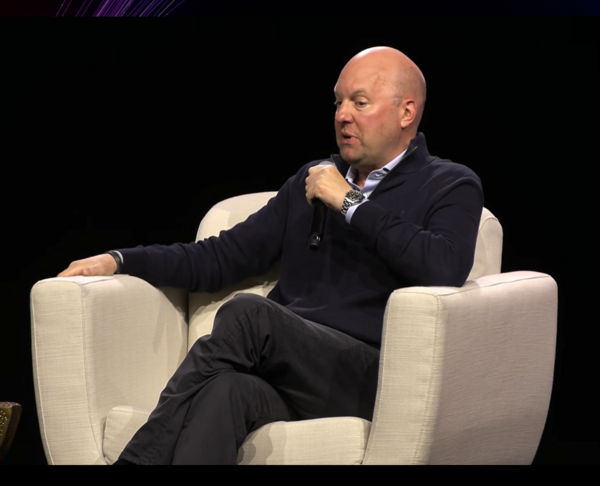
In other words, not all SaaS firms are created equal. "We are seeing a bunch of software companies that are not moving fast enough on AI and we're seeing traditional software companies that have figured out an AI twist and have ignited growth," said Andreessen.
Nvidia CEO Jensen Huang said the SaaS selling was "illogical," but your job isn't to rationalize your vendor's health or how they react during a panic.
Simply put, investors are re-evaluating SaaS and so should you. After all, Wall Street and IT buyers are heavily invested. From the enterprise perspective, you'll need to go through your roster of SaaS vendors and pretend you're a general manager for a team. What players give you upside? What players are overpriced? Who should be tossed for an upgrade? And more importantly, what vendor gives you optionality for agentic AI and whatever else emerges? This isn't a time for 5-year deals. It's a time to keep your options open and make sure your roster of vendors is healthy and give you an architecture that is futureproof to some degree.
Cognizant CEO Ravi Kumar said on the company’s fourth quarter earnings call that there’s an AI velocity gap and enterprises need a bridge from the traditional systems to the new agentic reality. You’ll need vendors that can ride along with the transition.
With that backdrop in mind, here's a checklist to determine whether your SaaS vendor will be displaced by an AI agent sooner instead of later.
Is this application worth building yourself?
With AI coding, you can build any application you want. Do you want to scale and maintain it though? A recent LinkedIn post noted that Anthropic uses Workday. Sure it could build an agent that knows labor laws across US states and countries, but it's not the best use of Anthropic's time. This same question applies to every category of SaaS.
Aaron Levie, CEO of Box, said at the Cisco AI Summit, that "as you might imagine, I'm going to say SaaS is not dead." He continued:
"A couple things are going to happen. Software will be cheaper to build, which means you're going to get more SaaS, and if you get more of something, and you have the same budget, then prices go down. I'm sympathetic to the idea that that you're going to see more competition in software. And I'm sympathetic that agents will do some capabilities that we've currently had in software. Those two things have to happen. They have to be inevitable.
There are two parts that I'm not sympathetic to. One is that we're just going to vibe code our own CRM system or ERP system. I largely don't think that's going to happen, because we all collectively have a fixed amount of resources in our organization, and our customer only pays us more if we can deliver more things that they want to buy that support their needs. And us vibe coding an ERP system is not on that list of things our customers care about. There are a couple of categories where you customize or build your own software because there's nothing in the market that solves your issue. But for the most part, that doesn't seem to be where you'd want to deploy your scarce resources."
Can you SaaS vendor go headless?
Let's say you want to buy into Anthropic's Claude as a front end to everything. You'll still need an enterprise system underneath. That's why Andreessen emphasized systems of record as a baby being tossed with the bathwater.
The bigger question is whether your SaaS systems are platforms that can be used underneath. The term headless is likely to become more critical. In a nutshell, headless SaaS means the core logic, workflows, rules, data model and APIs are accessible and usable independently of its native user interface. OpenAI when it announced Frontier played up the idea that its agent management system is UI agnostic.
There's significant value in an enterprise software platform that can detach its UI and enable any AI agent to call APIs, trigger workflows and execute. Why? You don't want to be locked into any one AI agent surface. If one vendor offers a built-in agent UI that only lives in its platform and another has a native UI and can go headless, the second one will win.
Large vendors that can play the headless game include:
- Atlassian.
- Boomi.
- Celonis.
- Palantir.
- Salesforce.
- ServiceNow.
- Snowflake.
Those examples can be debated and aren't designed to be comprehensive.
Can your vendors orchestrate workflows and agents?
Something needs to be the conductor of your enterprise processes. Here's where Boomi, an integration and orchestration engine more than 75,000 AI agents in production, and ServiceNow stand out. Salesforce also has a play with Agentforce and its other brands like MuleSoft.
The big picture here is that your agents need to talk to other systems easily with connectors. Other vendors also can play in workflow automation. The bigger question is whether Anthropic and OpenAI can be that neutral orchestration layer.
See: BT150 CxO zeitgeist: AI agent growing pains abound
Is your SaaS provider a system of record?
Systems of records have all the stuff that makes eyes glaze over such as governance, controls, compliance and security.
You're friendly neighborhood acronym--CRM, ERP and industry platforms--aren't going anywhere. Why would you build those systems? What's the edge? If anything, these systems will be abstracted in efforts like the ServiceNow-Rimini Street partnership. Case in point: Enterprises have complained about SAP ERP and Oracle databases for decades. Both are still in your stack with more wallet share. Systems of record matter.
Does your SaaS vendor help your hurt your decision velocity?
Integration, extensibility, APIs and other tech buzzwords essentially boil down to one question: Does this software get in your way? AI collapses decision speed. Use it.
Constellation Research analyst Michael Ni said the enterprise software game has changed. “Early adopters are moving beyond copilots and POCs to begin implementing AI-driven automation, and those initiatives are showing the payoff: automated decision loops that improve more quickly when they are observed, tested, and refined. But as multiple research studies have shown, larger AI models and copilots are not enough. The key to achieving positive business impact and driving operational efficiency lies in decision automation rooted in governance, trust, and organizational adoption,” said Ni in a report.
It’s clear models won’t be enough, but you better make sure your SaaS vendor is more force multiplier to decision velocity instead of hinderance.
What is the financial health of your SaaS vendor?
Now this item is critical. Why? Seats are going to fall. Debt is going to become more painful. And software firms owned by private equity or funded by it may be squeezed. That cash crunch is going to mean less investment. One SaaS earthquake is ok, but ongoing tremors may cause doom loops. Check out those balance sheets. This question will be asked repeatedly in the tech sector. Google CEO Sundar Pichai was asked on the company’s fourth quarter earnings call about the risk of having so many SaaS companies building on Gemini.
A few milestones leading up to SaaS-ageddon include:
Larry Dignan is Editor in Chief of Constellation Insights at Constellation Research, where he leads editorial coverage focused on enterprise technology, digital transformation, and emerging trends shaping the future of business. He oversees research-driven news, analysis, interviews, and event coverage designed to help technology buyers and vendors navigate complex markets with clarity and context. ...
Read morePublished
Author
