Results

Google's Agent Payments Protocol fleshes out AI agent commerce

Google's Agent Payments Protocol fleshes out AI agent commerce

Google launched the Agent Payments Protocol (AP2) in a move that will flesh out how AI agents will handle commerce and transactions. AP2 is an extension of Google's Agent2Agent (A2A) protocol.

While the grand vision of agentic AI is that various agents will carry out tasks for you, commerce was a big sticking point. Anthropic's Model Context Protocol (MCP) and A2A have developed quickly so AI agents can communicate and trade information, but anything revolving money was an issue.

AP2 aims to create a payment framework that can be leveraged by merchants and payment networks. Google said it lined up more than 60 organizations to support AP2 including American Express, Coinbase, Etsy, Intuit, Mastercard, PayPal, Salesforce and ServiceNow to name a few. Visa wasn't initially listed in Google's blog post.

Google said AP2 will address payment issues around authorization, authenticity and accountability. A user has to give an agent authority to make a purchase and AP2 enables merchants to make sure an agent is accurately making a purchase. There's also protocols for fraudulent and incorrect transactions.

Here are the key points about AP2:

  • The system revolves around Mandates, which are "tamper-proof, cryptographically-signed digital contracts that serve as verifiable proof of a user's instructions."
  • Mandates address real-time purchases where a human asks an agent to find something. The request is captured in an initial Intent Mandate and then a Cart Mandate for the final purchase.
  • Delegated tests will require a detailed Intent Mandate up front to outline rules of engagement.
  • Mandates can also specify personalized offers, price bands and details about the purchase.

Constellation Research's take

Constellation analysts chimed in on AP2. Michael Ni said:

"With AP2, Google shifts the center of gravity from last-touch clicks to agent-driven commerce. Intent can now be monetized earlier in the flow, reflecting that ad revenue tied to final-click attribution is at risk. The opportunity lies in redefining how those aggregating buyer interest measure and monetize these new intent entry points."

Holger Mueller noted that AP2 is "allowing agents to do what humans to in a human designed e-commerce world." The big question is whether Microsoft will support it.

Esteban Kolsky added "Google is doing a good job positioning itself as the option for serious AI work with Gemini releases, capacity planning, interfaces, and a bunch of governance related components that no one else is providing." 

Marketing Transformation Matrix Commerce Revenue & Growth Effectiveness Next-Generation Customer Experience Data to Decisions Innovation & Product-led Growth Future of Work Tech Optimization Digital Safety, Privacy & Cybersecurity ML Machine Learning LLMs Agentic AI Generative AI Robotics AI Analytics Automation Quantum Computing Cloud Digital Transformation Disruptive Technology Enterprise IT Enterprise Acceleration Enterprise Software Next Gen Apps IoT Blockchain Leadership VR Chief Information Officer Chief Executive Officer Chief Technology Officer Chief AI Officer Chief Data Officer Chief Analytics Officer Chief Information Security Officer Chief Product Officer

Workday spends $1.1 billion on Sana, aims to be front door to work

Workday spends $1.1 billion on Sana, aims to be front door to work

Workday has acquired Sana, an AI agent startup that surfaces knowledge in enterprise systems, for $1.1 billion in a bet that the HCM and finance software provider can become "the front door to work."

The news, announced at Workday Rising 2025, touches on a few themes worth noting.

  • Workday's Sana acquisition pairs with other announcements such as Workday Data Cloud to telegraph a platform play for the company. Workday's argument that its data on people and money can power a broader AI agent platform.
  • There's a healthy debate about how AI agents could upend software. Workday's Sana's purchase gives the company a hedge.
  • It's quite possible that AI agents are the new user interface of choice. Sana puts Workday in good position if AI agents are the de facto interface.

Gerrit Kazmaier, president, product and technology at Workday, said Sana's AI-native approach and design chops will help Workday revamp work. "(Sana) will make Workday the new front door for work, delivering a proactive, personalized, and intelligent experience that unlocks unmatched AI capabilities for the workplace," said Kazmaier.

The Workday-Sana vision of work revolves around bringing enterprise knowledge, data and workflows in one place. This front door for work will find answers from various data stores including Workday, Google Drive, SharePoint and Office365, integrate actions, create content and automate workflows.

In addition, Sana has more than 100 connectors to various repositories ranging from Box to Snowflake to SAP and Salesforce. See: AI agents, automation, process mining starting to converge

The big theme with Sana is that Workday is trying to make AI easier, more practical and useful. Workday Executive Chair Aneel Bhusri said:

"People thought AI was going to solve everything, and vendors were out there marketing way ahead of what they had product wise. Vendors have gotten more realistic about delivering solutions to their customers, and, frankly, smarter about what works and what doesn't work. What you'll see from workday and others over the next 12 to 18 months will be real solutions that really help you run your business better and really leverage the power of AI, not just quick fixes."

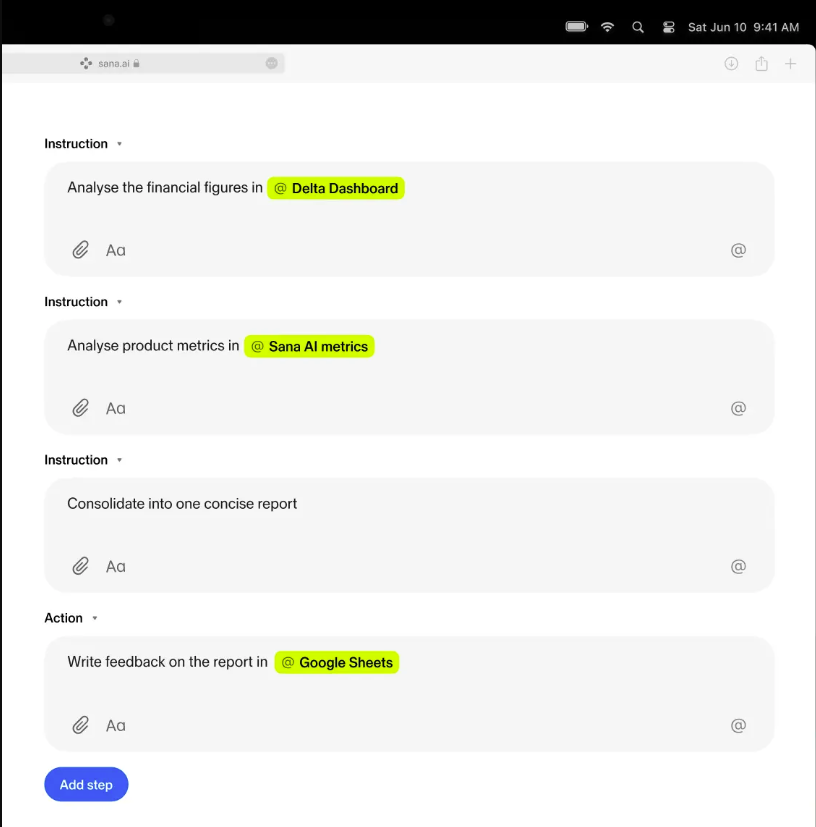
Here's a look at Sana's UI.

Sana Agents feature search and chat as well as coding tools and automation. Sana also has a learning platform, Sana Learn, that combines learning management, content creation and course generation. Sana Learn will complement Workday Learning with AI tools and personalization.

Kazmaier said during Workday's investor day:

"We think about Sana like the iOS for enterprise in the future. And we see it being like a power combination with Workday because we have incredible distribution. We have 75 million users already. And you can ask 100% expect us to leverage that to bring Sana as an experience to every one of them.

Now the beautiful thing about Sana is that it's not just an incredible enterprise search and enterprise action experience. It also gives us the opportunity to encompass many, many more workflows that people are not doing in Workday today. People engage with Sana today on average 7 times a day in the current form. If we bring this to all of our customers and we open up that AI extensibility for them many things that they are doing today with legacy ticket-based automation, programmed exits, DIY AI systems, they will just naturally fall into this."

Workday has been on a bit of a buying spree of late. In the last 18 months, Workday has acquired the following:

  • Sana.
  • Paradox.
  • Flowise.
  • Evisort.
  • HiredScore.

Holger Mueller, an analyst at Constellation Research, said:

"Workday is on a record acquisition spree, Sana the latest one. At the same time, Workday is radically changing it's data and AI architecture. Here's the question: How will Workday integrate the last three acquisitions? Customers want and need AI asap and Workday needs to deliver fast, while addressing architectural debt and not creating too much new debt."


Data to Decisions Future of Work Next-Generation Customer Experience Innovation & Product-led Growth Tech Optimization Digital Safety, Privacy & Cybersecurity workday ML Machine Learning LLMs Agentic AI Generative AI Robotics AI Analytics Automation Quantum Computing Cloud Digital Transformation Disruptive Technology Enterprise IT Enterprise Acceleration Enterprise Software Next Gen Apps IoT Blockchain Leadership VR CX EX Employee Experience HCM SaaS PaaS HR Chief Information Officer Chief Executive Officer Chief Technology Officer Chief AI Officer Chief Data Officer Chief Analytics Officer Chief Information Security Officer Chief Product Officer Chief Customer Officer Chief People Officer Chief Human Resources Officer

MongoDB launches effort to modernize legacy data, application layers

MongoDB launches effort to modernize legacy data, application layers

MongoDB launched MongoDB AMP (Application Modernization Platform) as the vendor becomes the latest to take on enterprise code transformation needed to migrate workloads.

Shilpa Kolhar, SVP of Application Modernization, said MongoDB AMP includes tools and techniques that can move workloads to its Atlas platform. Kolhar argued that MongoDB AMP moves beyond enterprise code transformation. MongoDB announced the news ahead of its MongoDB.local NYC conference. 

"MongoDB AMP is not about throwing the legacy code base into another system that doesn't work. We have tried it. Real applications have large, complex code bases that AI can't directly handle correctly and efficiently," she said. "This is especially true with applications that are centered around stored procedures, where the business logic is spread across the application. Our tooling enables us to break this problem into smaller chunks, smaller pieces, and then work through the code base using an interactive and automated process."

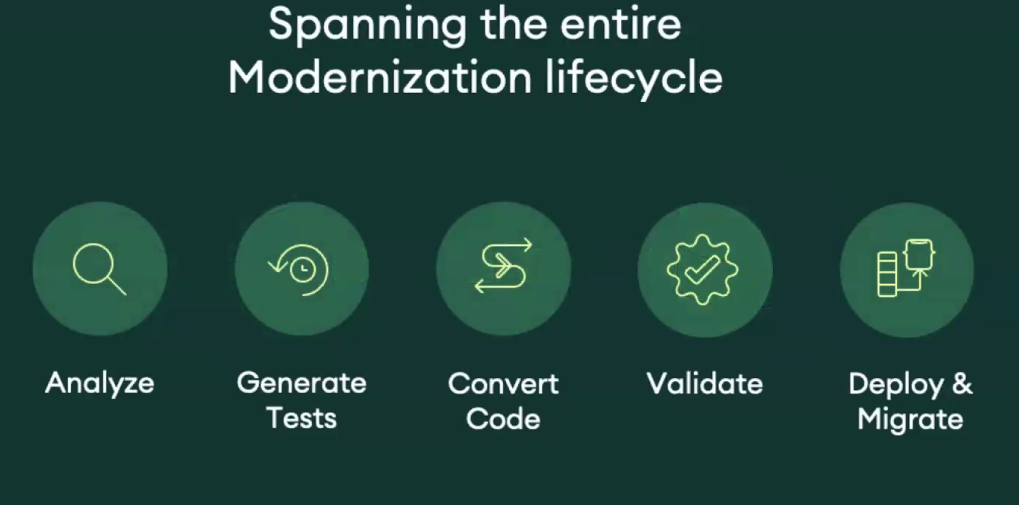
MongoDB AMP includes a set of agentic workflows that build, test, and repair throughout the conversion process. MongoDB said that combining AMP with its repeatable frameworks have sped up code transformation speed 10x with overall modernization projects sped up 2x to 3x.

There are multiple code transformation efforts that aim to use AI to create AI-native applications. AWS Transform is one of the better known. MongoDB is pitching AI as a code transformation tool with a data layer twist, but it also said enterprises need a more holistic approach that includes analytics, deployment and data migration to name a few.

The win for enterprise vendors is that they can gain workloads while saving customers money on pricey consulting engagements.

MongoDB said MongoDB AMP is built on two years of development with migrating customers. The company cited Australia’s Bendigo Bank, Lombard Odier and IntellectAI as customers that migrated relational databases to MongoDB as well as adjacent code.

Kolhar said:

"With AMP, we are getting into both the database modernization and also the entire application tier of modernization. So, it's not just the database migration alone. We have built tools to support many different combinations of the legacy stack.

We have multiple agents that help with analysis of the code, but we do have some deterministic tools as well. We have AI agents to actually split the code base into chunks that can be recomposed, and then what you're converting in."

Data to Decisions Next-Generation Customer Experience Tech Optimization mongodb Big Data Chief Information Officer Chief Technology Officer Chief Information Security Officer Chief Data Officer

Workday launches Workday Data Cloud, Workday Build, more AI agents

Workday launches Workday Data Cloud, Workday Build, more AI agents

Workday launched Workday Data Cloud, Workday Build as well as a set of Illuminate AI agents as it aims to build a larger ecosystem around its platform.

At Workday Rising, the company rolled out Workday Data Cloud, which puts the human capital management and financial software company in the center of data flows. Workday Data Cloud has zero-copy access to data lakes, data warehouses, applications and business intelligence tools.

Databricks, Salesforce and Snowflake are among the headliner customers. When asked what would make Workday Data Cloud different from other data clouds, Workday CTO Peter Bailis said the company has the "people and money data" that others can build on. SAP is following the same logic with its SAP Business Data Cloud via a partnership with Databricks

Workday Data Cloud uses Iceberg to make its platform data open, accessible and AI ready, said Bailis.

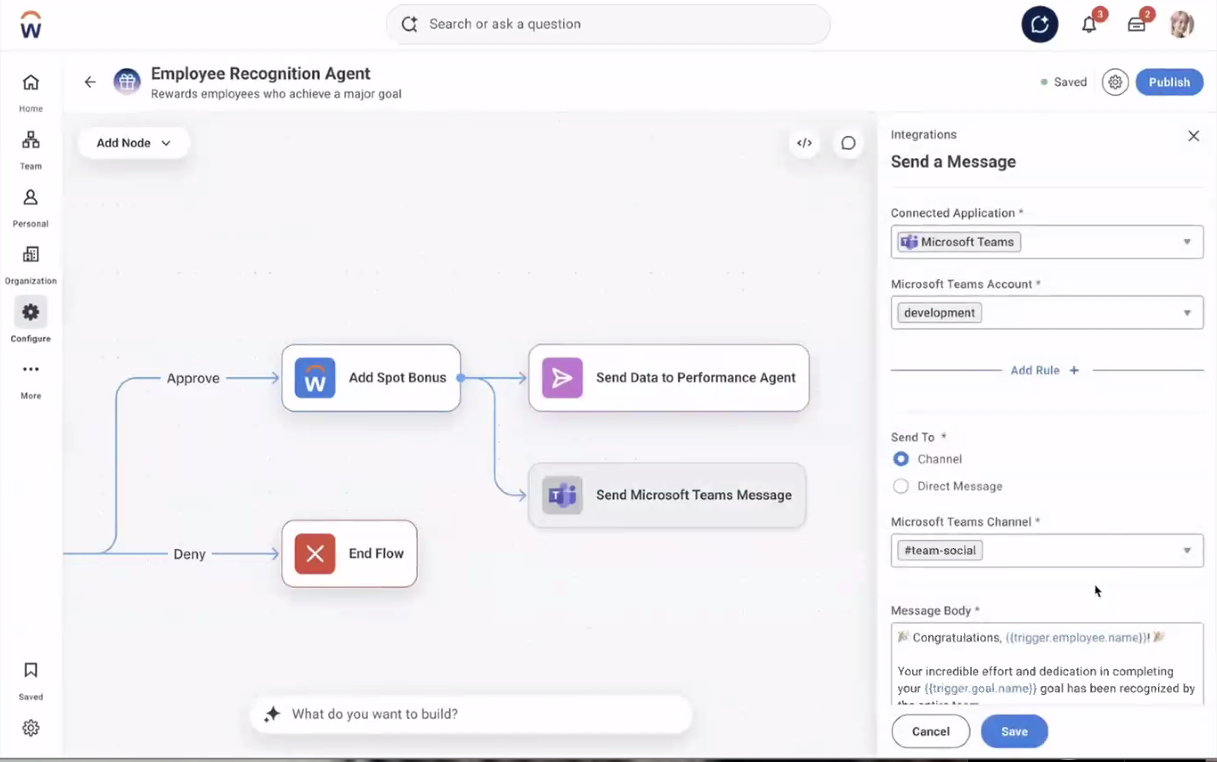
The company also outlined Workday Build, which is a set of tools so developers can build on the Workday platform. The tools include Workday Flowise Agent Builder, Extend Apps, Orchestration and connections to Workday Data Cloud. There's also the Workday Marketplace and community tools for developers.

Workday Rising 2025 builds on the announcements made last year that rounded out Workday as more of a platform play.

"Our strategy is threefold. One, we're building the best AI agents for HR and finance that deliver real business value. Our data has context, and we're deeply embedding AI into HR and finance processes. Second, we're continuing to accelerate investments in our core so we're doubling down on what Workday does best. And finally, we're building an open platform designed for work. We're shifting from the system of record for people and money to a system of action for people and money that understands their customer businesses, understands what they need and helps them reimagine what work gets done," said Bailis.

In addition, Workday scaled out its Illuminate AI agent offerings that aim to bring data and context to business processes. These include the following additions:

  • Illuminate HR Agents include a business process copilot, case agent, document intelligence for contingent labor, employee sentiment agent as well as agents for job architecture and performance.
  • Illuminate for Finance Agents include AI agents focused on cost and profitability, financial close, and financial scenario testing.
  • Illuminate for Industry Agents include agents for academic requirements and student administration.
  • Workday said it will soon add Workday Flowise Agent Builder and the Workday Paradox Candidate Experience Agent when the Paradox deal closes.

According to Workday, Illuminate agents will be able to connect to third-party agents including Google Cloud, Salesforce and Microsoft among others. Workday is supporting Model Context Protocol (MCP) and Agent2Agent protocols.

The company also launched Workday Flex Credits so customers can pivot to more consumption based models as AI agents proliferate. There's a set of credits built into subscriptions and as AI agents scale customers can add more credits as usage expands.

Data to Decisions Digital Safety, Privacy & Cybersecurity Innovation & Product-led Growth Tech Optimization Future of Work workday SaaS PaaS IaaS Cloud Digital Transformation Disruptive Technology Enterprise IT Enterprise Acceleration Enterprise Software Next Gen Apps IoT Blockchain CRM ERP CCaaS UCaaS Collaboration Enterprise Service AI Analytics Automation CX EX Employee Experience HCM Machine Learning ML Leadership HR Chief Information Officer Chief Technology Officer Chief Information Security Officer Chief Data Officer Chief Customer Officer Chief People Officer Chief Human Resources Officer

SAP S/4HANA Cloud strategy makes headway, says DSAG

SAP S/4HANA Cloud strategy makes headway, says DSAG

SAP is making progress with its cloud and AI strategy with customers as enterprises are allocating more budget to S/4HANA Cloud.

That's the high-level takeaway from the latest investment survey from the German-speaking SAP User Group (DSAG). The survey incorporates responses from DSAG members as well as large enterprises that aren't part of the group.

The results were released at the DSAG Annual Congress.

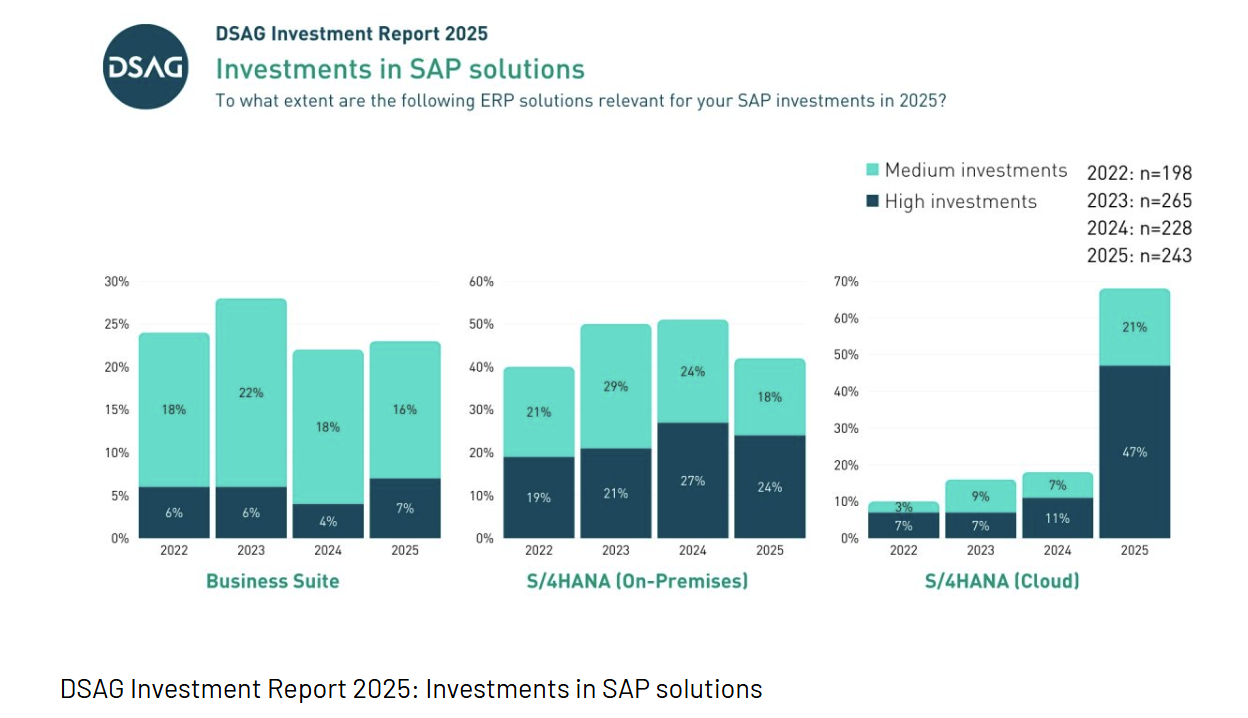
SAP has fleshed out its Business Suite strategy, role of AI and agents as well as migration plans as it prods customers to move to the cloud and a clean data core. DSAG found that 47% of respondents are increasing SAP budgets, up from 46% a year ago.

Yet, there is a good bit of flux. Twenty-three percent of respondents said the SAP budget remains unchanged and 25% said budgets were decreasing, up from 19% a year ago.

Jens Hungershausen, DSAG Chairman of the Board, noted that companies are clearly reviewing SAP budgets, but there are multiple factors a play. "Possible reasons could be delays in planned migrations, savings through consolidation of SAP systems or a general reduction in costs," he said.

Among the key takeaways from the DSAG Investment Report 2025:

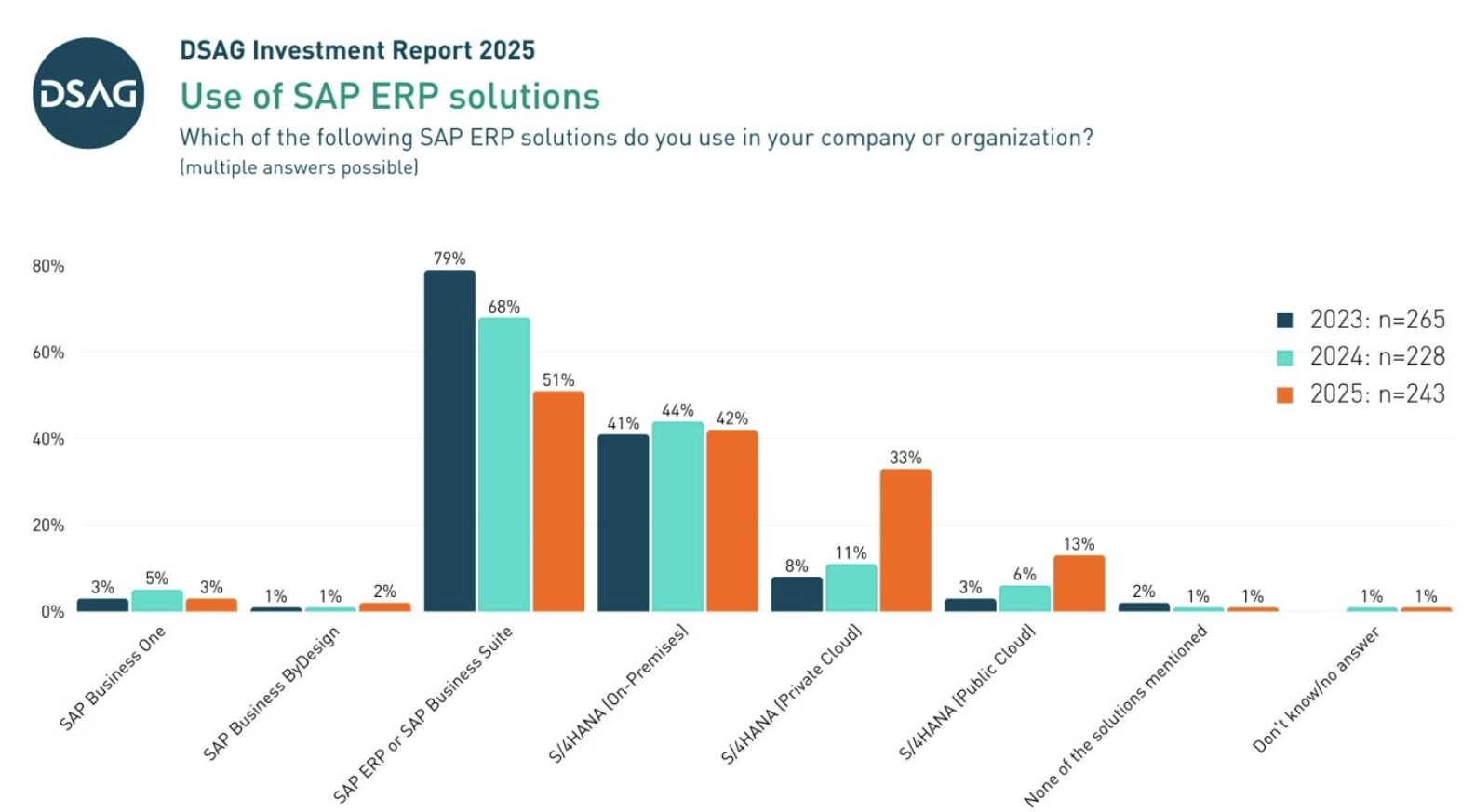
  • The use of S/4HANA Private Cloud and S/4HANA Public Cloud is seeing growth. Thirty-three percent of enterprises use S/4HANA Private Cloud, up from 11% a year ago, and 13% use S/4HANA Public Cloud, up from 6% a year ago.
  • 42% of enterprises are on S4/HANA on-premises.
  • 68% of respondents are planning to invest in S/4HANA Cloud. DSAG noted that the structure of the survey and more large enterprises likely boosted the results.
  • 38% of respondents had a positive view of the S/4HANA cloud strategy, up from 13% a year ago.
  • 48% of enterprises surveyed are using or plan to use the RISE with SAP program.
  • Business Technology Platform is getting the most investment with 40% saying it will get high and medium investments. SAP SuccessFactors was cited by 25% with Signavio at 18%.

"SAP hasn't found the silver bullet to solve it's upgrade problem. Whole AI helped earlier in the year, and it is now back to packaging. The crux remains - S/4HANA does not have the automatic advantages to self entice customers to upgrade. We will see where SAP ends up in 2025," said Holger Mueller, an analyst at Constellation Research. 

Data to Decisions Chief Information Officer

AI agents, automation, process mining starting to converge

AI agents, automation, process mining starting to converge

Enterprise software vendors appear to be coalescing around the idea that process mining is an enabler for agentic AI and should be built into platforms.

In recent days, process mining, task mining and process automation have all received some play. ServiceNow, which has been acquiring process mining and task mining capabilities as well as partnering with Celonis, has built in more process knowhow into its platform.

ServiceNow acquired UltimateSuite in late 2023 to build out its native process and task mining capabilities. Those capabilities are now included in its Zurich release, which revolves around agentic AI with embedded process automation. Kush Panchbhai, Senior Vice President of AI Platform, Zurich is an effort to give customers the tools to "pivot from legacy automations to proactive automations across all of the workspace" and structured and unstructured data.

The ability to identify inefficiencies via process and task mining is critical because those insights "are then food for our AI agents" to automate with streamlined processes, said Panchbhai. You don’t have to sell me on this process mining meets agentic AI notion. Simply put, I thought agentic AI would just scale process disaster without some kind of optimization in the background.
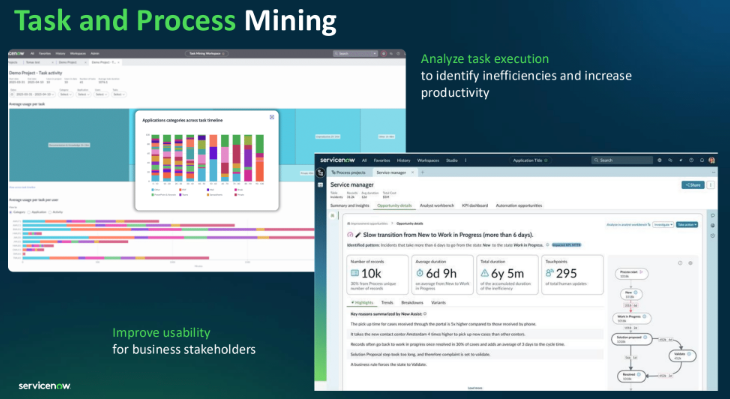
While ServiceNow’s process efforts are part of the workflow automation continuum, it’s worth noting that other enterprise vendors are onto the idea. Here’s a look at some of the milestones in recent days. Research: Time to Introduce Hi-Fi for Enterprise Processes

Get Constellation Insights newsletter

UiPath: Leveraging RPA and process roots with neutrality

UiPath delivered better-than-expected second quarter results and noted that it is landing larger deals because customers are looking to meld AI, automation, process and orchestration with a neutral vendor.

"With UiPath Maestro, we unify agents, robots and people across systems with governance and transparency so outcomes are measurable and repeatable. This combination is delivering tangible ROI, fueling increasing commercial momentum," said Dines.

Indeed, UiPath's second quarter revenue was $362 million, up 14% from a year ago, and non-GAAP operating income improved to $62 million. It appears that UiPath has emerged from a rough patch. "Since launching our Agentic platform, customers have executed almost 1 million agent runs. Maestro orchestrated over 170,000 process instances, and over 450 customers are actively developing agents," said Dines.
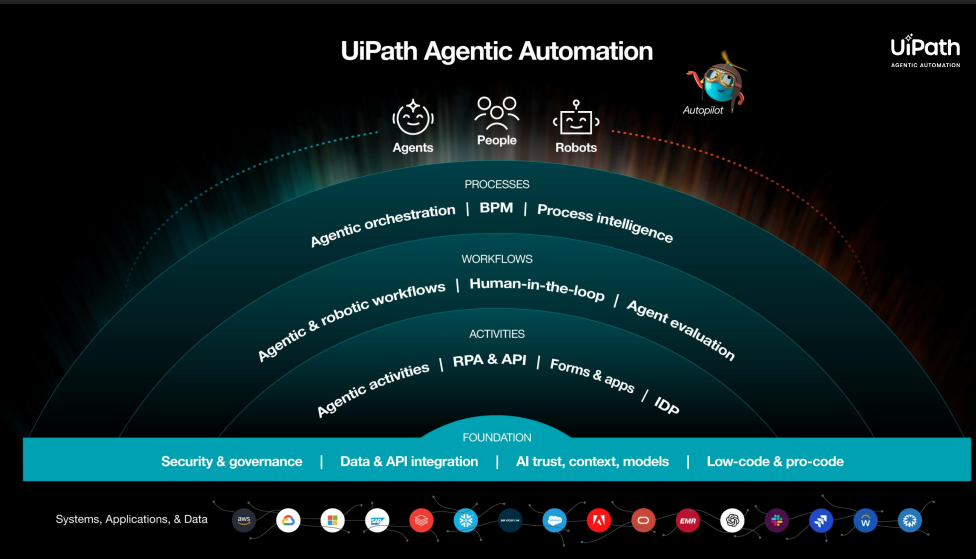
More importantly for UiPath, the company is deepening relationships with customers. Customers with $100,000 or more in ARR increased to 2,432 in the quarter while customers with more than $1 million in ARR came in at 320.

Dines cited Voya Financial a lead customer in the second quarter. Voya automated more than 100 processes and now is targeting more than 40 high-impact use cases in accidental claims with Maestro orchestrating workflows.

Neutrality has its role, according to Dines. "Our key pitch is being really agnostic. I think most of the customers right now are concerned into being completely on one side of a business platform. Because if you look at agentic and orchestration, most of the processes actually spend multiple business systems. You will have to make a choice if you choose an orchestration or an agentic solution that is provided that one of the business systems," he said.

Also see: Hi-Fi process management needs to be foundation for AI | Bloomfilter co-CEO Severinghaus on the intersection of process mining, software development |
Why enterprise, process workflows are the new battleground

SAP: Process mining is a tool for AI adoption

SAP CFO Dominik Asam said he considers process mining to be part of the tooling for AI adoption in the enterprise.

Asam said at the Goldman Sachs Communacopia + Technology conference that the company is selling software but also transformation and AI automation. That transformation also requires some core building blocks.

"If you want to deploy AI, you have to have all the tooling required like process mining, like the enterprise architecture management, also now the in-app guidance of the user to adopt the tools," said Asam. "SAP has a pretty favorable position that we really sit at the nexus of the processes and the data."

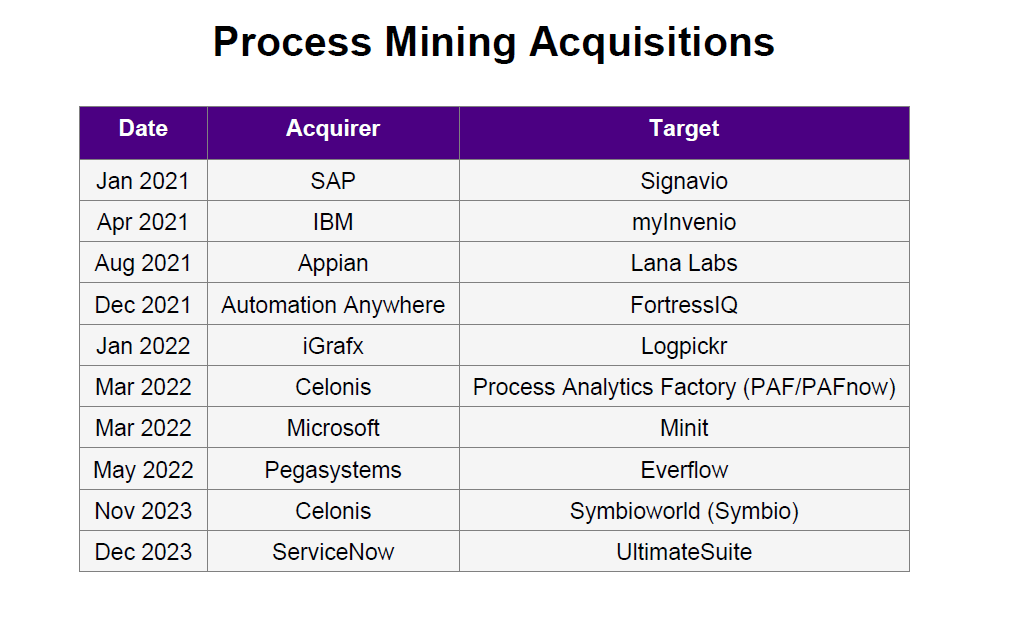
SAP has acquired its way into process mining with Signavio and LeanIX. It also has a partnership with UiPath. SAP and Celonis are mired in a court battle over process mining competition.

C3 AI: Process automation part of a comeback?

C3 AI launched the C3 AI Agentic Process Automation. The company bills the launch as the next generation of robotic process automation.

The company has just hired new CEO Stephen Ehikian, who inherited the launch of C3 AI Agentic Process Automation. Like most process mining and AI agent plays, C3 is selling by the process, value and enterprise pain points. C3’s key points include:

  • C3 AI Agentic Process Automation focuses on business processes such as “order-to-cash, customer service, invoice processing, debt collection, supplier onboarding, procurement, and employee onboarding, as well as industrial operations such as equipment troubleshooting, manufacturing operations, production planning, inventory management, and aircraft maintenance.”
  • The C3 offering is looking to address use cases that used to be addressed by robotic process automation (RPA).
  • Now C3 AI Agentic Process Automation is a combination of AI models, predetermined steps and controls with an interactive UI.

Although the company billed C3 AI Agentic Process Automation as a breakthrough what’s being offered rhymes with what UiPath has built. It’s unclear whether C3 AI can leverage its process automation suite to better compete with multiple vendors in the enterprise and Palantir in government accounts.

What’s next?

The working theory is that ServiceNow’s move to highlight process mining and task mining in Zurich will lead to more efforts from rivals.

  • For instance, Microsoft acquired Minit in 2022 and talked up process mining and automation for a few quarters after the deal closed. It’s unclear what happened to Minit’s technology, but Microsoft wouldn’t need to do much to embed process into its various AI agent platforms.
  • Salesforce, which has a bit of ServiceNow envy these days, has enough time to layer in process mining and automation talk into its Agentforce messaging at its annual Dreamforce conference. Salesforce if it truly wants to be seen as a broad platform for agentic AI—beyond its core service, CRM and marketing clouds—may have to buy its way into the process mining game. Salesforce heads into Dreamforce 2025: A look at the big themes
  • Celonis, the big dog in process mining and process intelligence, has its Celosphere conference Nov. 3 to Nov. 5 in Munich. The company has repeatedly noted that process intelligence enables agentic AI, but the market hasn’t bought into it. ServiceNow’s moves with Zurich are likely to give the process mining market a lot more play to the benefit of Celonis.
  • UiPath is only looking more valuable in this mix. The company has evolved from RPA to process automation to AI agent orchestration. It’s neutral positioning as a vendor is also valuable. The real kicker with UiPath is that its market cap is between $6 billion and $7 billion depending on the day. UiPath could solve some problems for an enterprise software vendor looking to be an agentic AI platform of choice. Or UiPath could go private. UiPath guided toward fiscal 2026 ARR of $1.82 billion to $1.825 billion and has $1.5 billion in cash with no debt.
Data to Decisions Future of Work Next-Generation Customer Experience Tech Optimization Innovation & Product-led Growth Revenue & Growth Effectiveness Digital Safety, Privacy & Cybersecurity ML Machine Learning LLMs Agentic AI Generative AI Robotics AI Analytics Automation Quantum Computing Cloud Digital Transformation Disruptive Technology Enterprise IT Enterprise Acceleration Enterprise Software Next Gen Apps IoT Blockchain Leadership VR Chief Information Officer Chief Executive Officer Chief Technology Officer Chief AI Officer Chief Data Officer Chief Analytics Officer Chief Information Security Officer Chief Product Officer

Chip-Level Security: How Hackers, AI Risks & Space Cybersecurity Threaten Enterprises | DisrupTV Ep. 410

Chip-Level Security: How Hackers, AI Risks & Space Cybersecurity Threaten Enterprises | DisrupTV Ep. 410

Chip-Level Security: How Hackers, AI Risks & Space Cybersecurity Threaten Enterprises | DisrupTV Ep. 410

In this episode of DisrupTV (Episode 410), host R “Ray” Wang engages with cybersecurity experts to explore the multifaceted threats facing modern enterprises. The discussion centers on three critical areas: chip-level security vulnerabilities, the dual-edged nature of AI in cybersecurity, and the overlooked risks associated with space technologies.

Guest Insights

Angela Brescia – CEO of Synderys

Angela Brescia leads Synderys, a cybersecurity company specializing in protecting critical infrastructure. She emphasizes the importance of securing the foundational components of technology, including hardware and firmware, to prevent potential breaches. Angela discusses Synderys' efforts to develop advanced security solutions that address vulnerabilities at the chip level, ensuring the integrity of systems from the ground up.

Trent Teyema – Founder & President at CSG Strategies, Inc.

Trent Teyema, a retired FBI Special Agent, founded CSG Strategies, Inc., a consultancy specializing in cybersecurity and critical infrastructure protection. He shares insights from his extensive experience in law enforcement and national security, highlighting the evolving tactics of cyber adversaries. Trent discusses the need for proactive measures and collaboration between public and private sectors to mitigate risks and enhance resilience against cyber threats.

Dr. David Bray – Distinguished Chair of the Accelerator, Stimson Center

Dr. David Bray serves as the Distinguished Chair of the Accelerator at the Stimson Center, focusing on the intersection of technology and national security. He provides an in-depth analysis of the implications of artificial intelligence in cybersecurity, discussing both its potential to enhance defense mechanisms and the new vulnerabilities it introduces. Dr. Bray also addresses the emerging threats posed by space-based technologies and the necessity for comprehensive strategies to safeguard against these risks.

Key Takeaways

1. Chip-Level Security: The Foundation of Trust

The conversation begins with an examination of chip-level security, highlighting how vulnerabilities at this foundational layer can compromise entire systems. Experts discuss the challenges in securing chips due to their complexity and the increasing sophistication of attacks targeting hardware components.

2. AI: A Double-Edged Sword in Cybersecurity

Artificial Intelligence is both a boon and a bane in the cybersecurity landscape. While AI enhances threat detection and response capabilities, it also empowers cyber adversaries with tools to automate and scale attacks. The episode delves into the implications of AI-driven threats and the need for robust defenses against such evolving risks.

3. Space Technologies: The Final Frontier of Cyber Threats

The discussion extends to the realm of space technologies, where satellites and other space-based assets are increasingly targeted by cyber threats. Experts emphasize the importance of securing these assets, as their compromise can have far-reaching consequences on global communications and national security.

Notable Quotes

  • “Securing the chip is securing the trust.” — Angela Brescia
  • “AI in the wrong hands is a force multiplier for cyber threats.” — Dr. David Bray
  • “Space is no longer a safe haven; it's a new battleground in cybersecurity.” — Trent Teyema

Final Thoughts

Episode 410 underscores the interconnectedness of modern cybersecurity threats. From the chips powering our devices to the AI algorithms analyzing data and the satellites orbiting above, vulnerabilities at any level can cascade into significant risks for enterprises. The discussion calls for a holistic approach to cybersecurity, integrating robust defenses across all layers to safeguard against the evolving threat landscape.

Related Episodes

If you found this episode insightful, you might also enjoy:


Data to Decisions Digital Safety, Privacy & Cybersecurity Future of Work Tech Optimization Chief Data Officer Chief Digital Officer Chief Executive Officer Chief Information Officer Chief Information Security Officer Chief Privacy Officer Chief Technology Officer On DisrupTV <iframe width="560" height="315" src="https://www.youtube.com/embed/tgqiYolwq8w?si=w7Nom9zgvkLidOlt" title="YouTube video player" frameborder="0" allow="accelerometer; autoplay; clipboard-write; encrypted-media; gyroscope; picture-in-picture; web-share" referrerpolicy="strict-origin-when-cross-origin" allowfullscreen></iframe>

OpenAI, Microsoft reach an understanding of something as AI harmony awaits

OpenAI, Microsoft reach an understanding of something as AI harmony awaits

OpenAI and Microsoft put out a joint statement that they've reached a detente and may have raised more questions than they answered. Simply put, the OpenAI and Microsoft relationship is a little more clear but not by much. I'm sure it'll all work out great. 

In a joint statement, the companies said:

"OpenAI and Microsoft have signed a non-binding memorandum of understanding (MOU) for the next phase of our partnership. We are actively working to finalize contractual terms in a definitive agreement. Together, we remain focused on delivering the best AI tools for everyone, grounded in our shared commitment to safety."

Welcome to the week of things that may happen...or not. OpenAI and Microsoft's statement will get a lot of play, but it's not much different than Oracle's massive remaining performance obligation figures which reportedly revolve around OpenAI buying $300 billion in AI compute in 2027. It's an I. O. U. since OpenAI doesn’t have the money...yet. I may buy that compute once I win the Powerball. I already signed the non-binding contract of things that may happen should I become obscenely wealthy in two years.

So now, OpenAI, which apparently is the master of projections for a perfect world, has an understanding that'll it'll reach an understanding with Microsoft.

But seriously, this OpenAI and Microsoft thing is great news. What we do know from another statement is that OpenAI will remain a non-profit that will have funding of more than $100 billion. Yes, these figures are starting to look like their priced in Japanese Yen at this point.

I just feel better that OpenAI and Microsoft are getting along.

The Public Benefit Corporation (PBC) will continue to oversee the for-profit OpenAI and have an equity stake. The stake tops $100 billion and makes PBC "one of the most well-resourced philanthropic organizations in the world."

To put this PBC funding in perspective, it's worth a Gates Foundation comparison. Bill Gates and Melinda Gates through 2024 have given $60.2 billion to the Gates Foundation, which has paid out $83.3 billion in grants since inception. Warren Buffet has given $43.3 billion to the Gates Foundation from 2006 to 2024. The Gates Foundation has a trust endowment of $77.2 billion exiting 2024.

OpenAI's PBC will have a larger endowment than the Gates Foundation with a key caveat: PBC's funding will be based on OpenAI's valuation and a future business that'll revolve around AGI and domination of the competition. Hmm.

In any case, this non-binding understanding with Microsoft makes the software giant more of an investor. The PBC would theoretically get to do more good as all parties benefit.

A cynic (can you see me raising my hand looking perplexed and possibly jumping up and down) would call this MOU a bit of vapor, but I’m sure glad OpenAI and Microsoft don't have to go nuclear since it's arguably the most lucrative technology partnership in history.

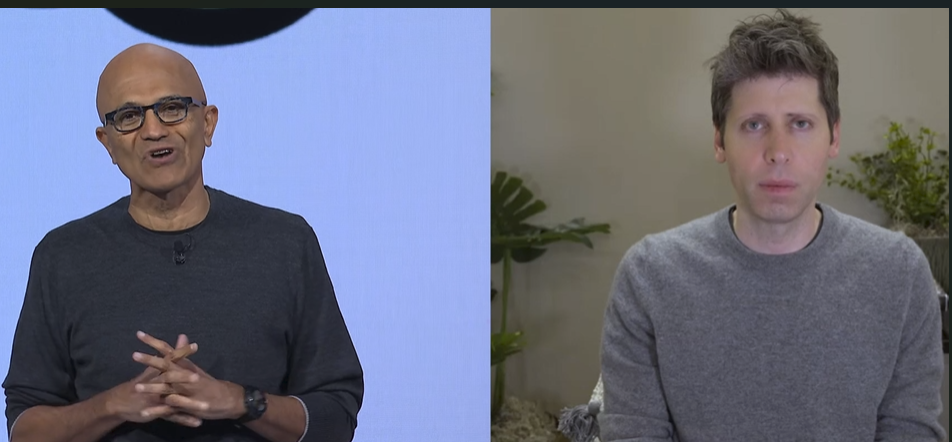
I mean just look at the happiness between these two.

Now Microsoft looks like it will officially be an investor under the new structure even though no details have been provided. The details will be critical:

  • How much power will PBC really have?
  • What happens when safety and mission collide with profits?
  • How will market pressures trade off with what the PBC wants?
  • Who will be on the board of the PBC overseeing the push to AGI?
  • How transparent is the oversight and governance of OpenAI?
  • PBC has a stake of more than $100 billion in OpenAI, but what’s the dilution to existing investors?
  • What rights will Microsoft have with its investment?
  • Will OpenAI spin off units that won't be under PBC control in the future?

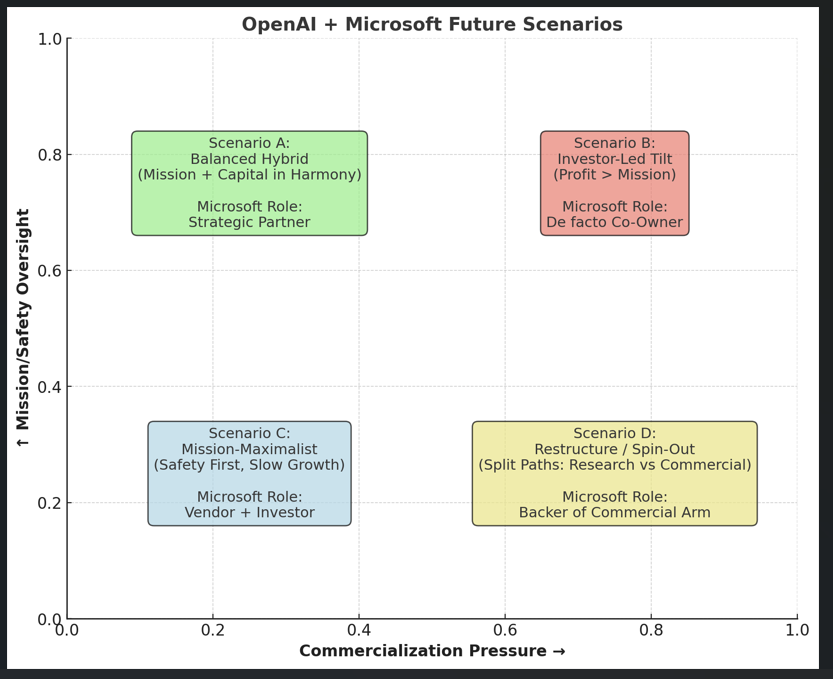
For giggles, I asked ChatGPT to clarify this new OpenAI-Microsoft detente and think through scenarios. After all, since we're playing with a made up understanding with made up numbers, we might as well break out the crystal ball too.

The scenarios boil down to this:

  • Mission and capital will be in harmony under this structure. PBC has real veto power over safety, direction and deployment of frontier models. Microsoft has preferred rights, but doesn't dictate roadmap. All is well. I couldn't stop laughing about the odds of this one playing out.
  • Investors gain influence and profits trump mission. Microsoft and other investors wind up influencing the PBC. Microsoft is essentially a co-owner. OpenAI benefits from faster commercialization and revenue growth, but has to hear "sell-out" from critics. I can see a PBC board of Larry Ellison, Elon Musk, Sam Altman, Satya Nadella and some token AI ethics professor from Stanford any day now.
  • PBC has a lot of authority and OpenAI grows slow. Tensions boil over as OpenAI rivals move faster. It's the good for drama, bad for market capitalization scenario.
  • OpenAI starts spinning out parts to focus more on investor-led initiatives. Think OpenAI Labs, OpenAI Enterprise and OpenAI Consumer as a trio of companies.

I’m sure we’ll get to the harmony scenario because in the age of RPO, IOUs and valuations based on SPAC-like made up future revenue figures what could go wrong?

Data to Decisions Innovation & Product-led Growth Future of Work Tech Optimization Next-Generation Customer Experience Digital Safety, Privacy & Cybersecurity openai Microsoft ML Machine Learning LLMs Agentic AI Generative AI Robotics AI Analytics Automation Quantum Computing Cloud Digital Transformation Disruptive Technology Enterprise IT Enterprise Acceleration Enterprise Software Next Gen Apps IoT Blockchain Leadership VR Chief Information Officer Chief Executive Officer Chief Technology Officer Chief AI Officer Chief Data Officer Chief Analytics Officer Chief Information Security Officer Chief Product Officer

Adobe reports strong Q3, raises outlook

Adobe reports strong Q3, raises outlook

Adobe reported better-than-expected third quarter earnings and raised its outlook for the rest of the fiscal year.

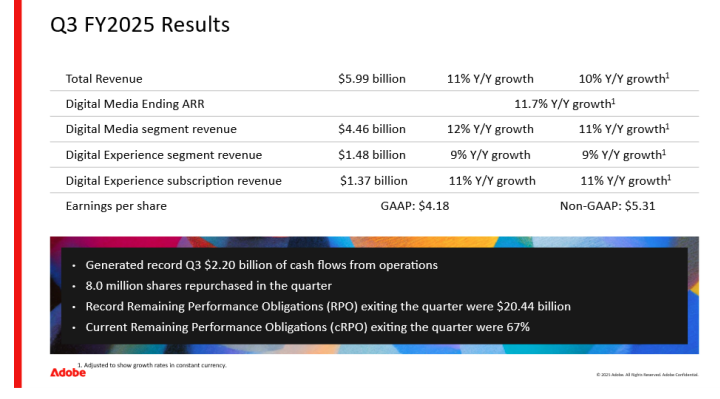
The company reported third quarter net income of $1.77 billion, or $4.18 a share, on revenue of $5.99 billion, up 11% from a year ago. Non-GAAP earnings were $5.31 a share.

Wall Street was expecting third quarter non-GAAP earnings of $5.18 a share on revenue of $5.91 billion.

Adobe CEO Shantanu Narayen said "AI-influenced" annual recurring revenue topped $5 billion and AI-first ARR topped $250 million. Narayen said Adobe was raising its outlook due to AI product innovation and go-to-market execution.

Narayen said:

"AI represents a tectonic technology shift and presents the biggest opportunity for Adobe in decades. Our strategy to harness AI is focused on infusing it across our category-leading applications to provide more value and delivering innovative new AI-first products. We’ve done a great job executing this strategy by accelerating innovation with a focus on offering greater value to Creative and Marketing Professionals and Business Professionals and Consumers."

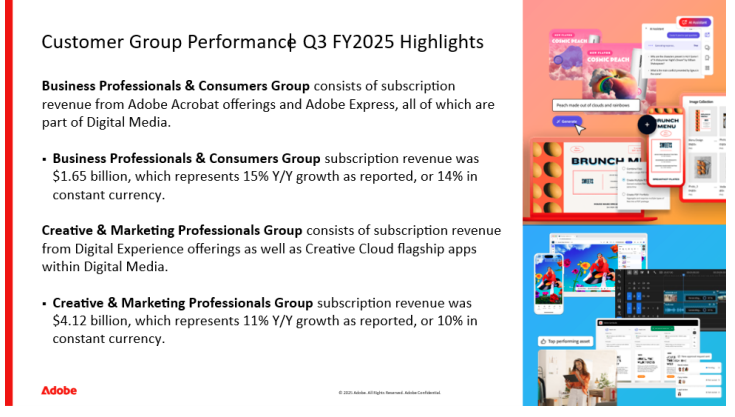
The company saw strong subscription growth across its digital media and digital experience units. Remaining Performance Obligations was $20.44 billion exiting the quarter. Adobe's digital media unit delivered revenue of $4.46 billion, up 12% from a year ago. Digital experience revenue was $1.48 billion, up 9%. Digital experience subscription revenue was $1.37 billion, up 11%.

Adobe's quarter didn't include uplift from its latest agentic AI additions. The company, which is facing increased competition from Canva and newly-public Figma, announced general availability of its AI agents for customer experience Sept. 10. Adobe said the new agents, powered by the Adobe Experience Platform Agent Orchestrator, will be able to understand context, plan multi-step actions and refine responses.

The out-of-the-box agents in Adobe Experience Platform include:

  • Audience Agent for audience optimization and personalization.
  • Journey Agent to create and orchestrate customer journeys across multiple channels.
  • Experimentation Agent to leverage performance data and optimize on the fly.
  • Data Insights Agent to aggregate signals across an enterprise.
  • Site Optimization Agent to manage brand websites and optimize for performance.
  • Product Support Agent, which can give answers based on knowledge bases and enterprise data.

As for the outlook, Adobe said fourth quarter revenue will be $6.075 billion to $6.125 billion with non-GAAP earnings of $5.35 a share to $5.40 a share. For fiscal 2025, Adobe projected revenue of $23.65 billion to $23.7 billion with non-GAAP earnings of $20.80 a share to $20.85 a share.

Box launches Box Extract, Box Automate, Box Shield Pro

Box launches Box Extract, Box Automate, Box Shield Pro

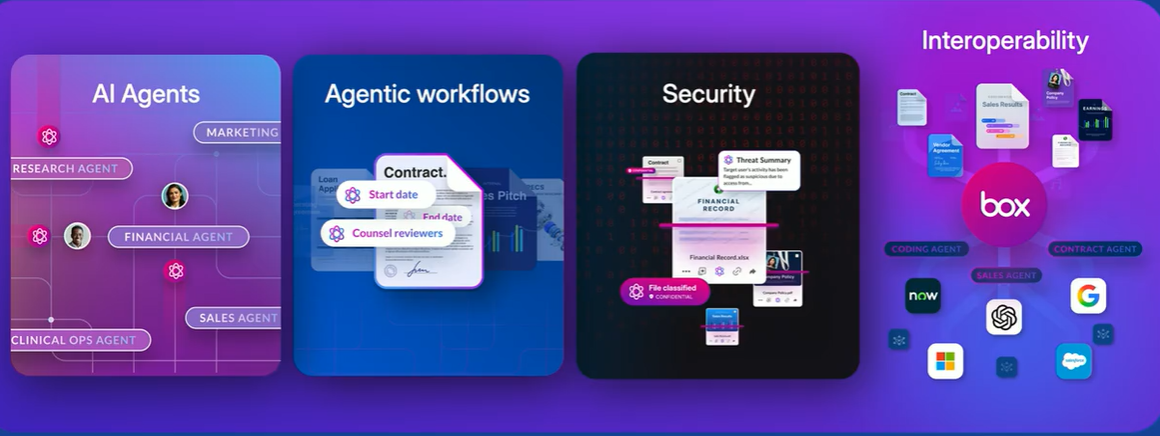
Box rolled out new tools to extract data from unstructured content, automate workflows and orchestrate work and layered more AI features in Box Apps.

At the company's BoxWorks conference, CEO Aaron Levie outlined Box Extract, Box Automate and new Box Apps features to address the day that AI agents outnumber people. Levie said:

"Imagine a future where these agents are running autonomously in the background, at scale across an organization. We will have potentially 100 times or more agents in our organization than people, and that's going to be a very different reality of what work looks like."

Levie argued that Box's Intelligent Content Management platform can address the content workflow, processes and governance.

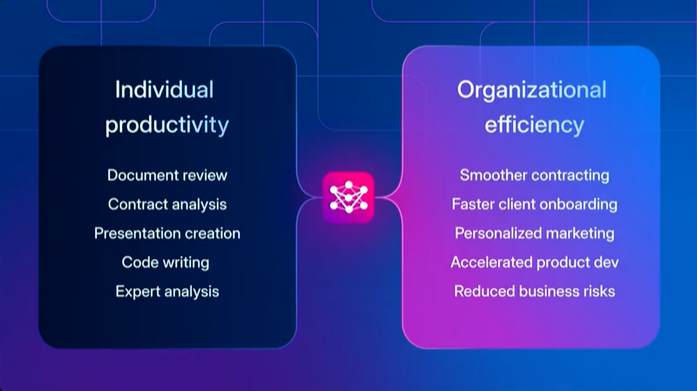
"We believe that the companies that thrive in this AI first era of work will be those that can fully tap into and take advantage of their unstructured data at scale," said Levie. "With AI agents on unstructured data we can streamline production, accelerate critical missions and deliver new products to market even faster."

Box previewed its BoxWorks announcements during its latest earnings conference call. Here's a look at the key announcements.

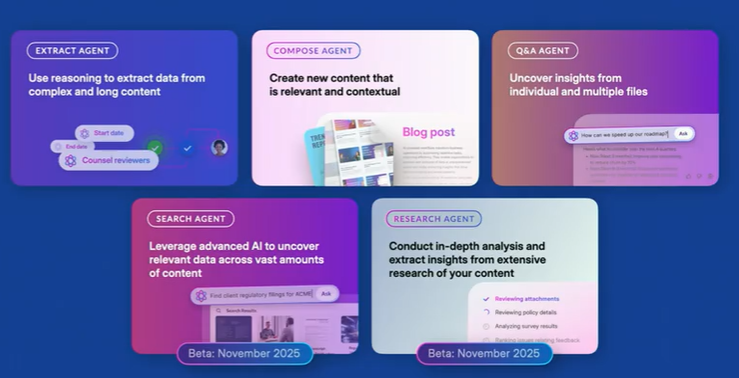
Box Extract uses AI via Box AI standards and Enhanced Extract Agents to understand documents and extract information. Box Extract can handle multiple formats including PDFs, scans, images and structured data, interpret text, tables, handwriting and bar codes, capture semantic relationships and ensure data quality.

According to Box, Box Extract can improve processes that need contract, invoices, forms and other unstructured content.

Box Automate is a tool to design and manage workflows with a no-code/low-code interface, create AI agents for workflows, route tasks and automate processes via integration with Box Forms, Box Doc, Box Sign and Box Hubs.

Box Apps will get new functionality to surface insights and trends, filter and surface content views via natural language, manage multiple dashboards and embed apps into third-party platforms.

BoxShield Pro will deliver tools to defend against ransomware attacks, classify sensitive content and analyze threats. BoxShield Pro is a new product built on top of Box Shield, which launched in 2019.

The company said the new offerings will be available later this year.

Data to Decisions Future of Work Innovation & Product-led Growth Tech Optimization Next-Generation Customer Experience Digital Safety, Privacy & Cybersecurity box ML Machine Learning LLMs Agentic AI Generative AI Robotics AI Analytics Automation Quantum Computing Cloud Digital Transformation Disruptive Technology Enterprise IT Enterprise Acceleration Enterprise Software Next Gen Apps IoT Blockchain Leadership VR Chief Information Officer Chief Executive Officer Chief Technology Officer Chief AI Officer Chief Data Officer Chief Analytics Officer Chief Information Security Officer Chief Product Officer