Results

News Analysis: The War on H-1B Visas - The New Services Economics

News Analysis: The War on H-1B Visas - The New Services Economics

Media Name: @rwang0 Ray Wang USCIS_Signature_Preferred_FC.jpg

POTUS Cracks Down on H-1B Abuse to Bolster Domestic Jobs

On September 19th, 2025, the President issued a proclamation restricting entry of certain non-immigrant workers.  In that proclamation:

  • $100,000 payment would be required for every H-1B visa recipient starting September 21, 2025 with an annual term.
  • Special exemptions by the Secretary of Homeland Security for any individual alien, all aliens working for a company, or all aliens working in an industry, if the Secretary of Homeland Security determines, in the Secretary’s discretion, that the hiring of such aliens to be employed as H-1B specialty occupation workers is in the national interest and does not pose a threat to the security or welfare of the United States.

Intended and Unintended Consequences Abound

Constellation expects three simultaneous responses with the reduction of H-1B petitions:

  1. Domestic hiring will increase.  The economics of adding $100k to each H-1B applicant will reduce the number of petitions for special talent.  Companies will prioritize US workers for domestic positions given the huge cost burden.
     
  2. Enterprises will accelerate automation and AI.  The baffling existence of BPO amidst a wave of automation and AI will cease to become a mystery.  Savvy organizations will take the opportunity to reduce as much of their labor costs as possible.  Should there be a dearth of talent, then automation and AI investments will accelerate.
  3. GCC's will overtake outsourcing.  So after 12/31/2025, if you outsource for a service let’s say $100k to a medical bill or claims processing in India from the US, that full amount is deductible today, providing a $21,000 corporate tax deduction (i.e. assuming a 21% corporate tax rate), resulting in a net cost of $79,000. However, the HIRE act complicates things. 

    Under the HIRE act what happens is the $100,000 payment would lose its deductibility while triggering a $25,000 excise tax. The effective after-tax cost would increase to $146,000 — an 85% increase over current costs. So if you have the HIRE Act pass plus less H1-Bs and already in place 1 year vs 15 year depreciation, offshore work will be much less affordable than US based work. This will have a punishing effect on outsourcers but lead to an increase of GCCs in India. 

The Bottom Line: A New World Order In Services Economics Will Emerge

The short term effect for IT Services firms would be an increase of GCC’s in India, more hiring in the US, and certainly more pressure to deliver automation and AI,  Concurrently, expect less outsourcing, less H-1B’s, and less job mobility.  This new world order on services economics could have devastating effects on attracting the best and brightest talent to the US just as countries such as UAE, Qatar, and Kingdom of Saudi Arabia are ramping up a talent war.

Your POV

How will you adjust to these new H-1B requirements? Do you think this will help the US or hurt the US? 

Add your comments to the blog or reach me via email: R (at) ConstellationR (dot) com or R (at) SoftwareInsider (dot) org. Please let us know if you need help with your strategy efforts. Here’s how we can assist:

  • Working with your boards to keep them up to date on technology and governance.
  • Connecting with other innovation minded leaders
  • Sharing best practices
  • Vendor selection
  • Implementation partner selection
  • Providing contract negotiations and software licensing support
  • Demystifying software licensing

Reprints can be purchased through Constellation Research, Inc. To request official reprints in PDF format, please contact Sales.

Disclosures

Although we work closely with many mega software vendors, we want you to trust us. For the full disclosure policy,stay tuned for the full client list on the Constellation Research website. * Not responsible for any factual errors or omissions.  However, happy to correct any errors upon email receipt.

Constellation Research recommends that readers consult a stock professional for their investment guidance. Investors should understand the potential conflicts of interest analysts might face. Constellation does not underwrite or own the securities of the companies the analysts cover. Analysts themselves sometimes own stocks in the companies they cover—either directly or indirectly, such as through employee stock-purchase pools in which they and their colleagues participate. As a general matter, investors should not rely solely on an analyst’s recommendation when deciding whether to buy, hold, or sell a stock. Instead, they should also do their own research—such as reading the prospectus for new companies or for public companies, the quarterly and annual reports filed with the SEC—to confirm whether a particular investment is appropriate for them in light of their individual financial circumstances.

Copyright © 2001 – 2025 R Wang and Insider Associates, LLC All rights reserved.

Contact the Sales team to purchase this report on a a la carte basis or join the Constellation Executive Network

Data to Decisions Digital Safety, Privacy & Cybersecurity Future of Work Innovation & Product-led Growth Marketing Transformation Matrix Commerce New C-Suite Next-Generation Customer Experience Tech Optimization Chief Analytics Officer Chief Customer Officer Chief Data Officer Chief Digital Officer Chief Executive Officer Chief Financial Officer Chief Information Officer Chief Information Security Officer Chief Marketing Officer Chief People Officer Chief Privacy Officer Chief Procurement Officer Chief Product Officer Chief Revenue Officer Chief Supply Chain Officer Chief Sustainability Officer Chief Technology Officer

From Navy SEAL Lessons to AI-First Businesses: Redefining Success | DisrupTV Ep. 411

From Navy SEAL Lessons to AI-First Businesses: Redefining Success | DisrupTV Ep. 411

From Navy SEAL Lessons to AI-First Businesses: Redefining Success | DisrupTV Ep. 411

In Episode 411 of DisrupTV, hosts R “Ray” Wang and Vala Afshar engage with three distinguished guests:

  • Mike Hayes – Former Navy SEAL Commander and author of Never Enough: A Navy SEAL Commander on Living a Life of Excellence, Agility, and Meaning.
  • Natalie Nixon – Creativity strategist, CEO of Figure 8 Thinking, and author of Move. Think. Rest: Redefining Productivity and Our Relationship with Time.
  • Henry King – Co-author of Autonomous: Why the Fittest Businesses Embrace AI-First Strategies and Digital Labor

The discussion dives into what it means to lead with purpose, rethink productivity, and build AI-first businesses. Mike Hayes shares lessons on mission-driven leadership and transformation, Natalie Nixon explores how movement and rest fuel creativity, and Vala Afshar with Henry King explain why the fittest companies embrace autonomy in the age of AI.

Key Takeaways

From the episode, several themes emerged that are particularly actionable for leaders, innovators, and organizations aiming to be AI-first:

Mission & Purpose Lay the Foundation for Leadership
Mike Hayes emphasizes that leadership anchored in mission (like that of Navy SEALs) provides clarity under pressure. Purpose becomes the guiding star for decisions, culture, and values — especially when facing uncertainty. C

Rest & Creative Pauses Are Not Luxuries, They’re Strategic Necessities
Natalie Nixon discusses how movement, rest, and intentional pauses enable creativity—not by slowing things down, but by allowing new insights to emerge. The ability to “step back” can spark innovation. 

AI-First Means Autonomy, Adaptability & Continuous Learning
Henry King (with contributions from the hosts) frames “AI-first” organizations as those that leverage AI not just as a tool but as part of their operating model. That includes giving teams autonomy, embracing iterative feedback, and being willing to evolve. 

Resilience Over Raw Efficiency
The conversation calls out that in fast-changing environments, the “fittest” aren’t always the fastest. Resilience—preparing for disruption, being able to rebound, maintaining core values—is what lets organizations endure. 

Mindset & Culture Matter
Across all guests, there’s consensus that having the right mindset (mission-driven, adaptable, centered on human values) and culture (rest, trust, autonomy) is as important as technology for sustainable innovation.

Final Thoughts

This episode reminds us that success today is multi-dimensional: it’s not just about speed or output, but about purpose, rest, adaptability, and resilience. AI-first businesses will differentiate themselves by how they treat people—by giving autonomy, embedding rest and reflection, and making mission central to operations. Leaders who want to build organizations that last must integrate these principles with both their strategy and culture.

If you are considering how to evolve your organization or team, think about which of these pieces are under-developed: mission alignment, creative rest, autonomy, or learning mindsets. Investing in those will yield outsized returns in innovation and sustainability.

Related Episodes

If you found this episode insightful, you might also enjoy:


New C-Suite Future of Work Tech Optimization Chief Executive Officer Chief Information Officer Chief Digital Officer Chief Information Security Officer Chief Technology Officer On DisrupTV <iframe width="560" height="315" src="https://www.youtube.com/embed/Vr_MqqRNh80?si=odyTpjLB6wiPad7W" title="YouTube video player" frameborder="0" allow="accelerometer; autoplay; clipboard-write; encrypted-media; gyroscope; picture-in-picture; web-share" referrerpolicy="strict-origin-when-cross-origin" allowfullscreen></iframe>
Southwest Power Pool building small AI factory to better simulate electric grid

Southwest Power Pool building small AI factory to better simulate electric grid

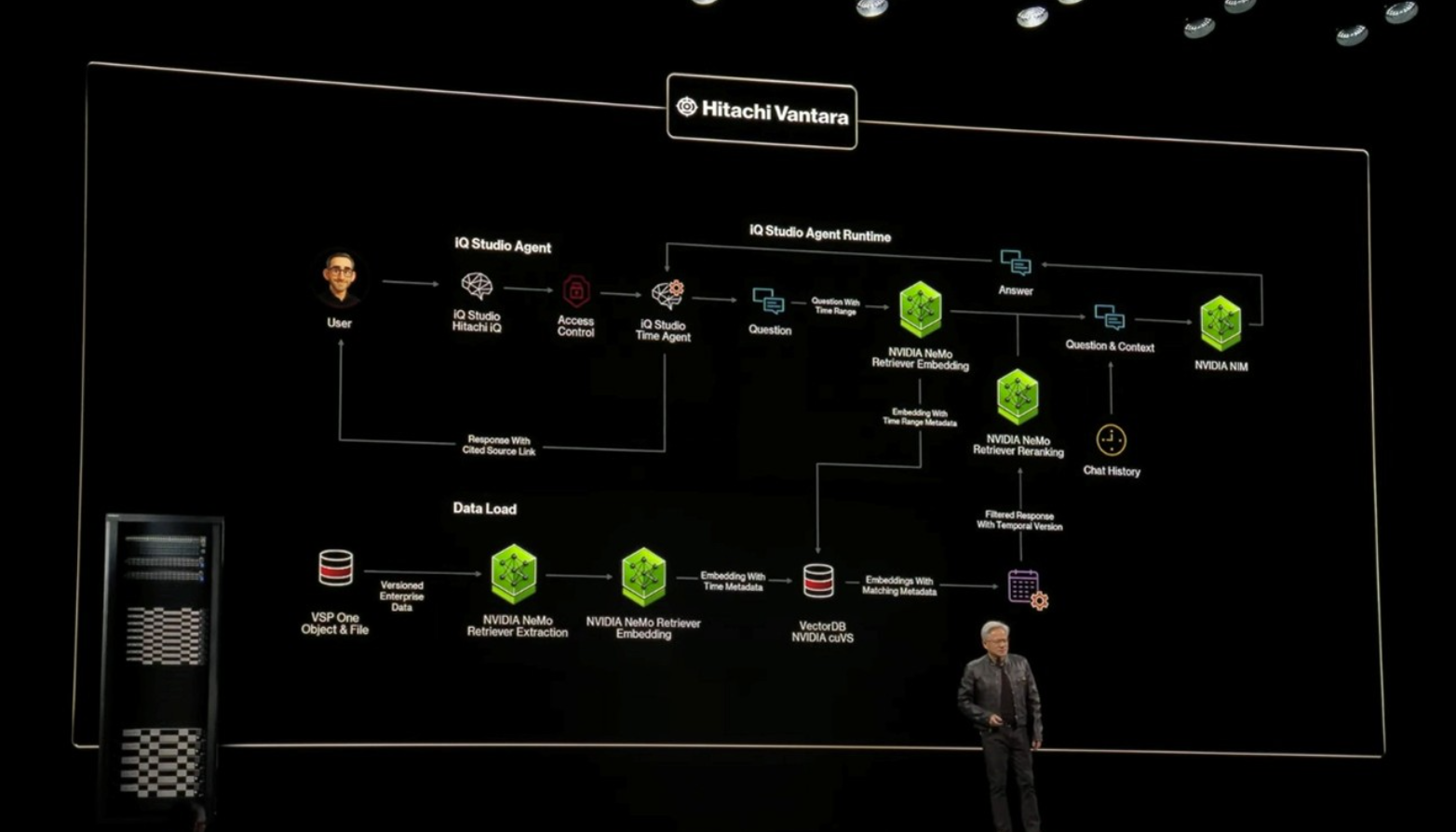
Southwest Power Pool (SPP) is building a mini AI factory with Nvidia, Hitachi Vantara and other Hitachi units to better simulate future demand on the electric grid in its region.

The first phase of the SPP effort is expected to become operational in the fourth quarter of 2025 or early 2026. Hitachi Vantara announced the partnership with SPP in June. The goal at the time was to develop industrial AI infrastructure to speed up simulations to resolve energy shortages, boost grid reliability and respond to outages.

Speaking at Hitachi Vantara's Analyst Live 2025 event, Felek Abbas, CTO and CISO for SPP, outlined the collaboration which aims to dramatically speed up the simulation process by at least 80% to predict future demand on the electric grid in its core states.

"The preliminary tests we've done show us getting an 80% reduction in time and we're hoping to beat that once we're on the final hardware," said Felek. "We'll essentially have a small AI factory within our facility."

SPP is a regional transmission organization that aims to improve the reliability of the electric grid while keeping costs low. The organization's footprint runs from Northwest Texas to the Canadian border. SPP also provides energy services such as reliability coordination and market facilitation in Arizona and Colorado.

SPP has about 125 stakeholders and member companies. Before AI data center demand, Felek said that electric peak loads for their region increased by about 1.5% a year. Today, growth is anywhere from 4% to 5% a year, said Felek..

"One of the things we absolutely need to do is bring more generation to the grid and in order to serve that load from AI, data centers and crypto mining is to run studies to determine what's feasible, whether the transmission system is robust enough and will it require additional construction," explained Felek.

The AI infrastructure deployed for SPP combines Hitachi Vantara's Hitachi-IQ and Nvidia's accelerating computer platform. Hitachi Vantara and Nvidia have been collaborating on enterprise AI and industrial AI systems and the storage provider has been called out during Nvidia CEO Jensen Huang's GTC keynotes.

Hitachi Vantara, along with its sibling companies such as Hitachi's GlobalLogic unit and Hitachi Energy, can bring expertise to multiple industrial AI use cases. SPP was a collaboration between Hitachi Vantara, Hitachi Digital Services along with Nvidia.

Felek said SPP's previous simulation process, which was largely manual, took 27 months. He added that SPP would run three simultaneously so it could deliver decisions for project requests once a year. "While this project is about speed, it's also about gaining more information, analyzing more areas of the grid and providing data to generation builders so they have expectations on the economic returns," said Felek. "To do that you need to know all the scenarios over the 20 year to 40 year lifespans."

This project with SPP, Hitachi Vantara and Nvidia is in the early stages but highlights on-premise AI and industrial AI use cases. Here are the key points:

  • Felek said the company is reinventing the entire simulation process.
  • SPP with Nvidia and Hitachi Vantara are looking to consolidate the data intake process and "have AI analyze the data as it is coming in and provide feedback to our stakeholders on quality." The previous process required human back-and-forth on data quality and corrections.
  • SPP is planning to automate reports and analysis to free up engineers.
  • Once the data is consolidated in a single repository, SPP can build models. Today, SPP takes six months to build models, but Felek said that process can dramatically sped up.
  • Felek added that SPP plans on leveraging an AI agent to build models from the data repository in real time. "The AI agent is going to determine issues with the models and automatically fix them," he said.
  • Leveraging Nvidia GPUs, SPP is building an inference engine that can deliver analysis on power flows dynamically and also provide economic analysis.

SPP will oversee the systems and technology implementation, but the Hitachi IQ and Nvidia enterprise stack will cover process automation, predictive analysis and communication systems integration. The Nvidia and Hitachi partnership runs alongside the SPP project and focuses on transmission planning processes and future needs for interconnections, planning, forecasting and analysis.

Data to Decisions Next-Generation Customer Experience Tech Optimization Chief Information Officer

Google to add AI agent features to Chrome as browser battles heat up

Google to add AI agent features to Chrome as browser battles heat up

Google's move to layer Gemini and AI features in Chrome, including AI agents, will revamp the browser just as a bevy of players are looking to reinvent the primary vehicle for enterprise applications.

In a blog post, Google outlined how it was building Gemini into Chrome and will soon be available in Google Workspace with "enterprise-grade data protections and controls."

For businesses, Google users will be able to use Gemini to take actions within Google Calendar, Docs and Drive without leaving the browser.

Google also said Chrome will get agentic AI tools in Gemini so an AI agent can act on your behalf. These browser tools land just as Google launched its latest agentic AI standard AP2 for transactions. See: Google's Agent Payments Protocol fleshes out AI agent commerce

The Gemini, AI and Chrome integrations come as multiple parties are trying to reinvent the browser. Among Google's large competitors, Microsoft's Edge is adding AI features and layering in Copilot. But the real action is elsewhere--and often in the enterprise.

Atlassian's move to acquire The Browser Company is a bet that the browser needs to be reinvented for SaaS apps. Perplexity launched Comet to bring AI to the front of the browser. Secure browsers are now critical for the enterprise with AI agents posing security risks.

Google's big Chrome update closes those emerging browser gaps. As Constellation Research analyst Holger Mueller explained, Google doesn't have to be first with AI features in Chrome. It just has to be on par with what's happening and get AI agents right.

Muller said:

"Google is generally ahead on AI in general, but when it comes to putting it into Chrome it shows all the signs of a market leader - no need to be the first, more important to get it right. So this new release is important as it brings features to Chrome that users could get otherwise already, and brings Google back to par with Chrome if not ahead. Google's fast follow approach allows it to avoid the mistakes and false starts earlier AI pioneers have seen."

Other AI features added to Chrome are the following:

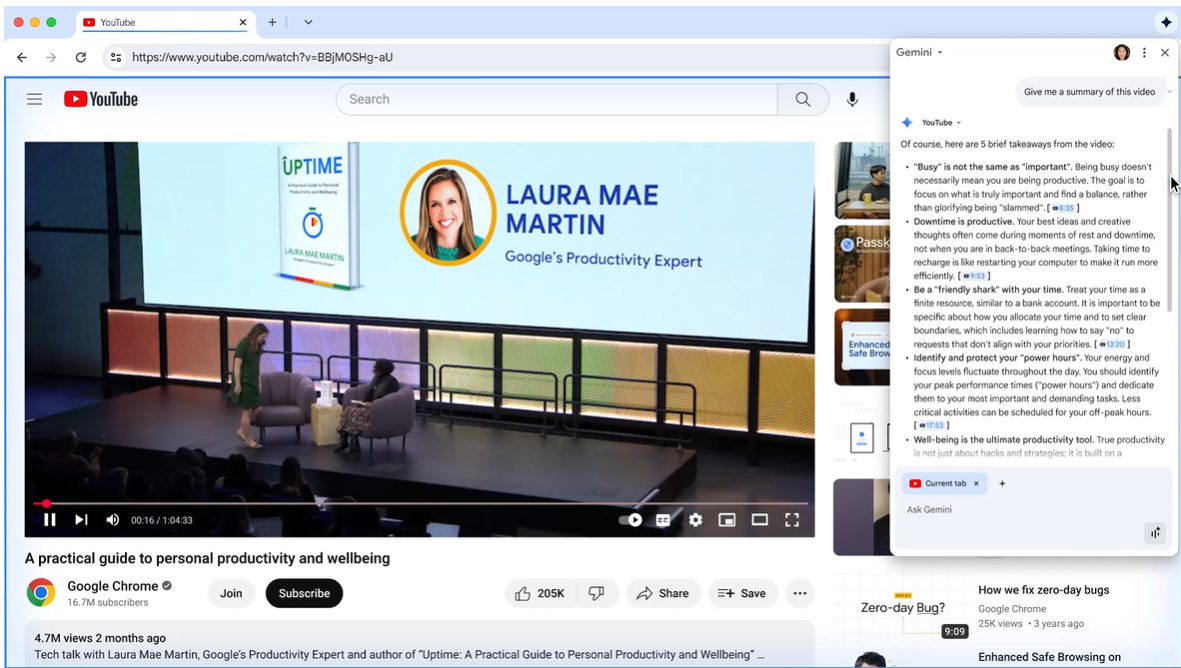
  • Gemini in Chrome will work across multiple tabs, consolidate information and act on them.
  • Gemini can recall previous sites and projects to keep you from scrolling through history.
  • Work through Google apps without changing tabs.
  • Add context with AI Overview from any current page.
  • Chrome will detect spam unwanted notifications within the browser and feature an AI agent that makes it easier to change compromised passwords.


Data to Decisions Future of Work Next-Generation Customer Experience Innovation & Product-led Growth Tech Optimization Digital Safety, Privacy & Cybersecurity Google ML Machine Learning LLMs Agentic AI Generative AI Robotics AI Analytics Automation Quantum Computing Cloud Digital Transformation Disruptive Technology Enterprise IT Enterprise Acceleration Enterprise Software Next Gen Apps IoT Blockchain Leadership VR Chief Information Officer Chief Executive Officer Chief Technology Officer Chief AI Officer Chief Data Officer Chief Analytics Officer Chief Information Security Officer Chief Product Officer
Atlassian buys DX for $1 billion

Atlassian buys DX for $1 billion

Atlassian said it will acquire DX, a startup specializing in engineering intelligence, for $1 billion as it aims to help enterprises track AI investments.

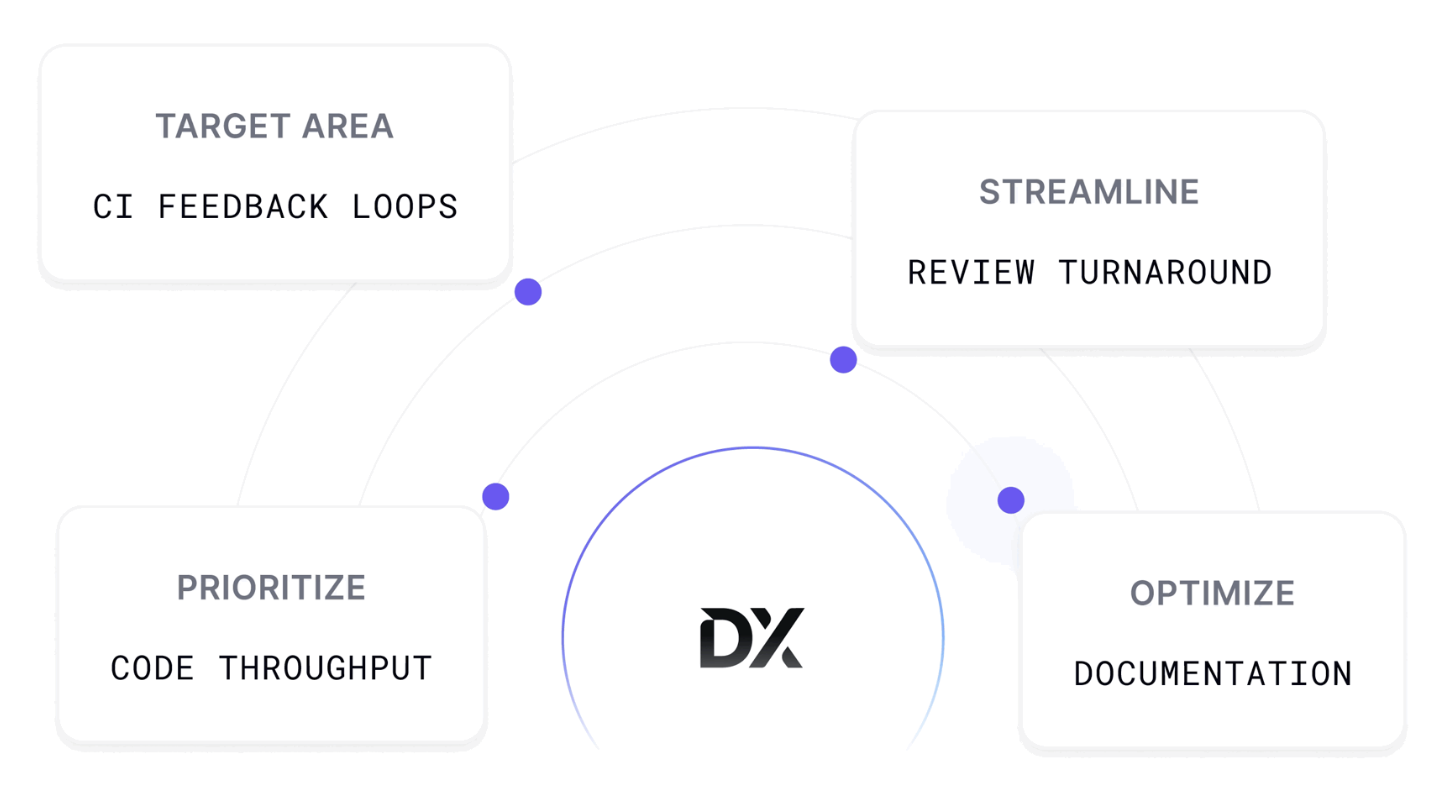
DX's platform measures and benchmarks developer productivity. Atlassian said the plan is to integrate DX into its system of work portfolio that includes Rovo Dev, Jira and Bitbucket.

Mike Cannon-Brookes, CEO of Atlassian, said DX will help enterprises create value from AI projects. "For developers this means less friction, more flow. For engineering leaders it means more clarity and confidence across the software development lifecycle. For companies, it ensures investments are being made in the right place to win," said Cannon-Brookes in a blog post.

DX has 350 enterprise customers and Atlassian will bring scale and distribution to the mix with its 300,000 customers. Nearly all of DX's customer base is already an Atlassian customer.

Atlassian with DX said it will bring 360 degree visibility into developer experience as well as insights to productivity.

Data to Decisions Future of Work Innovation & Product-led Growth Next-Generation Customer Experience Chief Information Officer

Nvidia invests $5 billion in Intel, aims to codevelop for data centers, PCs

Nvidia invests $5 billion in Intel, aims to codevelop for data centers, PCs

Nvidia said it will invest $5 billion in Intel and co-develop custom data center and PC products. The move gives Intel more capital and also solidifies its relevance going forward.

The Nvidia-Intel deal lands following the US government's $8.9 billion investment in Intel common stock. The US government agreed to purchase 433.3 million shares of Intel at $20.47 a share for a 9.9% stake.

Nvidia is buying Intel shares at $23.28 a share.

Intel's partnership with Nvidia covers multiple areas. Here's a look:

  • The pact covers multiple generations of products for cloud, enterprise and consumer markets.
  • Intel and Nvidia will look to connect architectures using Nvidia NVLink as well as Intel's CPUs with Nvidia GPUs.
  • In the data center, Intel will build Nvidia's custom x86 CPUs.
  • For PCs, Intel will build and offer x86 system-on-chips that integrate Nvidia RTX GPU chiplets. The x86 RTX SOCs will power a range of PCs.

Nvidia CEO Jensen Huang said the deal "tightly couples NVIDIA’s AI and accelerated computing stack with Intel’s CPUs and the x86 ecosystem" and is aimed at "reinventing every layer of the computing stack."

Intel CEO Lip-Bu Tan lands a big win for its foundry and said "appreciate the confidence Jensen and the NVIDIA team have placed in us."

Holger Mueller, an analyst with Constellation Research, said:

"This is a strategic move by Nvidia who now gets control on the missing piece in it's chip portfolio - CPUs. If Nvidia manages to tie its chips into the Intel server offerings it will give it an additional foothold in the (on premises) data center. However, partnerships in the chip industry don't last forever. CxOs need to be aware of lock-in, but for now I think CxOs with Intel server farms are happy. Regulatory approval may become an issue as Nvidia was not allowed to acquire Arm some time back. Lastly this Nvidia deal highlights the utter failure of Intel building AI chips."

Speaking at an investment conference earlier this month, Intel CFO David Zinsner said one of Tan’s big initiatives was improving its balance sheet. The investments from the US government and Softbank largely did that and the Nvidia deal adds to that cash cushion.

Zinsner said September 4:

“As we look at the capital we've raised, we feel pretty good about where our balance sheet is. We think we have now at this point strong liquidity. By the way, this quarter itself was a significant quarter in terms of incremental capital raise. We sold almost $1 billion worth of Mobileye stock. We're expecting to close Altera in the next few weeks, that adds another $3.5 billion. I think that the SoftBank money will come in by the end of the quarter, they have to do some regulatory filings and assuming that all of that is pretty clean, we should get that $2 billion. And then we got -- as I said, last week, we got the $5.7 billion from the U.S. government.”

With Intel and Nvidia pairing up it remains to be seen how this will impact AMD, which has been taking share from Intel in the data center and PC markets and remains far ahead on AI accelerators.

Data to Decisions Tech Optimization nvidia Big Data Chief Information Officer Chief Technology Officer Chief Information Security Officer Chief Data Officer
Zoom launches AI Companion 3.0, bevy of CX tools

Zoom launches AI Companion 3.0, bevy of CX tools

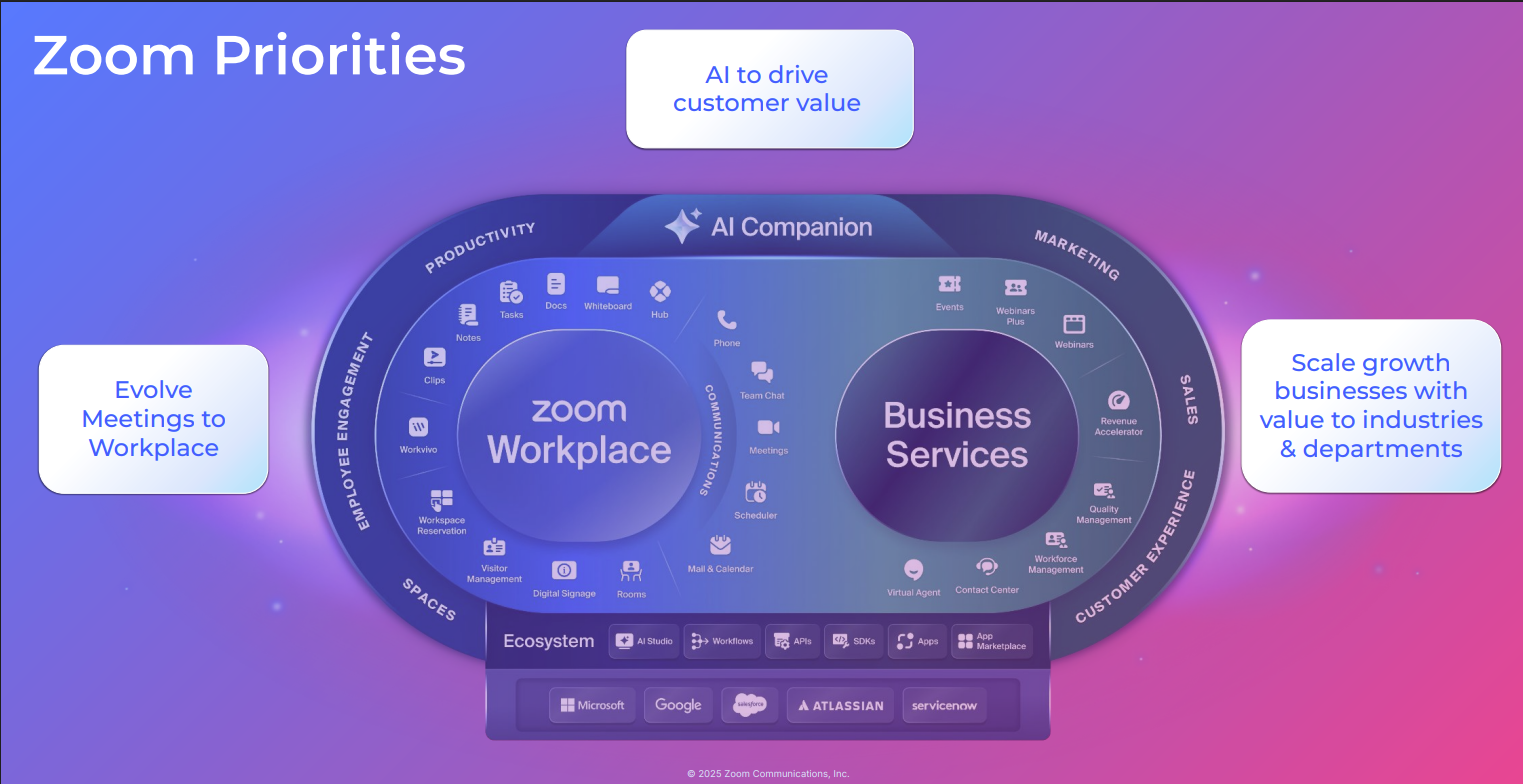
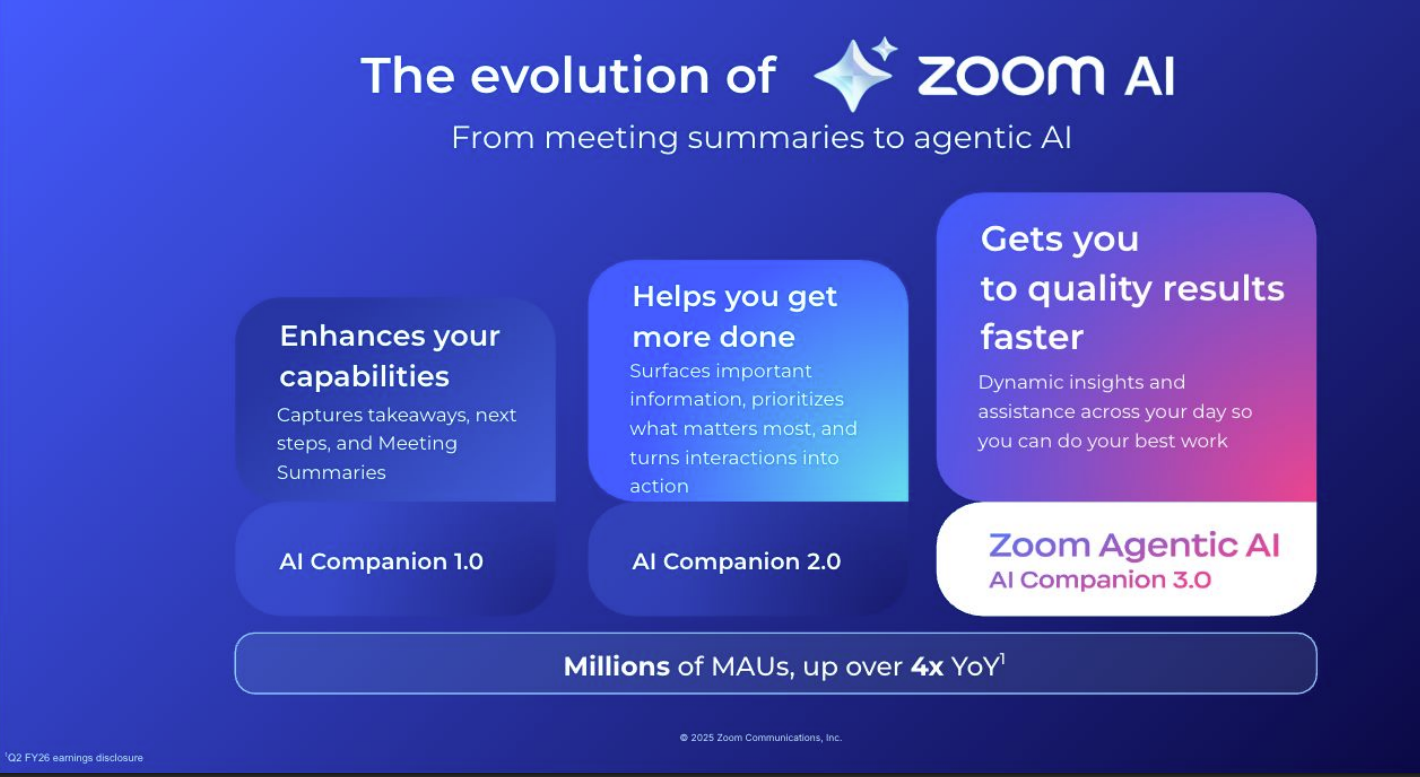
Zoom launched its third version of the Zoom AI Companion and layered in AI enhancements, including lifelike AI avatars, across its platform. It also outlined new capabilities for Zoom Business Services.

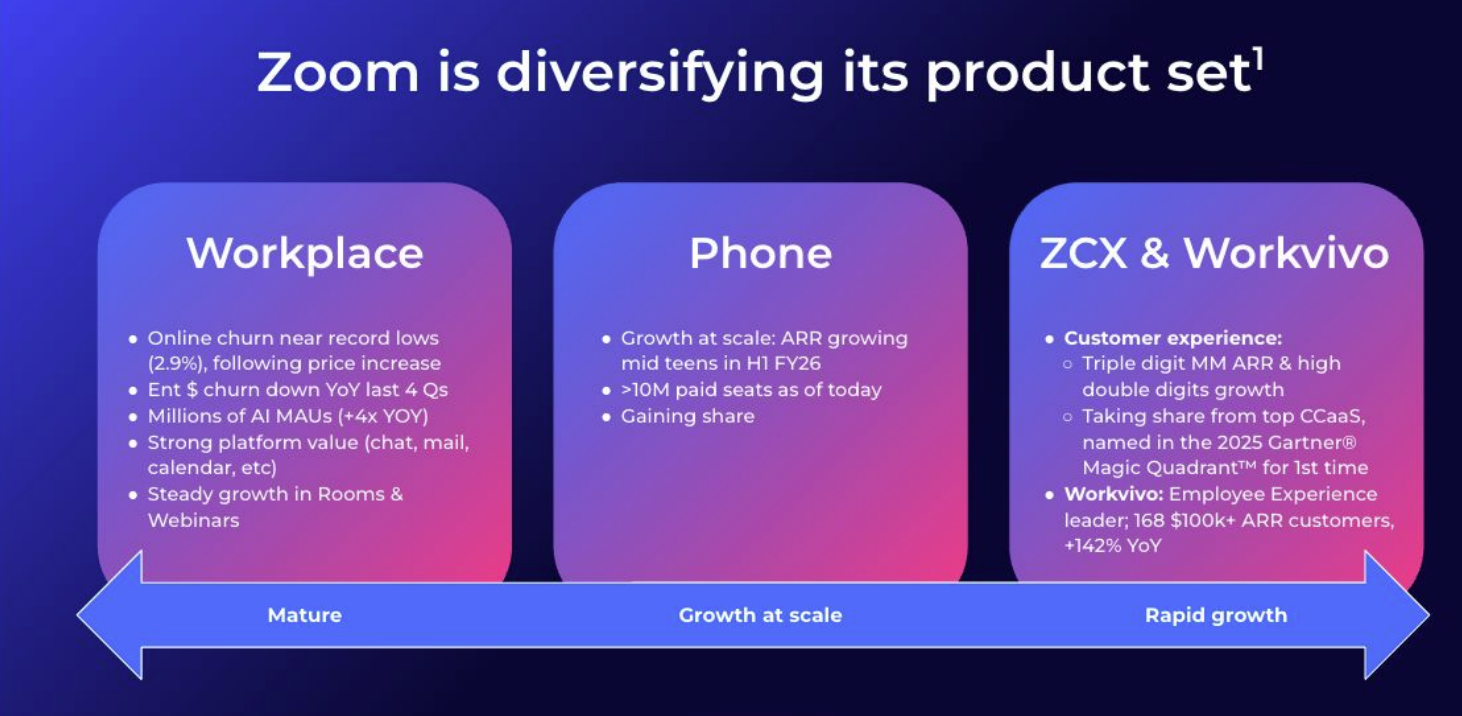
Announced at Zoomtopia, the company pushed further into the deployment of custom AI agents as well as managing workflows across collaboration tools. AI Companion 3.0 is part of "the journey from a communication collaboration company to become a system of action company," said Zoom CEO Eric Yuan.

At a high-level, Zoom rolled out the following:

  • Zoom AI Companion 3.0, which will be able to automate work and create insights from conversations.
  • AI Companion can now take notes across in-person meetings and third-party platforms starting with Microsoft Teams and Google Meet with support for Cisco Webex in the future.
  • A Custom AI Companion add-on gives users the ability to tailor AI Companion experiences and use cases.
  • Zoom Workplace gets lifelike AI avatars, live translations and proactive tools.
  • AI Companion can schedule meetings, free up time and help you prepare for meetups with recommendations.
  • Zoom said AI Companion will be able to work with Agent2Agent (A2A) starting with ServiceNow agents.

With the launches, Zoom delves further into agentic AI and collaborative workflow management. Zoom said its AI retrieval tools can search across Zoom Workspace as well as Google and Microsoft platforms.

Zoom is also giving customers the flexibility to work in a web browser with personalized experiences.

As for the Zoom Business Services updates, the company rolled out a set of tools to address customer journeys.

Zoom Business Services includes Zoom Customer Experience (Zoom CX), Zoom Revenue Accelerator (ZRA), and Zoom Events and Webinars.

Here's the breakdown:

  • Zoom Virtual Agent's extension into Zoom Phone now supports industry-specific use cases in healthcare.
  • Zoom Virtual Agent can use your voice for a customized experience.
  • The company added Automated Quality Management for Zoom Virtual Agent for supervisors, which also get a dashboard to monitor virtual agents.
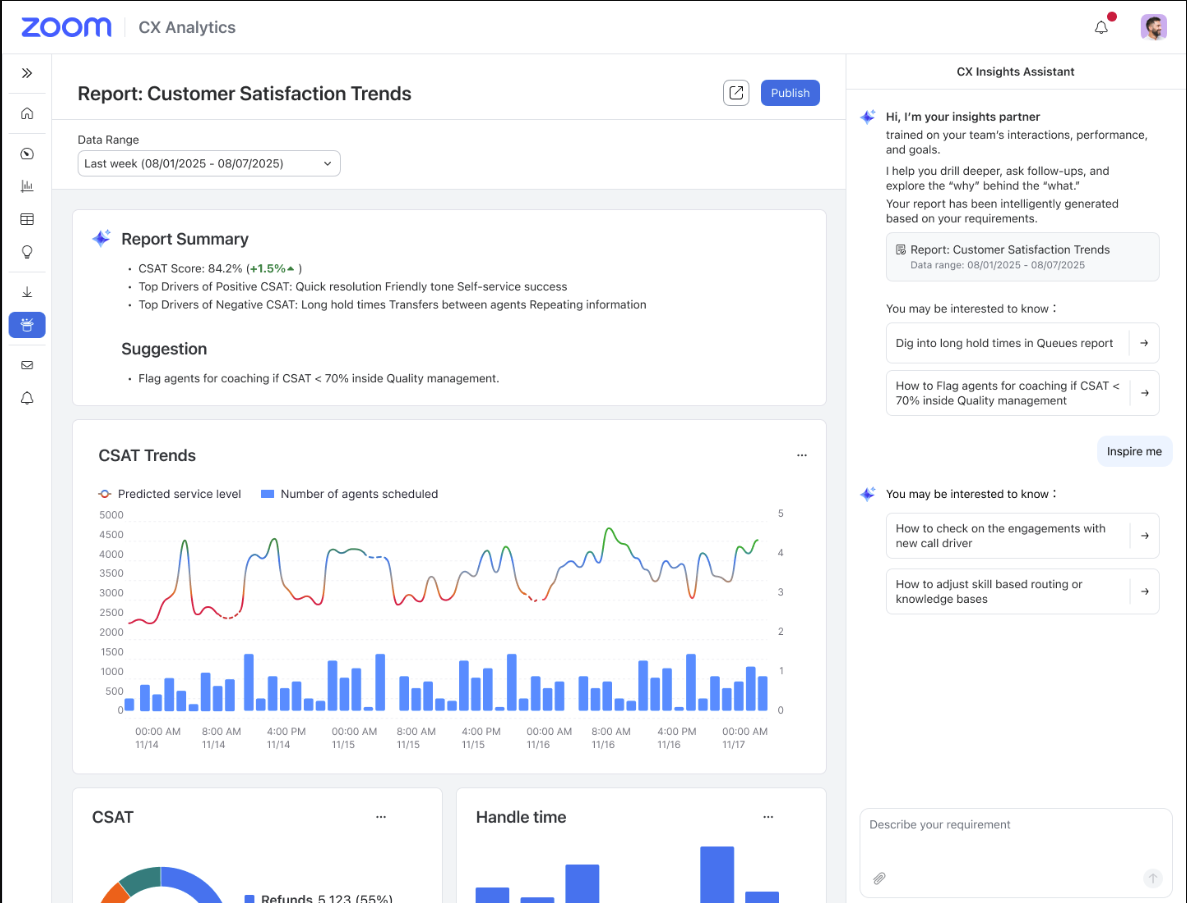
  • Zoom CX Insights will launch in December to provide a natural language entry point to highlight trending topics and get AI suggestions to improve.
  • Agentic AI Expert Assist will give support agents workflows and data to resolve issues faster. Live translation for voice and video and living customer documents will be added.
  • Zoom Revenue Accelerator will get tools to automatically prospect for leads, personalize engagement and follow up as needed.
  • Zoom Events and Webinars will get an Ask AI Companion Attendee Panel and Production Studio in the Cloud, which promises broadcast quality without local hardware or internet speed constraints.

Speaking on an investor Q&A following the Zoomtopia keynote, CFO Michelle Chang outlined the vision that extends the company beyond its core collaboration tools. 

Chang noted that enterprise demand is driving growth and will hit 60% of revenue in fiscal 2026. "The win in AI is a natural place for Zoom, not only because of what we have on the communication and collaborations front, but what we bring also in the employee experience and then the Contact Center or customer experience," said Chang. 


Data to Decisions Future of Work Next-Generation Customer Experience Innovation & Product-led Growth New C-Suite Marketing Transformation Digital Safety, Privacy & Cybersecurity zoom Chief Information Officer

CrowdStrike acquires Pangea, builds out its security AI agent portfolio

CrowdStrike acquires Pangea, builds out its security AI agent portfolio

CrowdStrike acquired Pangea and launched Threat AI, a system of AI agents designed to take on cybersecurity and intelligence workflows.

Threat AI falls under the umbrella of CrowdStrike's Agentic Security Workforce, an effort that will inject digital labor throughout its platform. CrowdStrike announced Threat AI and its latest acquisition at its Fal.Con conference.

As for the Pangea acquisition, CrowdStrike said it will use the deal to extend its Falcon platform into AI Detection and Response (AIDR), a category that aims to secure data, models, agents and enterprise AI.

CrowdStrike said Pangea will deliver visibility and control of AI agents and workflows, block prompt injection attacks and secure AI development.

Threat AI will include the following:

  • Malware Analysis Agent, which automates analyst workflows and can classify, analyze and compare malware.
  • Hunt Agent is a proactive threat hunting agent that works across the enterprise.
  • CrowdStrike said it will be adding agents for triage, correlation and exposure in the future.

Among other CrowdStrike announcements:

  • CrowdStrike launched its Fall release of its Falcon platform that serves as a base for its AI agents.
  • The company expanded its agentic tools with in Falcon modules and Charlotte AI AgentWorks, a new no-code AI agent builder.
  • CrowdStrike said Agentic Security Workforce is powered by the Falcon Agentic Security Platform.
  • The company rolled out a bevy of agents across its modules including Exposure Prioritization Agent, Search Analysis Agent, Correlation Rule Generation Agent, Data Transformation Agent and Workflow Generation Agent.
Data to Decisions Digital Safety, Privacy & Cybersecurity Innovation & Product-led Growth Future of Work Tech Optimization Next-Generation Customer Experience crowdstrike AI GenerativeAI ML Machine Learning LLMs Agentic AI Analytics Automation Disruptive Technology cybersecurity Chief Information Officer Chief Information Security Officer Chief Revenue Officer Chief Privacy Officer Chief AI Officer Chief Experience Officer

Microsoft to build quantum center in Maryland

Microsoft to build quantum center in Maryland

Microsoft is building a new quantum computing center in Maryland and line up with its work with DARPA on evaluating and funding quantum systems.

In an interview, Charles Tahan, Partner, Microsoft Quantum, said the facility is a partnership with the state of Maryland, which has built a quantum computing corridor built with IonQ as an anchor tenant along with the University of Maryland.

Tahan said the buildout will include substantial lab space for technical work, office space for operations and dedicated zones to collaborate with partners, university students and the broader quantum computing community. "It's a great location for what we want to do," said Tahan. "This will be a place where people can use our technology in a trusted way. It will also help the other side to see if their technology can be compatible with our stack and hopefully push the entire quantum field forward."

Microsoft is part of a DARPA program that is evaluating and funding quantum computing development.

The plan for Microsoft is to have its first equipment operational at the new facility by June 2026 with topological qubit test systems. Tahan said the Maryland Microsoft facility could become a potential hub with cloud access to prototype systems from the software giant and partners.

Tahan added that the Maryland center will focus on its topological approach to quantum computing.

Earlier this year, Microsoft announced Majorana One, a quantum processor with a topological architecture designed to scale to 1 million qubits in theory.

Microsoft is taking a platform approach to quantum computing with plans to intersect with artificial intelligence and high-performance computing. Microsoft also announced its quantum ready initiative for enterprises to go along with partnerships with Atom Computing and Quantinuum.

Tahan said:

"Microsoft is a platform company, and it's very much true in quantum. We're not only trying to build quantum computers internally, but work with our partners. We're about empowering many companies that our end users really get access to the best technology at any given time."

Data to Decisions Tech Optimization Innovation & Product-led Growth Microsoft Quantum Computing Chief Information Officer

MongoDB brings full-text search, vector search to on-prem, self-managed versions

MongoDB brings full-text search, vector search to on-prem, self-managed versions

MongoDB said it will bring its search and vector search tools to MongoDB Community Edition and MongoDB Enterprise Server. The move provides enterprises full-text search and vector search features on MongoDB on-premises and self-managed deployment.

The new capabilities are in public preview for developers. MongoDB announced the news at its MongoDB.local NYC developer conference.

Ben Cefalo, Senior Vice President, Head of Core Products at MongoDB. said adding full-text search and vector search to on-prem, self-managed and local deployments gives developers more flexibility. Ultimately, MongoDB gets a new path to entice enterprises to move to the company's fully managed Atlas platform.

Cefalo said in a briefing:

“What we've heard consistently from our community is that integrating advanced search into self-managed application often requires both external search engines or vector databases. This creates friction at every stage, architectural complexities, operational overhead and a constant synchronization task. It distracts developers from their core innovation. We believe they shouldn't have to make the tradeoff.”

Key points:

  • MongoDB's decision to move full-text search and vector search tools to on-prem and self-managed options simplify extract, transform and load operations.
  • Enterprises won't have to manage multiple versions for additional search tools.
  • MongoDB Community Edition and MongoDB Enterprise Server customers will be able to test and build applications locally.
  • Developers can combine keywords and vector search in unified results that can be used for AI apps.
  • Data in MongoDB can serve as a long-term memory store for AI agents and enhance grounding and RAG systems.

At MongoDB.local NYC, MongoDB also announced the following.

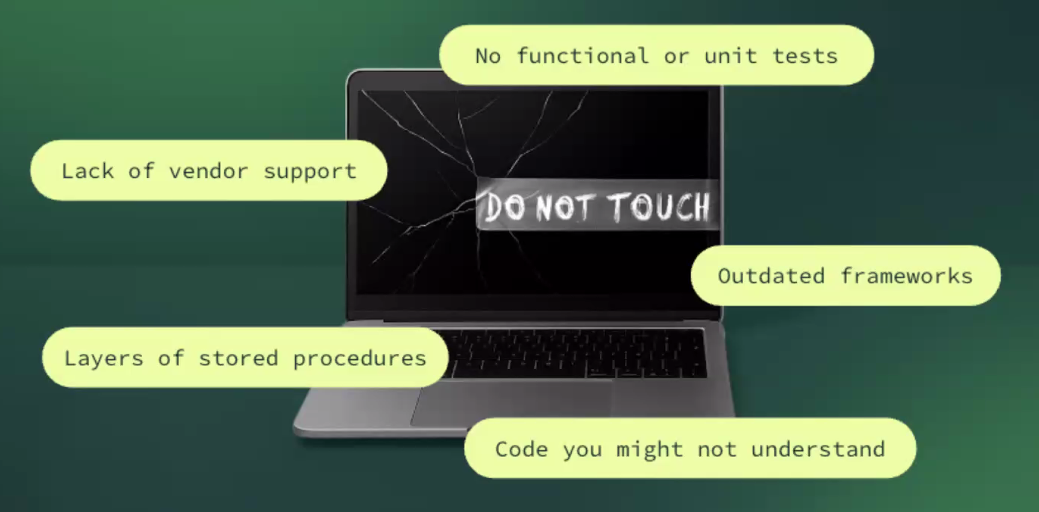
  • The launch of MongoDB AI Modernization Platform (AMP).
  • MongoDB 8.2 delivers a 49% performance boost for index queries and 10 faster memory reads.
  • MongoDB 8.2 will get enhanced Queryable Encryption capabilities.

Data to Decisions Next-Generation Customer Experience mongodb Big Data Chief Information Officer Chief Technology Officer Chief Information Security Officer Chief Data Officer