Results

BT150 zeitgeist: Inside a ransomware attack, AI project success

BT150 zeitgeist: Inside a ransomware attack, AI project success

CxOs in the BT150 recount recovering from a ransomware attack and the ingredients for successful AI projects.
In our August BT150 meetup, CxOs in our network discussed cybersecurity and insurance as well as AI projects that actually work. The best advice was to not be blinded by LLMs. Here's a recap of our CxO call, which operates under Chatham House rules.

Live inside a ransomware attack. One CxO recounted a recent ransomware attack at his company. The attack exposed a big gap between cybersecurity awareness and execution. "The house of cards finally got revealed, which is good and bad, but also made me feel even more helpless," the CxO said.

Post-attack challenges abound. The company that was hit by the ransomware attack faced multiple challenges as it recovered. Here's a look:

  • Insurance complications. It took nine months to get pricing for a cybersecurity insurance pricing. Many insurers didn't want to cover ransomware attacks, but would cover recovery.
  • FBI guidance conflicts. The company was advised not to pay the ransom, but that advice conflicted with insurance policies that might cover ransom payments.
  • Extended recovery. Daily meetings were held as the company tried to assess what files were taken, encrypted, or compromised.
  • Boards are actively discussing ransomware recovery processes and debating whether it's better to get cybersecurity insurance or invest money in better security.

AI success

AI bubble or not, targeted success stories abound. CxOs discussed the ongoing conversation about the AI bubble and potential ramifications. It's a debate we've been having at Constellation Research. AI has been used for management training, warehouse operation optimizations and manufacturing. The key words across these AI projects were targeted, governed and measurable.

"Don't be blinded by large language models." The successful projects are likely to feature smaller models and industry models focused on use cases including physical AI.

Without governance, AI pilots fail. "I've seen a lot of projects where companies don't know what they're looking for and throwing AI blindly against the wall and hoping something sticks instead of identifying a specific process to fix," said one CxO.

Manufacturing's AI transformation. CxOs talked about the evolution toward industry 5.0 in manufacturing with the use of AI and digital twins driving transformation. AI agents are being developed for functional testing, defect detection and assembly line optimization. The takeaway: AI-enhanced processes are reinventing manufacturing.

Leadership and governance matters. CxOs on the call emphasized that successful AI implementation required strong leadership and governance frameworks. Participants noted that without proper executive oversight and targeted approaches, AI initiatives often fail to deliver expected value, reinforcing the importance of senior leadership in driving AI strategy and execution.


Data to Decisions Digital Safety, Privacy & Cybersecurity Innovation & Product-led Growth New C-Suite I am Team Leader at the Nominee Organization (no vendor self nominations) Distillation Aftershots BT150 Leadership Security Zero Trust Chief Executive Officer Chief Information Officer Chief Information Security Officer Chief Technology Officer Chief Experience Officer Chief Privacy Officer
Alibaba Cloud revenue growth accelerates in Q1, $19 bilion revenue run rate

Alibaba Cloud revenue growth accelerates in Q1, $19 bilion revenue run rate

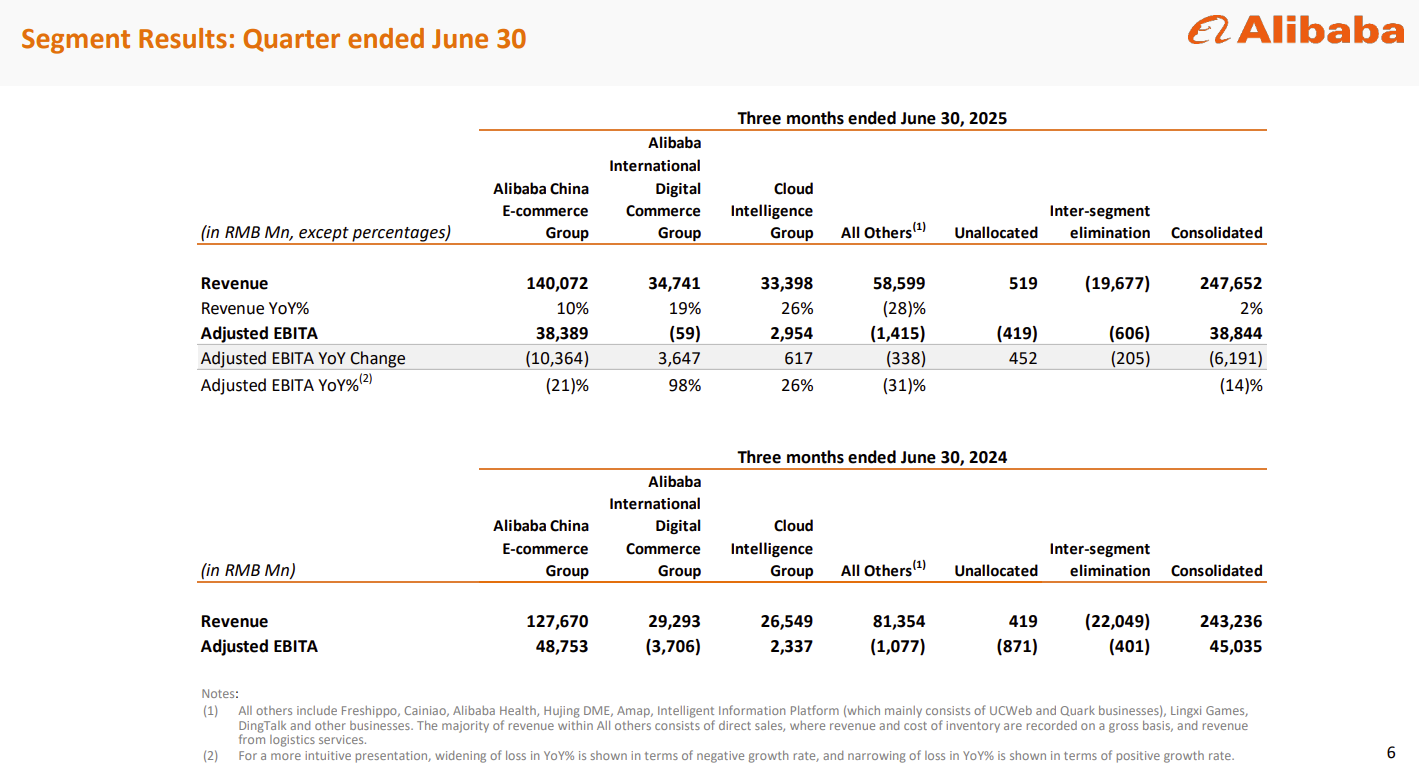
Alibaba's cloud business accelerated in the company's fiscal first quarter with revenue growth of 26% and an annual revenue run rate approaching $19 billion.

The company's Cloud Intelligence Group reported first quarter revenue of $4.66 billion, up 26% from a year ago, with earnings before interest, taxes and amortization of $2.34 billion. According to the Wall Street Journal, Alibaba has created its own chip for AI workloads similar to other cloud providers. AWS, Microsoft and Google Cloud all have custom silicon to lessen their dependence on Nvidia. In Alibaba’s case, the custom chip is designed to be a substitute for Nvidia’s H20.

Alibaba said its cloud revenue growth was driven by public cloud services as well as AI-related workloads.

For comparison, AWS has an annual revenue run rate of $124 billion compared to $50 billion for Google Cloud and $75 billion in annual sales for Microsoft Azure. Alibaba’s annual revenue run rate is in the ballpark of Oracle Cloud, which is at about $27 billion pending Oracle’s earnings report in September.

Alibaba, however, represents AI workloads in China, which has been leveraging open source models without the latest Nvidia chips to advance its ambitions. Alibaba will capture a lot of those workloads and its Qwen open source LLM is popular. During Nvidia’s second quarter earnings call, CEO Jensen Huang said China is critical to the AI market.

“About 50% of the world's AI researchers are in China. The vast majority of the leading open source models are created in China. And so it's fairly important, I think, for the American technology companies to be able to address that market,” said Huang. “And open source, as you know, is created in one country, but it's used all over the world. The open source models have come out of China."

Eddie Wu said Alibaba's cloud demand is driven by external customers with AI workloads. "We remain committed to investing in our two strategic pillars of consumption and AI + Cloud to capture historic opportunities and drive long-term growth," said Wu.

According to Alibaba, AI-related product revenue delivered triple-digit revenue growth for the eighth consecutive quarter. AI demand is also driving increased demand for Alibaba's compute and storage services to support AI adoption.

The company noted that it will continue to invest in its cloud unit to meet demand.

Alibaba, including its e-commerce operations, reported first quarter net income of $6.02 billion on revenue of $34.57 billion.

Data to Decisions Big Data Chief Information Officer Chief Technology Officer Chief Information Security Officer Chief Data Officer

Dell Technologies delivers strong Q2 as AI system demand surges

Dell Technologies delivers strong Q2 as AI system demand surges

Dell Technologies said demand for AI servers and systems remains strong, but the PC business is showing some weakness.

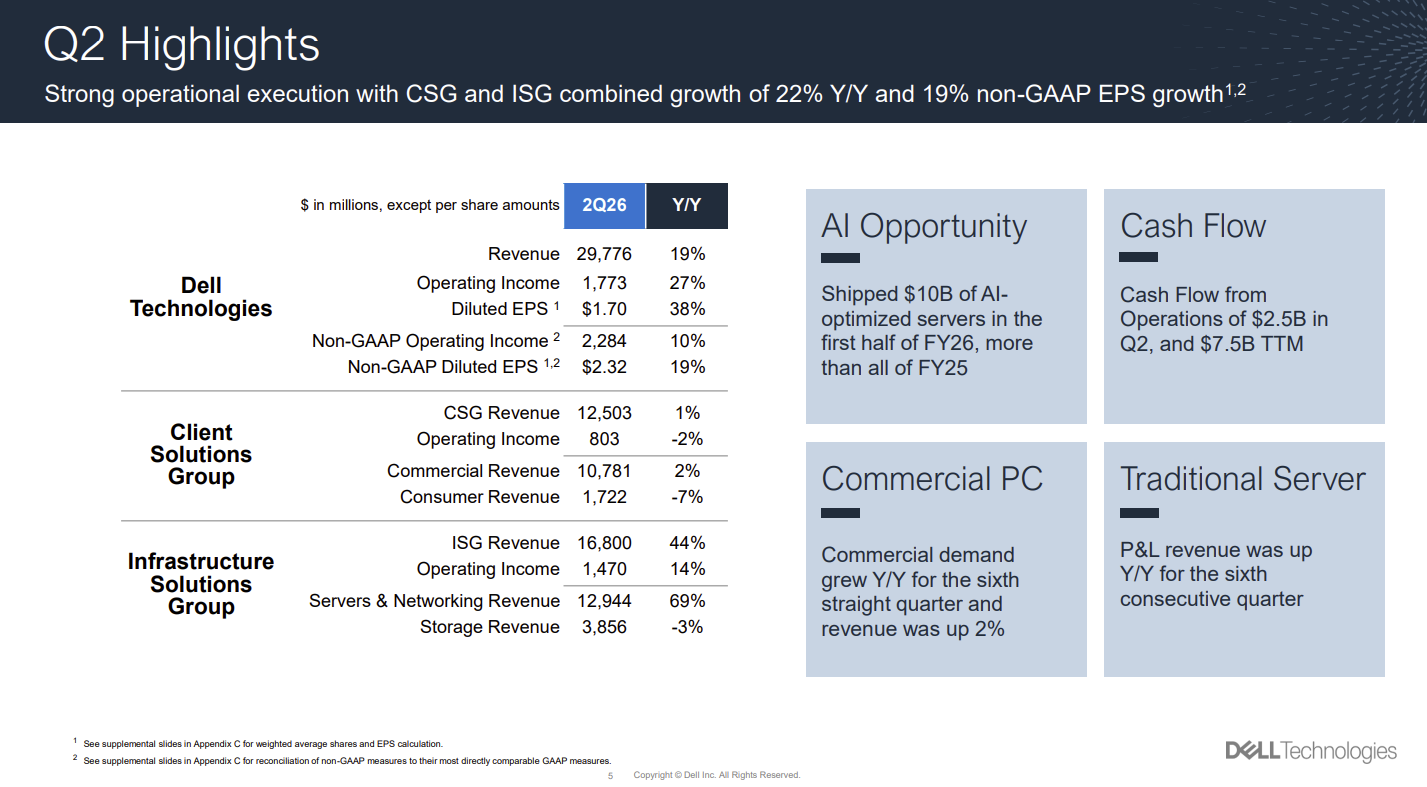
The company reported second quarter earnings of $1.70 a share on revenue of $29.8 billion, up 19% from a year ago. Non-GAAP earnings for the second quarter came in at $2.32 a share.

Wall Street was expecting Dell to report second quarter earnings of $2.29 a share on revenue of $29.19 billion.

The story for Dell remains the same: Strong demand for AI systems and adjacent hardware.

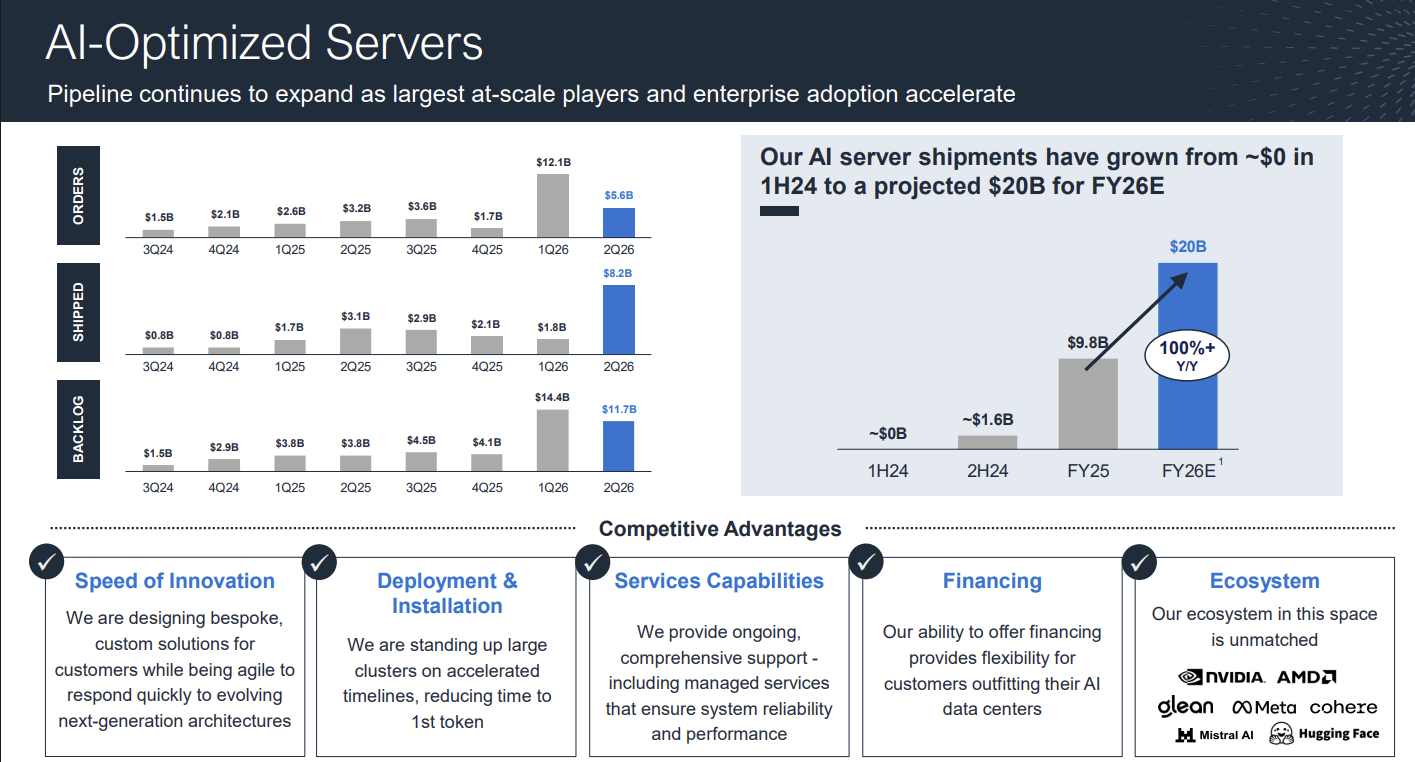
Jeff Clarke, chief operating officer of Dell, said the company shipped $10 billion in AI systems in the first half of fiscal 2026 and topped all shipments in fiscal 2025. Clarke said "demand for our AI solutions continues to be exceptional, and we’re raising our AI server shipment guidance for FY26 to $20 billion dollars."

Dell delivered record revenue in servers and networking. The company's infrastructure solutions group (ISG) delivered revenue of $16.8 billion, up 44% from a year ago. Server and networking revenue was $12.9 billion, up 69%. Operating income for ISG was $1.5 billion.

The PC business for Dell remains an issue. Dell's client solutions group revenue in the second quarter was $12.5 billion, up 1% from a year ago. Commercial revenue was up 2% and consumer revenue was down 7%. Operating income was $803 million.

As for Dell's outlook, the company projected third quarter revenue of $26.5 billion and $27.5 billion, up 11% from a year ago, with non-GAAP earnings of $2.45 a share. Fiscal 2026 revenue is expected to be between $105 billion and $109 billion, up 12% from a year ago at the midpoint. Non-GAAP earnings for the fiscal year is expected to be $9.55 a share.

In prepared remarks, Clarke noted the following:

  • "We booked $5.6 billion in orders in the second quarter and shipped a record $8.2 billion, resulting in an ending backlog of $11.7 billion."
  • "Our five quarter pipeline continued to grow sequentially, with double digit growth across enterprise and sovereign opportunities."
  • "We are seeing strong Enterprise interest in our new Nvidia RTX Pro 6000 AI Factory solutions."
  • "We expect moderate growth as the PC refresh continues, driven by an aging installed base and the Windows 10 end-of-life, which is now 48 days away. To fully seize the refresh opportunity, we’ve taken steps to improve execution and expand our PC TAM."

Constellation Research analyst Holger Mueller said:

"If an enterprise needs to run on premises, it's really down to two options with Dell and HPE. Those two are slowly but steadily outgrowing other competitors. AI is also the big sales point for Dell for on-premises servers, not surprisingly its strongest segment. Growing AI systems revenue from zero in the first half of 2024 to a projected $20 billion in fiscal 2026 is an accomplishment. It is clear that Dell customers are replacing traditional servers with AI servers."

Data to Decisions Tech Optimization dell Big Data Chief Information Officer Chief Technology Officer Chief Information Security Officer Chief Data Officer

Broadcom pitches VMware Cloud Foundation 9 as the future, but rivals eye disgruntled customers

Broadcom pitches VMware Cloud Foundation 9 as the future, but rivals eye disgruntled customers

Broadcom CEO Hock Tan said enterprises can bet on VMware's platform for on-premises AI workloads as well as private cloud. But the competition is only going to increase as rivals aim to poach VMware customers.

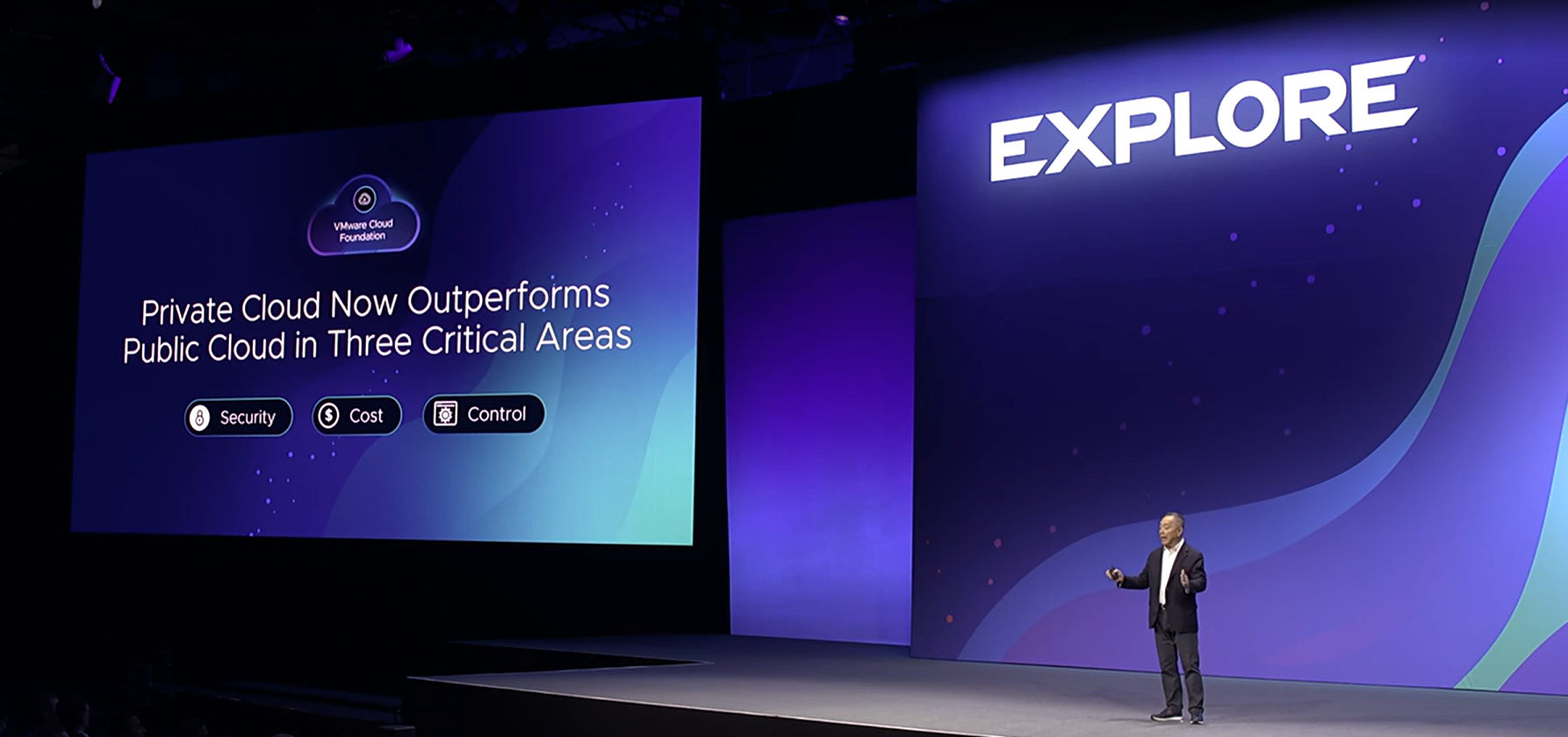
Tan's talk landed as VMware held its Explore conference. Given Broadcom's business is being driven by custom AI processors it's easy to overlook the VMware acquisition. Despite intense competition from Microsoft, HPE, hyperscalers and Nutanix to name a few, Broadcom has delivered on what it said it would do with VMware.

Broadcom's plan was to simplify pricing, focus on VMware Cloud Foundation (VCF) and large enterprises.

Tan said:

"Most of you continue to be weighed down by your legacy infrastructure, and you're afraid to move forward. How do you let go of your IT path so you can build for the future?

Well, I can tell you for sure, the answer is not to run straight to public cloud as you did 5, 10 years ago. If you're going to do cloud, do it right, embrace VCF 9.0 and stay on-prem. That VCF 9.0 is the culmination of 25 years of VMware technology and innovation. And this is the platform for the future."

At VMware Explore, the company announced the following:

It remains to see if Tan's wooing of enterprises will pay off. It does appear that VMware has battled back vs. the competition either by favorable pricing or technology roadmap. Tan's biggest argument is that Broadcom has delivered on its promises.

"Since the acquisition two years ago, we rolled up our sleeves, did the tough engineering work and the result today is VMware Cloud Foundation 9.0, a real software-defined platform to run all your application workloads with compute, networking and storage tightly integrated," he said. "We deliver VCF as a single SKU. We made it plug and play. And with VCF 9.0, just want you to know, private cloud now outperforms public cloud."

The Explore keynote also featured a heavy dose of customers including Barclays and Grinnell Mutual that modernized on VCF. "With VCF, it's really allowing my small team to extract maximum value from a really cohesive set of tools. And that unifying software, it extends to that pain point that exists between infrastructure and developers," said Jeremy Wright, Director of IT Infrastructure, Grinnell Mutual.

Not so fast, say rivals

Tan's argument that VCF 9.0 is your future isn't going to give pause to rivals. Just ahead of the Explore keynote, Microsoft launched a VM Conversion tool that makes it easy to convert VMware to Windows Server and Hyper-V.

Before that Microsoft announcement, Platform9 launched a tool to migrate entire VMware vSphere clusters.

In May, AWS launched AWS Transform for VMware all designed to migrate VMware customers. Now generally available, AWS Transform for VMware is just getting traction.

And Nutanix's second quarter earnings call featured its usual batch of VMware questions. CEO Rajiv Ramaswami said Nutanix is taking workloads from VMware, but it's a long game. He said:

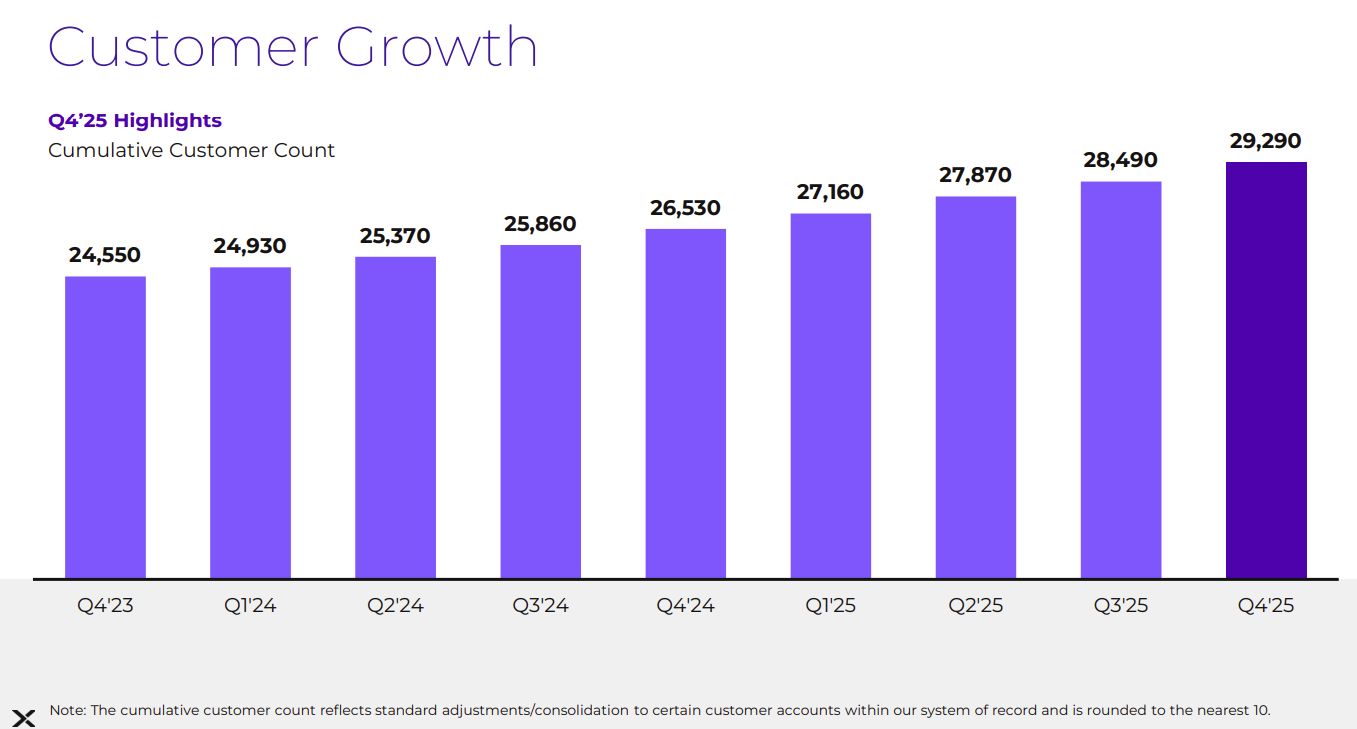
"I think the vast majority of the opportunity is still in front of us. And if you were to characterize this as a multi- inning baseball game, I'd probably say we're in the second inning at this point. The fact we've added 2,700 customers over the last year is a good sign that there are people moving. But there's 200,000 customers out there for VMware.

It's going to take time. And for the bigger customers, it's going to take even longer. The real big ones out there will take a long time to migrate. The smaller you are, the faster it is to migrate. The longer you are -- the bigger you are, the longer it's going to take."

Tech Optimization vmware Chief Information Officer

Snowflake Q2 earnings strong with revenue growth of 32%

Snowflake Q2 earnings strong with revenue growth of 32%

Snowflake delivered strong second quarter earnings as its AI Data Cloud gains traction.

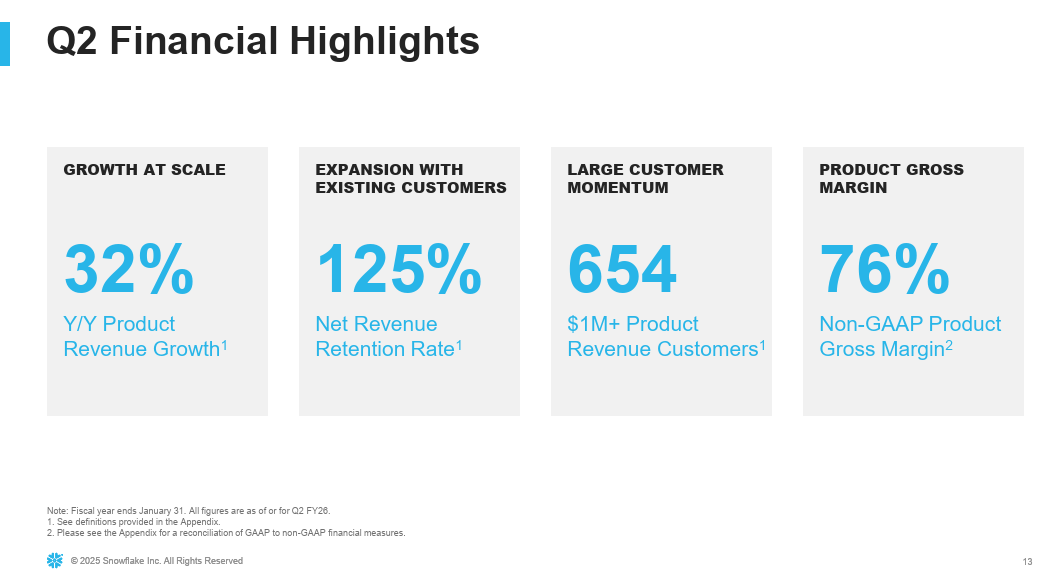
The company reported a GAAP second quarter net loss of $298 million, or 89 cents a share, on revenue of $1.144 billion, up 32% from a year ago. Snowflake reported second quarter non-GAAP earnings of 35 cents a share.

Wall Street was expecting Snowflake to report second quarter non-GAAP earnings of 27 cents a share on revenue of $1.09 billion.

Snowflake said it has 654 customers with trailing 12-month product revenue greater than $1 million. Product revenue in the second quarter was $1.09 billion.

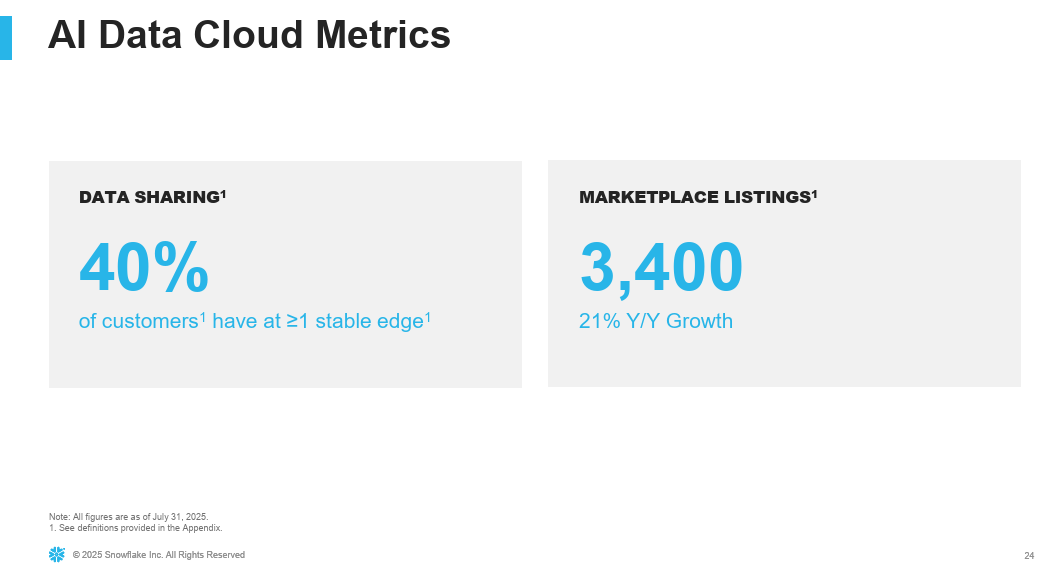
Sridhar Ramaswamy, CEO of Snowflake, said the company is executing well and “thousands of customers are betting their business on Snowflake and more than 6,100 accounts are using Snowflake’s AI every week.“

Nevertheless, Snowflake is valued at about $65 billion by the public markets compared to Databricks' $100 billion private market valuation

As for the outlook, Snowflake projected product revenue in the third quarter of $1.125 billion and $1.13 billion, up 25% to 26%. Operating income margin will be 9% on a non-GAAP basis.

For fiscal 2026, Snowflake projected product revenue of $4.395 billion, up 27% from a year ago.

On an earnings call, Snowflake cited BlackRock, Cambia Medicare, Thomson Reuters and Duck Creek Technologies as customers.

Ramaswamy said the following on the earnings call:

  • "In the first half of the year alone, we launched approximately 250 capabilities to general availability, demonstrating both the pace of our innovation and the breadth of our platform expansion. But we aren't stopping there. As we innovate, we are continuing to strengthen our platform and help our customers do more with their data to deliver great business outcomes."
  • "We are continuing to see strong adoption of open data formats, especially truly open modern table formats like Apache Iceberg. We now have over 1,200 accounts using Iceberg."
  • "There is more and more recognition that the AI components of our data platform can deliver enormous value. And we are seeing budgets get allocated from large customers for AI projects."
  • "I think there is honestly years of work ahead in terms of the value that we can get from AI. The models have advanced so much that I think just effectively using them in all of the workflows that matter to enterprises is going to create enormous value for all of us."

Data to Decisions snowflake AI ML Machine Learning LLMs Agentic AI Generative AI Robotics Analytics Automation Cloud SaaS PaaS IaaS Quantum Computing Digital Transformation Disruptive Technology Enterprise IT Enterprise Acceleration Enterprise Software Next Gen Apps IoT Blockchain CRM ERP CCaaS UCaaS Collaboration Enterprise Service developer Metaverse VR Healthcare Supply Chain Leadership Chief Information Officer Chief Technology Officer Chief Information Security Officer Chief Data Officer

Nvidia delivers strong Q2, rides data center demand, but China a wild card

Nvidia delivers strong Q2, rides data center demand, but China a wild card

Nvidia reported better-than-expected second quarter results and said revenue for the third quarter will be about $54 billion. Nvidia recorded no sales of its H20 processors in China in the second quarter and doesn’t assume any shipments in the third quarter.

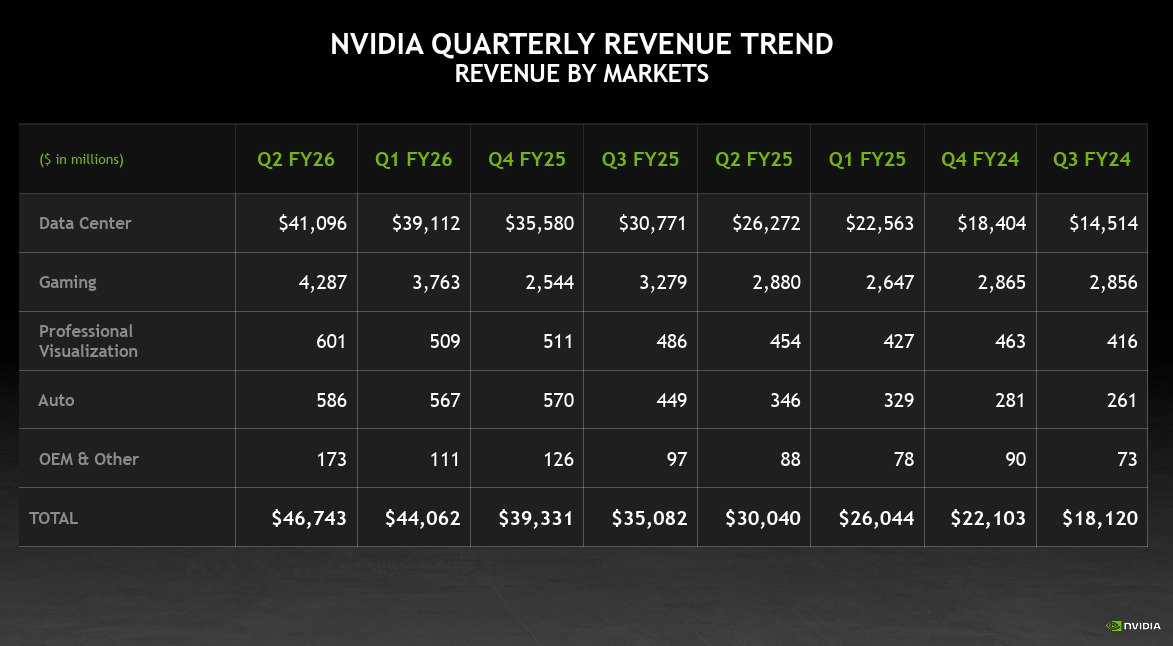
The AI chip giant reported second quarter earnings of $26.42 billion, or $1.08 a share, on revenue of $46.74 billion, up 56% from a year ago and up 6% sequentially. Non-GAAP earnings were $1.05 a share.

Wall Street was expecting Nvidia to report second quarter non-GAAP earnings of $1.01 a share on revenue of $46.13 billion.

Simply put, there is a lot of noise around Nvidia results given China sales, US government headlines and talk of an AI bubble.

Key takeaways:

  • Nvidia released $180 million or previously reserved H20 inventory from $650 million unrestricted H20 sales to a customer outside of China.
  • CEO Jensen Huang said, “production of Blackwell Ultra is ramping at full speed, and demand is extraordinary.”
  • The company approved an additional $60 billion in its stock repurchase program.
  • Data center revenue was $41.1 billion, up 56% from a year ago.
  • Second quarter gaming revenue was $4.3 billion, up 49% from a year ago.
  • Professional visualization revenue as $601 million, up 32% from a year ago.
  • Automotive and robotics revenue was $586 million, up 69% from a year ago.
  • Networking revenue was $7.3 billion, up 98% from a year ago.
  • Hyperscale cloud providers drove 50% of data center revenue. 
  • Data center revenue was a bit lighter than estimates.
  • Inventory was $15.0 billion, up from $11.3 billion sequentially, to support the ramp of Blackwell Ultra.

As for the outlook, Nvidia projected third quarter revenue of $54 billion with non-GAAP gross margins of 73.3% to 73.5%.

CFO Colette Kress said in prepared remarks.

Data center growth was “driven by demand for our accelerated computing platform used for large language models, recommendation engines, and generative and agentic AI applications. We continue to ramp our Blackwell architecture, which grew 17% sequentially, including our newest architecture, Blackwell Ultra.”

Constellation Research analyst Holger Mueller said:

"Nothing seems to be able to slow down Nvidia, which reported record revenue in each of their segments, with 'very little brother' gaming topping $4 billion in revenue. Closer to the data center, networking revenue practically doubled, and is now 1/7th of data center revenue. Headwinds are not foreseeable for the short term future - as Nvidia braved the China/H20 challenge. Things keep looking up for Nvidia." 

On a conference call, Kress said:

  • "The transition to the GB300 has been seamless for major cloud service providers due to its shared architecture, software and physical footprint with the GB200 enabling them to build and deploy GB300 racks with ease."
  • "Factory builds in late July and early August were successfully converted to support the GB300 ramp, and today, full production is underway. The current run rate is back at full speed, producing approximately 1,000 racks per week."
  • "Rubin remains on schedule for volume production next year."
  • "We have not included H20 in our Q3 outlook as we continue to work through geopolitical issues. If geopolitical issues recede, we should ship $2 billion to $5 billion in H20 revenue in Q3 and if we had more orders, we can build more."
  • "The market for AI inference is expanding rapidly with reasoning and agentic AI, gaining traction across industries."
  • "We are on track to achieve over $20 billion in sovereign AI revenue this year, more than double than that of last year."

Huang's mission on the conference call was to allay concerns that the easy money has been made. He said the following:

  • "The amount of computation that is that has resulted in agentic AI has grown tremendously. And of course, the effectiveness has also grown tremendously because of agentic AI."
  • "Enterprises have been opened up as a result of agentic AI and vision language models. We now are seeing a breakthrough in physical AI, in robotics, autonomous systems. So the last year, AI has made tremendous progress and agentic systems, reasoning systems, is completely revolutionary."
  • "The last couple of years, you have seen that capex has grown in just the top four CSPs by has doubled and grown to about $600 billion so we're in the beginning of this build out."
  • "We're in every cloud for a good reason. Not only are we the most energy efficient, our perf per watt is the best of any computing platform, and in a world of power limited data centers, perf per watt drives directly to revenues."
  • "About 50% of the world's AI researchers are in China. The vast majority of the leading open source models are created in China. And so it's fairly important, I think, for the American technology companies to be able to address that market. And open source, as you know, is created in one country, but it's used all over the world. The open source models have come out of China."
Data to Decisions Tech Optimization Innovation & Product-led Growth nvidia Big Data Chief Information Officer Chief Technology Officer Chief Information Security Officer Chief Data Officer

CrowdStrike acquires Onum, reports strong Q2

CrowdStrike acquires Onum, reports strong Q2

CrowdStrike said it will acquire Onum, a company that specializes in real-time telemetry data pipelines, in a move that will bring more data into the cybersecurity vendor’s platform.

CEO George Kurtz said Onum “is both a pipeline and a filter, which will stream high-quality, filtered data directly into the platform to drive autonomous cybersecurity at scale.” Onum data will be folded into CrowdStrike’s Falcon Next-Gen SIEM.

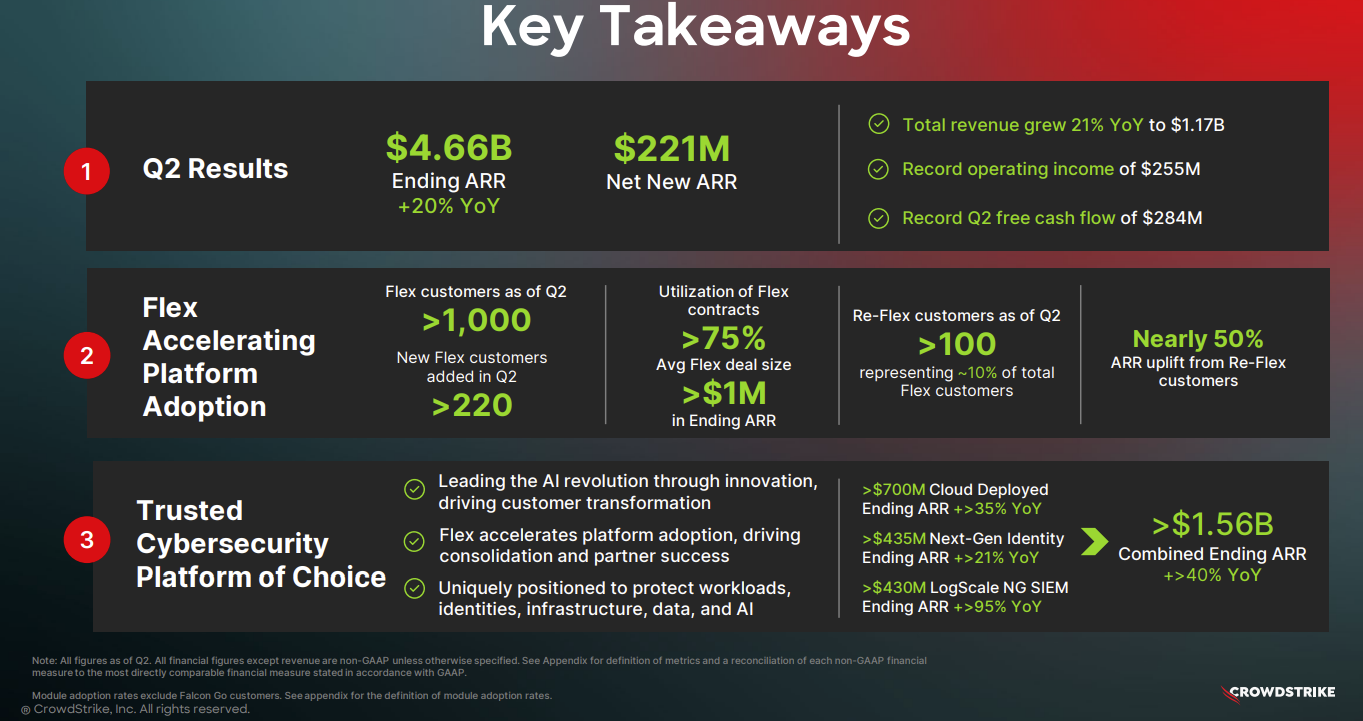
The company also reported second quarter results. CrowdStrike reported a second quarter net loss of $77.7 million, or 31 cents per share, on revenue of $1.17 billion, up 21% from a year ago. Non-GAAP earnings in the quarter checked in at 93 cents a share.

Wall Street was looking for second quarter non-GAAP earnings of 83 cents a share on revenue of $1.15 billion.

CrowdStrike’s quarter landed following a strong outlook from Palo Alto Networks, which also recently said it would acquire CyberArk for $25 billion.

As for the outlook, CrowdStrike projected third quarter revenue between $1.208 billion and $1.218 billion with non-GAAP earnings of 93 cents a share to 95 cents a share. For fiscal 2026, CrowdStrike is projecting revenue between $4.75 billion and $4.8 billion with non-GAAP earnings of $3.60 a share to $3.72 a share.

CrowdStrike CEO George Kurtz on a conference call said AI is complicating the cybersecurity landscape even as it leads to opportunities.

Kurtz said:

"In cybersecurity as well as the broader technology market, AI's impact is palpable. As organizations of all sizes embrace AI transformation, I hear several thematic concerns from executives and Boards. One, where is shadow AI emerging in my business? Two, how do I control what data enters AI systems? Three, how do I control what AI systems can do in my enterprise? Which ultimately leads to the focal question of four, how do I secure AI agents? AI has made the role of CISOs and CIOs more complicated than ever.

CrowdStrike's role in the agentic era is staying ahead of AI-armed threat actors to secure AI at every layer. Beginning with the AI model itself to the workloads and hosts on which they run to the actual human and agentic identities, to the end-user devices accessing these systems and applications."

Kurtz also outlined the reasoning behind the Onum purchase and the company's goal to use it to secure every stage of the AI life cycle.

"Onum will bring Falcon's AI-powered detections closer to third-party data sources in pipeline, starting analysis before data even enters the Falcon platform. Here's why Onum stood out to us. One, speed. Onum delivers 5x more events per second than its nearest competitor and processes data in real-time versus legacy batch and store methods. Two cost. Onum's smart filtering reduces data storage costs by 50%. Three, superior outcomes. Onum's real-time pipeline detection starts before data enters the Falcon platform, delivering up to 70% faster incident response with 40% less ingestion overhead."

Other takeaways from Kurtz:

  • The company had more than 1,000 Falcon Flex customers with the average Flex customer representing more than $1 million of annual recurring revenue.
  • "I think a big part of it is going to be the AI story of understanding how all these interdependencies work in the build environments, in code and obviously, in sort of these interactions with MCP-type services. So this is something that we continue to invest in this area."
  • "Customers are in the early journey of how they leverage AI. And it's moving from, hey, this is really a cool technology to how do we implement it and implement it securely and do it in a way that actually accrues value back to the business. If we believe in AI, and we think there's going to be more AI in the future, in the next year, 3 or 5 years, then security is a necessity. You're not going to have more AI without security."

Data to Decisions Innovation & Product-led Growth Future of Work Tech Optimization Next-Generation Customer Experience Digital Safety, Privacy & Cybersecurity crowdstrike AI GenerativeAI ML Machine Learning LLMs Agentic AI Analytics Automation Disruptive Technology cybersecurity Chief Revenue Officer Chief Information Security Officer Chief Privacy Officer Chief AI Officer Chief Experience Officer

Anthropic: Vibe hacking and weaponizing agentic AI

Anthropic: Vibe hacking and weaponizing agentic AI

Anthropic released a threat intelligence report that introduces "vibe hacking" and a bevy of other examples where criminals weaponized agentic AI.

In a blog post, Anthropic outlined how Claude has been misused including extortion, ransomware and vibe hacking. To its credit, Anthropic has developed defenses, but even the best perimeters get tested and thwarted.

By penning its threat intelligence report, Anthropic is winning enterprise credibility with the transparency. Nevertheless, the attacks and threat actors are a little jarring. In short, agentic AI has lowered the bar for cybercrime and criminals are weaponizing AI for profiling, data analysis, stealing and creating false identities.

Here's a look at some of the more interesting items in Anthropic's report.

Meet vibe hacking. Anthropic said it thwarted a cybercriminal that used Claude Code to steal personal data targeting 17 organizations. The hacker said it would expose the data to extort victims into paying ransoms topping $500,000.

Claude Code was used for automation, harvesting credentials and penetrating networks.

No-code ransomware as a service. In this case, Claude was used to develop, market and distribute ransomware including evasion capabilities.

Chinese and North Korean threat actors used Claude for various attacks and to enhance operations. North Korea used Claude to distribute malware and land fraudulent IT jobs. A Chinese threat actor used Claude to attack infrastructure in Vietnam.

The full report has in-depth case studies and are worth the read.

Data to Decisions Digital Safety, Privacy & Cybersecurity Chief Information Officer

AI Bubble, Agentic Strategy, Revenue Intelligence | ConstellationTV Episode 112

AI Bubble, Agentic Strategy, Revenue Intelligence | ConstellationTV Episode 112

Is enterprise tech in an AI bubble, or are we finally seeing real value? In our latest episode, co-hosts Martin Schneider and Larry Dignan talk enterprise tech news, including breaking down the hype vs. reality in AI and Salesforce’s AgentForce strategy.

Next, an exclusive interview with Raju Malhotra, Chief Product & Technology Officer at Certinia. He shares best practices for building effective #aiagents and a vision for the future of hybrid human-agent workforces.

Finally, Martin shares insights from his new “Big Idea” report on why it’s time to rethink expansion revenue and how agentic AI is transforming customer engagement.

00:00 - Introduction
00:29 - Enterprise News
11:00 - Interview with Certinia (Raju Malhotra):  
22:44 - Martin's Big Idea Report 
27:55 - Bloopers!

Watch now and subscribe to Constellation Research's YouTube channel for consistent enterprise tech insights!

Data to Decisions Digital Safety, Privacy & Cybersecurity Future of Work Innovation & Product-led Growth Marketing Transformation Matrix Commerce New C-Suite Next-Generation Customer Experience Tech Optimization Chief Analytics Officer Chief Customer Officer Chief Data Officer Chief Digital Officer Chief Executive Officer Chief Financial Officer Chief Information Officer Chief Information Security Officer Chief Marketing Officer Chief People Officer Chief Privacy Officer Chief Procurement Officer Chief Product Officer Chief Revenue Officer Chief Supply Chain Officer Chief Sustainability Officer Chief Technology Officer On ConstellationTV <iframe width="560" height="315" src="https://www.youtube.com/embed/_PwGZyKWk3E?si=2msAF-uIIm3iGtHe" title="YouTube video player" frameborder="0" allow="accelerometer; autoplay; clipboard-write; encrypted-media; gyroscope; picture-in-picture; web-share" referrerpolicy="strict-origin-when-cross-origin" allowfullscreen></iframe>
ShortList Spotlight: Amplitude, Leading Marketing Analytics Solutions

ShortList Spotlight: Amplitude, Leading Marketing Analytics Solutions

Marketing analytics has evolved from simple measurement to driving real-time action and growth. 📈 Today’s tools don’t just report results—they help us understand WHY and empower us to act, often with the help of AI and automation. In the clip below, Constellation analyst Liz Miller highlights one standout tool from her Marketing Analytics Solutions ShortList: Amplitude.

Liz explains how Amplitude doesn't just track digital product performance, but connects the dots across campaigns, experiences, and outcomes—helping marketers and product teams work smarter, together.

💡 Curious about the full ShortList of top marketing analytics solutions? Check it out at https://lnkd.in/ezbjRdQ9.

Marketing Transformation Next-Generation Customer Experience Chief Marketing Officer On ShortList Spotlights <iframe width="560" height="315" src="https://www.youtube.com/embed/sYFCcMytm40?si=9Fj8nYMAbBzeLUk_" title="YouTube video player" frameborder="0" allow="accelerometer; autoplay; clipboard-write; encrypted-media; gyroscope; picture-in-picture; web-share" referrerpolicy="strict-origin-when-cross-origin" allowfullscreen></iframe>