Results

News Analysis - SAP HCM On-Prem Option for SAP S/4HANA - or is this S/4HCM?

News Analysis - SAP HCM On-Prem Option for SAP S/4HANA - or is this S/4HCM?

It’s a new year and new product announcements are coming out – normally in the consumer space, given CES looming large. Looks like SAP did not want to stand back and had a major announcement in the HCM space: The announcement of a new, on premises (yes you read this right) HCM product, planned to be available in 2023, a record time range of 5 years out. Definitively worth a news analysis, the press release can be found here.


So let’s jump into my customary dissection of a press release:

Nearly six years ago, SAP acquired SuccessFactors, providing our customers with the best cloud-based human capital management (HCM) solutions on the market. Since then, the number of customers using SAP SuccessFactors solutions has nearly quadrupled, and we continue to see increasing momentum toward the cloud for HCM globally and across all industries.

MyPOV – Good description of the status quo both in regards of product and go to market strategy and reality. SAP customers had the choice to keep their existing, R/3 based SAP HCM product (which isn’t a bad product btw.) on premises. Many used the SuccessFactors Talent Management functions in parallel, in the cloud. SAP’s strategy was to use EmployeeCentral as the fix point for HCM automation and then gradually move its customers to a cloud based, maybe SuccessFactors based architecture (my speculation) was foiled for reasons outside of SAP HCM product / go to market makings with the overwhelming on premises adoption of SAP S/4HANA. 


Our investment strategy follows this market demand, with the bulk of the planned innovations for our HCM portfolio focused on SAP SuccessFactors solutions.

MyPOV – This is the reassurance statement for the SAP SuccessFactors customers – the last thing SAP wants them to get nervous and look at other cloud based HCM products. 


SAP also continues to support our customers using SAP ERP HCM, our on-premise HCM solution. While an increasing number of them are migrating to SAP SuccessFactors solutions to accelerate their digital HR journeys, we also recognize that every customer journey is unique and must be undertaken at each customer’s own pace. For some SAP customers this includes a desire to deploy their HCM solution in an on-premise environment for the foreseeable future. 

MyPOV – Good for SAP to acknowledge customer reality. Vendors can strategize and build on product as much as they want – they need customers to follow. When they don’t follow – later more – investments have to be adjusted. The ‘some SAP customers’ are the first 1000 (and numbers growing) SAP S/4HANA on premises customers. The foundation of what SAP wants to be the new ERP suite of the 21st century, it’s 21st century version of R/3. 


To support these customers’ needs, we plan to offer a new on-premise HCM option based on SAP ERP HCM with a comparable functional scope (except for the SAP E-Recruiting application and SAP Learning Solution).”  It is intended to be deployed alongside, and integrated with, SAP S/4HANA. The solution is planned for availability in 2023, with maintenance planned at least through 2030.

MyPOV – And the cat is out of the bag… a new HCM “option” (press release aficionados will cherish the absence of naming this “product” or at least “solution”) with a comparable scope to the current SAP HCM solution is planned for 2023. As readers know, the current SAP HCM is supported till 2025. So this will require some precision upgrading by the SAP install base and is pretty much a product road map / deliver plan that allows for very little slippage. The product comes with the ‘default’ 7 years of maintenance, that if there is any success is likely to extended. Also interesting that the new HCM option is going to be deployed next to S/4HANA, SAP calls this ‘side car’. Actively wondering why this HCM option is not offered as part of S/4HANA. Quick reminder: Originally S/4HANA was a copy of R/3, and now simplification and improvements have been and are being added. And no surprise the cloud intensive HCM functions of Recruiting and Learning are being excluded. These would be hard to size from a system capacity perspective for customers, customers are likely going to be happy to keep e.g. the video processing and playback to the cloud. 


To recognize our customers’ existing investments, it is our intent to offer a license conversion program. Details are planned to be finalized in 2018 although the solution will not be available for purchase until eventual availability. At that time, it is intended that customers can license the new solution and start migrating to it using planned SAP-provided migration tools and services. As the underlying solution is intended to be based on SAP ERP HCM, we expect this to be a nondisruptive transition. It is planned that customers running an integrated ERP and HCM deployment in one instance today can move to a partitioned deployment model and run the offering on a separate instance.

MyPOV – No surprise – SAP wants to make it easy for customers to adopt the new product. License conversion on the commercial side, migration help on the implementation side. Will be great to see / learn more details and good to see SAP setting an internal target of 2018… not much will happen till then on the customer side. 


We are pleased to provide options to meet our customers’ preferences across cloud, on-premise and hybrid operating environments and will continue to provide updates on our solution road map and ongoing innovations.

MyPOV – Boilerplate, good – but eventually acknowledging that the customer is king, and vendors have to meet customers where they are, where they want to stay and be. 


Overall MyPOV

Pinch me – it’s 2018 and we analyze a press release about an … on premises product. Reality in Europe (and some other parts of the world) is though that customer want a cloud ready product, that could be operated in the cloud if they desire, but then deploy on premises. Data safety, data statutory, privacy and performance arguments are the  most prominent reasons customer want to stay on premises. Of course there is a substantial portion of sticking with what has worked and is familiar since half a century…

At the end of the day the SAP HCM product strategy got run over by the SAP S/4HANA strategy and adoption reality. I have been pointing out the lack of HCM (and CRM) messaging, road map and positioning in S/4HANA (to the point of having an informal bet with the former head of SAP SuccessFactors on SAP needing an on premise adoption option for HCM in 2018 as a consequence, made at the SuccessConnect analyst summit in 2016…). SAP customers bought a suite and want a suite back. At the moment they see fragmentation across the board, at least for HCM, CRM and Procurement. With 9x%+ of 

SAP S/4HANA customers opting for on premises SAP was faced with the option of extending the old R/3 code and maintaining it for longer than 2025. But that would have taken off upgrade pressure on customers to move to S/4HANA… and SAP wants return of R&D from S/4HANA and some revenue. Even if SAP had provided a full suite (incl. payroll) in SuccessFactors, in the cloud today, on premises minded and bound customers would not have taken it. And a customer upgrading to S/4HANA (with no HCM in it) would have to either keep operating some R/3 infrastructure for HCM automation or move to the (non-existing) full automation of HCM in SuccessFactors… that would have opened up potential selection of other HCM suites. And with SAP competition pushing suites (beyond HCM), the overall S/4HANA upgrade could be questioned. 

So SAP customers found themselves in a tough spot: Influence SAP through the user group to extend R/3 based HCM support (and the rest) beyond 2025 – and operate on an aging on premises infrastructure. Or reap the benefits of S/4HANA investments and force / influence SAP to undertake a S/4HCM (my naming!) project. I call it S/4HCM as I expect SAP to undertake the same process it did for e.g. Finance with S/4HANA – now again for HCM. Take R/3 based HCM, move it to a new product / code line, simplify, update to 21st century, take advantage of Leonardo (my speculation) etc. – a repeat of the S/4HANA approach and process, just for HCM. Now tons of branding pros and cons on this one. The SAP user groups had to choose between a rock and a hard place: Keep old R/3 or move forward with S/4HANA. At the end it seems (e.g. in Germany with DSAG) the active customers, using, adopting and planning to use S/4HANA have won inside of the user groups). 

With all the challenges, there are also some kudos for SAP into this. Announcing a new product to be available 5+ years from now is probably a record for the enterprise software industry (for the observers, Oracle held that with a 4 year ETA for the called Oracle Fusion in 2008). This gives customers a chance to plan on the long-term side and monitor SAP’s progress. The other side of the coin is of course that SAP will now push the S/4HANA upgrade path even more. Deploy the new SAP ERP sidecar option and move to the new ‘digital core’ (as SAP calls it). 

At the end of the day this is a great lesson learnt that customer adoption ultimately dictates product investment and road maps. Vendors can only move and entice customers on a value based proposition so far… with the bulk of S/4HANA being on premises the writing was on the wall that SAP needed an on premises strategy for HCM (and likely for CRM and Procurement). Now the question is… what does this mean for SAP’s CRM and Purchasing plans. We can only speculate…





Future of Work Tech Optimization Next-Generation Customer Experience Digital Safety, Privacy & Cybersecurity Distillation Aftershots Data to Decisions Innovation & Product-led Growth SuccessFactors SAP AI Analytics Automation CX EX Employee Experience HCM Machine Learning ML SaaS PaaS Cloud Digital Transformation Enterprise Software Enterprise IT Leadership HR IaaS Disruptive Technology Enterprise Acceleration Next Gen Apps IoT Blockchain CRM ERP CCaaS UCaaS Collaboration Enterprise Service Chief Customer Officer Chief People Officer Chief Human Resources Officer Chief Technology Officer Chief Information Officer Chief Information Security Officer Chief Data Officer Chief Executive Officer

Digital Transformation Digest:T-Mobile's New IoT Play, SAP Keeps the On-Premises Flame Burning, Ford Drives Further into Smart Cities

Digital Transformation Digest:T-Mobile's New IoT Play, SAP Keeps the On-Premises Flame Burning, Ford Drives Further into Smart Cities

Constellation Insights

T-Mobile goes narrow, but aims big with new IoT play: Self-styled "uncarrier" T-Mobile is staking a big flag in IoT (Internet of Things) with Magenta, a narrowband network that at $6 per device per year, drastically undercuts that of Verizon's comparable offering for IoT devices:

At one tenth the cost of Verizon’s Cat-M plans ...T-Mobile’s new NB-IoT plan takes advantage of narrowband technology, and the efficiency it provides, to significantly lower the costs of connecting things and unleash the next wave of IoT innovation.
 
T-Mobile’s new NB-IoT plan lights up new capabilities to connect massive numbers of devices with small and steady streams of data at low cost. NB-IoT is much more affordable than Cat-M and is already the globally-preferred standard to power the rapidly expanding world of IoT applications. Because it can operate in guard bands – the network equivalent of driving down the shoulders on the highway -- NB-IoT carries data with greater efficiency and performance and doesn’t compete with other data traffic for network resources.

POV: T-Mobile made the announcement in conjunction with the Consumer Electronics Show, ongoing this week in Las Vegas. It's a splashy move to say the least and is clearly T-Mobile's biggest bid for enterprise business to date. It's worth nothing that the $6 pricing model is on a limited-time basis, but T-Mobile can deliver adequate performance at even two or three times that much money, the network should gain traction quickly. It could also help drive down pricing on IoT networking from other carriers, particularly Verizon. Overall, the market seems set to gain a viable new option, which is always good for customers and competition.

SAP plans new on-premises HCM app: Like all enterprise software vendors, SAP has been pouring resources into building out a cloud application portfolio. But the reality is that many of its customers will keep large parts of their application footprint on-premises for the foreseeable future. SAP has acknowledged that reality in a new announcement about its HCM (human capital management) software strategy.

Nearly six years ago, SAP acquired SuccessFactors, providing our customers with the best cloud-based human capital management (HCM) solutions on the market. Since then, the number of customers using SAP SuccessFactors solutions has nearly quadrupled, and we continue to see increasing momentum toward the cloud for HCM globally and across all industries.

Our investment strategy follows this market demand, with the bulk of the planned innovations for our HCM portfolio focused on SAP SuccessFactors solutions.

However, SAP is also developing a new on-premises HCM application that is comparable in scope to the existing one, with availabilty in 2023 and support extended through at least 2030. SAP will offer a license conversion program, the details of which have yet to be completed.

POV: SAP competitors may seize upon the announcement as somehow evidence of SuccessFactors' inferiority, but the reality is a bit more complicated. The vendor's customer base is deeply rooted in some of the world's most conservative industries and it's not surprising that there's enough demand for a new on-premises HCM application. To that end, SAP is essentially obligated to provide new innovations to customers that have dutifully paid annual maintenance fees, but still have no inclination to move to the cloud.

Ford launches smart cities push with Autonomic: Automaker Ford is teaming up with a startup called Autonomic to shape a new vision for smart, connected cities. The companies see data from autonomous vehicles, bicycles and next-generation public transportation as a crucial wellspring of insight into how future cities will live and breathe, but at the same time, a difficult matter to wrangle. Here are the key details from a Ford blog post:

If we play our cards right, we can help allow for millions of people to move into cities and keep streets less congested, not more. We can connect people living in transit deserts to the city center for better jobs. We can manage our curbs better, remove parked and idling cars, and instead plant more trees and share fresh air with more in our community.

Building an ecosystem such as this requires the large-scale connection of bits of distinct data that flow from a variety of sources. And those sources — public transportation services, self-driving cars, cyclists and even infrastructure — will need to speak the same language and communicate with each other if we’re to realize the true potential of this type of ecosystem.

The first step along that path is to establish a platform that enables that kind of communication. That’s why Ford is working with Autonomic ... This platform can manage information flow and basic transactions between a variety of components in the transportation ecosystem — service providers, personal vehicles, bicycles, pedestrians, mass transit systems and city infrastructure, including traffic lights and parking locations.

POV: CES is a perennial place for brands to lay out ambitious technology strategies; Ford's partnership with Autonomic falls in line with that trend. Ford's plans are promising in their outlines. The company compared its planned collaboration with Autonomic as designed to build "a box of Legos" that can be snapped together to fit differing needs, not a monolithic, one-size-fits-all platform. This is the right approach given how much variety and complexity the world's cities contain. It will be interesting to see how their collaboration unfolds over the course of 2018.

Future of Work Next-Generation Customer Experience Tech Optimization Chief People Officer Chief Information Officer Chief Digital Officer

Embrace the Era of Smart Analytics

Embrace the Era of Smart Analytics

Machine learning and artificial intelligence advances in five areas will ease data prep, discovery, analysis, prediction and data-driven decision making.

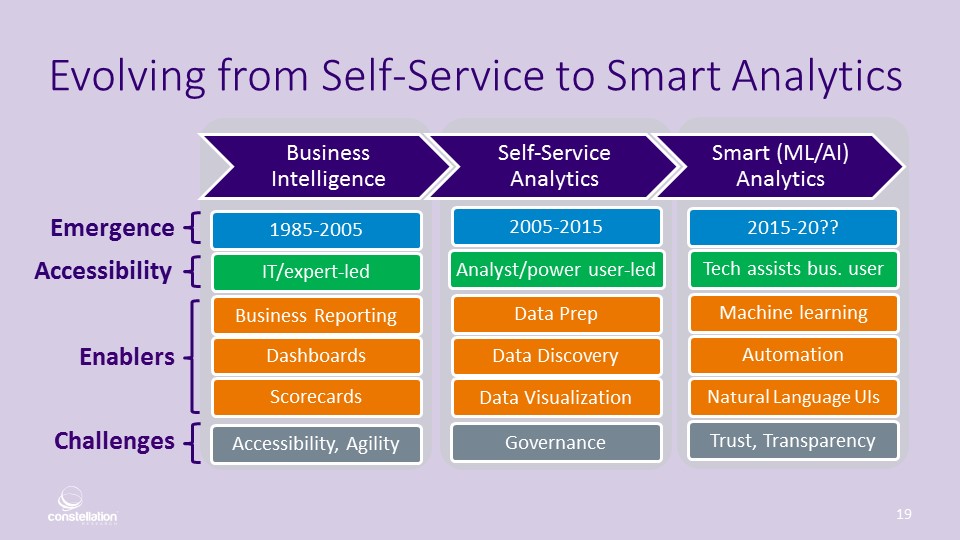
For ten years the prevailing trend in business intelligence (BI) and analytics has been the move toward self service. That’s about to change. In 2018 and beyond we’ll see a growing list of what many call “smart” capabilities powered by machine learning (ML) and artificial intelligence (AI). These features are sure to help us move beyond the limits of the self-service era.

As I explain in a my latest report, “How Machine Learning & Artificial Intelligence Will Change BI & Analytics,” we’re already starting to see smart capabilities in five areas: data prep, discovery, analysis, prediction and AI-powered, prescriptive applications. My research details investments being made by more than 20 startups and 14 established BI and analytics vendors to advance the state of the art.

Expect a steady drumbeat of announcements throughout 2018 and beyond about ML applied to tasks including cleansing and combining data, discovering new data, and suggesting new combinations of data that could, in turn, uncover important insights. Non-technical business users will appreciate ML-powered suggestions on best-fit data visualizations. Automated modeling features, meanwhile, will help non-technical business users tap into the power of predictive analytics.

As noted, some of these capabilities are already starting to appear. My report details which capabilities are available today, those starting to appear and those we should expect in the future. For example, natural language (NL) querying based on keywords available in column headers has been with us for years. Some vendors are now using more advanced NL capabilities that can discern nuances and intent in complete sentences (whether typed or translated from voice with speech-to-text capabilities). On the cutting edge, systems are starting to retain the context of queries; instead of asking one, isolated question at a time, you’ll have a responsive dialogue with the data, drilling down and exploring from an initial query.

Of course, many business users are more interested in action and outcomes than interpreting reports, dashboards and data visualization. These are the users more likely to take advantage of the growing list of smart, ML- and AI-powered prescriptive applications emerging. Here’s where the context of decisions is built into business applications for sales, marketing, HR, supply chain, logistics and more. In these cases the data analysis can be tuned to deliver recommended next steps or even to automate actions sure to lead to desired outcomes.

These emerging capabilities will make BI, analytics and data-driven decision-making that much more accessible, understandable and actionable for non-technical business users, but embracing the new won’t be as easy as waving a magic wand. I’ve spoken to practitioners who were surprised and dismayed to see employees responding to ML- and AI-powered recommendations in unexpected ways. Salespeople, for example, sometimes stubbornly pursue leads deemed as less than promising by predictive scores. Here’s where change management will be crucial. As I explain in my report, delivering transparent and explainable AI that instills trust will be crucial to making smart systems succeed. Here's a link to a free excerpt of the complete 27-page report.

Related Reading:
Eight Data-to-Decisions Trends to Watch in 2018
Amazon Web Services Adds Yet More Data and ML Services, But When is Enough Enough?
Salesforce Dreamforce 2017: 4 Next Steps for Einstein


Data to Decisions Future of Work Tech Optimization Chief Executive Officer Chief Information Officer Chief Digital Officer

How much are businesses actually investing in AI?

How much are businesses actually investing in AI?

Constellation Research is conducting a survey to find out how much businesses are investing in AI and how those investments might impact the organization.

If you are an individual with authority or influence over technology strategy in your organization please take this short survey by January 12, 2018. The survey contains 17 multiple-choice questions and should take less than 10 minutes to complete.

The survey seeks to understand: what are the drivers of business investment in AI; how much are businesses investing in AI; at what stage of implementation are businesses in their implementations; what are businesses using AI to accomplish; is there resistance to the adoption of AI; and how will AI impact the workforce.

For the purposes of this survey, Constellation defines artificial intelligence as the culmination of technologies such as deep learning, neural networks, natural language processing, and big data/predictive analytics to produce software that is self-improving, automatic, and emulates human intelligence.

Take the Constellation Research 2018 AI Survey here. Constellation will send survey participants a summary of the survey data.

Marketing Transformation Data to Decisions

Will Your Job Be Replaced by Artificial Intelligence?

Will Your Job Be Replaced by Artificial Intelligence?

Are you worried about computers, automation, robots or artificial intelligence replacing you? Futurist Brian David Johnson and I chat about the relationship between humans, technology and our careers.

Future of Work Tech Optimization Innovation & Product-led Growth New C-Suite Next-Generation Customer Experience Digital Safety, Privacy & Cybersecurity Distillation Aftershots Data to Decisions AI Analytics Automation CX EX Employee Experience HCM Machine Learning ML SaaS PaaS Cloud Digital Transformation Enterprise Software Enterprise IT Leadership HR LLMs Agentic AI Generative AI business Marketing IaaS Disruptive Technology Enterprise Acceleration Next Gen Apps IoT Blockchain CRM ERP finance Healthcare Customer Service Content Management Collaboration Chief Customer Officer Chief People Officer Chief Human Resources Officer Chief Experience Officer Chief Executive Officer Chief Information Officer Chief Technology Officer Chief AI Officer Chief Data Officer Chief Analytics Officer Chief Information Security Officer Chief Product Officer

Report: Three New Skills Pivotal for the Future of Work

Report: Three New Skills Pivotal for the Future of Work

The tools and techniques employees use at work are very different now than they were just a few years ago. This report examines three of the key areas in which employees will need to be proficient for the Future of Work:

  • Augmenting skills with artificial intelligence and automation
  • Leveraging data to make informed insights and calculated actions
  • Using creativity in storytelling to better engage with colleagues and customers

The full report can be purchased >> here <<.

Future of Work

Digital Transformation Digest: Starry Internet Eyes National Expansion, Macy's Digital Drive Continues, California Struggles to Launch Pot-Tracking System

Digital Transformation Digest: Starry Internet Eyes National Expansion, Macy's Digital Drive Continues, California Struggles to Launch Pot-Tracking System

Constellation Insights
 

Starry Internet eyes expansion in 2018: After a couple of years testing its unique wireless broadband service in the Boston area, Starry Internet is set to expand coverage to Los Angeles and Washington, D.C. in the near future, with plans for more than a dozen other major market additions over the course of the year. 

The company's service uses base stations mounted on rooftops that deliver Internet connections via high-frequency millimeter waves. Devices placed at and inside subscribers' homes capture the signals, convert them to lower frequencies and create a wifi network. Starry says it can offer 200MB broadband for $50 a month, a claim that has drawn its share of skepticism.

Company CEO Chet Kanojia is known for his previous startup, Aereo, which used antennas to capture and stream local TV channels. The company failed when the U.S. Supreme Court ruled its business model was in violation of the law.

POV: The notion of ultra-fast, affordable wireless Internet is a tantalizing one, particularly in light of the recent FCC vote overturning net neutrality laws. In fact, Starry has made net neutrality a centerpiece of its marketing efforts, saying it will never throttle customer data or block any websites. 

But there are serious challenges standing in its way. Any wireless network is at heart a real estate play; it's not trivial to site and build a cellular tower, particularly in expensive urban areas. Starry's infrastructure has a much smaller footprint, but its use of millimeter waves has drawbacks, namely a much shorter range than other technologies. If Starry is going to offer broadband at scale it will need to blanket urban areas with base stations, and each will require negotiations with building owners.

Then there is the question of how entrenched carriers will respond. If Starry's plans work out, they will not stand idly by. To that end, millimeter waves are hardly new or exclusive to Starry. While it has had a couple of years to develop special hardware and run limited beta tests, players with bigger resources pose a clear threat.

Ultimately, innovation in wireless broadband is a good thing, however. It will be interesting to see how the year unfolds for Starry.

Macy's digital drive still work in progress: Venerable department store chain Macy's reported that sales for the November-December holiday period rose 1.1 percent year-over-year, but at the same time announced plans to close 11 more stores, including one in downtown Miami. Four of the stores, including one in Los Angeles, had already been disclosed as slated for closure.

Macy's announced plans to close 100 locations in August 2016 and with the latest batch, will have completed 81 of of them. In total, the chain has shuttered 124 stores since 2015.

There are multiple store brands among Macy's holdings, including Bloomingdale's and Blue Mercury. Holiday sales were spurred by strong performance in areas such as fine jewelry, men's tailored clothing and high-end cosmetics.

Macy's CEO Jeff Gennette said in a statement that the company's store closings are all part of a bigger plan:

“Our primary focus in 2017 has been to continue the strong growth of digital and mobile, stabilize our brick & mortar business and set the foundation for future growth. We’ve made good progress on each, including encouraging trend improvements in our brick & mortar business. A healthy store base combined with robust digital capabilities is Macy’s recipe for success."

POV: Macy's results announcement doesn't mention it, but strong holiday sales on higher-ticket items was likely driven by the chain's Star Rewards loyalty program, which it overhauled prior to the holiday season. Macy's derives half of its annual revenue from the 10 percent of customers who spend at least $1,200 per year there. Those shoppers are now enrolled in the program's Platinum tier, which gives them 5 percent back plus free shipping. It's the brainchild of Gennette, who has been tasked with improving Macy's omnichannel strategy. This element, at least, seems to be working.

Still, Macy's has work yet to do. "They are not doing well with their digital strategy," says Constellation VP and principal analyst Cindy Zhou. "The emails are unfocused and it's challenging to find associates to help in-store. They need to focus more on personalized customer engagement and how to improve their digital-to-in-store experience."

California's marijuana-tracking system has yet to fire up: The Golden State is unfortunately notorious for a long string of wildly expensive, poorly executed government IT projects. The latest could end up being a system that is supposed to track recreational marijuana sales, now that the drug was legalized for that use on Jan. 1. Here are the key details from an Associated Press report:

California’s legal pot economy was supposed to operate under the umbrella of a vast computerized system to track marijuana from seed to storefronts, ensuring that plants are followed throughout the supply chain and don’t drift into the black market.

But recreational cannabis sales began this week without the computer system in use for pot businesses. Instead, they are being asked to document sales and transfers of pot manually, using paper invoices or shipping manifests. That raises the potential that an unknown amount of weed will continue slipping into the illicit market, as it has for years.

For the moment, “you are looking at pieces of paper and self-reporting. A lot of these regulations are not being enforced right now,” said Jerred Kiloh, a Los Angeles dispensary owner who heads the United Cannabis Business Association, an industry group.

POV: State officials say the system has been "implemented," but it's not clear when the necessary training dispensaries need on it will be complete, or when its use will be firmly mandated. Overall, the project has a number of moving pieces, a factor that can often lead to delays and overruns.

The voter referendum legalizing recreational marijuania in November 2016 also dictated that the state begin issuing licenses for it by Jan. 1. Several state agencies are involved in the regulatory process, and the licensing system will actually consist of two software platforms, one from Accela and another from Pegasystems. There are also multiple systems integrators working on the project. Finally, there is a track-and-trace system component, which hadn't even been procured as of last June.

California is banking on recreational marijuana generating substantial tax revenue, so getting the system up and running soon is paramount. But rushing its completion may only lead to more problems; this may be a case when mellowing out a bit is the best option for state officials.


Marketing Transformation Matrix Commerce Next-Generation Customer Experience Tech Optimization Chief Customer Officer Chief Executive Officer Chief Financial Officer Chief Information Officer Chief Supply Chain Officer Chief Digital Officer

Digital Transformation Digest: Amazon Eyes Alexa for Ad Revenue, Microsoft Acquires Avere for High-End Azure Workloads, and More

Digital Transformation Digest: Amazon Eyes Alexa for Ad Revenue, Microsoft Acquires Avere for High-End Azure Workloads, and More

Amazon eyeing Alexa for digital ads: Some of the world's largest consumer goods companies have had discussions with Amazon about advertising and product placement through the Alexa voice assistant, according to a new report from CNBC. The companies reportedly include Proctor & Gamble and Clorox:

Some of the early discussions have centered on whether companies would pay for higher placement if a user searches for a product such as shampoo on the device, similar to how paid searches work in Google.

The move by Amazon, which right now does very little advertising on the Echo, could mean big things for consumer companies that are fretting their influence on a voice-powered shopping experience.

With Alexa's clout anticipated to rise, brands are worried about being left out of the voice-shopping platform entirely. Advertisers and brands are particularly focused on search placement on Alexa because shoppers are more likely to select a top result on a voice assistant than they are on the web, where it's easy to scroll down or ignore written suggestions.

POV: Right now, Amazon allows advertising on Alexa in a limited manner. For example, a podcast or streaming radio channel can have ads as long as the voice doesn't sound like Alexa, refer to Alexa or mimic its interactive style.

Amazon says it sold tens of millions of Echo devices over the holiday shopping season, and market estimates have it with nearly three-fourths of the voice assistant market overall. The number of third-party Alexa apps is also rising, with the total of Alexa skills reaching 25,000 last month. It's a large and rapidly growing target for advertising, particularly when combined with Amazon's rich trove of user data.

Therefore, it's a safe bet that advertising will soon be more pervasive on Alexa; the question will be how well Amazon manages the user experience and advertising policies going forward. In any case, CMOs should have a plan for voice assistant ads on their radar going into 2018.

This was bound to happen sooner or later, says Constellation VP and principal analyst Cindy Zhou. "If you look at the Amazon dash buttons, they are branded and I do see the potential ad revenue for Amazon with sponsored voice searches," she says. For example, if you say now "Alexa, what deals are available?" it reads off the different products exclusive to voice shopping, Zhou notes. "I imagine Amazon working these into the Alexa offers and providing a preferred position when reading out deals," she adds. "I can see brands bidding to be read first through third as most people lose patience, similar to reading only page one or two of search results."

Microsoft buys Avere to boost high-end Azure workloads: Redmond has made its first acquisition of the new year, and the target is hybrid and high-performance computing workloads for Azure. Microsoft is paying an undisclosed sum for Avere Systems, a Pittsburgh company focused on flash storage and advanced file systems.

Formed in 2008, Avere's products optimize on-premises storage installations while helping efficiently move HPC workloads to the cloud when they make financial and logistical sense. Customers include Sony Pictures, John Hopkins University, the Centers for Disease Control, the Library of Congress and Turner Broadcasting. Its CEO, Ron Bianchini, founded Spinnaker Networks, which was sold to NetApp for $300 million in 2003.

Avere has raised about $86 million in venture funding since its inception. Google participated in the most recent round, but it's unclear whether the acquisition was a competitive process between Microsoft and other players.

POV: It's interesting to note that Avere has existing partnerships with both Amazon Web Services and Google Cloud Platform; it's not clear what will become of those arrangements once the Microsoft deal is closed. Google actually named Avere its cloud platform partner of the year in 2015, and indications are that it's currently ahead of Microsoft in terms of integration with Avere's technology. Avere plays in a fairly crowded space, which suggests its technology stood particularly well to Microsoft, which had many choices.

Overall, Avere looks like a good complement to a previous HPC-related acquisition Microsoft made in August, of Cycle Computing. That company developed CycleCloud, a software platform for orchestrating and managing high-end computing jobs on the cloud. In a blog post, Microsoft noted that HPC is becoming relevant to many more industries in the past as they seek to take advantage of machine learning:

Whether it’s building animations and special effects for the next blockbuster movie or discovering new treatments for life-threatening diseases, the need for high-performance storage and the flexibility to store and process data where it makes the most sense for the business is critically important.

Avere also helps build out Microsoft's hybrid cloud play, which got a big boost last year with the release of Azure Stack, which allows companies to run the Azure software stack in their own datacenters. (Go here for Constellation VP and principal analyst Holger Mueller's take on Azure Stack.)

As for Avere, "the cloud is becoming vertical, and Microsoft buying a media specialist in Avere is a proof point," Mueller says. While Avere is specialized in media and specific file formats, it is a rather late move by Microsoft, given that much of the media and streaming content out there already sits on infrastructure," he adds."

Black hat hacker gifts IoT botnet code to the world: A hacker posted source code over the Christmas holiday for an IoT botnet that takes advantage of a weakness in Huawei routers, raising the specter of a new wave of crippling botnet attacks as the year begins.

Dubbed Satori, the malware is a variant of Mirai, the notorious botnet that took down some of the world's largest websites last year. The hacker posted the code to Pastebin, according to Ankit Anubhav, principal researcher at IoT device security vendor NewSkySecurity.

Check Point had discovered the vulnerability in December and reported it to Huawei, which has issued a fix. But the subsequent release of the code should result in it being exploited by "script kiddies and copy-paste botnet masters," Anubhav wrote.

The real problem is that IoT attacks "are becoming modular day by day," he added. "When an IoT exploit becomes freely available, it hardly takes much time for threat actors to up their arsenal and implement the exploit as one of the attack vectors in their botnet code."

POV: It remains to be seen how much impact Satori has going forward, but in general, the state of IoT device security remains woeful and shows little sign of broad improvement. The holiday season, during which many millions of new Internet-connected devices were purchased, has massively increased the attack surface. That situation and a lack of best security practices around IoT are a recipe for pain, if not disaster.

Digital Safety, Privacy & Cybersecurity Marketing Transformation Next-Generation Customer Experience Tech Optimization Chief Customer Officer Chief Information Officer Chief Digital Officer

Digital Transformation Digest: Amazon and Salesforce's Move Away from Oracle, Adblocker War Heats Up, Tech Conferences to Watch

Digital Transformation Digest: Amazon and Salesforce's Move Away from Oracle, Adblocker War Heats Up, Tech Conferences to Watch

Constellation Insights

Amazon, Salesforce reportedly moving off Oracle: The Oracle database lies at the core of untold numbers of applications and enterprise IT environments, including those at Amazon and Salesforce. But that reportedly may not be the case for good, as both companies have active efforts underway to move off Oracle to alternatives, according to a report in the Information.

The progress has been fairly significant at Amazon; it has moved its customer master and order master databases to a NoSQL platform, according to the Information's report. Salesforce has been working on an Oracle alternative with the code-name Sayonara, which was first reported by Fortune in mid-2016. It has been rumored for years prior to that report Salesforce was investigating a move onto PostgreSQL.

POV: The report comes at an interesting time for Oracle, which is about to launch the newest version of its database. The update will give the platform the ability to patch itself on the fly; Oracle CTO Larry Ellison has dubbed it a "self-driving" database, playing off the interest in autonomous vehicles. Oracle believes the new version will spark a wave of workload migrations to Oracle's cloud. 

Salesforce may be working on an Oracle exit plan, but will be tied to the platform for the next several years. It signed a nine-year contract renewal with Oracle in 2013 that was reportedly worth $300 million; even so, Salesforce CEO Marc Benioff said at the time that it would cut his database costs in half. (Notably, a source told the Information that Salesforce intends to be completely off of Oracle by 2023.)

Ellison hasn't been shy about bragging how Salesforce and Amazon, both fierce competitors of Oracle's, pay millions of dollars to use its software. If either company succeeds in moving substantially away from Oracle's database, it will provide a case study for other large enterprises in how to pull such a task off.

It might be easier for Salesforce to make a move off Oracle, as it can incrementally shift subscribers and instances, says Constellation VP and principal analyst Holger Mueller. But at the same time, the type of features Oracle is promising in the new database version are just what cloud vendors want, since they can reduce or even eliminate labor costs and human error, Mueller adds.

The ad-blocker arms race heats up: The war over online ads, with users and ad-blocking browser extensions on one side, and marketers and publishers on the other, reached new heights in 2017. One of the biggest developments was Google's decision to add a native ad-blocker to its Chrome browser, which has more than 60 percent market share. Google's blocker will go into action on Feb. 15; it will block only ads deemed overly intrusive under a set of standards laid out by the Coalition for Better Ads, an industry group that includes Google, Facebook and other companies that are highly dependent on advertising revenue.

But while Google's move was high-profile, thousands of the world's top websites have been waging a quieter war against ad-blocking technologies, researchers at the University of Iowa have determined. The researchers developed a system that analyzed the top 10,000 websites on Internet traffic monitor Alexa, and found that 30.5 percent of of them employed anti-adblocking code, a much higher percentage—up to 52 times as many—than previous studies uncovered.

POV: The researchers' paper goes on to detail programming methods aimed at thwarting anti-adblockers. Overall, their work raises provocative questions about a pressing issue for not just large Internet companies but all brands, as well as their customers. As the researchers note, the adblocker versus anti-adblocker war will likely escalate as the year unfolds:

It is crucial that adblockers are able to keep up with anti-adblockers. Moreover, the increasing popularity of adblocking has already led to various reform efforts within the online advertising industry to improve ads ...However, to keep up the pressure on publishers and advertisers in the long term, we believe it is crucial that adblockers keep pace with anti-adblockers in the rapidly escalating technological arms race.

Constellation believes that Google's native Chrome adblocker can have the weight and influence needed to spark significant improvements in the quality of Internet advertising. Companies making investments in online ad programs deserve to get a fair shot at a return on them, but not at the sake of user experience and brand integrity.

Tech conference season kicks off—what's on tap: After a quiet period over the holiday break, the tech conference calendar will be busy this month. Here's a look at the top events and what to expect.

CES: First up is the massive Consumer Electronics Show, which starts Jan. 8 in Las Vegas. The show will feature the usual raft of gadget and audiovisual product announcements, but the biggest conversations will be around around smart cities, autonomous vehicle technology, IoT and the arrival of 5G networks.

NRF 2018: The retail industry's biggest and most important conference kicks off Jan. 14 in New York. Expect a heavier-than-ever emphasis on technology during this year's event, particuarly in areas such as AI and robotics, which will have direct impact on the in-store customer experience.

World Economic Forum: The annual gathering of world leaders takes place Jan. 23-26 in Davos, Switzerland, under the theme "Creating a Shared Future in a Fractured World." While not a pure technology conference by any means, Davos is nonetheless an important setting for discussions on the digital economy.


Marketing Transformation Matrix Commerce Next-Generation Customer Experience Tech Optimization Chief Customer Officer Chief Information Officer Chief Marketing Officer Chief Digital Officer

Constellation's 2017 Enterprise Awards

Constellation's 2017 Enterprise Awards

Constellation Insights

The team at Constellation Research wishes you all a great holiday season this year. In the interest of recognizing the year's memorable tech industry's events, trends and companies, we present the winners of the second annual Enterprise Awards.
As with last year, the winners and runners-up were chosen via internal voting and debate among the analyst team. Agree with the results? Disagree? Send us your feedback at [email protected] and we'll do a follow-up post.
Best Enterprise Software Startup
Winner: Zoom
Why did it win?: Zoom has been around since 2011 but saw a dramatic uptick in business, doubling its user base to more than 700,000 companies and about 7,000 educational institutions. Moreover, Zoom customers are using the product more frequently: Annualized meeting minutes hosted by Zoom's cloud platform went from 6.9 billion to greater than 20 billion. In a highly competitive market segment, Zoom is gaining serious traction, which tells us it is doing something right. Also this year, Zoom held its first user conference, moved into a key vertical with a new telemedicine offering, built integrations with the likes of Slack and Microsoft Teams, and rolled out features for augmented reality and artificial intelligence. Go here to view Constellation VP and principal analyst Alan Lepofsky's interview with Zoom CEO Eric Yuan.
Runner-Up Winners: Optoro, ProoV, Docker
Why did they win?: Optoro's cloud platform helps retailers salvage the most money they can from returned or unsold items; it's managing to attract Home Depot and other big names in the crowded but increasingly complex world of reverse logistics. ProoV's offering helps CIOs and CTOs run proof-of-concept exercises on new technologies quickly and securely. Docker shot to more than a $2 billion valuation this year while remaining the top name in containers, which are the choice of architecture for next-generation applications.
Best Enterprise Software Vendor
Winner: Oracle
Why did it win?: Oracle's leadership is nothing if not persistent, especially when it comes to pushing toward the cloud in SaaS, PaaS and IaaS. In its most recent quarter, cloud revenue jumped 44 percent year-over-year to $1.5 billion. Certainly, some of the growth has come from Oracle's relentless series of acquisitions, but not all. It is also gaining serious traction in the SaaS back office, with ERP and HCM revenue rising 65 percent year over year. On the marketing front, Oracle has become a serious player with the buildout of its Data Cloud, which delivers access to a vast and rich trove of user information. Up next: Delivering on the promise that customers will start migrating their Oracle database workloads to the cloud en masse with the imminent arrival of Oracle's "self-driving" database.
Runner-up winner: Salesforce
Why did it win?: Salesforce spent 2017 in execution mode, stitching together the many acquisitions it made in 2016. Despite being a fairly mature company, Salesforce is continuing to log growth rates well above 25 percent. This year also saw Salesforce coalesce a strategy around AI and unveil a new version of its gamified Trailhead training system, which looks like it will generate increased stickiness among customers as Salesforce heads toward $20 billion in revenue.

Best Enterprise Services Vendor

Winner: Persistent Systems

Why did it win?: Persistent embodies the idea of a co-innovation partner, rapidly shedding its mere product development services vendor skin. One case in point: Its work with the Biocomplexity Institute at Virginia Tech on an analytics platform for battling infectious disease. Persistent has also shown a knack for hatching innovative partnerships, such as its deal with USAA, a group of U.S. financial services companies, around secure authentication.

Runner-up winner: Infosys
Why did it win?: Infosys had a rocky 2017 on the public relations front due to intense infighting between founder N R Narayana Murthy and the then corporate board. CEO Vishal Sikka abruptly resigned in August, citing a toxic atmosphere. But Infosys managed to find a seasoned and able replacement for Sikka in just a few months, hiring former Capgemini executive Salil Parekh, while retaining its customer base. Parekh's legacy at Infosys has yet to be written but will be interesting to watch.
Best Tech Acquisition
Winner: Intel buys Mobileye for $15.3 billion
Why did it win?: The chipmaker put down a massive bet on Mobileye's autonomous driving technology, paying 60 times its earnings for the Israeli company. In doing so, Intel made a big competitive stride against rivals Qualcomm and NVIDIA in autonomous vehicles, which Goldman Sachs has said could generate nearly $100 billion by 2025. Intel CEO Brian Krzanich made the reason for the acquisition plain—cars are becoming the new server, he said following the deal's announcement.
Runner-up winners: Broadcom-Qualcomm, Amazon-Whole Foods
Why did they win?: Broadcom's $130 billion offer for Qualcomm isn't complete yet and may never be if it can't pass regulatory hurdles, but goes on the list for its sheer scope. Amazon shook up the retail world by buying Whole Foods—as if it wasn't already on notice—and opened up a range of tantalizing possibilities for its supply chain and customer base.

Best Enterprise Partnership
The Partnership on AI: Late last year, Amazon, Facebook, IBM, DeepMind and Microsoft formed the Partnership on AI, a nonprofit consortium that promotes education and interoperability concerning artificial intelligence. Its goals include development of AI best practices, educating the public about AI and how it can benefit society, and to give AI researchers a means for collaboration. The group picked up serious momentum this year, with Apple joining as a founding member in January. Later, the partnership added six board members from six nonprofits, while big names such as eBay, Intel, SAP, Salesforce and Sony joined as for-profit partners.
Why did it win?: AI was one of the year's hottest tech topics and has the potential to reorder modern society. As such, it's important to have well-funded and well-balanced efforts such as the partnership. Constellation looks forward to its work in 2018.
Runner-up winner: Cloud Native Computing Foundation
Why did it win?: The CNCF is another sterling example of the industry finding a way to rapidly come together cooperatively for mutual benefit for both customers and vendors. Since its formation two years ago, there are now 160 CNCF members representing a who's who of enterprise vendors, and the group, which is overseen by the Linux Foundation, has 14 thriving open-source projects under its purview.
Best Enterprise CEO
Winner: Steve Lucas, Marketo
Why did he win?: Sometimes when a company is scooped up by private equity, as Marketo was in late 2016, they largely drop off the radar. Not Marketo, and credit for that must go to Lucas, who in his first year as CEO oversaw a rewrite of Marketo's software, executed key acquisitions and struck a deal with Google to move onto its cloud platform. Lucas has also made a series of personnel changes in the C-suite that have poised Marketo for a strong 2018, and has emerged as an articulate and engaging thought leader on marketing technology.
Runner-up: Andy Jassy, Amazon Web Services
Why did he win?: Jassy is now presiding over an $18 billion business in AWS, one that shipped more than 1,000 new features and services this year (and it seemed like a good half of them came in one big batch at the recent re:Invent conference). Despite its size, AWS is still growing at a torrid pace, with revenue up 40 percent. And AWS's sheer scale serves to tie an anchor to its lead thanks to economies of scale. It doesn't hurt that Jassy can cite a quickly expanding crowd of big-name reference customers, such as GE, who are moving wholesale to AWS.
Best New Category
Digital enterprise platforms: Constellation saw the emergence of digital enterprise platforms as a hot new category in 2017. They are embodied by companies such as Segment.io, C3 and Uptake. While differing in some specifics, all are trying to solve the same problem, that of streaming and orchestrating data with AI powering the whole works. The macro enterprise IT trend is how to move from systems of transactions to systems of engagement, with mass personalization at scale. These are the companies powering that vision.
Runner-up winner: Who would have thought mapping software would get hot again? But it has, thanks to new use cases and the emergence of companies such as Maplarge and Mapbox. Mapping software is being used for augmented and virtual reality, content and commerce.
Biggest Tech Flops of 2017

Unfortunately, the year saw its share of controversies and disasters in tech. Here are our picks of some of the most notorious.

Winner: Equifax data breach

Why did it win?: While there were a number of high-profile data breaches this year, what happened at consumer credit reporting agency Equifax stands out—and not in a good way. The personal information of nearly 150 million U.S. citizens was exposed in the breach, with the data including not only names and addresses but Social Security numbers. A post-mortem assessment found serious security lapses at Equifax, which are even more unconscionable given the nature of its business.

Runner-up winner: Juicero

Why did it win?: Investors thought a $699 wifi-enabled juice press that used proprietary packs of fruit and vegetables, sold by subscription, was a pretty good idea, to the tune of $120 million in funding. Alas, Juicero's fortunes quickly soured after Bloomberg published a story describing how the company's juice packs could simply be squeezed by hand with similar results. Juicero stopped selling the machines and is now shopping its intellectual property. It is unclear who will be interested in it.