Results

10 Signs You Have a Customer Understanding Deficit and Three Things to Do About It

We talk a lot these days about the “experience economy” and that fact that any business, regardless of what it sells, is competing on the experience it creates for customers. As a business, you’re shaping those experiences, whether you do so consciously or not.

If that doesn’t strike pangs of fear in the hearts of customer-focused leaders, this should: most companies, especially large ones, face far more fundamental challenges than designing great customer experiences. In all likelihood, your organization doesn’t have a consistent view of who your customers (real or potential) are and why they come to you. Marketing, sales, and customer service may think they do, but it probably isn’t the same view.

Without a shared understanding of customers across the organization, it’s impossible to design consistent experiences—much less the ones you want.

Here are 10 common symptoms of the problem and why it happens:

Three Things To Do About It Right Now

So how do we fix it?

1. Define What It Means to Serve Customers Well in Your Business

The first step is to concentrate on the most important business objective: serving customers. What does that look like for you? What should or could it look like? (Warning: If you don’t buy into the principle that the best way to serve your business is through serving your customers, this blog isn’t for you. And no, I’m not interested in that timeshare.)

To serve your customers well, you need to know them well enough to anticipate their needs. Get it right and you’ll not only have a clear idea of why and when customers are most motivated to buy what you offer, you’ll also know how, when, and where to communicate with them most effectively. Your service will be timely and even preemptive. Your marketing, sales/commerce, and service organizations will work together like a well-oiled machine to build durable, mutually sustainable customer relationships based on great experiences.

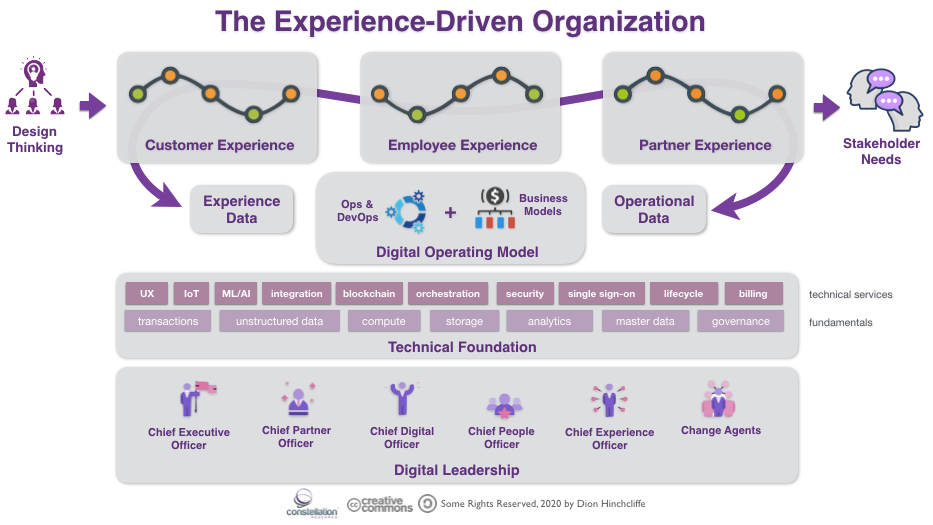
With customer understanding at the heart of your business, it’s then possible to build the organizations, processes, and technology infrastructure that power insight-driven experience design (IXD).

2. Think About Your Employees—All Your Employees—Differently

IXD is all about enabling employees with the right tools so that they can create workflows that cross departmental boundaries to support actual customer journeys, not the mythical ones we might like them to follow. It’s also about empowering those same employees with the information they need—in context—at the appropriate moment in time so that they can make the best decisions to serve customers, whether they’re in marketing, sales, service, or any other part of the organization.

The best people to tackle the myriad challenges inherent in serving customers better are the ones directly involved in doing it. That means everyone, regardless of their role or seniority. We have technology tools today that make it possible, now we need to empower employees, give them clear direction on the objectives, and trust them to make the right decisions.

The combination of digital communication, cloud services, APIs, data analytics, AI and machine learning, and low-code/no-code apps makes it possible to design customer experiences that convey the sincerity and relevance of the best in-person interactions in any context or channel. Even so, the best tools in the world will never make it happen without a clear—and very human—understanding of customers.

3. Decide Where To Start

If history has taught us anything, it's that a big-bang approach to major change will likely fail. Establishing the principles of customer understanding and building the capabilities for IXD require a strong vision but an interative process. Where to start depends on the unique circumstances of your organization. How much direct influence do you have personally? Who weilds the greatest influence in your organization, individually or departmentally? Who are the most capable and dynamic leaders? Who has the greatest short-term interest in making the requisite changes?

Cherry-pick your starting points and use cases or customer journeys based on what will generate the best initial results and the greatest interest internally. Build an action plan designed to make the most of opportunistic interest, build momentum, and create a steady rate of change. With the right support and constant, clear communication on the goals, it's easy for people to buy into serving customers better. It not only feels like the right thing to do, it usually is. 

For more on how customer understanding and IXD make it possible to compete and win in the experience economy, read Customer Understanding: The Key to Insight-Driven Experience Design.


Data to Decisions Marketing Transformation Matrix Commerce New C-Suite Next-Generation Customer Experience B2C CX Chief Customer Officer Chief Executive Officer Chief Information Officer Chief Marketing Officer Chief Digital Officer Chief Revenue Officer Chief People Officer Chief Human Resources Officer

Getting Your Weekly Dose of Knowledge Thanks to DisrupTV

Have you checked out our weekly show DisrupTV? We bring together some of the smartest leaders across industries to get their advice and discuss the biggest trends impacting businesses today. With over 300 unique guests and nearly 150 episodes, it’s been a wild ride, and we are not slowing down. Be sure to catch up on episodes you may have missed and check out the upcoming lineups – all listed on our website.

In recent weeks, leadership advice has been a key theme, all from pretty unique perspectives. If you are looking to move up in your career or build a stronger skillset, be sure to check out the full interviews. Here’s the high-level points:

Be creative.
Dickson Tang, Speaker and Author of “Leadership for future of work: 9 ways to build career edge over robots with human creativity,” reminded us that we are all born creative. Unfortunately, traditional schooling sometimes stifles this quality. His advice is to always look for ways to inspire creativity, lead in a positive manner, and give space to make mistakes for the best path for growth.

Focus on Quality.
It’s not about the sheer numbers but the depth of your connections that creates true impact, explained Erica Dhawan, Keynote Speaker on Collaboration & CEO at Cotential. It’s important to network and build teams with quality. Look to combine knowledge, ambition and human capital to exponentially improve. She also reminded us to always be patient, adaptable, and consistent over a long period of time. When your team knows what to expect, they will follow by example.

Continue to learn.
Meagen Eisenberg, Chief Marketing Officer at TripActions and successful startup executive, shared important factors when it comes to scaling a company – people, process and technology. This nicely aligns with important leadership and career growth factors. Always ask questions to fully understand your customers’ wants and needs, for example. If you continue to connect with those actually using your offerings and keep an open mind to learn in the evolving environments, you will be more successful in achieving your end goals in business and personally as a leader.

We’ve also heard some interesting news commentary and healthcare trends this past month. Be sure to check out the interview with Heather Clancy, editorial director at GreenBiz, to learn about the latest in green tech and sustainability. Her interviews never disappoint!

Don't miss your chance to learn from these great leaders each week! Tune in every week for DisrupTV, hosted by Vala Afshar and R “Ray” Wang, on Fridays 11 AM PT/2 PM ET.

New C-Suite Marketing Transformation Future of Work Chief Customer Officer Chief Executive Officer Chief People Officer Chief Information Officer Chief Marketing Officer Chief Digital Officer
IBM Goes Short on Customer Experience

On April 4, IBM announced an agreement to sell its portfolio of marketing and commerce software to private investment company Centerbridge Partners. The size of the deal, which is expected to close by mid-2019, was not disclosed.

Mark Simpson, vice president of offering management and strategy for the IBM marketing platform and commerce offerings, will lead the new entity as CEO. The new company’s name, as well as how many and which employees will transfer along with Simpson, are yet to be determined.

The scope of the agreement includes:

  • Campaign Automation
  • Marketing Assistant
  • Media Optimizer
  • Customer Experience Analytics
  • Content Hub
  • Real-Time Personalization
  • Personalized Search
  • Universal Behavior Exchange
  • Intelligent Bidder
  • Price & Promotion Optimization
  • Payments Gateway

Constellation’s View

This announcement comes close on the heels of IBM’s agreement in December 2018 to sell a portfolio of software to HCL for $1.8 billion. It’s clear IBM is actively packaging up discrete capabilities and offerings that it can sell to interested buyers. In our view, this is as much about replenishing the coffers as it is refocusing the main business. Given how hot all things “customer experience” are there days, this particular deal makes sense all around.

Pros:

Because of both its engineering heritage and its size and scale, IBM doesn’t really have a strong brand association with customer experience and marketing tools. This new entity has the opportunity to build a much stronger market presence and reputation around customer experience.

Pulling together this set of marketing and commerce capabilities—some of which are underpinned by IBM Watson’s AI—makes it much easier to manage as a coherent, integrated portfolio. It also helps clarify for customers how these pieces might fit together. Under the terms of the deal, core Watson capabilities and APIs are not in scope (they'll be subject to a partnership agreement) but AI tools developed specifically for marketing products will transfer to the new company.

The combination of products and know-how give the new entity an opportunity to build a better analytics presence that connects strong analytics capabilities to feedback loops that make that output actionable for employees.

For customers, there’s likely to be more, and more focused, investment in helping solve the big problems companies have with building great customer experiences. A single entity that’s wholly focused on tools and technologies to support customer experience doesn’t have to compete with all the rest of IBM for investment dollars.

Cons:

According to what’s been announced so far, this new entity will focus on serving CMOs and marketing organizations. This runs counter to what most enterprise customers want and what most other major competitors in this market are moving toward: connecting marketing technologies with the rest of enterprise IT. Rump IBM has strong ties to the enterprise IT department. The new entity won’t.

It’s unclear what proportion of the new entity’s capabilities will be selling products (including SaaS services) vs. consulting, implementation, and other services. We see a clear trend toward a greater and greater embedding of best practices within products and tools. Nevertheless, the ability to support enterprises in building customer experiences is critical to helping customers succeed. It’s certainly part of what sets IBM apart from other competitors.

Bottom Line

This deal makes sense for IBM and for the new, as-yet unnamed entity that will become a stand-alone company. Its prospects are good, but challenges remain. This is a competitive, rapidly changing market in which critical mass plays a major role in success.

The growing priority for enterprises is to support customer journeys across all parts of the customer lifecycle. It’s about breaking down departmental silos and creating a holistic, enterprise-wide view of customers. Whether and when this new entity figures that out remains to be seen.

For customers, there’s substantial up side. If nothing else, the new company will have a clear focus and investment strategy. And there’s nothing like clarity of purpose to ensure good follow-through.

Data to Decisions Marketing Transformation New C-Suite Next-Generation Customer Experience B2C CX Chief Customer Officer Chief Information Officer Chief Marketing Officer Chief Digital Officer Chief Revenue Officer Chief People Officer Chief Human Resources Officer

News Analysis - SAP keeps re-organizing, Fox-Martin in charge of world-wide sales, Enslin out, replaced by Morgan

Late on a Friday night in Germany SAP issues a press release that Robert Enslin is leaving the company. The organizational consequence was that of Jennifer Morgan taking over the Cloud Business Group, Enslin's previous responsibility. Her go to market activities are no completely with Adaire Fox-Martin – who now solely owns go to market for SAP.


The late Friday night release always implies that SAP tried to 'hide' the new around the departure and re-organization ad the board level, especially since it is the 2nd one this year (read about Leukert's departure here). So let's start with dissecting the press release in our customary fashion, it can be found here.
 
WALLDORF — SAP SE (NYSE: SAP) today announced that Executive Board Member and President of the Cloud Business Group Robert Enslin has elected to resign from the company to pursue an external opportunity.
MyPOV - Short and sweet – Enslin looking for an external opportunity. The remarkable part is that he does that after a 27-year career with SAP. Usually that long tenured board members and SAP employees get the chance to retire (contrast and compare with for instance Kleinemeier). The Cloud Business group is in the midst of a transformation to move to the SAP technology stack (and in most cases off Oracle's database), but that effort seems well under way. Enslin got more responsibility during the tenure with the addition of Callidus Cloud in 2018 and recently Qualtrics. So, it needs to be something that has happened more recently to prompt him to look for external opportunities.
 
SAP Executive Board Member Jennifer Morgan will succeed Enslin as president of the Cloud Business Group (CBG). SAP Executive Board Member Adaire Fox-Martin will take sole responsibility of Global Customer Operations (GCO) as president. These leadership changes are effective immediately.
MyPOV - So Morgan is the 'new' Enslin – leaving sole revenue responsibility to Fox-Martin. Well not completely as all six 'sisters' of the Cloud Business Unit have a salesforce and revenue targets. This is taking it to the next level challenge wise for both executives. Fox-Martin must deliver the bulk of SAP's revenue, ironically a job that Enslin had for a long time. And Morgan needs to show she can deliver products to market, as she has not held product development responsibility in her career. Both executives have their work cut out in the next years.
 
Enslin, who first joined SAP in 1992, departs following a long and successful career at the company. He was named to the Executive Board in 2014, initially as president of Global Customer Operations. A respected technology leader with a unique global perspective on business and economic trends, he earned a highly favorable reputation with customers and industry analysts. His two-year stint as president of the company's Cloud Business Group resulted in an aggressive build-out of SAP's cloud portfolio, including the recently closed acquisition of Experience Management leader Qualtrics.
MyPOV - Sad to see such an SAP veteran go – but I guess it was time for the next level. Enslin has delivered sales results during challenging times for SAP, and more recently made sure that 4 of the 6 sisters (Ariba, Fieldglass, hybris and SuccessFactors) are moving to SAP's technology stack – most prominently SAP HANA, SAP Cloud platform and SAP analytics. Interesting that his 27-year retrospective of his SAP career speaks little about the sales success. Enslin emerged as the best sells person for SAP in North America, delivering regular performance and results, culminating in the world-wide sales responsibility. Most recently Enslin's impact is going to be to have moved Fieldglass and most likely SuccessFactors over to SAP's tech stack. Insight on Ariba is still out. Plans for Qualtrics are tbd, given the recent acquisition. Concur is free to leverage 100% AWS (HANA is out there).
 
Comments from Professor Hasso Plattner, Chairman of the Supervisory Board of SAP
"We are very grateful for the many significant contributions Robert Enslin has made to SAP. The Supervisory Board has immense confidence in Jennifer Morgan and Adaire Fox-Martin as they assume broader responsibilities on our Executive Board."
MyPOV - Good quote by Plattner, but what alternatives did SAP have? The alternatives would have been presidents inside of the cloud business unit. But they are all busy at delivering results while their product teams are re-platforming. At the same time, with Enslin leaving, the designate backup for McDermott is out of SAP as well. Time to groom a potential successor. And leading SAP you always need to have some product development responsibility (McDermott is the only exception, so was Apoteker). So, its timely for Morgan to get development responsibility. I wrote the same for new board member Klein earlier this year. Klein and Mueller would have been the other two alternatives, but they just got on the board, and need to show they can deliver first. And maybe mistakenly, SAP always had a business leaders on top of the SAP cloud business unit and each off the six sisters. That the technology transformation to SAP's technology, despite being postulate by Plattner on a yearly level – is not a surprise by now. But hindsight is always easy.
 
Comments from Bill McDermott, CEO of SAP
"Let me first congratulate Rob Enslin for everything he's done in his distinguished SAP career. He'll be a great champion for SAP in his new opportunity and a lifelong friend to me personally. With Jennifer Morgan and Adaire Fox-Martin moving up, we have two dynamic leaders who will help us take SAP to the next level. Our market-leading core ERP and high-growth cloud application portfolio make SAP a rarity in the enterprise software industry. This transition gives us a clear path to continue simplifying the company. SAP's leadership team will drive greater operational efficiency, faster time to market, higher product quality and superior market fit, all while significantly improving margins. 'The Best Run SAP' is our motto, our maxim and our strategy to run the company with greater discipline and focus. I could not be more optimistic about SAP's road map to create value for our customers, employees and shareholders – a true Best-Run SAP."
MyPOV – A long quote by McDermott. Nice to see him thank Enslin and sparking the curiosity where Enslin maybe going. SAP has a lot of partners – so the field is wide open. And agreed that with Fox-Martin solely in charge of almost all sales (the cloud business units sales leaders have a dotted line into her) – SAP certainly simplifies the sales organization and responsibility. Not so much though from a product development side, as the Morgan for Enslin replacement doesn't solve the challenges of a product development troika now between Klein, Morgan and Mueller. It changes the dynamics in the troika as Morgan is less senior than Enslin (who I joked, could have been a father age gap wise to Klein / Mueller). And certainly, the board has gotten much younger, it maybe (math pending) on record low average age – even before Kleinemeier retires.
 
Comments from Robert Enslin
"I am truly grateful to Hasso Plattner, Bill McDermott and all my SAP colleagues for the opportunity to be part of such a special company. As I leave SAP for a new journey, I do so with unrivaled respect for the company and its amazing customers around the world."
MyPOV – Nice quote. Always good to leave on a high note.
 
Comments from Jennifer Morgan
"I am very honored by this opportunity to work with the outstanding team in SAP's Cloud Business Group. I have never been stronger in my belief that SAP's best days are yet to come."
MyPOV – Good quote. Would have loved to see some of the Cloud Business group goals in here. 
 
Comments from Adaire Fox-Martin
"For the entirety of my career at SAP I have focused on our customers and their success. I could not be more energized to continue this exciting journey as president of Global Customer Operations."
MyPOV – Good quote – focus on the customer. Strange though Fox-Martin trails Morgan in sequence. Alphabet can't be used as explanation. At least form an outside perspective and revenue responsibility (not functional diversity) her job eclipses Morgan's.


Overall MyPOV

SAP's board organization doesn't come to peace, and with that stability that is key for execution. Except for Finance, HR and Services – every board area has been changed, re-organized in the course of 6 months. I can't think of such a board level change happening at SAP … ever. And the next change is already announced, as Kleinemeier stayed an extra year to keep doing the work that Leukert was supposed to take over. Organization need stability on the top, and changes on the top have repercussions many levels down the organization, all the way to middle management changing. In a traditionally stable culture like SAP these changes are especially challenging, as networks have operated over decades, that are now changing. But change can be for the better, so we will have to see what happens.
 
The other aspect is of course SAP's questionable job of succession management. This is not an easy job at board level, and one only needs to think the issues e.g. Apple has had. But SAP needs to benchmark itself with the competition, and there the parallels of loosing Leukert are similar to Oracle losing Kurian, but Oracle absorbed that change much better (for now, blog post coming). If SAP did not have the double leadership in sales, a luxury and complexity, Morgan would not even have been available as a board member. The other potential successor(s) for Enslin had to come from the presidents of the cloud subsidiaries. But none of them made it, and not sure if any was ready for running all 6 sisters at this moment. As a side note: A mini consolidation occurred with moving Fieldglass under Barry Padgett who now runs Ariba and Fieldglass. And apparently no external candidates have been considered. But then SAP has a questionable record of bringing in outside board members, it has tried and failed twice for its people leader before Ries was installed.
So, except for Mucic, Kleinemeier and Ries, everybody has a new job on the SAP board – or is new to the board. The good news is, this board has worked together before. And SAP has reduced sales complexity whit handing the sales keys for (almost) all of SAP sales. One can argue McDermott's job hasn't changed, but I'd argue that he is the product developer in chief (see here), a new role for him.
 
For customers these changes simplify things on the sales side, where Fox-Martin is the last word – before reaching out to McDermott. Things remain as complex on the product side as before, with new relationships with Morgan having to be developed. Her background in sales is likely going to make the first phase of customer interaction easier, the potential challenge will be not to over extend product development commitments.
 
But at the end of the day, it is what it is: SAP's executive board is younger than ever before (or a very long time), and needs to get going asap as the challenges are massive and not getting smaller because SAP is reorganizing: Making the value proposition of the digital core real, getting S/4HANA right, adding new technologies across the products, operating on the new reality of SAP owned integration between its products and moving the six sisters to the SAP technology stack. All while delivering results to shareholder expectations. Time to roll up the sleeves for the SAP board.


[For additional reference checkout my analysis of SAP's last major board reorg, in April 2017, which created the cloud business group - here.]


Future of Work Tech Optimization Data to Decisions Innovation & Product-led Growth New C-Suite Sales Marketing Next-Generation Customer Experience Digital Safety, Privacy & Cybersecurity AI Analytics Automation CX EX Employee Experience HCM Machine Learning ML SaaS PaaS Cloud Digital Transformation Enterprise Software Enterprise IT Leadership HR Chief Customer Officer Chief People Officer Chief Human Resources Officer

Progress Report - SAP Cloud Analyst Summit 2019 - Intelligent Suite and Moving to SAP Tech Stack

We had the opportunity to attend the yearly SAP Cloud analyst meeting, held from March 6th till 7th in Salt Lake City. It was co-located with Qualtrics X4 Summit user conference, a good move to get the analysts up to speed on the newest 'sister' (as I call the SAP cloud businesses). Much of the summit was under NDA and we had to go through a reverse factual review – sharing with SAP before we published… then more work happened, and I am belated with this post… but better late … than never. 


Here is the 1 slide condensation (if the slide doesn't show up, check here):


Want to read on? Here you go:

The big SAP cloud business re-platform is under way. With this I refer to the effort of moving the 'sisters' to the SAP technology stack, meaning SAP HANA, SAP Cloud Platform, SAP Analytics and Leonardo. That effort is under way and seems to be going well. Fieldglass – the smallest sister – is already on HANA. Work at SuccessFactors and hybris is under way. Not sure where the Ariba efforts stand. As I learnt a week later at Concur's Fusion – the Concur efforts are excused from the effort, going "all in" with Amazon's AWS Cloud. Customers want to know where the effort stands – so SAP is well advised at giving some updates and timelines at some point in the near future.

Concur and Qualtrics - clarity and questions. The Concur decision makes a lot of sense, as likely HANA is punitively high for products like Tripit. And to be fair – HANA was never designed to be a travel expense / travel management database with millions of users. The big question is now what SAP will do with Qualtrics. Let the new experience management acquisition "daughter" run by itself for a while, move it to the SAP stack or maybe also to AWS (where it largely is already)? It was too early to get firm answers of this. But the question is pertinent to make the SAP desire of a new software category with "Experience Management" going – as customers and prospects will want to know what this new software will run on. Personally, I am sceptic HANA can be the database for capturing and continuously querying digital exhaust to predict and create superior experiences. That's more of a Hadoop job. Future will tell.

Reduced functional progress is the price. As with any re-platform – this must be an all hands effort at all the daughters. They almost all picked Oracle and have heavily optimized on that platform. When you do that on Oracle, you write a lot of stored procedures, and those cannot be migrated to another database – also if its HANA. This means that a decade + of code that has been built e.g. at SuccessFactors and Ariba will have to be re-written and tested. If SAP shares the effort publicly it will likely make customers a little nervous and open the install base up for FUD from the competitors. So likely SAP will have to undertake the effort behind closed doors. The consequence is less functional progress for the 'daughter' as developer across the product are busy re-coding and testing functionality. I am not covering Ariba in depth, but SuccessFactors and we can see that slow down on the SuccessFactors side. Pretty much since Spring of 2018 the major piece of innovation coming from SuccessFactors is … a mobile version. Building mobile versions while re-platforming the core offering is a proven strategy for vendors in that phase – mobile is separate technology (especially when you move to HANA) and there are well defined interfaces to the rest of the product. So, it was not a surprise the demo of SuccessFactor's Amy Wilson in Salt Lake City was about – mobile, with SAP Cockpit and the future what Qualtrics can be doing in combination with SuccessFactors for the employee experience. We will see what SAP will share soon.

A new role for SAP technology. SAP has long invested into HANA, SAP Cloud Platform and more. Executives have adamantly insisted that both are strong products, that stand alone and compete with e.g. the Oracle database. That seems to be history now, though SAP has not officially stated it is changing the role of its technology products to focus less on independent, best of breed competition, but making its technology support its application products and ambitions. Certainly, a valid approach, but a lot of investment that will not capitalize. The litmus test question: What is SAP had banked on Oracle only its database – how much SaaS product could have been built? Certainly, more than SAP has been able to build so far. It would have been the reverse takeover of the sisters' decision to standardize on that database. In the past SAP always mentioned the license payments that had to go to Oracle – but SAP does not have a principal issue with it – as we see with its multi-cloud strategy: Here SAP uses the IaaS partners the same way as it uses / used to use its database partners.

But What Ifs are nice scenario plays – it is what it is – and SAP seems to have made that decision. Data points into that direction. It would be good for SAP to make it public.

MyPOV

Let's focus on the good news first: The SAP Intelligent Suite messaging, unveiled at the very first meeting of this group one year ago – is still the true north for S/4HANA, C/4HANA and the sisters. It takes time to build product and keeping the vision and strategy the same is vital for delivering successful enterprise products. I may have missed the plans on the integration side. SAP is creating a distributed system landscape and this time owns the integration between these automation islands. At Sapphire 2018 executives were aware of owning this and committed to it. By now its time to see more specifics on how SAP wants to enable that integration for its customers.

On the concern side, every re-platform is risky business. It must work, must happen likely behind the scenes (as it happens in the cloud world - to not make customers nervous) and means a functional pause for the products undertaking the effort… But the train has left the station, certainly for SuccessFactors, maybe for Ariba, maybe for hybris. The big question now is what the plan for Qualtrics will be. Given SAP's complex development organization (see here) – customers need to plead for transparency by SAP in the form of roadmaps.

But overall kudos for SAP to give insights on its overall state of the cloud products. It was good to see three board members (Enslin, Klein and Mueller) as well as their key lieutenants (e.g. Faerber, Saueressig, Wilson) coming to Salt Lake City to speak with the analysts present there. Now all eyes are on Sapphire.

More on SAP


Tech Optimization SaaS PaaS IaaS Cloud Digital Transformation Disruptive Technology Enterprise IT Enterprise Acceleration Enterprise Software Next Gen Apps IoT Blockchain CRM ERP CCaaS UCaaS Collaboration Enterprise Service Chief Information Officer Chief Technology Officer Chief Information Security Officer Chief Data Officer Chief Executive Officer

DisrupTV: Driving Disruption for Real Impact

Autonomous vehicles, 3D printing, value-chain disruption and podcasts. We had a phenomenally entertaining and mind-expanding episode of DisrupTV recently. Here’s the quick takeaways.

Technology Disruptions Taking Over Markets

We caught up with Tasha Keeney, analyst at ARK Invest, to discuss the major headways in autonomous vehicles. There’s substantial cost savings and value promise for these types of taxis, semi-truck long-distance shipping and daily driving without an actual person at the wheel. While we are still a few years off, the work in place to get this going shows the reality will be here before we know it.

Keeney also shared some of her takeaways from her recent interview with Elon Musk, noting that they are three years ahead of the competition, especially for efficiency, battery production and autonomous hardware and data! The traditional automaker industry needs to step up its game by making major business model changes, or it’s predicted that those brands will be out of business with where the market is headed.

She also drove the conversation into what’s happening in 3D printing. While the consumer side has been somewhat disappointing, there are big advancements happening in healthcare and aerospace. Eyewear is a great example. There’s a program where you pick a design, and it will scan your face, tweak it to fit your face, and print it! Talk about true customization and instant gratification. This is just one example, but the opportunities are endless.

Disrupting the Value Chain by Chipping Away at the Competition  

The show switched gears just a bit and caught up with Thales Teixeira, Author & Associate Professor at Harvard Business School, where he discussed findings from his book, titled “Unlocking the Customer Value Chain: How Decoupling Drives Consumer Disruption.”  

The true disruptors aren’t the companies that come out with a similar, slightly better product. The ones that don’t try to copy but look at a missing piece, the inefficiencies, or some small weak aspect of the value chain from that big giant is key.

Let’s look at an example. How do you traditionally buy beauty products? You go into a store, like Sephora, look at all the different products, test them out, ask questions at the store, and then purchase a product. If you like it, you will go back and buy it again. Along the way, there are usually hiccups though, explained Thales. There’s no parking close at the store, customer service agent is rude, out of the product you want, dissatisfaction when you get home and then having to go back to get more...

The true disruptors are chipping away at certain aspects of the buying process and making that piece exemplary. Want samples but hate crowds? Have them ordered to your house! Already love a product, sign up for subscription and avoid the lines. Thinking differently at ways to build an offering is how to make a big dent and impact.

Sex, Drugs, Rock and Roll, and Podcasts

Well, that changed lanes quickly! The show closed out with an interview with Dr. Janice Presser, Founder & CTO at Teamability.com. She shared what’s happening with the "podcast revolution." Podcasts are broadcasted out in a one-way communication. They share interesting topics but aren’t necessarily getting millions of live viewers. We are in the middle of this challenge. How do you speed around the weak piece in the value chain? The true disruption and game-changer will be real engagement. We are team oriented and being able to engage in the conversation during and even after the podcast is completed will truly change the game.

This is just a high-level take on the great advice shared during the show. Please check out the full discussions in the video replay here or the podcast.

Tune in every week for DisrupTV, hosted by Vala Afshar and R “Ray” Wang, on Fridays 11 AM PT/2 PM ET. Drive (or let your car do it) straight toward the end goal and don’t let the pot holes slow you down.


Data to Decisions Future of Work Marketing Transformation New C-Suite Next-Generation Customer Experience Tech Optimization Chief Customer Officer Chief Digital Officer Chief Executive Officer Chief Financial Officer Chief Information Officer Chief Marketing Officer Chief People Officer Chief Revenue Officer

#AppleEvent announcement and the potential in #healthcare

Big announcement by Apple with new subscriptions for news, tv, gaming, and a credit card offer that may impact the credit card industry. This can be a great play and set up for the healthcare industry as Apple looks to keep the 1.4B devices users in the ecosystem. The top three areas that healthcare vendors and providers can think about are:

1. Home care health — We can all agree that the future of healthcare will be at a setting that is convenient for the patient and the home is definitely a great option. The TV streaming ecosystem is the perfect platform for telemedicine. For the last few years, I have seen the cable tv providers attempt at a play to provide telehealth to their members but it has not been a core strategy, therefore it did not gain the market traction. Now with the Apple TV ecosystem, the market is ripe for a telehealth vendor or hospital organization to take advantage of the platform to offer healthcare services. Quick virtual consultation, remote patient interaction, and other forms of patient engagement as a strategy for population health is an area to consider to take advantage of the platform.

2. Credit card — Health systems are still catching up to accept apple pay as a mechanism to pay for your healthcare bill. With the apple credit card, health systems can still focus on accepting apple pay. Another offer can be loyalty rewards when you are using the apple credit card. Healthcare organizations focusing on wellness can set up partnerships with a gym membership and grocery store to promote a healthier lifestyle in order to drive down healthcare cost. This partnership can then provide incentives for consumers that use the apple credit card for payment.

3. Gaming — Healthcare has not tapped into the gamification strategy yet. This is a perfect platform to enhance clinical training as well as a platform to engage with the patients. Think pelaton for healthcare where you are promoting a healthy lifestyle.

Media Name: Screen Shot 2019-03-26 at 8.23.56 AM.png
Next-Generation Customer Experience Tech Optimization apple Chief Customer Officer Chief Marketing Officer Chief Digital Officer

Oracle Modern CX Spotlights Customer Data Platform, AI Accelerator

Oracle previews CX Unity, 'next-gen' sales UI, and DataFox upgrades. The  investments are promising, but don't dismiss data lakes so easily.

“You have to empower whoever gets to the customer first.” This is the key message that Rob Tarkoff, executive VP and general manager of Oracle CX Cloud, shared at Oracle Modern Customer Experience (CX), March 19-21, in Las Vegas.

Tarkoff’s point was that customers rarely follow prescribed, linear journeys, so everybody must be armed with customer insight and context whether they’re in marketing, sales, commerce or service. To gain contextual insight you need data, and that’s why Oracle announced Oracle CX Unity last October at Oracle Open World. Billed as a “customer intelligence platform,” CX Unity is designed to provide “a comprehensive view into customer interactions across channels and applications.”

CX Unity is Oracle’s entry into the emerging customer data platform (CDP) market, a category first defined in 2013 and that gave rise to The Customer Data Platform Institute (CDPI) in 2016. Search through CDPI’s directory and you won’t find any big tech vendors -- just pioneers and startups mostly emerging from the marketing technology space. That’s about to change, with both Oracle and, on March 25, Salesforce, announcing their intention to offer CDPs. And it’s a safe bet that Adobe won’t be far behind on March 26, Adobe followed suit, announcing its own CDP, building on last year's announcement of a joint initiative with Microsoft and SAP to work together on an open customer data standard.

As defined by CDPI, a CDP is "packaged software that creates a persistent, unified customer database that is accessible to other systems." The platform benefits marketers because it “allows a faster, more efficient solution than general purpose technologies that try to solve many problems at once.” The need for CDPs emerged as marketers started pursuing mass personalization at scale, and it’s only getting more intense as customers expect you know them and their most recent dealings with your company in real time.

Attendees heard lots of promises about the advantages that CX Unity will bring. Oracle has announced availability for CX Unity by late summer. It’s only natural for Oracle to deliver a CDP, but unlike marketing-only vendors, it has a duty to reconcile this offering with the company’s MDM, data warehouse and data lake offerings (as I discuss below).

As for the “next-generation” sales experience demonstrated at Modern CX, the description made it clear that it was an early vision statement -- so not something I would expect to see in 2019. The demo combined automated voice-to-text call transcription/logging and contextual, AI-based recommendation capabilities. I've seen similar capabilities both from Oracle partners, like the OppSource Sales Engagement app, which is integrated with the Oracle Sales Cloud, and from Oracle rivals (like Salesforce Einstein Voice, now in pilot release).

The third big highlight from Modern CX for me was DataFox, which was acquired last October and mentioned by nearly every executive who took the stage at the event. Think of Oracle DataFox as an AI accelerator that will bolster the smart-recommendation capabilities of Oracle’s CX and ERP clouds, mostly through Oracle Adaptive Intelligent Apps.

On the sales front, DataFox studies the companies you sell to successfully in a business-to-business context using machine learning and then finds lookalikes. It also prioritizes leads and next steps and it recommends talking points to help salespeople accelerate their selling. DataFox look-alike capabilities will be used in the ERP context to avoid supplier risk and to spot best-fit alternative suppliers.

MyPOV on Oracle Modern CX Announcements

DataFox was clearly a good acquisition for Oracle, and I particularly like the “human-in-the-loop” (Mechanical-Turk-like) training and exception-handling capabilities. The next-gen sales demo struck me as a “we’re working on it” trail balloon, but if it makes it to market in 2019, Oracle will be among the fast followers on AI-augmented sales.

At the center of Modern CX was CX Unity, which executives described as “three years in the making.” I’m hoping for conversations with early beta customers by Oracle Open World in September. I have to admit, it has to be more challenging for a vendor like Oracle to jump into the CDP market. Unlike marketing-only vendors, I would think Oracle will be held to a higher standard to reconcile its CDP with its master data management (MDM), data warehouse and data lake offerings. I asked one Oracle exec about how CDPs and customer MDM will coexist, and he described them as complimentary, which they should be. But he went on to largely dismiss MDM as only relevant in a legal-liability context, resolving identities for ERP transaction purposes. In my view that underplays the value of MDM and you’ll want your steward-resolved customer MDM identities synchronized with your CDP.

I also wasn’t entirely comfortable with how easily Oracle’s CX executives picked on data lakes as a poor alternative to what CX Unity will offer. It’s all well and good for marketing types to try to put their arms around “customer” data, but as CDPs start to grow, I think larger enterprises and others with incumbent data warehouses and data lakes will start to see overlaps and redundancies.

What is and what isn’t customer-related behavioral data, and who decides which data to store and where? I think customers will expect more guidance (and, perhaps, integrations) from companies like Oracle than they would from marketing-focused startups to help them rationalize investments in data warehouses, data lakes and the emerging customer data platform.

Related Reading:
IBM Think 2019: Takeaways on the Promise of Cloud-Portable Artificial Intelligence
Salesforce Dreamforce 2018 Spotlights Identity, Integration, AI and Getting More For Less
Microsoft Steps Up Data Platform and AI Ambitions


Data to Decisions Next-Generation Customer Experience Tech Optimization Oracle Chief Customer Officer Chief Information Officer Chief Digital Officer Chief Analytics Officer Chief Data Officer

Musings - Apple Services Event 2019

Apple had its long anticipated services event in Cupertino on the 25th of March. Not surprisingly, Apple announced a news, TV service. The gaming service was expected somewhat. The real surprise was the card. 


I collected my notes and thoughts in a Twitter Moment (if it doesn't render - you can find it here):


MyPOV


Tech companies do not get media, so I am sceptical that Apple can pull of anything of real substance around News and TV. Most people get these services already and often for free (as bundled with other services). Granted - Apple can throw billions at this - and showed the star power at the event. But the stars will take the money, but not guarantee success. It all reminded me of Yahoo! signing Katie Couric to go into news. Why will it work today for Apple? The challenge is also to convert a free offering (Apple News) to a paid one - never easy.

The gaming offering is interesting, as it offers a syndicated view on the Apps Store for gamers. Apple may be able to charge for placement etc. but then - it makes money already and game vendors don't like it (see Fortnite bypassing the paywall). And gamers are fiercely independent - yes they may have an iPhone - but they will side load it / jailbreak it with not a moment of hesitation for the newest game. 

The most interesting offering is certainly the card. Technology with NFC payments and the smartphone capabilities can certainly disrupt payments and credit cards. It's an antiquated industry, charging premiums and waiting for disruption. Apple may be able to pull this one off - though margins will be lower than selling shiny glitzy objects. If Apple (and investors) can stomach this - great opportunity.

But overall I remain sceptical. The Apple install base has stopped growing. No smartphone / phone maker has been able to revert it. When the moment is passed, the moment is passed. Services on a shrinking platform cannot right the overall enterprise. Assuming iPhone replacements will happen every 3 years, Apple needs to extract about 500$ in services soon to smoothen the bump and then over the life of a headset. A tall order. Only subscribe (and forget) can get Apple there. And there are enough Apple fans out there to do so...  going platform independent is the only way. And that's easy for the card. Future will tell if and how much services can save Apple from fading.

P.S. We often talk about product companies needing to become service companies. This is a very hard transition. If one of the richest, in talent on board and acquirable as well as financial resources, company struggles so much here... what is an ordinary / regular company going to do? Certainly place frugal bets more carefully. 


Tech Optimization apple Chief Executive Officer Chief Information Officer Chief Marketing Officer Chief Digital Officer

A Portrait of Huawei: What Digital Leaders Should Know

HuaweiFor Huawei, it's been a long journey from manufacturing back-office PBX switches back in the 1980s to besting Apple last year to become the second largest mobile phone producer in the world. A family startup story on the order of Hewlett Packard in the United States, the company has grown steadily into a global "Big Tech" behemoth, with major lines of business well beyond its well-known smartphone handsets that now include affordable yet high performance telecom equipment, cloud computing platforms, an Internet of Things stack, smart city solutions, and products in many other related categories.

Now, as the advent of 5G looms -- a vast set of expansive new wireless standards that will ultimately remake the fortunes of entire industries and the largest tech firms alike -- Huawei stands at both the crossroads and at an inflection point. Namely, the company has a historic opportunity to be the frontrunner in this game-changing new wireless technology that will dominate the mobile world for the next decade. If only it can overcome a few significant challengees.

As a Chinese company whose founder Ren Zhengfei has supposed ties to the Chinese government, Huawei has undergone intense scrutiny in the United States and other countries over the years. The concerns are primarily over the worry that the firm could be induced into handing over the consumer and corporate data that flows through its many products. This recently and most famously came to a head as its CFO was detained in Canada over several serious charges that some claim are politically motivated. There is also the ongoing question of whether Huawei has placed or enabled back doors for security and intelligence services into its otherwise highly secure equipment.

The effort Huawei has put into the security of its products is something this author can attest to, having been given a detailed tour of the extraordinary lengths the firm goes through to digitally sign, test, and verify every component in its hardware offerings. But these proof points have been insufficient to ward off concerns, leading to a 5G equipment ban in Australia and perhaps the same soon in the United States, though other countries have rebuffed such actions. Its clear however, that more will have to be done by the company to assure the industry. This then was the backdrop of Huawei's latest and most public foray into grappling with these challenges as 2019 began.

Top-Tier Enterprise Capabilities, Some Strings Attached

This year, at the annual Mobile World Congress (MWC) conference in Barcelona, Huawei hosted me as a guest again, as it periodically does, to give me an opportunity to catch up with their latest products and technological advances, as well as to assess their overall situation. As an advisor to top technology executives around the world, I was keen to see how the company would address the political headwinds facing it, right on the eve of the arrival of 5G, a topic which utterly dominated the agenda of the event for the reasons cited above.

Huawei itself has increasingly become a leading player in many technology sectors, often seizing high ground in areas such as smart devices and telecom equipment by offering best-in-class equipment for essentially commodity prices (although premium pricing for the company's unique market offerings like the foldable Mate X, is also increasingly a trend.) Its vision and capabilities in the enterprise sector in particular have been gaining attention lately because they are maturing faster than many of its competitors.

Huawei Chairman Guo Ping and CMO Qiu Heng with Constellation Research's Dion Hinchcliffe at Mobile World Congress 2019

I also had an enlightening sit down conversation with Huawei Enterprise CMO Qiu Heng at MWC, as he walked me through his go-to-market approach that he calls "industrial marketing", which uses additional dedicated "industry teams" to bridge the marketing and product teams to create new products with what they believe are exactly the right features and focus for maximum impact. It was enlightening that he noted in our talk that the enterprise solutions group revenue is doubling at present every year. That's an enormous and nearly unparalleled pace of growth for a large business technology division. It's also a helpful indicator of how influential Huawei will likely continue to become in the enterprise outside of where it's more widely known in consumer handsets.

In short, Huawei has now become a presence that's impossible to ignore in many strategic technology conversations by leaders in business, government, and other organizations. This is especially the case as Huawei has now gone beyond winning on price point, to offering notably differentiated products that are often more advanced than their competitors are offering. A key example illustrates this point: For its new "One" Digital Platform -- a comprehensive entry into what I call target platforms for digital transformation, which was introduced at a special event at MWC that I covered in detail at the time -- Huawei is actually producing its own unique chipsets dedicated to accelerate machine learning and AI, something few other companies in its category are even able to consider, but less execute on.

In my analysis, Huawei has begun delivering compelling, top-tier capabilites to the enterprise for the journey through digital transformation at just about every level -- from the most overarching platforms down to tactical components -- at price points that many competitors simply cannot match. This combination of high capability and low cost will be an an unignorable advantage for many organizations. And so they will have to sort through Huawei's other, more politcal challenges in deciding whether they can become a true, long term strategic partner.

A Trust by Verification Offer of Transparency

The defining event for Huawei at MWC was undoubtably rotating chaiman Guo Ping's keynote at MWC on Day 2. Maintaining a lighthearded but firm tone, Ping bluntly assured the audience -- and the world watching -- that "Huawei never has and never will put back doors in its products."

But notably and to his credit, Ping did not expect that to settle the matter. Instead, he announced an elaborate cybersecurity transparency center in Brussels that will be aimed at providing independent hardware verification and create a more trustworthy environment in general around 5G tecnologies, though the details have yet to be completely worked out. "Based on a common set of standards, technical verification and legal verification can lay the foundation for building trust. This must be a collaborative effort, because no single vendor, government, or telco operator can do it alone." Huwaei's own press release claims that customers will be able use the center to test its products -- and others together in combination -- in detail to verify their security compliance. Mincing no words, the company refers to this more open policy for trust as "Security or nothing."

Certainly, this is a significant step in the right direction. An indepedent transparency and verification process is what Huawei needs at this point, though I'd note that every major tech vendor needs one in the today's climate of concern about the safety and privacy of digital services.

How Trustworthy Verification of the Cloud and Other Digital Services Can Be Used for Huawei and Other Big Tech

What then should digital leaders do about Huawei today, as the question was recently posed in the Wall Street Journal? The company is simply too large and compelling to ignore, particular as competitors adopt its products and gain their advantages. In today's ever growing environment of concern about the safety and privacy of digital technologies, and the risks posed by governments meddling in the affairs and operations of technology companies themselves (certainly the U.S. itself is far from immune, having apparently asked big tech firms to systematically build in back doors for its own use), how can executives possibly manage the risk and gain the upside from what in my opinion is an otherwise highly capable enterprise technology firm?

How to Safely Partner with Big Tech like Huawei

The answers for safely dealing with Huawei (and all other tech endors as it turns out), will require more discipline than organizations have had in the past, even as the answers also surface uncomfortable truths and will sometimes require companies to make rather difficult choices:

  • Take the long-term view. Huawei will be a dominant 5G, telecom, and smart device maker almost no matter what happens, unless further substantial additional concerns are uncovered. It will likely flip these advantages into market leadership in Internet of things, cloud, AI, and other emerging categories. I've talked with many Huawei executives over the years, and the companies thinks and strategizes long term and many moves ahead. For example, it has a twenty year strategic plan. While it wants your business now, it's also seemingly willing to wait until the time is right for customers to convert. Yet, as long as permanent advantage isn't lost forever (always a real risk in the fast-moving tech industry), some buyers can bide their time until remaining concerns about the company are resolved. This is the easiest option, but one that can leave significant opporunity and first mover advantage on the table.
  • Reject avoidable Faustian bargains. This is the proverbial situation where whereby something of supreme importance, such as values or safety, is traded for less vital, short term benefit. Even if one looks only at major data breaches (and not government espionage), the reality is that it's likely that most or all the big tech vendors are compromised by security and/or privacy concerns in some way. As a result, using digital technology of any kind is an increasingly challenging and committing prospect, not just from a vendor lock-in perspective, but in the downstream choices that vendor selection makes in terms of which type of moral compromises come along for the ride. If such choices can be made at all. If your interest is in customer safety, first and foremost, then Huawei's idea to create centers of verification that are used rigorously to ensure safety is a stronger offer than almost anyone else is making today. It is likely that all major tech vendors will eventually be called onto the carpet to prove that they are trustworthy in a similar way as well. However, as the European Commission is finding, such an effort to ensure consistent governance even in a single common market with advances like 5G is an incredibly complex affair well beyond the ability of smaller actors to grapple with by themselves. As Huawei notes, you can't do this yourself. Consistently avoid poor technology decisions by requiring trusted vertification from independent groups that you in turn have gone through rigorous due diligence to trust.
  • Hedge bets with multicloud and be ready to move. This is easier for large organizations, which tend to have a more global presence, yet can be a viable strategy for any organization until more certainty in digital data privacy and security are more effectively established. The crux of this strategy is make sure any major cloud choice is an immediately reversible decision in the event of adverse situations (an example of how this works in practice here.) While this won't help manage security risk with point technologies like mobile and IoT devices, it will work with everything except edge devices. This strategy has the disadvantage in that it closes the door on the barn after the horse (customer data) has left, but if an enterprise uses any cloud technologies, then it still must be able close that door very quickly regardness.
  • Build an end-to-end verified trust chain of digital services over time. This is a long term strategy and the most important one. It also goes well beyond being able to deal with Huawei as a strategic partner, though it does make that viable as well. A verified trust chain offers the promise of dealing head-on with the reality that any digital or cloud vendor can be compromised, so ensure up front that they are definitively safe before adopting any new product or service. As data privacy, security, and control become top-of-the-agenda issues, organizations can take Huawei's concept of verification to ensure that no segment of their digital supply chains has unproven levels of security or privacy. While this is certainl a major effort it can be spread out across a wide base of enterprises. But it's where the digital industry must logically go: Indepedent centers of verification to ensure each element of the digital supply chain is safe.

For all intents and purposes, Huawei has moved into the top tier of technology vendors, both in the consumer and enterprise sectors. While not yet a household name like Apple or Samsung in some parts of the world, the company is one of the fastest growing players in the enterprise space. While we still have to see if their offering of transparency to build trust is as thorough as it needs to be in order to succeed in certain key markets, their overall path is clear in becoming one of the leading vendors in the technology world with products that will almost certainly lead certain top industries like 5G and has a good shot at AI and cloud as well.

The four strategies above, which I would argue need to be employed regardless of whether a company wishes to use Huawei products or another vendor's, are a way to ensure organizations have truly safe access to the strategic enterprise technologies they need to survive and grow. While a tall order, trust regimes are becoming the next big requirement for a basic digital foundation. CIOs in particular, must be leading the charge in ensuring such trust regimes are in place consistently and thoroughly across their entire digital supply chain. I applaud Huawei's approach to building trust in the digital world, even as there is still much to do.

New C-Suite Digital Safety, Privacy & Cybersecurity Sales Marketing Marketing B2B B2C CX Customer Experience EX Employee Experience AI ML Generative AI Analytics Automation Cloud Digital Transformation Disruptive Technology Growth eCommerce Enterprise Software Next Gen Apps Social Customer Service Content Management Collaboration Security Zero Trust Chief Executive Officer Chief Information Officer Chief Marketing Officer Chief Information Security Officer Chief Privacy Officer