


10 Signs You Have a Customer Understanding Deficit and Three Things to Do About It
We talk a lot these days about the “experience economy” and that fact that any business, regardless of what it sells, is competing on the experience it creates for customers. As a business, you’re shaping those experiences, whether you do so consciously or not.
If that doesn’t strike pangs of fear in the hearts of customer-focused leaders, this should: most companies, especially large ones, face far more fundamental challenges than designing great customer experiences. In all likelihood, your organization doesn’t have a consistent view of who your customers (real or potential) are and why they come to you. Marketing, sales, and customer service may think they do, but it probably isn’t the same view.
Without a shared understanding of customers across the organization, it’s impossible to design consistent experiences—much less the ones you want.
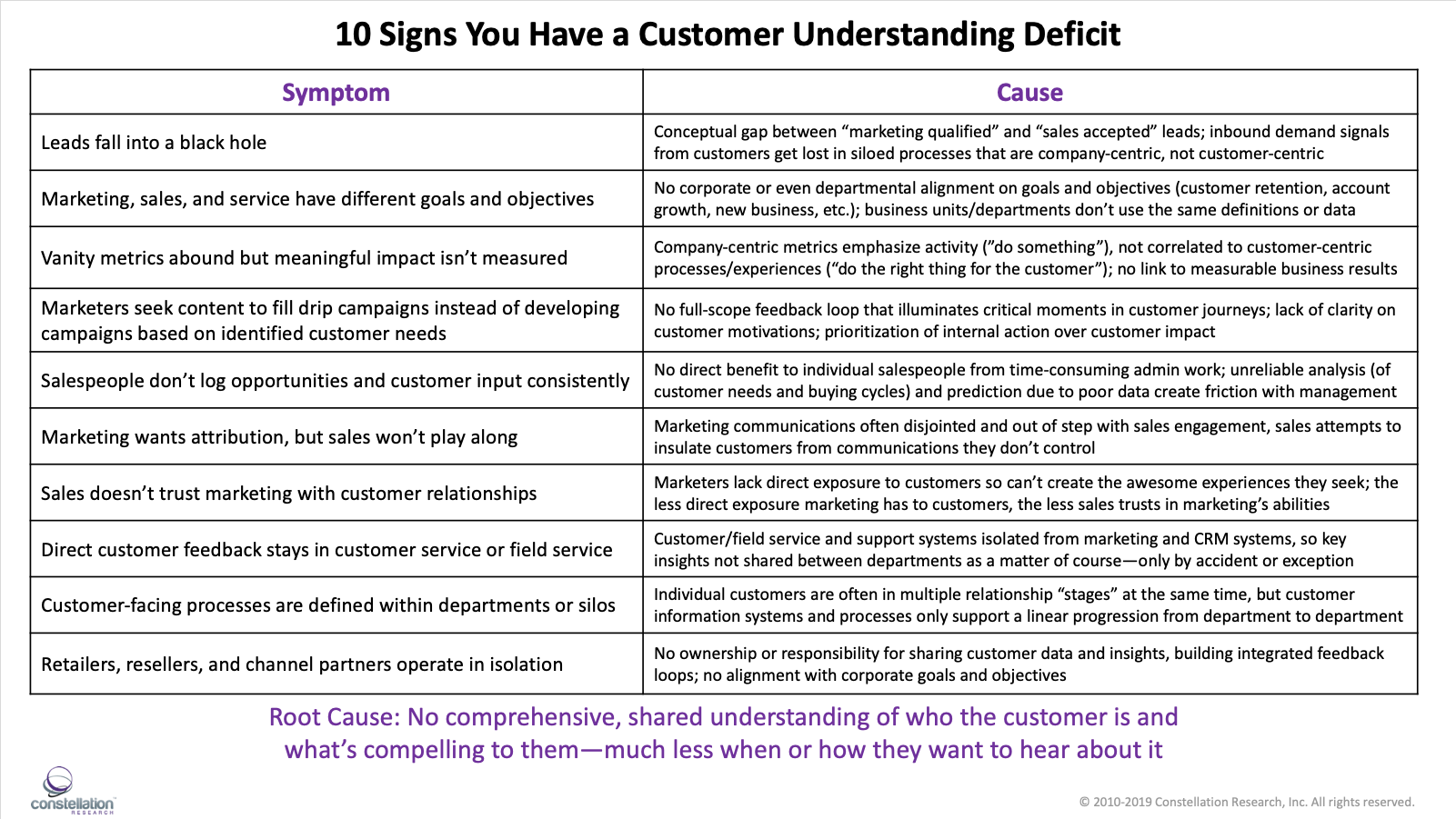
Here are 10 common symptoms of the problem and why it happens:
Three Things To Do About It Right Now
So how do we fix it?
1. Define What It Means to Serve Customers Well in Your Business
The first step is to concentrate on the most important business objective: serving customers. What does that look like for you? What should or could it look like? (Warning: If you don’t buy into the principle that the best way to serve your business is through serving your customers, this blog isn’t for you. And no, I’m not interested in that timeshare.)
To serve your customers well, you need to know them well enough to anticipate their needs. Get it right and you’ll not only have a clear idea of why and when customers are most motivated to buy what you offer, you’ll also know how, when, and where to communicate with them most effectively. Your service will be timely and even preemptive. Your marketing, sales/commerce, and service organizations will work together like a well-oiled machine to build durable, mutually sustainable customer relationships based on great experiences.
With customer understanding at the heart of your business, it’s then possible to build the organizations, processes, and technology infrastructure that power insight-driven experience design (IXD).
2. Think About Your Employees—All Your Employees—Differently
IXD is all about enabling employees with the right tools so that they can create workflows that cross departmental boundaries to support actual customer journeys, not the mythical ones we might like them to follow. It’s also about empowering those same employees with the information they need—in context—at the appropriate moment in time so that they can make the best decisions to serve customers, whether they’re in marketing, sales, service, or any other part of the organization.
The best people to tackle the myriad challenges inherent in serving customers better are the ones directly involved in doing it. That means everyone, regardless of their role or seniority. We have technology tools today that make it possible, now we need to empower employees, give them clear direction on the objectives, and trust them to make the right decisions.
The combination of digital communication, cloud services, APIs, data analytics, AI and machine learning, and low-code/no-code apps makes it possible to design customer experiences that convey the sincerity and relevance of the best in-person interactions in any context or channel. Even so, the best tools in the world will never make it happen without a clear—and very human—understanding of customers.
3. Decide Where To Start
If history has taught us anything, it's that a big-bang approach to major change will likely fail. Establishing the principles of customer understanding and building the capabilities for IXD require a strong vision but an interative process. Where to start depends on the unique circumstances of your organization. How much direct influence do you have personally? Who weilds the greatest influence in your organization, individually or departmentally? Who are the most capable and dynamic leaders? Who has the greatest short-term interest in making the requisite changes?
Cherry-pick your starting points and use cases or customer journeys based on what will generate the best initial results and the greatest interest internally. Build an action plan designed to make the most of opportunistic interest, build momentum, and create a steady rate of change. With the right support and constant, clear communication on the goals, it's easy for people to buy into serving customers better. It not only feels like the right thing to do, it usually is.
For more on how customer understanding and IXD make it possible to compete and win in the experience economy, read Customer Understanding: The Key to Insight-Driven Experience Design.