
Results

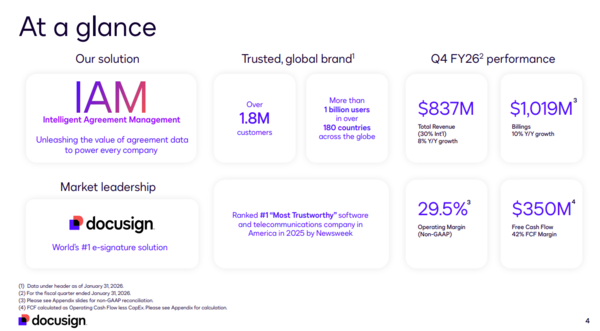
DocuSign reported better-than-expected fourth quarter results and upped its outlook for the first quarter and fiscal 2027. The company reported earnings of 44 cents a share on revenue of $836.86 million, up 8% from a year ago. Non-GAAP earnings of $1.01 a share topped expectations.

Wall Street was expecting DocuSign to report fourth quarter non-GAAP earnings of 95 cents a share on revenue of $828.22 million.

For the first quarter, DocuSign projected first quarter revenue of $822 million to $826 million. For fiscal 2027, DocuSign projected revenue of $3.48 million to $3.5 million. Those results were ahead of expectations.

DocuSign Q4 2026

Speaking at the Constellation Research Futures Forum, Tarkan Maner, President and Chief Commercial Officer at Nutanix, said that CEOs have to answer the AI question, but more pressing issues are also migrations from competitor VMware and others. "This Broadcom VMware migration is one of the biggest issues going to hit our industry in the next 20 to 24 months. And I don't think a lot of people are understanding this," said Maner. "This is going to create more opportunities for AI applications in the enterprise."

AMD is investing $150 million in Nutanix shares at $36.26 as the two companies are partnering on enterprise AI. The two companies are pursuing a joint roadmap to integrate AMD ROCm and AMD Enterprise AI software into the Nutanix Cloud Platform and the Nutanix Kubernetes Platform, which will use EPYC CPUs and AMD Instinct GPUs. The deal equates to more distribution for Nutanix. AMD will also fund up to $100 million to support joint engineering and go-to-market efforts. Separately, Nutanix reported better-than-expected fiscal second quarter results.

Fidji Simo, OpenAI’s CEO of applications, has told employees to stop focusing on side projects and refocus on coding and business users. The upshot is that the company can't do everything all at once as it is taking fire from Anthropic. The comments at an all-hands meeting were reported by The Wall Street Journal. I can't say I disagree with Fidji. At some point, OpenAI won't be able to endlessly raise money and investors aren't going to put up with the company being spread to thin. OpenAI is chasing AI chat ads, devices, superintelligence and being an enterprise player. If OpenAI can't always raise money, it will have to be a lot more strategic.

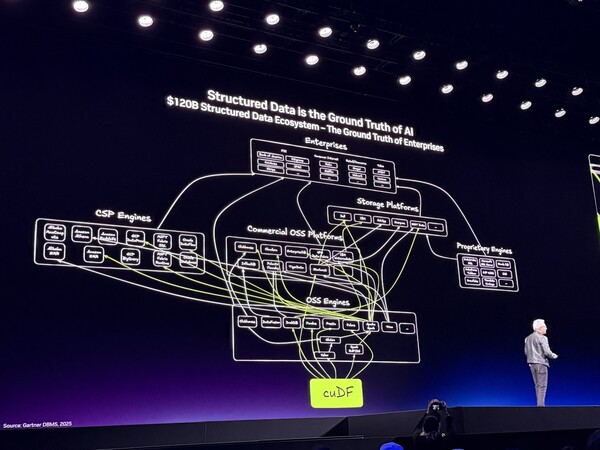
From Nvidia's GTC 2026 and Jensen Huang's keynote.

"I know how many of you grew up with GeForce. GeForce is Nvidia's greatest marketing campaign. We attracted future customers, starting long before you could afford to pay for it yourself. Your parents paid. Parents paid for you to be Nvidia customers, and every single year they paid up, year after year after year until someday you became an amazing computer scientist and became a proper customer. This is the house that GeForce made 25 years ago."

OpenClaw founder Peter Steinberg was asked about why he started OpenClaw. The short version: "Sometimes you just want to talk to your computer," he said. "You also want AI that actually does things."

Steinberg, who counts Nvidia CEO Jensen Huang as one of his biggest fans, said:

"I wanted this since May. And to me, it was so obvious that all the big labs would be building it. The months passed and it was November and there was still nothing. And was like oh I have to do it myself? I just vibed it into existence basically. And then ever since it's been a rocket ship, but clearly people want AI that actually does things like. You have your own identity and now we, we're heading into a future where we make this possible."

Nebius said Meta has signed a five-year agreement for $12 billion in dedicated capacity in multiple locations. The deployment will be based on Nvidia's Vera Rubin platform. Nebius said it will start delivering the capacity in early 2027. Meta has the option to purchase another $15 billion of upcoming Nebius infrastructure over five years to potentially bring the total contract value to $27 billion.