


AI doesn't replace engineering rigor, says Altimetrik CEO
Artificial intelligence has revamped the software development and building systems with code generation, but it doesn't replace engineering rigor. If anything, enterprises need more enterprise rigor to ensure you're not scaling code problems with AI.
That's a takeaway from Raj Sundaresan, CEO of Altimetrik and AI-focused services firm. "AI is being embraced and that's exactly the reason I keep finding engineering crises," said Sundaresan. "Companies believe that bringing in AI means you can lower the bar because AI will take care of it. It's even more important for us to ensure that the engineering rigor stays and that there's enough scrutiny happening before anything is pushed to production."

"AI is a huge change, but you don't drop your precision engineering," he added.
Sundaresan was speaking at Constellation Research's Future Forum. The forum features 120 public company CEOs and board members that collectively have more than $500 billion in revenue. The three-day forum is operating under Chatham House rules for many of the decision-makers and buy side.
Sundaresan's take was echoed by other decisionmakers who said that the biggest risk of AI code generation is scaling bad software. Although coding is believed to be dead on arrival, developer skills are more needed than ever for integration, spotting issues and knowing how to leverage the AI.
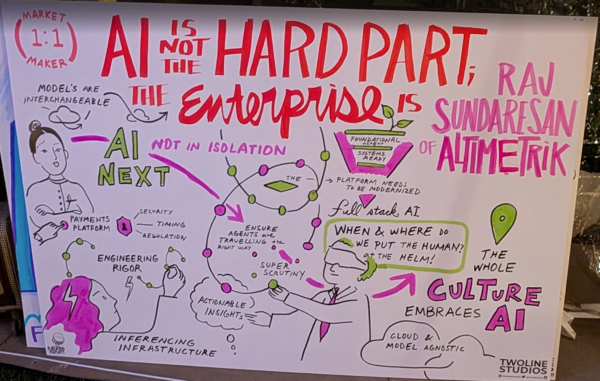
Other takeaways from Sundaresan's talk:
- AI isn't a separate project that should be isolated in the enterprise. Integration of AI across all processes and systems is critical.
- Enterprises need to modernize data, platforms and operations as a foundation for AI. AI needs a full-stack approach. "Bring that foundational aspect of AI. Bring in the intelligent systems and operations instead of just spaces. You have to be very to be very systemic with data pipelines and monitoring and manage your inference so it is true," said Sundaresan.
- Altimetrik is focused on "human at the helm" over human in the loop. Humans should oversee and orchestrate AI/agent systems, ensuring security, orchestration and proper outcomes. "It has to be human at the helm and ensure that you're leading through the change," said Sundaresan.
- The real challenge to implementing AI is cultural and organizational. Make sure AI is part of everyone’s work, guided by the CEO and measured by actionable outcomes.
- Frontier models clash with enterprise reality. Frontier customers assume enterprises have green field conditions, but companies have legacy systems and constraints hampering adoption. =
- Model choices don't matter as much as delivering value. Sundaresan said, "the difference between the frontier models is minimal." "If you're chasing models, you will be chasing your tail," he said. "We want companies to take the models, adopt them and bring value and create new revenue generation. It's not about the model itself."
- Small models that are domain specific will win. Near‑term future is in smaller, domain‑specific models derived from large open‑source models, running in private or controlled environments for security and business focus.
- "In the next six to twelve months you’re going to see small language models which are very domain specific and very business focused. And this could be also within your private cloud, and that's where I think the whole market will be," said Sundaresan.
- Enterprises and government need to put their strategic focus on inferencing and distilling multiple frontier models into domain-specific knowledge. "The model training is one aspect. Inference is another one. I think that's where the market is going to trend towards, where you're going to be focusing a lot more on inferencing with the models you have," said Sundaresan.
Larry Dignan is Editor in Chief of Constellation Insights at Constellation Research, where he leads editorial coverage focused on enterprise technology, digital transformation, and emerging trends shaping the future of business. He oversees research-driven news, analysis, interviews, and event coverage designed to help technology buyers and vendors navigate complex markets with clarity and context. ...
Read morePublished
Author
