


Cisco's Patel on space data centers, AI infrastructure and hiring young workers
Cisco Jeetu Patel, President and Chief Product Officer at Cisco, is excited about the AI-driven future, but can't ignore the risks. Patel talked space data centers, hiring the next generation and the risks and rewards ahead.
Here's a look at what Patel had to say at Constellation Research's Futures Forum about the current AI landscape. The forum features 120 public company CEOs and board members that collectively have more than $500 billion in revenue. The three-day forum is operating under Chatham House rules for many of the decision-makers and buy side.
Volatility is the new normal. Patel noted that AI combined with geopolitics and overall volatility has forced decisionmakers to continually pivot. "Projecting even six months out, nine months out, is actually very disorienting, because it's very hard to predict what's going to happen," said Patel.
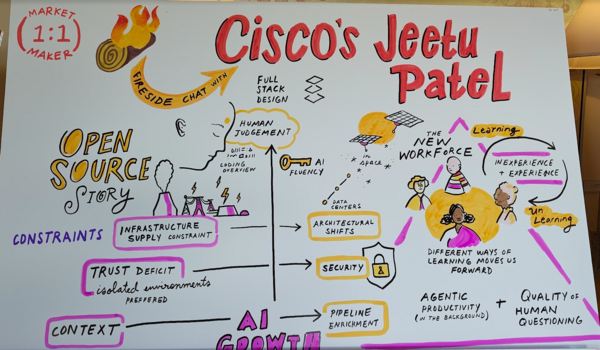
Infrastructure constraints leading to space data centers. Patel said the infrastructure constraints are massive. There's not enough power compute and network bandwidth in the world to satiate the needs of AI that tends to be universal. "I think people keep comparing this to the dot-com days, and I think the difference is every piece of supply that's available right now is actually being consumed. So, it's not like you have to grow into the demand. The demand is there," said Patel.
Those constraints mean architecture will change because you won't be able to bring that much power to data centers. Patel said space will also be an option.
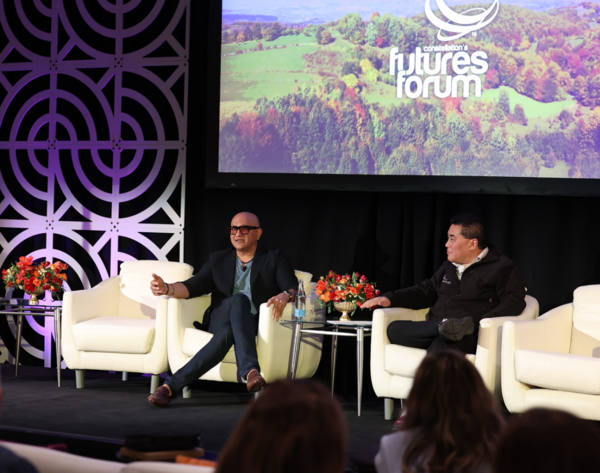
"I think space data centers are probably three to five years. In the five-year range, you'll start to see some meaningful advancements in space. Just because there's so much more power available there and solar is more effective," said Patel.
- Cisco reports strong Q2, sees networking, AI infrastructure surge
- AWS CEO Garman said space data centers likely to take longer
- Nvidia launches space data center effort
Digital trust. "There's a huge trust deficit. People just don't trust systems," said Patel. This trust issue will be compounded by developments such as OpenClaw. There will be a sprawl of AI agents and outdated security systems. Nvidia GTC 2026: Nvidia launches NemoClaw, eyes to pair with DGX Spark, DGX Station
Data gaps. Agents will need to be enriched with context and data. "These agents need to get enriched with context, and if you don't enrich them with context, they're still going to make decisions, and those decisions are just going to be uninformed decisions. But so, you need to make sure that the context enrichment and the data pipelines that need to be there within organizations," said Patel. "I think most organizations aren't ready with going out and getting their data apparatus in place to go out and reach the context."
Foundational models and open source. "I think United States needs to have an open-source story that's going to have to be pretty robust. I think it actually makes a huge difference if your foundation models have an open-source component," said Patel.
Geopolitics. "It's very hard to have a product strategy these days without thinking about what happens strategically within the market as well," said Patel.
Psychology and change management. "The amount of advancements that we're making in coding are so huge that it's very hard to predict what happens even six months from now. And so, I think that that creates a level of you have to make sure to not be frenetic, but you have to maintain a very high pace and velocity within the company without being frenetic," said Patel.
He added that change management is going to be critical since the workforce and processes are being upended.
"Oddly enough, the thing that is the hardest thing for companies to deal with is managing the human psychology of the engineers while you're going through this transition. Because one, you have to make sure that they're moving at a really fast pace. And two, they have to make sure that they feel a level of security in the fact that when they use these technologies, they have a higher chance of success than if they don't."
Hiring younger workers. "I don't believe in this notion that entry level jobs are gone and you shouldn't hire younger people. I think that's the stupidest thing someone can do as a company. Early in your career, you come with not only good ideas but also a level of absence of knowledge which allows them to ask questions that someone who has got the bias of experience just will not be able to ask," said Patel.
He added:
"We have to kind of think through this where the augmentation of new talent coming in cannot be just super senior people. It has to be a balance, and you have to figure out a way to unlearn as much as you learn, because experience has a huge benefit and pattern recognition, it has a huge liability in creating, you know, kind of unfounded bias.
I actually think knowledge is not going to be the differentiator for the next generation. It's the quality of questions that you can ask that'll be the differentiator, because that its intelligence is completely commoditized."
Larry Dignan is Editor in Chief of Constellation Insights at Constellation Research, where he leads editorial coverage focused on enterprise technology, digital transformation, and emerging trends shaping the future of business. He oversees research-driven news, analysis, interviews, and event coverage designed to help technology buyers and vendors navigate complex markets with clarity and context. ...
Read morePublished
Author
