


Nvidia Nemotron: Much needed open-source model champion in US
Nvidia's launch of its latest Nemotron models cements its role as the leading open-source LLM company in the US. For Nvidia, open-source models are all about playing the long game with AI systems and insulating its business.
The company launched Nvidia Nemotron 3 Super, a 120-billion parameter open model designed for agentic AI. The model is being used by AI native companies, notably Perplexity, as well as enterprise software vendors such as Amdocs, Palantir, Cadence and Siemens. Neomotron 3 Super will expand its enterprise reach via all the cloud providers, neoclouds including CoreWeave, Crusoe and Nebius, inference providers, data platforms and systems integrators.
As previously noted, enterprises have to consider open-source models or risk locking into a proprietary AI model stack that may be cheap today and eat at your operating costs tomorrow. The US is dominated by proprietary large language models (LLMs) by OpenAI, Anthropic and Google. Open-source models are dominated by China, which features Alibaba's Qwen, DeepSeek and various offerings.
- Why enterprise AI leaders need to bank on open-source LLMs
- Nvidia launches Nemotron 3 open models to enable multi-agent systems
With Meta all but abandoning Llama, Nvidia is quickly becoming the primary open-source LLM player in the US. It is the champion of US open-source models and is devoting billions of dollars to the effort. IBM's Granite family of models is in the mix.
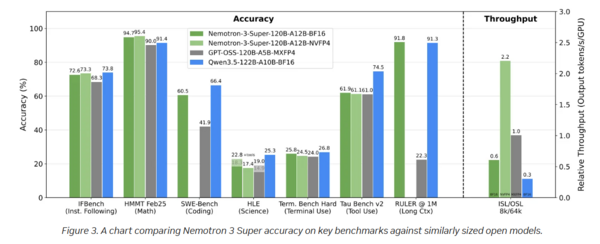
Nemotron 3 Super has a hybrid architecture with 4x higher memory and compute efficiency, a mixture of experts approach and 3x faster inference. In the benchmarks, it's clear Nemotron's competitive set is China models. Nvidia is also offering cookbooks and everything developers need to deploy Nemotron.
At GTC 2026, Nvidia will likely flesh out more news and advances from its Nemotron family.
Here's why Nvidia is all about Nemotron and open-source LLMs.
Insurance for volatile geopolitics. If the only US option is expensive proprietary models, companies are going to be slower to adopt AI. With China leading in open-source LLMs, it stands to reason that its models will be used heavily. The problem with China leading open source is outlined in Nvidia's annual report.
The US government "is considering restrictions that would limit our ability to support third-party applications and models built on open-source foundation models originating in China. Such restrictions, if implemented, would favor our foreign competitors and negatively impact our business."
For Nvidia, open-source models are about playing the long game of broad developer adoption. "The recent rise in high-quality open-source foundation models is making advanced AI capabilities broadly accessible. Open-source AI is dependent on developer adoption and if deployed on our competitors’ platforms, it could reduce demand for our products and services," Nvidia said in its annual SEC filing.
Nvidia's business moat is software. Sure, Nvidia primarily monetizes AI via its GPUs, but it has more than 7.5 million developers building on its CUDA platform and adjacent software tools. Open-source models create a developer flywheel. "We are the leader in accelerating and releasing open AI models which enterprises, sovereigns, and startups can leverage to develop and run applications on our platform," said Nvidia. "We evangelize AI through partnerships with hundreds of universities and tens of thousands of startups through our Inception program. Additionally, our Deep Learning Institute provides instruction on the latest techniques on how to design, train, and deploy neural networks in applications using our accelerated computing platform."
Enterprises won't broadly adopt agentic AI directly or indirectly without open-source models. Most enterprises will wind up adopting agentic AI via software vendors. Software vendors, say ServiceNow or Salesforce, view LLMs as cost centers. It makes more margin sense to deploy focused use-case focused open-source models than be locked-in. The best LLM for a particular use case is the most cost-effective one.
Revenue diversification and competition. Nvidia is valued more than the GDP of Japan due to a handful of customers with AI infrastructure FOMO. Open source does the following:
- Keeps pressure on LLM giants to innovate. Open-source models are roughly 6 months behind frontier models. Nvidia needs Nemotron so proprietary AI giants keep innovating on at a breakneck pace and spend more on GPUs. Nvidia’s worst-case scenario a fat and happy OpenAI or Anthropic.
- Broadens adoption. In the long run, even Nvidia realizes you can't rely on a half dozen players to drive growth. It needs to diversify its customer base and the best way to do that is its software ecosystem powered by open-source models.
Larry Dignan is Editor in Chief of Constellation Insights at Constellation Research, where he leads editorial coverage focused on enterprise technology, digital transformation, and emerging trends shaping the future of business. He oversees research-driven news, analysis, interviews, and event coverage designed to help technology buyers and vendors navigate complex markets with clarity and context. ...
Read morePublished
Author
