


Boomi CEO on data movement, wrangling AI agents and SaaS
Boomi CEO Steve Lucas said data movement is critical to AI workloads and AI agents. The company recently unveiled its next iteration that revolves around data readiness and activation. He also had some notable rants.
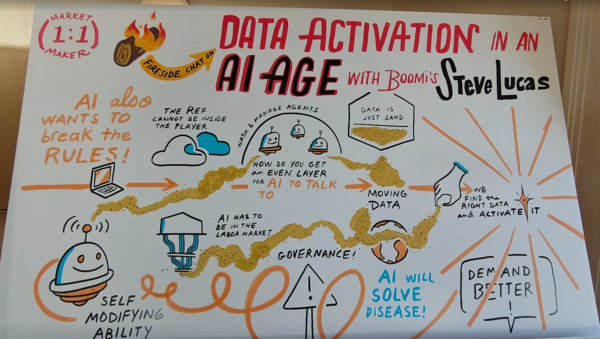
Speaking at Constellation Research's Futures Forum, Lucas said data isn't the new oil. It's more like sand. "Data is just sand. That's all it is. There's plenty of it. The Sahara is full of it, and we don't activate very much of it. We use next to none of it. The average enterprise uses maybe 20% of the data they store. What do you do with the rest of it? There's value in it. At Boomi, what we do is we move data to your apps, your databases, your APIs, your systems, your processes. We move data. We move more data per second by 2x than Visa does, explained Lucas.

Data movement is becoming a frontline issue as AI agents proliferate. At Nvidia GTC 2026, CEO Jensen Huang had a chart showing data movement and highlighted how structured data is critical to AI context.
"If you're moving data and getting it into the right place, it's the difference between knowing something happened and doing something about it," said Lucas, who said that's the problem Boomi is trying to solve.
More:
- ServiceNow's Tzitzon on AI's pace, teams and being multi-dimensional
- Cisco's Patel on space data centers, AI infrastructure and hiring young workers
- AI doesn't replace engineering rigor, says Altimetrik CEO
Data readiness will be a big issue as AI agents proliferate. Lucas said the pace of change in AI is a lot, but CEOs tend to be coalescing around preparing their data for AI use. "Everything we've been talking about in business intelligence for 30 years just gets worse with artificial intelligence. That's the challenge. We're finding organizations are calling and they're just saying, 'look, we just need to get our data. We need to deliver it to AI in real time,'" said Lucas.
On other topics:
Agents are going to have a management headache. "We're at that point where we have to be able to watch and manage these agents with compliance, country by country, protecting sovereignty, the 1,200 potential pieces of legislation across just the US alone. Forget globally. How are we even going to manage this? So, it's really cool that you're going to have a process that has 200 agents in it that swarm and make decisions. How will you know what decisions they make on whose behalf, with what data did they access? That's what we're this solution that our agentic management solution, or governance solution, literally lets you look at," said Lucas. "If your management processes were messed up to begin with, they even more messed up trying to manage those agents, because you don't even know what's going on completely."
The state of SaaS. Lucas had a rant bubbling up. We'll just do this in full:
"Humans don't like rules. We generally operate without them, right? So why did we build ERP, CRM, HCM? Why did we build these things? Because we need to apply rules to the humans. These are logic gate systems. We built them to do that. Let's just jump to artificial intelligence. Is AI learning from humans, or logic gates? AI wants to break the rules. They're the logic gates, and let's put them inside the players. If anyone's ever played a pickup basketball game, we all know that that is ridiculous, right? And it's like, I call foul, and everybody protests, and you just change the rules. The point is, we're at a place in time where, like, there's no way these logic gates go away.
I had this genius the other day say, 'well, Steve, you know, I can build a CRM with AI.' Oh, that's awesome. Free CRM has been around a long time. It's called open source. It has anybody want to run and operate your own CRM system? Nope, that's a stupid idea. It's just stupid. So, we'll talk about these things and it's 'we'll just have AI do the maintenance, the operation, the support, the upgrades.
Why are we seeing these deflations in market caps right? Because we can't see past the change. I don't know what it's going to look like, but I do know there's no freaking way I want and agent or whatever running around my organization with the ability to self-modify when I have to remain compliant to long list of things."
The human element of AI transformation. Lucas had high praise for LLM giants, but the reality is LLMs are great technology, but CEOs have to be wary of handing over the keys. LLMs are the equivalent of players that are also referees. "We're not putting the referee inside the player. That's not how this is going to work. We, this group right here, can influence massive architectural decisions in the world. We can. And as brilliant as people are that founded frontier models and they'll be trillionaires and all that great stuff. It's not their call. It's ours. We get to choose. I'm not playing that game. We're happy to work with them. We'll build agents to do all the things. I think humans win in the end. This is your red line," said Lucas.
AI economics. Lucas said the current AI economics don't work. "What OpenAI has demonstrated so far is that they can lose one to $2 billion a month. If you think about it, OpenAI is saying AI is going to eat into the labor market. Well, it's going to have to just pay the bills. It's going to have to eat at the labor market. Otherwise, they don't succeed," said Lucas.
Larry Dignan is Editor in Chief of Constellation Insights at Constellation Research, where he leads editorial coverage focused on enterprise technology, digital transformation, and emerging trends shaping the future of business. He oversees research-driven news, analysis, interviews, and event coverage designed to help technology buyers and vendors navigate complex markets with clarity and context. ...
Read morePublished
Author
