Results

Digital Transformation Digest: Slack Off the Block, Whitman to Uber? And More

Constellation Insights

Slack off Amazon's shopping list?: Last month, Bloomberg reported that Amazon was contemplating an acquisition of group messaging platform Slack for up to $9 billion. Now the wire service is back with a new report, also citing anonymous sources, stating that Slack is raising a $250 million funding round, and that acquisition talks "have cooled in recent weeks."

POV: While Slack has five million daily active users, it only launched its enterprise edition in January. But Slack maintains that it has brought a mature initial product to market that's ready to serve large companies at scale. Slack integrates with Microsoft's Office platform but also competes with Redmond's Teams product. Would it make sense as part of Amazon? Constellation VP and principal analyst Alan Lepofsky explores that question right here.

Whitman taking the wheel at Uber?: From the "didn't see that one coming" department, Bloomberg is also reporting that Hewlett-Packard Enterprise chief Meg Whitman is on the short list of candidates to fill the empty CEO slot at embattled ridesharing company Uber. An HPE spokesman told Bloomberg that Whitman is "fully committed to HPE and plans to stay with the company until her work is done."

POV: Whitman would be an ideal CEO for Uber on a number of fronts. She's a highly seasoned and senior tech executive who has led major corporate transitions, namely the 2015 split of HP into two separate companies. (However, opinions vary greatly on how well that transition has gone.) Whitman is also politically well-connected, something Uber needs as it fights regulatory battles.

In addition, Whitman is a woman. Uber founder Travis Kalanick stepped down earlier this year, with the final straw being revelations about a pervasively sexist environment at the company. Whitman is respected for far more than her gender, of course, but Uber's pledge to change its culture would carry more weight with somebody of her stature at the helm.

Will Whitman go? The HPE spokesman's quote really doesn't rule anything out. Committments don't have to last forever and Whitman may have already decided her "work is done" there. She has also chosen this week to announce her departure from HP's board of directors.

Facebook adds more business features to Messenger: Chatbots are becoming table stakes for any company's sales, marketing and support business, particularly in the B2C arena. To that end, Facebook is adding a series of new features to its Messenger Platform focused on delivering more useful and intelligent chatbots. Here are the key details from a Facebook blog post announcing Messenger 2.1:

Built-in NLP to enhance automated conversations: This is a simple way for developers to incorporate NLP into their bots. When Built-in NLP is enabled it automatically detects meaning and information in the text of messages that a user sends, before it gets passed to the bot. This first version can detect the following entities: hello, bye, thanks, date & time, location, amount of money, phone number, email and a URL. This is the first step in bringing NLP capabilities to all developers, enabling brands to scale their experiences on Messenger.

Other important new features include improved support for payments, additional "call to action" buttons—including Shop Now and Get Support—developers can use on pages. Facebook's blog post goes into more detail.

POV: Facebook is still in the early stages of monetizing Messenger, currently serving up ads to small numbers of users, CEO Mark Zuckerberg said on the company's Q2 earnings call this week. There's a longer-term strategy in place, he added:

The biggest strategic thing that we really need to do in messaging right now is make it so that people organically interact with businesses and that that is a good interaction both for people and for the businesses.

If you're a business and you have a higher ROI for interacting with a person in your messaging thread than you do on the mobile web or trying to get them to install an app, then that creates this positive feedback loop, where you're going to point your ads towards the Messenger thread. You're going to invest more of your engineering resources in building out the content and experience on the Messenger thread.

POV: Zuckerberg and other executives fielded a slew of questions from analysts about Messenger monetization on the call. Again and again, they painted a similar response: Facebook will take its time figuring out how to make money on Messenger while also pleasing users in the process. It's a good way to go but how Facebook executes the strategy will be something to watch.

Adobe adds more AI to Target: We hear the phrase a lot—mass personalization at scale. That's what Adobe is attempting to deliver with an update to Target, the ad-targeting engine derived from the acquistion of Omniture. For one thing, brands will now be able to add their own algorithms and data models to Target. Adobe is also integrating Target with its Sensei machine learning and AI framework.

What kind of personalization? Adobe's announcement gives the example of a hotel chain using Target to deliver offers to reward members based on the fact it knows the customer has a track record of traveling to warm places.

POV: "Marketers have been challenged with segmentation and the one-click personalization with be a welcomed feature," says Constellation VP and principal analyst Cindy Zhou.

Legacy watch: Mega-bucks government IT system holding data hostage: A $364 million computer system that is supposed to run Rhode Island public assistance services is unable to furnish federally-mandated quality control reports for its food stamp program. While it's just a threat for now, the feds say continued noncompliance could lead to "suspensions/disallowance" of federal dollars, as the Providence Journal-Bulletin reports.

Specifically, the system can't separate out food stamp information from other public-assistance data. It was launched last year despite protests from federal officials that it wasn't ready—calls that were apparently all too prescient. Other hiccups with the system have led to what was at one point a backlong of 14,000 pending applications for benefits.

POV: System failures and government IT projects unfortunately are phrases often said in the same sentence. This is the largest IT project in the state's history and to say its rollout wasn't executed well is an understatement. The question now is how quickly the state can stabilize it, and just as importantly, determine accountability for its shortcomings.


Future of Work Marketing Transformation Matrix Commerce Next-Generation Customer Experience Tech Optimization

Event Report - July 2017 Microsoft London AI Event

We had the opportunity to attend Microsoft’s AI event held in London on July 12th 2017. The event was Microsoft R&D centric, with R&D Leader Harry Shum leading the presentation and more key R&D leaders at hand to share progress and plans that Microsoft has in AI space.


So, look at my musings on the event here: (if the video doesn’t show up, check here)


No time to watch – here is the 1-2 slide condensation (if the slide doesn’t show up, check here):


Want to read on? 

Here you go: Always tough to pick the takeaways – but here are my Top 3:
 
Microsoft gains momentum with broad AI portfolio – One can argue that Microsoft may have come late to the recent Machine Learning / AI market trend, but the vendor is certainly into the market now, with a broad, possibly one of the broadest offerings. AI changes almost all of Microsoft’s products, and the vendor has a broad product portfolio – so this does ultimately not come as a surprise at all. So, we see AI offerings coming to Microsoft Office, to Outlook all the way to the virtual keyboard offering SwiftKey (that Microsoft acquired February). Languages remain a border for communication and the online translation capability that Microsoft has built – are very good, embedded in to PowerPoint at first. Yours truly was able to test it with English, German and Italian – and it worked better than I expected. Especially as the translation model still operates on a generic universal (but likely monster size) pattern recognition model. It’s fascinating to see how well an older technology approach can do when pushed very hard (and on the flipside, shows that e.g. Apple – using the same architecture for Siri – has not done much to help her understand users). Speaking of Apple – Microsoft continues its ‘embrace & extend’ strategy for iOS and Android, also for AI, with a release of the “Seeing AI” product – a fun implementation of picture / pattern / emotion recognition to understand and see how the machines can make sense of the world around us. Finally, Microsoft goes all the way to the roots of its AI efforts, to Bing, where almost all of AI started and showed the Bing Entity Search API. This API, as well as the gesture API of Project Prague are interesting and important developer offerings to attract them to build next gen Applications on Microsoft cloud technology.

Beyond the direct product impact, Microsoft announced “AI for Earth” bringing the heft of R&D and deep pockets of Microsoft to the challenging environmental questions that the world sees – and where AI certainly can help. 
 
Packed Event
Dedicated AI team in Microsoft Research – Microsoft also announced the formation of a dedicated team within its research organization that will focus on a more integrative approach to AI. The team of more than 100 researchers has representation in all the company’s labs around the world, including  the UK, the location of the event. Good to see Microsoft adhering to good research principles when it comes to basic research (as it needs to happen with AI) – starting with a cross-disciplinary approach. Microsoft has the deep pockets to do this, one of the few vendors who can, and it will be interesting to see what the approach will yield. Given that there is a global arms race towards usage of AI for all kinds of computing questions, it will be key that over the multi-disciplinary approach Microsoft doesn’t not neglect speed to market. But that’s a common challenge Microsoft has been able to master well during its overall existence.
 
 
Chris Bishop announced AMLab partnership


Democratization of AI and Ethics – Always good to see the commitment to bring AI to more people and use cases, one of the leitmotivs of any Nadella presentation these days. The event was certainly in line with this and presented many examples for it – all starting with AI for Earth. And good to see that Microsoft has created an ethical design guide for all its employees working on AI. An important subject and mechanism amongst the ‘grown up’ AI vendors.
 
Great London Views
 

MyPOV

A notable event to attend, showing Microsoft’s across the board commitment and push to AI. AI everywhere is pretty much at play at Microsoft and is showing first and promising results. Having the event in London showed the R&D investment that Microsoft is doing beyond Redmond / the US and the UK certainly has a substantial contribution to AI in general and a significant Microsoft presence. But it is early days, e.g. one of the mechanisms that have always worked for Microsoft - connecting it all into a suite of consistent and user centric offerings has not happened yet. E.g. translating a slide with a picture of a person in PowerPoint, mentioning the name of the person - will not (yet) make it a recognized person in the “Seeing AI” app. And there are of course the downsides from a data privacy perspective – but Microsoft must realize that its competitors in the space are ruthless at leveraging those synergies. It is likely Microsoft needs (and will) do the same.

On the concern side, Microsoft has to find a match to the uptake in mindshare and real-world AI deployments that Google’s Tensorflow is seeing, if not Tensorflow will be the Kubernetes of 2017 – a Google launched open source offering that dominates an important aspect of the cloud infrastructure. And one can argue that Tensorflow is even bigger stakes than Kubernetes, as it not only dominates the AI / Machine Learning equation, but due to data gravity pulls along substantial data storage and processing load. Not to mention the model training and execution loads.

But for now, it is good to see the progress at Microsoft, who is pushing AI wide and deep across its existing products, as well as new offerings. A deep R&D and research check book certainly helps, but must show tangible, shorter horizon returns to capture what matters most in AI these days – cloud load – both from a storage and compute perspective. Stay tuned.


Want to learn more? Checkout the Storify collection below (if it doesn’t show up – check here).


Tech Optimization Data to Decisions Innovation & Product-led Growth Future of Work Next-Generation Customer Experience Digital Safety, Privacy & Cybersecurity Microsoft ML Machine Learning LLMs Agentic AI Generative AI AI Analytics Automation business Marketing SaaS PaaS IaaS Digital Transformation Disruptive Technology Enterprise IT Enterprise Acceleration Enterprise Software Next Gen Apps IoT Blockchain CRM ERP finance Healthcare Customer Service Content Management Collaboration Cloud CCaaS UCaaS Enterprise Service Robotics Quantum Computing developer Metaverse VR Supply Chain Leadership Chief Executive Officer Chief Information Officer Chief Technology Officer Chief AI Officer Chief Data Officer Chief Analytics Officer Chief Information Security Officer Chief Product Officer Chief Digital Officer Chief Operating Officer

Infor Advances Data Agenda With ‘Coleman’ AI, Birst BI Integration

Infor lays out plans for artificial intelligence and cloud-based business intelligence and analytics. Here’s what customers need to know.

Infor entered the increasingly crowded artificial intelligence (AI) arena July 11 by introducing its Coleman AI platform. Unveild at the company’s Inforum 2017 event in NY, Coleman was described as a language- and image-savvy AI platform that will automate rote tasks and augment human capabilities in a range of industry-specific use cases. Infor also used Inforum to detail its plans for Brist, the cloud-based business intelligence platform acquired in April.

Named for ’60-era NASA data scientist Katherine Coleman Johnson, one of three African American NASA mathematicians portrayed in the 2016 film “Hidden Figures,” Coleman builds on Infor assets including machine learning capabilities for retail acquired with Predictix and the work of the company’s Dynamic Science Labs. The labs have developed apps including a price optimization app for distributors and an inventory optimization app for healthcare providers.

Existing apps and machine learning capabilities are being folded into the Coleman portfolio, and Infor says it’s also well along in developing a unifying data platform for AI. Built on Amazon Web Services infrastructure, including an Amazon S3 data lake, the platform will aggregate petabytes of data available from Infor’s various industry-focused CloudSuites. The data will fuel AI-powered optimization, recommendation, and decision-automation services that will be delivered through Infor’s Ion API-integration platform.

Infor will use the speech recognition and natural language understanding capabilities of the Amazon Lex AI service to power conversational capabilities. This will enable Coleman to serve as a human assistant, answering questions such as, “Coleman, what are the payments outstanding for company X,” or “Coleman, forecast demand for product Y.” Conversational UIs will also support multi-faceted processes with simple requests such as, “Coleman, approve the promotion of Sara Jones.”

With image-recognition capabilities, Coleman will turn smart phone cameras into search tools. Take a picture of a product, for example, and Coleman will be able to identify the product and detail prices, specifications and availability details. Used internally, Coleman will tell workers how much inventory is available, what’s on order, when it will arrive and whether alternatives are available from other suppliers.

MyPOV on Coleman Vision vs. Reality

Infor certainly offered a compelling AI vision, but executives also acknowledged that it’s “early days” for Coleman. Data-pipeline development and modeling is further along in some industries than others, they acknowledged. Smart services for retail are likely to arrive first. As for the ingredients of Coleman, it’s a mixed collection of Infor and third-party IP. It remains to be seen just how it will all come together and when we’ll start seeing smart prediction, recommendation, optimization, and automation services beyond what existed before Coleman was announced.

I’m particularly eager to understand how and whether Infor uses generalized models based on aggregated CloudSuite data and then develops customer-specific recommendations and smart services. With its recent Leonardo launch, SAP talked about combining shared models and customer-specific models. Customers will also want to know whether it’s as simple as “turning Coleman on” from within a CloudSuite, as Infor executives suggested. We have also yet to learn just how much data will be required to generate reliable predictions, recommendations, optimization and automated actions.

Infor’s Birst Acquisition and Plans for Analytics

When Infor announced the acquisition of Birst in April, the first question for customers of the cloud-based BI company was, “will Birst disappear as an independent company?” The answer was an emphatic no. Birst operations continue unchanged under the direction of the existing management team. Birst founder and CEO, Brad Peters, continues as General Manager of what’s now known as “Birst, an Infor Company.”

The first question for Infor customers was, “how will Birst work with my existing Infor BI investments, including Cognos-based reporting tools and Infor BI cubes?” The company laid out detailed integration plans at Inforum.

In the first phase of the three-phase plan, currently underway, Infor customers can swap out like-for-like capabilities that they’ve licensed from Infor for newer, cloud-based capabilities from Birst. For example, customers using Infor’s Cognos-based reporting tools can switch to reporting tools available from Birst. They’ll also be able to add capabilities, at extra cost, that weren’t available from Infor, such as Birst’s ETL engine and self-service data-exploration and visualization capabilities.

Infor has already integrated Birst with Infor Ming.le collaboration and single-sign-on capabilities, but phase two, expected to be completed in September, will bring even deeper levels of integration. For example, customers using Infor BI will be able to use Birst as a cloud-based environment for analysis and reporting. This will enable Infor customers to leverage their Infor BI cubes while also blending in external data sources and taking advantage of Birst’s modern data-exploration and visualization capabilities. Integration is also underway between Infor’s Amazon S3- and Athena-based data lake environment and Birst. This will extend Birst’s big data analysis capabilities.

In phase three, Birst will add predictive capabilities from Infor’s Dynamic Science Labs unit. We’ll also see deeper integration of Birst-powered analytic services into the Infor XI platform as well as ties to Coleman AI services. The delivery date for phase three was unspecified.

MyPOV on Birst Integration

Infor is doing its best to preserve existing customer investments while providing an upgrade path to newer and more extensive Birst capabilities. On the reporting front there’s not a migration path for existing operational reports, so customers will likely gradually phase out existing tools supporting legacy reports while building new reports on Birst. The deeper and more significant value is in Infor BI, so it’s a big win for customers to see those cubes integrated with Birst’s cloud-accessible, self-service analytical environment. Overall, Birst brings significant upgrades to Infor’s analytics layer that will help support the company’s move into big data and artificial intelligence.

Related Reading:
SAP Machine Learning Plans: A Deeper Dive From Sapphire Now
Oracle Launches Adaptive Intelligent Apps for CX
Qlik Plots Course to Big Data, Cloud and ‘AI’ Innovation

Digital Transformation Digest: Sage Scoops Up Intacct, Google Landing Big Cloud Deals, the End of Flash, and More

Constellation Insights

Cloud consolidation: Sage is acquiring SaaS financials vendor Intacct for $850 million, in one of the larger pure enterprise application deals in recent memory. It's the biggest purchase in the history of Sage, which grew steadily in the 1990s through a string of acquisitions. For Sage, the move also takes a key competitor off the table, given the success Intacct has had in replacing on-premises Sage financials packages in midmarket accounts.

Intacct's leadership will remain on board after the deal goes through. The company is one of the most venerable independent SaaS vendors, having been founded in 1999. Intacct's sweet spot has been in companies with between 100 and 1,000 employees, although its current messaging states that its platform is "hard to outgrow." In general, Intacct competes with the likes of Quickbooks, Workday and FinancialForce.

POV: The acquisition seems like a beneficial one to both sides, with Sage paying a handsome premium for Intacct but in return gaining a mature product with a strong U.S. presence and more than 11,000 customers overall. The question now becomes how much Sage devotes to Intaact in terms of resources going forward, particularly with respect to keeping pace with longtime key competitor NetSuite.

Hubspot brings in AI with Kemvi: CRM and marketing software vendor Hubspot is adding some AI capabilities to the mix with the acquisition of Kemvi, a tiny startup that has developed an algorithm called DeepGraph. In essence, DeepGraph is about giving salespeople a headstart on learning more about their customers and prospects, as Hubspot's announcement describes:

DeepGraph uses machine learning technology to help salespeople better understand their prospective buyers. The system identifies new prospects, provides suggestions for creating personalized emails, identifies new market segments, freeing up time that can be spent on more valuable sales tasks. DeepGraph also acts as a knowledge graph with information about buyers, markets, and products, helping salespeople understand the nuances of their customers’ behavior.

POV: The deal is an acqui-hire more than anything else (Kemvi has just two staffers, according to Techcrunch) but gives Hubspot's platform additional AI capabilities to go along with existing ones for lead scoring and personalized content delivery.

Google Cloud Platform's big deals: Whatever Google's enterprise sales division is doing with Cloud Platform, it seems to be working. Either that or Google has now managed to deliver a combination of features and pricing that can deliver hockey-stick growth. In the second quarter, the number of GCP deals worth at least $500,000 grew 300 percent year over year, CEO Sundar Pichai said during Google parent company Alphabet's earnings call:

In terms of serving Cloud customers, we are world-class and available being reliable and those are things we want to stay best-in-class. So, we are clearly planning for that and planning ahead of our infrastructure and we have been consistently doing that.

And Heather in terms of your question about workloads and stuff, we are actually seeing quite a diverse set of used cases across sectors and industries and geographies.

POV: While Pichai characterized GCP as one of the company's fastest-growing businesses, he didn't specify the total number of large deals, or other metrics that would help provide context for the year-over-year growth numbers.

The uptick in deal size makes sense, says Constellation Research VP and principal analyst Holger Mueller. "Machine learning, AI and big data deployments all start with a trial and then get big quickly," he notes. The big money deals have only started coming Google's way in the past two or three quarters, and before that there was a lot of prototyping and validating going on, Mueller says.

RightScale targets cloud waste with Optima: As the IaaS and PaaS markets shake out to four big players—Amazon Web Services, Microsoft, Google and IBM—customers are looking to mix and match services for the best pricing and targeted workloads, particularly as overall usage of cloud grows. RightScale would like to rent you a tool for that. It's called Optima, and builds upon the company's existing portfolio of cloud management services:

Collaborative optimization: RightScale is the first cloud management platform (CMP) to help various resource owners in an enterprise to collaborate to take action on changes to cloud spending.

RightScale Optima includes data from all public and private cloud providers and enables organizations to see usage and cost data in a single unified dashboard; view costs by cloud account, team, or application to understand usage trends; perform chargeback and showback; and leverage tags to allocate costs to departments or business units.

POV: RightScale competes with other independent cloud monitoring vendors, such as CloudCruiser, as well as in-house services offered by IaaS and PaaS vendors. With Otpima, it's betting that customers will want to rely on a third-party—one presumably unbiased toward any particular service—to manage cloud spend.

Legacy watch: The end of Flash: Adobe has set a retirement date for Flash, its widely used but oft-criticized and famously buggy multimedia browser plugin. Flash Player will no longer receive updates after the end of 2020. Adobe is working with a number of partners, including Google and Apple, to phase out Flash over the next few years. (There's some irony in Apple's participation, given that many saw its decision not to support Flash on the iPhone as the proverbial writing on the plugin's wall.)

Flash has been on a steep decline of late. Three years ago, 80 percent of desktop Chrome users visited a site with Flash, but today that percentage is just 17 percent, Google said in a blog post.

POV: While few may truly miss Flash, it's pending doom nonethless stands as a major milestone in the future of the web, and paves a wider path forward for more modern standards such as HTML5.

Marketing Transformation Next-Generation Customer Experience Tech Optimization Chief Customer Officer Chief Financial Officer Chief Information Officer Chief Marketing Officer Chief Revenue Officer

CEN Member Chat: The Future of Work in HCM

During this CEN Member Chat, Holger Mueller, VP & Principal Analyst at Constellation Research, covers what you need to know about the future of work in HCM.

Future of Work Chief Executive Officer Chief People Officer Chief Information Officer Chief Digital Officer On <iframe src="https://player.vimeo.com/video/226033511?badge=0&autopause=0&player_id=0" width="1280" height="720" frameborder="0" title="CEN Member Chat: The Future of Work in HCM" webkitallowfullscreen mozallowfullscreen allowfullscreen></iframe>

IBM Moves the Encryption Debate's Needle Big-Time with New z14 Systems

Constellation Insights

IBM's next-generation Z14 mainframe systems have arrived, and the watch-phrase is "full encryption." That means everything associated with a Z14—from applications to cloud services and databases—can be encrypted at all times with no appreciable performance hit, according to Big Blue.
 
It's a hook that should prove enticing to IBM's mainframe installed base, which tends to buy systems and then wait a few years for the next hardware release to refresh. (The Z13 arrived in early 2015). But the Z14's positioning also adds fuel to the online privacy debate, coming just a few weeks after the Five Eyes nations—the U.S., U.K. Australia, Canada and New Zealand—met to discuss encryption and national security.
 
"There is this clear trend among tech companies and cloud providers to basically stay the hell out of their clients' business, and this is what IBM's 'full Encryption' is all about," says Constellation Research VP and principal analyst Steve Wilson. "The company is saying that while they are providing sophisticated managed services, they are not watching or tracking how those services are used. They are promising that 'we cannot see your data, even if we wanted to.'"
 

This is the same promise being made by others, like Apple, which famously resisted the FBI's demand for a backdoor to an alleged terrorist's encrypted iPhone. "It's colliding with the interests of law enforcement, who are not accustomed to these absolute security features," Wilson says.

IBM's full encryption appears to be more sophisticated than cloud encryption to date, offering containers engineered to military-grade security standards. "This is a bit like a 'smart bank safety deposit box,'" Wilson adds. "The IBM containers don't just store secret data, they allow tenants to use the data and run their own processes, but still in complete secrecy, like a Swiss Bank.

Big Blue "has been promoting the quality and certification of its crypto, which I think is great to see," Wilson adds. "Every company needs to lift its game on behalf of clients. We need to see more systems built to standards like FIPS 140 level 3+ and Common Criteria level EAL 5+. IBM is in that league."

What will be interesting to see is how national security interests react to IBM's move. "I don't suppose terrorists will be buying main frames or renting space in IBM's cloud, so there is no need to panic," Wilson says. "And perhaps governments can try to negotiate with cloud providers some governance mechanisms that would keep bad actors out of the action, rather than banning this sort of capability for all businesses.  We shall see."
 
Tech Optimization Digital Safety, Privacy & Cybersecurity Chief Customer Officer Chief Information Officer

Cloud Configure Price Quote Solutions Deliver 10 Compelling Benefits - My New Report

Questions about Cloud Configure Price Quote (CPQ) solutions have popped up in most of my inquiries from B2B sales leaders this past year. My new report, the CRO’s Guide to Sales Acceleration with CPQ, was a labor of love inspired by these many conversations I had with sales executives, field sellers, and members of the Sales Enablement Society, on their sales effectiveness challenges. With B2B sales cycles lengthening and complexity growing, CPQ solutions deliver compelling ROI whether it be increasing the average deal size or accelerating the sales cycle. With so many aspects of sales controlled by the buyer, CPQ empowers sellers be more effective in an area they can control - delivering an accurate quote to the customer quickly.
 
The report aims to help sales leaders achieve the following:
 
  • Understand the value CPQ solutions can deliver
  • Data to help you build a business case
  • Questions to ask when selecting a vendor
  • Success stories for inspiration
  • Implementation tips and best practices
I found 10 primary benefits of CPQ solutions, each with direct correlation to accelerating sales cycles, increasing margins, and streamlining processes so sellers can focus on selling. One of the key findings from my research was how long and arduous a manual quote process could be - 10 business days from submitting a request to delivering a quote to the customer. From the many discussions I had with users, CPQ solutions delivered a 300% average time savings compared to manual quotes. More concerning was how many errors these manual quotes often contained, such as outdated pricing or missed upsell opportunities by not including compatible solutions or service tier upgrades. Please see my infographic below for all 10 Benefits of CPQ.
 
Lastly, I’ll share one comment I heard consistently from all the CPQ end-users -- â€œI wish we had started sooner”.
 
Constellation clients can access the full report, or visitors can download an excerpt, at http://bit.ly/2tMxZA5. Are you a current CPQ user or considering deploying the solution? Leave me a comment below and I look forward to hearing your thoughts!
 
Infographic: 10 Benefits of CPQ
 
Marketing Transformation Next-Generation Customer Experience Revenue & Growth Effectiveness New C-Suite Chief Financial Officer Chief Revenue Officer

Digital Transformation Digest: Big Microsoft Software Launches, IBM's Encrypted Mainframes, and More

Constellation Insights

Microsoft ships LinkedIn app for Windows 10, first SQL Server 2017 release candidate: Microsoft is starting out the week with a pair of key software releases. First up is a new LinkedIn desktop app for Windows 10 PCs. The company promises a richer LinkedIn experience with the app compared to viewing the site through a web browser. It's launching through Windows Store in 22 languages, with global availability expected by month's end.

Meanwhile, the much-anticipated SQL Server 2017 has its first public release candidate, following seven community technology previews. In Microsoft parlance, a release candidate is considered essentially code-complete, although further testing and stabilization will occur before general availability. SQL Server 2017 is set to be a popular item among enterprises, of course, since it delivers both Windows and Linux support. There's an early adopter program available for companies who want to go into production with it now.

POV: The new LinkedIn app is another logical step in the process of integrating LinkedIn with Microsoft's platform. The question is whether Microsoft can achieve integration without blurring an important boundary, says Constellation VP and principal analyst Alan Lepofsky: "Overall, my fear about Microsoft and LinkedIn is that LinkedIn data is personal, not corporate. It's what I choose to write. It's who I choose to connect with. Microsoft needs to ensure the boundary is still there."

Meanwhile, although it came as a shock to many when Microsoft announced it would port SQL Server 2017 to Linux, the reality is that it had little choice. As Constellation VP and principal analyst Doug Henschen noted at the time, Linux is the dominant OS for the cloud, and provides ample cost savings compared to Windows. For its part, Microsoft says customers were demanding Linux support in the name of running mixed workloads.

IBM's new fully-encrypted mainframe: Big Blue is betting that full encryption, among other features, can spark a major refresh cycle by its mainframe customers. The new Z14 encrypts mainframe applications, cloud services and databases 100 percent of the time, with no performance hit, according to IBM:

The standard practice today is to encrypt small chunks of data at a time, and invest significant labor to select and manage individual fields. This bulk encryption at cloud scale is made possible by a massive 7x increase in cryptographic performance over the previous generation z13 – driven by a 4x increase in silicon dedicated to cryptographic algorithms.

It succeeds the Z13, which was released in early 2015. IBM is positioning the Z14 as ideal for machine learning and blockchain applications, two areas it has placed much emphasis on as of late. It also included a number of tidbits outlining the Z14's raw power, such as the ability to run 12 billion encrypted transactions per day on a single system.

POV: IBM's news release goes into great detail on the encryption features, as well as new software pricing models that it says makes the Z14 competitive with public clouds and x86 server environments. While it's not likely that the Z14 will pull in large numbers of new customers for IBM's mainframe business, it seems poised to draw significant interest from the installed base.

Court ruling upholds secret FBI data requests: IBM's new mainframe comes as government officials and tech debate over law enforcement's access to encrypted user data in the course of solving or preventing crimes. On a related front, a U.S. appeals court upheld a ruling that allowed the FBI to issue national security letters—essentially subpoenas demanding user data—under gag orders that in some cases are permanent. That means the company receiving the letter as well as the affected customer aren't allowed to discuss them.

The Electronic Frontier Foundation, which has fought against NSLs for years, calls them "one of the most frightening and invasive" examples of expanded government surveillance under the PATRIOT Act. 

Fortune's Brainstorm Tech: One of the more interesting and eclectic technology "big ideas" conferences, Fortune's Brainstorm Tech, kicks off today in Aspen. As usual, the three-day event will feature a wide range of speakers from the Fortune 500, hot startups, media, Hollywood and more. 

Bookmark the livestream of the event right here. Michael Dell, Target CEO Brian Cornell, Nest Labs CTO Yoky Matsuoka and former CIA director John Brennan are some of the dozens that will be featured on the livestream.

Legacy watch: Aggrieved UK postmasters have their day in court over IT system: About 500 UK postmasters have joined a class action lawsuit that claims problems with a post office IT system resulted in them receiving heavy fines over missing funds, and in some cases even jail time. Post office officials have denied the system was at fault, but this week they will deliver an outline of their defense to the class and its lawyers.

ComputerWeekly has the scoop on the latest move in the case, which has more twists and turns than Zig Zag Hill in Wiltshire.

Data to Decisions Digital Safety, Privacy & Cybersecurity Future of Work Tech Optimization Chief Customer Officer Chief People Officer Chief Information Officer Chief Digital Officer

Microsoft 365 Plus the Always Expanding Office 365 Portfolio

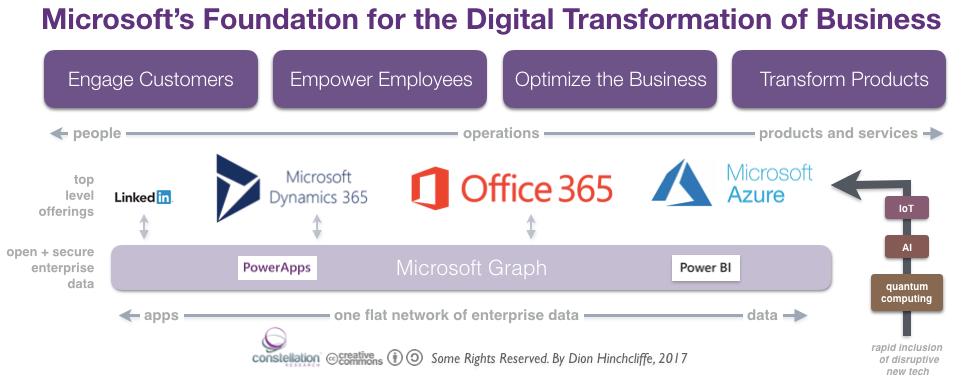
July 10th at Microsoft Inspire, their Worldwide Business Partner conference, Microsoft introduced Microsoft 365, a new purchasing model that bundles Windows + Office 365 + Enterprise Mobility and Security.

They also introduced three new (SMB focused) business applications... plus made MileIQ available to select O365 plans.

  • Microsoft Connections—A simple-to-use email marketing service.
  • Microsoft Listings—An easy way to publish your business information on top sites.
  • Microsoft Invoicing—A new way to create professional invoices and get paid fast

Microsoft Continues To Strive for the Modern Workplace

I was very pleased to see Microsoft continue to push the messages around the intersection of Personal Productivity/Team Collaboration and Artificial Intelligence. In the keynote, they demonstrated several scenarios where Office365 is being enhanced with automation from Cortana and Microsoft Cognitive Services. Perhaps the most impressive (Future of Work) demo was how Microsoft combines Yammer and Stream to hold all company town hall meetings, where the talks are transcribed and translated in real time by Microsoft's AI tools.

Here is the information I collected during the keynote:


Future of Work

DisrupTV Dissects the Top Headlines on AI, Digital Transformation & Data Breaches


From “Black Friday in July,” to conference after conference, and a not-so-small data breach, this week was jam-packed with news and chatter from some of the biggest companies across industries.

We were lucky to catch up with Larry Dignan, editor in chief at ZDNet, on DisrupTV this week. He joined our hosts Vala Afshar and R “Ray” Wang to provide some blunt and entertaining commentary on the major news items that topped the headlines this week – from Amazon, SAP, Workday, Microsoft, Infor, and OpenText, Verizon and Wendy’s.

Jump into the video below at 39 minutes for the start of Larry’s segment.


DisrupTV Episode 70: Scott Hartley, Avi Goldberg, Larry Dignan from Constellation Research on Vimeo.

Innovation & Product-led Growth Data to Decisions Digital Safety, Privacy & Cybersecurity Tech Optimization Future of Work DisrupTV infor amazon SAP Leadership Chief Customer Officer Chief Digital Officer Chief Executive Officer Chief Financial Officer Chief Information Officer Chief Marketing Officer Chief People Officer Chief Procurement Officer Chief Revenue Officer Chief Supply Chain Officer Chief Technology Officer Chief Information Security Officer Chief Data Officer