Results

It’s Time to Think Differently About Business Apps—And the Future of Customer-Facing Work

It was just before the dawn of the 21st century and I was a young, fresh-faced analyst covering technology services. My focus was on application implementation services, the denim-and-shovels analog in the ERP goldrush. It was a busy time. Companies were desperate to plow ahead with ERP projects, both because they wanted to be viewed as investment-worthy by stock markets and to avoid a nasty little problem called Y2K.

Back then the focus was on “having” or “doing” ERP. If your business didn’t or wasn’t, you were behind the times. For all the high-minded talk about business process reengineering, the reality was much more prosaic. More often than not, businesses found themselves with major delays and project cost overruns, usually resulting in big cuts to user training or adoption programs.

The system was the thing. It encompassed everything: data structures and storage, processing and workflow, and user interfaces. The people just had to figure out how to work with it. Actually using it required employees to conform to the way the system was designed. Interfaces typically reflected what was most straightforward from a technology perspective, not what best supported the work a given employee or department was trying to do. The system ruled, and if it didn’t work the way you wanted it to, you could add your complaints to an ever-expanding list of projects the IT department was already working on to change it. Picture the scene at the end of Indiana Jones and the Raiders of the Lost Ark when the Ark of the Covenant gets put into a vast government storage warehouse. That kind of list.

Fast forward to 2020. A lot has changed. Business applications are much less monolithic and much more flexible. Some are even easy to use. But for the most part, our concepts of enterprise software still center on what the software does, not what we’re trying to achieve with it.

It’s time to think differently about business applications. Rather than concentrating on functional areas, we need a mental model that helps us to understand the capabilities required to achieve our objectives. Things like engaging our customers effectively, creating ongoing conversations, and shaping great experiences, for example—the building blocks that underpin successful businesses.

A different way of thinking about enterprise software will help us to make better decisions about what we need to invest in, the role(s) each element fills, and how it all works together (read: integrates) to support the way we want to operate.

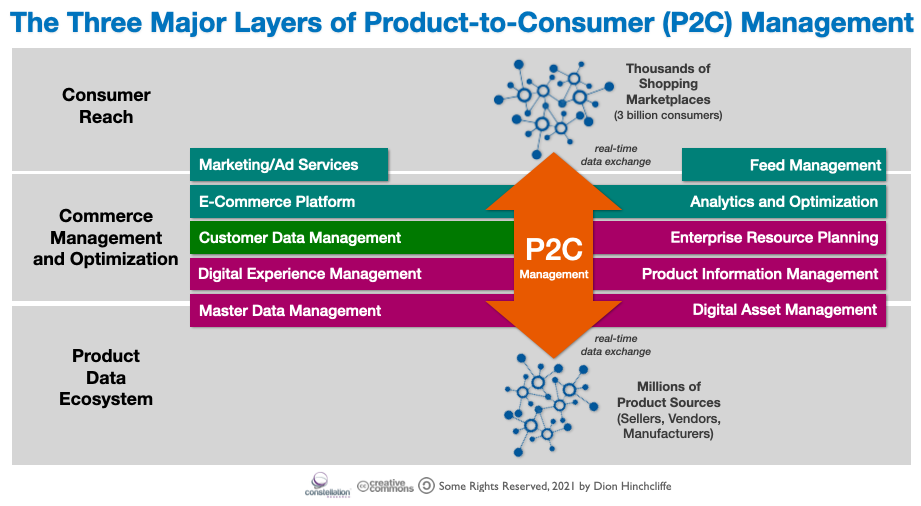
To do that, stop thinking about enterprise applications in terms of the functions they support. Instead, think of three core elements of business technology that constantly interact: data flows, processes and workflows, and user interfaces (see Figure).

Is this a gross oversimplification? Absolutely. But it’s a very useful abstraction when it comes to mapping out who needs what where, and the most effective way of presenting it.

Let’s break down what each element includes:

Interfaces

Think of interfaces as the digital workspaces an individual employee uses to do their job. This is what they log into when they start work for the day. It’s the place where they find the information and resources they need. The appropriate interface—what’s incorporated within it and how information or functions are presented—depends in large part on the individual role. That will look very different for a customer service agent, a salesperson, or a business analyst in corporate strategy, for example, though there may be common elements across all three. Personal preference also plays a significant role. How I prefer to see data may be completely different from my closest colleague.

Really good interfaces incorporate a variety of data sources and functional capabilities. They are most effective when they’re designed to anticipate and support the way people actually do their work. Familiar is good; intuitive and effective are better. And if you can manage all three—magic.

Processes and Workflows

In any business, there is a crowded landscape of business processes and workflows. Some are formally encoded in applications, others are informal or even manual. As more processes become digital, there’s a greater degree of integration and automation. Application configuration and integration address much of this. The growing use of low-code/no-code workflow management tools extends automation even further.

For any type of work, the crucial question is which process areas are relevant or important. Who is responsible for overseeing or assuring which processes? How does that process and communication flow work when a process extends beyond one team or department? What processing happens where?

Data Flows

Simply cataloguing all of the different sources and repositories of data—even just customer data—is a never-ending task. And as important as it is to know which data are where, it’s even more crucial to understand where given data elements—or analysis and insights derived from those data—need to go in order to support different kinds of work. Data is the lifeblood of any organization. While every part of the business needs access to it, each needs different elements in particular forms and cadences. The customer data that’s most essential to the billing department differs greatly from what’s most important to marketing. But they all need to have a consistent view of the same data.

Framing the types of data, where they originate, the forms in which they are most useful, and for whom they are most relevant offers greater clarity in determining priorities.

Doing Things Differently, Doing Different Things

Every part of the business is doing a certain kind of work—whether it’s finance, operations, HR, or the vast array of customer-facing interactions. Marketing, sales, and customer service are only the most obvious. Each department or team has its own set of tools, some of which are company-wide, others that are unique to them, and some that are in between. Different groups have distinct priorities, types of work, and ways of working.

The key point here is that different types of work require distinct data inputs, specific process flows or portions of broader processes, and tailored environments in which to present information in order to support decisions and actions.

This becomes even more crucial as we adapt our businesses to rapidly changing demands and circumstances. To be successful, we need to find different, better ways of working—and sometimes change what we’re doing in the first place.

With this in mind, and by abstracting enterprise software across these three elements, it’s far easier to understand where there are gaps and what the options are to fill them. Because the biggest challenge to today is not a lack of technology tools. It’s determining the most appropriate combination, in terms of both capabilities and return on investment, to support the work your business does—and the way you want to do it.

Data to Decisions Future of Work Marketing Transformation Next-Generation Customer Experience Tech Optimization Chief Analytics Officer Chief Customer Officer Chief Data Officer Chief Digital Officer Chief Information Officer Chief Marketing Officer Chief Privacy Officer Chief Revenue Officer

Excellence, Extreme Humanism & Building Future-Ready Tech | DisrupTV Ep. 193

Excellence, Extreme Humanism & Building Future-Ready Tech | DisrupTV Ep. 193

In DisrupTV Episode 193, hosts R “Ray” Wang and Vala Afshar welcome two transformative thinkers who challenge how we lead and build in the digital era:

  • Tom Peters, the celebrated author of In Search of Excellence and Excellence Now: Extreme Humanism, reframes leadership through empathy, humility, and relentless service to people. 
  • Michael J. Sikorsky, CEO & Co-Founder of Robots & Pencils, shares how embedding mobile-first innovation and a “talent obsession” philosophy has driven explosive growth and tech transformation.

Key Takeaways

Extreme Humanism in Leadership
Peters brings forward the view that business excellence and empathy go hand in hand. Leadership should prioritize kindness, EQ, and “serving the front-liners” to drive growth and meaning. 

Building with Empathy and Agility
Michael’s leadership approach centers on building talent-centered products—mobile and frontier technologies that transform business, anchored in a deep understanding of user needs.

Memorable Quotes

Tom Peters:
“The best leaders hire for emotional intelligence, not just hard skills.” 

Michael J. Sikorsky:
“We built Robots & Pencils with a talent obsession—believing people-first fuels innovation.”

Final Thoughts

Episode 193 is a masterclass in blending empathy with innovation. Tom Peters reminds us that excellence starts with honoring humanity—at work, in teams, and in governance. Michael J. Sikorsky demonstrates how building with empathy—and nurturing talent—creates breakthrough tech that matters. Together, they sculpt a leadership model that is not only high-performing but deeply human and future-ready.

Related Episodes


On DisrupTV <iframe width="560" height="315" src="https://www.youtube.com/embed/WCa0czZKOFQ?si=JBKAe6sFVNRoU8d_" title="YouTube video player" frameborder="0" allow="accelerometer; autoplay; clipboard-write; encrypted-media; gyroscope; picture-in-picture; web-share" referrerpolicy="strict-origin-when-cross-origin" allowfullscreen></iframe>

Business Reboot 2020: Data-to-Decisions Priorities For Getting Back to Business

Survive or thrive? The underlying conditions of the business matter more than business conditions. Get on with analysis and planning.

As we approach the summer of 2020, much of North America -- and the world -- is getting back to business. It’s clearly not business as usual, with continued social distancing and uneven, half-steps back to business. With recovery in mind, here are some of the latest points of advice from my Constellation Research “Post Pandemic Playbook” for data-to-decisions initiatives.

Underlying Conditions for Business

Just as certain underlying medical conditions make people more susceptible to COVID-19, certain underlying business conditions can make or break a company in a challenging economic climate. Being an analyst, I’ve come up with a two-by-two matrix (below) to explain. On the vertical axis are resources and debt, while the horizontal axis weighs the impact – lasting or not -- of the pandemic and lockdown.

Resources exist in many forms. Large companies, for example, are in a better position, generally, to absorb economic blows, than are small companies, but there’s much more to it than that. Other resources include access to capital, financial health, brand equity, large and sticky customer bases, business agility, and seasoned, innovative leadership. All these resources can be counted in an organization’s favor, and many small companies have more of them than troubled large companies.

High debt is always a millstone around a company’s neck, and if you compound that with a deep economic impact, as we’ve seen in travel and retail, the outcome is not good. Hertz, JC Penney, Niemen Marcus and J. Crew have been the headline bankruptcies in recent weeks, and what they all had in common was high debt levels and, in most cases, questionable management practices and strategies.

At the opposite extreme there are examples of companies that have seen less-damaging economic impact. Grocery stores and drug stores never closed during the crisis, so many food supply and consumer product goods (CPG) companies are doing reasonably well. In fact, some companies, like Kimberly Clark and PepsiCo, saw big sales increases in sales in the first quarter, due in part to consumers stockpiling (and hoarding) goods before the lockdown.

Kimberly Clark reported a 14% increase in paper product sales in Q1 while PepsiCo saw strong SuperBowl snack and beverage sales followed by consumer stockpiling that sent the company’s first-quarter sales up 7%. PayPal saw a 17% increase in new accounts and a 20% increase in payment transactions in the first quarter, as organizations and consumers sought alternative payment options amid the lockdown.

The point is that it’s hard to anticipate outcomes by industry. Instead, look at underlying health, agility and leadership by company. We’re likely to see strong, agile companies consolidating their positions and perhaps acquiring vulnerable rivals that lack resources or that are saddled with debt.

Move to Fine-Grained, Low-Latency Analysis

Even firms that discovered a silver lining in an otherwise dark cloud, like Kimberly Clark, have pulled their financial guidance for 2020 because uncertainty remains. This is one reason I’ve been advocating the adoption of more precise analyses driven by more granular, low-latency data. Timely, fine-grained insight will help organizations better understand big differences in business resumption within countries, states, cities, counties and even suburbs and exurbs. Aggregations at the level of global regions and regions within countries are less useful than they once were. Similarly, predictive models built on old data may need to be retrained or entirely rebuilt for today’s very different customer behaviors.

Demand-driven forecasting is nothing new, but it can make a significant difference when dealing with the rapidly shifting market conditions we’ve seen over the last couple of months. Heading into the lockdown in February, global systems integration and consulting firm Infosys helped a major CPG company to harness near-real time point-of-sale (POS) data, as well as weather, trade promotions and competitive data, to improve the accuracy and timeliness of demand forecasts. Previously the company relied on shipment data, which would have totally missed demand spikes experienced heading into the lockdown in mid-March.

A CPG Pulse report on comparative "essential product" sales and out of stock (OOS) conditions in Georgia and New York in Q1 2020. Source: Infosys

POS-driven analyses of sales in New York State, for example, spotted panic buying setting in on March 12. Sales of the company’s products in the state increased 51% compared to the prior month. As a result, out-of-stock (OOS) conditions spiked by 28%. However, the early warning provided by timely analysis helped the CPG company stabilize the supply problems by March 17. Overall, the use of granular, store-by-store daily POS data has improved forecast accuracy by 70% to 85%. These forecasts are used to accelerate the delivery dates of firm orders, within the guidelines of service level agreements, to prevent stock-outs. The typical improvement across all states for the company has been a 2% increase in overall sales.  

Adopt Continuous Planning  

I’ve been writing about the need for frequent, iterative financial planning and analysis for years, but the need has been all the more acute in today’s climate. The leading firms I have encountered have stepped up from monthly to weekly or even daily planning to respond to changes in supply chains, sales, financial results, and human resources requirements. Cloud-based planning platforms make it far easier to support continuous and collaborative planning among finance and business leaders. But what if your organization is locked into antiquated, spreadsheet-based methods? Is it realistic to deploy a new platform in the middle of such a tumultuous period?

During last week’s Planful Virtual Tour, customer SmartyPants Vitamins presented on a focused, 20-day planning deployment that stayed on track amid the lockdown in March. SmartyPants has been an innovator and challenger in the vitamin category. It launched in 2011 with a single product: affordable children’s multi-vitamin gummies without artificial ingredients. The company subsequently branched out into gummy vitamins for adults and even pets, and in 2016 it surpassed $25 million in sales.

Early in the first quarter of 2020, the company decided on a phased deployment of the Planful, cloud-based planning platform rather than a big-bang deployment addressing the entire balance sheet. “We decided to focus on sales and trade spending, as opposed to the total balance sheet, because sales drives the rest of the organization and how we allocate spending,” explained Cheryl Chow, the company’s Senior Finance Manager. “Sales was already on a monthly cadence, and we needed something dynamic that could pull in actual results data and then reforecast the rest of the year quickly and at a very detailed level.”

Cheryl Chow, Senior Finance Manager at SmartyPants Vitamins, said the company's focused planning deployment went off as planned in March despite work-from-home challenges.

Little did the Marina Del Rey, CA-based company know that its March 2020 project would soon have to cope with that state’s pandemic lockdown. The switch to working from home definitely “added a level of complexity” to the project, said Chow, but the team managed to stick to its 20-business-day deployment schedule with some parallel execution of the four deployment steps: Step 1. Understand revenue drivers and templates and test modeling hierarchies; Step 2. Simultaneously import existing data into Planful, including historical actuals and the existing budget; Step 3. Build out and test reports and reconciling data disparities; Step 4. Roll out new planning and reporting capabilities to the sales team with thorough training.

The crisis confirmed that the decision to start with sales and trade-spend forecasting was the right approach. "Because we were doing this during a period of craziness with Coronavirus, our demand-planning team really needed weekly forecasts,” Chow explains. “They use details available in the sales and trade-spend forecasts to do demand planning because these are the drivers of the business, so it was clear it's what we needed to focus on in the first phase."

SmartyPants wrapped up forecasting sales and trade-spend for the full year and it has developed preliminary sales and trade-spend forecasts for 2021. The company has also moved into the second phase of its Planful deployment, addressing operating expenses.


“Just two months in we’re now wrapping up operating expense templates and starting forecasting for the rest of 2020 and preliminary 2021,” explained Chow. “That's a huge win because I don't want to have to manage dozens of spreadsheets from departments maintaining separate budgets and planning.”


In a planned third phase, set for the second half of 2020, SmartyPants will extend the platform to address cost of goods sold and the overall balance sheet.


In response to the many companies now desperate to get to faster and more agile planning, Planful has come up with fixed-cost, 30-day deployment offerings for specific financial planning and analysis use cases that are currently in high demand. These include cash-flow forecasting, workforce planning, monthly close and consolidation, and multi-dimensional ad hoc analysis. I’d expect other vendors to follow Planful’s approach of offering focused, fixed-cost, fixed-time deployments during this recovery period.


I’ve been around long enough to have seen tough economic conditions before, from the real estate collapse of 1987 to the dot-com bust of 2001 and the Great Recession of 2007. The agile and adaptive companies respond, rebound and lead the way back to better times.

Data to Decisions Tech Optimization ML Machine Learning LLMs Agentic AI Generative AI AI Analytics Automation business Marketing SaaS PaaS IaaS Digital Transformation Disruptive Technology Enterprise IT Enterprise Acceleration Enterprise Software Next Gen Apps IoT Blockchain CRM ERP finance Healthcare Customer Service Content Management Collaboration Chief Financial Officer Chief Information Officer Chief Analytics Officer Chief Data Officer Chief Technology Officer Chief Information Security Officer

Dear CMOs: Should You Sit This One Out?

Today could very well have started with an early morning crisis call that was dominated by the question, “HOW do we respond to THIS?” That call might have happened Friday afternoon…perhaps over the weekend. Some of you might be having this call right now.

In times of crisis it falls to the marketers, communications leaders and customer advocates to start to communicate, especially when that crisis feels as hurtful and impossible as the current tidal wave of emotion sweeping the United States. We have just spent the past several months working to assure (then reassure) our customers that we are “in this together” as the coronavirus spread across the globe stealing lives and wreaking havoc on economies. Now, we have a painful race conversation topped by outbreaks of violence and senseless brutality. It is starting to feel like we just can’t get a win these days.

It is understandable that we want to have a position – a statement of where our brands stand on the issues that impact our customers and our people. But in times like this, we need to stop and really think through the hard questions before saying a word.

Please let’s be clear here: I am NOT advocating for silence. In fact, I whole heartedly support any brand willing and able to take a stand in support of equality, humanity and lifting a community up. What I am offering is a bit of candor.

Making a statement and taking a stand today must be met with continuous action tomorrow and into the next days, weeks and years. Fall down on that promise…break the trust built by your statement and you will lose your customer.

Be bold. Take a stand. Just don’t walk into this lightly.

When embarking on a crisis or support statement…regardless if it is this week or the next crisis around the corner…I suggest asking yourself these honest questions:

  1. Is Your Brand an AUTHENTIC part of THIS Conversation? Now is NOT the time to test this. Your gut has already answered this question before you got to this line. Most marketers know…instantly…if they are part of the conversation or part of the distraction. If you are part of the distraction…sit this one out.
     
  2. What Stand Feels Right for Your Brand, Your People and Your Customers? This isn’t just about one community…one audience…it is about ALL of your audiences. This is as much about your customers as it is about the people who come to work to build your brand, your products, your promises every day. Have you taken the time to really listen and understand what is important about today's conversation in their words and in their lives? What IS at the heart of the issue for them? Is it the violence? Is it equality? Is it shouting at the top of their lungs, but never being heard? What stand and what statement will best respect and reflect what you have heard? If you don’t know…sit this one out.
     
  3. Can You and WILL YOU Follow Thru? Any communication you send out today will be remembered tomorrow. Case in point: The NFL released what, on paper, feels like an earnest and heartfelt statement against police brutality and disproportionate violence against the African American community. The response was swift, with words like hypocrisy and false being added to the league’s sentiment. Amazon released a similar statement denouncing the “inequitable and brutal treatment of Black people.” Hours later, responses emerged pointing to stories of protests from minority workers about working conditions. While I am confident that the words issued by the NFL and Amazon were earnest and intended to be a unifying rallying cry, they were used as opportunities to bring up history and highlight inauthentic voices and moments. Right or wrong, the NFL’s stand against players “taking a knee” in protest discounted them from being seen as an authentic participant in today’s conversation. Will your brand be able to push past any noise of the past to be part of a future conversation? Will your brand WANT to be part of any future conversations? If you don’t know…sit this one out.
     
  4. How Long Will You or Can You Demonstrate Your Commitment? Unlike showing support for a single cause or a single event, the current social conversation is a lengthy one. This isn’t writing a check to a charity of choice. This conversation will not go away this week, at the end of the protests or even after the next election. They will continue and be reignited with the inevitability of the “next time it happens.” And because this is a matter of when and not if the conversation reignites, will your brand be there again, reaffirming your commitment to the cause and taking an even bigger step to show support? If you don’t know…please, sit this one out.
     
  5. Why Do You Want to Respond? THIS is the most important question to answer...and answer honestly. Do you want to respond because everyone else has? Did your competition beat you to a statement…so it is now or never? Do you think it will keep you relevant in the conversation? Did someone tell you your GenZ customers expect you to respond? This is NOT the conversation to test out your tone of empathy. Unless your brand has an authentic voice in this conversation…unless there is both empathy and honesty interlaced with every word...this is NOT the time to experiment with social consciousness. Virtue signaling does not mean your virtue or your signal is not earnest and pure. But today’s debate and today’s customer has gotten enough chatter and has very little bandwidth for more noise. They crave authentic voices. Trust me…if you are still not sure…sit this one out.

Here is what some people might not tell you. It is 100% OK to say no…to admit you don’t really WANT to have a voice in the current events of the day. But you need to be honest about that now…not a day after a statement goes out. If you don’t want to respond…don’t. The reality of communicating in a crisis is that best intentions don’t cut it. Now, more than ever, nothing less than an authentic communication that is in line with your brand vision, direction and purpose will do. And yes...if you are in doubt...ask us. Advise is our stock in trade. And we are here to help. Just be prepared for me to tell you...it might be best to sit this one out.

Marketing Transformation Chief Marketing Officer

Data Value, Product Innovation & the IoT Frontier | DisrupTV Ep. 192

Data Value, Product Innovation & the IoT Frontier | DisrupTV Ep. 192

In DisrupTV Episode 192, hosts R “Ray” Wang and Vala Afshar welcome three forward-thinking experts who unpack the ethics, innovation, and communications shaping enterprise transformation:

  • Howard Steven Friedman, an acclaimed data scientist, health economist, and author of Ultimate Price: The Value We Place on Life, explores how data quantifies value and guides decisions.
  • Judy Ko, Chief Product Officer at StreamSets, shares insights on real-time data infrastructure and how product design can empower data-driven organizations. 
  • Jack Vaughan, writer, analyst, and researcher at Progressive Gauge LLC, sheds light on IoT trends, edge computing, and technology narratives shaping the future.

Key Takeaways

Quantifying Life’s Value
Friedman challenges us to consider how we value human life—not just economically but ethically—through data. His work sparks conversations about how societal decisions are shaped by what we can quantify. 

Empowering Through Product Design
Ko underscores how StreamSets’ platform approaches product design with a focus on reliability, real-time data movement, and simplifying complex pipelines—automating trust in systems at scale. 

Understanding IoT & Embedded Technology
Vaughan brings critical context to emerging tech by tracking IoT, edge computing, and next-gen data patterns—emphasizing the importance of narrative clarity in tech conversations.

Memorable Quotes

Howard Steven Friedman:
“Understanding the ‘ultimate price’ isn’t just an academic thought experiment—it’s central to public decisions when lives are at stake.” 

Judy Ko:
"Empowering data teams with clear, scalable pipelines is foundational to building trust in modern enterprise systems."

Jack Vaughan:
“Technology only becomes meaningful when we frame it clearly—IoT isn’t magic, it’s measurement and storytelling at scale.”

Final Thoughts

Episode 192 weaves a powerful narrative about value, infrastructure, and insight in the digital era. Friedman invites us to reflect on how society—through data—assigns worth to human life. Ko demonstrates how well-designed platforms can build organizational confidence in real-time data. Vaughan shows how technology’s meaning grows when communicated with clarity. Together, their dialogue underscores that ethical metrics, strategic product design, and informed storytelling are essential for navigating today’s evolving data landscape.

Related Episodes


Data to Decisions Digital Safety, Privacy & Cybersecurity Future of Work Tech Optimization Chief Information Officer Chief Digital Officer Chief Analytics Officer Chief Data Officer Chief Information Security Officer On DisrupTV <iframe width="560" height="315" src="https://www.youtube.com/embed/lWy1Rexv2EE?si=VvwEi51pEDglBL4x" title="YouTube video player" frameborder="0" allow="accelerometer; autoplay; clipboard-write; encrypted-media; gyroscope; picture-in-picture; web-share" referrerpolicy="strict-origin-when-cross-origin" allowfullscreen></iframe>

Innovating Through Crisis — Digital Resilience, Entrepreneurship & Customer Trust | DisrupTV Ep. 191

Innovating Through Crisis — Digital Resilience, Entrepreneurship & Customer Trust | DisrupTV Ep. 191

In this pivotal episode, R “Ray” Wang and Vala Afshar host three visionary leaders navigating the COVID crisis with bold leadership:

  • Milan Rao, President at Wipro, on preserving employee safety, enabling remote operations, and accelerating digital transformation.
  • Jim McKelvey, co-founder of Square and author of The Innovation Stack, on why trust, bold moves, and creating new markets matter in times of upheaval.
  • Liz Miller, VP and Principal Analyst at Constellation Research, on the reputation test brands face in crises—where operational consistency defines trust.

Key Takeaways

  • Protect, Pivot, Prosper: Milan Rao outlines a three-step crisis framework—protect employees and customers, rebuild safe operations, and emerge stronger with digital tools.
  • Innovation Over Iteration: Jim McKelvey emphasizes that copying solves old problems; true disruption requires new solutions. Square’s mini-credit-card reader, designed to spark conversation, is a testament to bold innovation over incremental improvement.
  • Trust Is Fragile: Liz Miller warns that brand consistency during crisis builds—or breaks—customer trust: “You can recover profits. Reputation? Not so easy.”

Notable Quotes

  • Milan Rao: "Everything is going to go virtual—the pandemic shattered the digital transformation ceiling."
  • Jim McKelvey: "You can’t be an expert in new—entrepreneurship demands courage beyond experience."
  • Jim McKelvey: "That little card reader? I refused to sacrifice a conversation starter for slightly better specs."
  • Liz Miller: "What happens to your brand when the customer finds out you left the back door open?—Trust isn’t just about revenue; it’s about integrity."

Final Thoughts

Episode 191 offers a masterclass in navigating crisis with courage:

  • Milan Rao shows how rapid digitization—focused on safety and continuity—can become the foundation for transformation.
  • Jim McKelvey champions innovation that defies norms and sparks conversation, proving that new problems require new thinking.
  • Liz Miller reminds leaders that brand strength lies in trust: during adversity, actions speak louder than words, and consistency builds lasting confidence.

Together, they illustrate that in crisis, resilience begins with empathy, audacity, and a steadfast commitment to values.

Related Episodes


On DisrupTV <iframe width="560" height="315" src="https://www.youtube.com/embed/uSlef__OYmo?si=EoLSj5zDvEJkrc7B" title="YouTube video player" frameborder="0" allow="accelerometer; autoplay; clipboard-write; encrypted-media; gyroscope; picture-in-picture; web-share" referrerpolicy="strict-origin-when-cross-origin" allowfullscreen></iframe>

Driving Digital Innovation, CX Strategy & Analyst Insights | DisrupTV Ep. 190

Driving Digital Innovation, CX Strategy & Analyst Insights | DisrupTV Ep. 190

In DisrupTV Episode 190, hosts R “Ray” Wang and Vala Afshar welcome three leading voices in technology, customer experience, and enterprise analysis:

  • Paul Daugherty, Group Chief Executive–Technology & Chief Technology Officer at Accenture, shares how emerging tech is reshaping enterprise leadership.
  • Stacey Epstein, Chief Marketing & Customer Experience Officer at ServiceMax, discusses the evolving art of marketing in driving customer-centricity.
  • Steve Wilson, VP & Principal Analyst at Constellation Research, offers strategic insights on macro-tech trends influencing organizations.

Key Takeaways

Emerging Tech as Enterprise Core
Paul Daugherty emphasizes that digital reinvention is not optional—it's central to business purpose, requiring CEOs and CTOs to lead with technology as a core enabler.

Customer Experience as Brand Differentiator
Stacey Epstein observes that CX isn’t just delivered by products—it’s curated through marketing, operations, and emotional trust-building across customer touchpoints.

Strategic Forecast from Analysts
Steve Wilson reminds us that analyzing signals—like adoption trends, innovation cycles, and vendor movement—can provide a forward-facing roadmap for leaders.

Notable Quotes

  • “Innovation isn’t a program—it’s the enterprise heartbeat, and leadership must treat it with urgency.” — Paul Daugherty
  • “Customer experience isn’t built in a silo—it’s nurtured in every marketing message and brand interaction.” — Stacey Epstein
  • “Watching the market isn’t enough—leaders must interpret the patterns and anticipate the shifts.” — Steve Wilson

Final Thoughts

Episode 190 distills a future-rooted approach to leadership:

  • Paul challenges executives to anchor their vision in digital innovation—not just transformation.
  • Stacey spotlights CX as the ultimate competitive frontier—driven by emotional resonance, not just tech delivery.
  • Steve elevates the analyst’s role, urging leaders to read ahead, not just along.

Together, they present a powerful triad: technology leadership, customer-first strategy, and strategic foresight—a blueprint for navigating the complexities of the modern enterprise.

Related Episodes


On DisrupTV <iframe width="560" height="315" src="https://www.youtube.com/embed/bgTXextuL8I?si=eqW367nQhDCzaHwa" title="YouTube video player" frameborder="0" allow="accelerometer; autoplay; clipboard-write; encrypted-media; gyroscope; picture-in-picture; web-share" referrerpolicy="strict-origin-when-cross-origin" allowfullscreen></iframe>

Event Report - IBM Think 2020 - Hybrid Cloud, AI, Quantum and more

IBM had to cancel the physical Think 2020 conference and go to a digital format like many other conferences. As the first major vendor event going digital, IBM had to set a yardstick in terms of digital events – and did not disappoint. A special challenge was that Red Hat's Red Hat Summit conference just happening the week before and it stole a lot of the 'thunder' especially in regards of hybrid cloud announcements. Weekly event proximity does not well for a set of rich announcements.


Here is the one slide summary in case you are too time pressed to read on:
 
 
And here are my key takeaways:
 
It is all about hybrid cloud. No surprise – the need for hybrid cloud and how IBM achieves it with Red Hat OpenShift was central to Think 2020. IBM did a good job with vision, sessions and customer examples for the adoption of OpenShift. The new push for edge was certainly not missing, as Red Hat released new capabilities for operating on the edge the week before. And with the race to 5G being first of all a massive backend overhaul, IBM did not miss out to show its value proposition for telcos here. A capability of OpenShift that CxOs need to note is that through its marketplace – multi-cloud deployments of 3rd party software can be achieved. Once an ISV is on the Red Hat Marketplace – its software runs not only on premises and the IBM Cloud, but also AWS, Microsoft Azure and Google Cloud. For CxOs appreciating consistent deployment and single control – certainly, a benefit. Interestingly, separate conversation with a database vendor that recently published on the Red Hat Marketplace – show little to no performance degradation from OpenShift deployments – vs native deployments.

Quantum shows momentum. While I have some concerns on many of the IBM offerings and services, I have little to none of them on the Quantum progress that IBM is demonstrating. It shows the traditional hardware DNA still delivers (ok it does for the mainframe as well) and in combination with software is a key differentiator that few other tech giants can compete with. IBM used the digital format to even expand its quantum presence at Think 2020, adding more presentation and sessions on Quantum technology. One of the clear upsides of the digital format. Needless to say, Covid-19 was present, and IBM showed how quantum technology is superior simulating complex scenarios – like the spread of the SARS-COV-V2 virus. Since some time, IBM is looking at Quantum from a stronger use case perspective that was not missing at Think 2020. No surprise – financial institutions will benefit from quantum (and I wonder why that is not part of the vertical Financial Service cloud offering – at least in PowerPoint), but also security and most interesting to me – for chemistry. The game in quantum has moved from the pure quantum machine to the point how well can enterprises embed quantum processes into the rest of their computing architecture – forming a different type of hybrid cloud, a hybrid computing cloud were conventional processors work with quantum machines bridging the two worlds of compute to power next generation applications. IBM is very well setup to take part of this 'other' hybrid computing model, as it has all the relevant offerings to support it.

Watson comes to Ops and we have AIOps. Given IBM's experience managing large software environments and hardware, its announcements into the new AI Ops space are not a surprise. Another driver is of course the complexity of a hybrid, distributed IT environment – that IBM is selling, implementing and operating for its clients. Giving customer and / or its own consultants the ability to run these complex environments more reliably, securely and resiliently is key. At the core is the industry wide admission that Kubernetes environments that are spread out over many compute platforms are inherently complex. Enterprises want self-driving solutions, that operate autonomously. The solution is of course AI and when it is IBM that is Watson. How well Watson is up to the task will have to be seen, its traditional expert system that is queried by a human and created / operated by a data scientist is not the setup needed for autonomous AIOps. Now we have to see how well IBM can automate in the AIOps space. Success is not optional, as IBM sells and implements complex hybrid environments that no longer can be reliably managed in their totality by humans.

Act – do not react. IBM. Of course, AI overall was not missing at Think 2020 and IBM has a new motto with 'Act – don't react'. It is a good line, as it describes well the recent best practice change in AI deployments… instead of humans analyzing data and the realizing something is wrong ('reacting') – it is key to close the insight to action loop. That has been the quest from the first mainframe-based report that was printed… and has not been addressed by the industry overall. CxOs need to pay attention though as often the 'act' is contained into the BI / AI system – which poses the same challenges as before… only makes the delivery of insights better. Certainly, a benefit – but not really what is possible. All to often, at Think 2020, it was also again about the data side of AI, but that is a problem that is largely solved and / or solvable – the quest is really for the autonomous AI system, that makes the human optional in 2020, at least for some easy to make decisions. How well IBM can fill the vision of the new motto remains to be seen – beginnings are promising, but autonomous is really the holy grail.

Digital Conference Rating: B. Moving from in person events to digital events creates formidable challenges for enterprises, but is a necessity during the Covid-19 pandemic. The yardstick of what is good is moving rapidly – what was good in April, is no longer good enough in May, as enterprises find ways to create better digital experiences. It is a profound learning shift from the executives, to the regular speakers, to the event teams. IBM did well for being the first large vendor to have their event (Google cancelled in April) – so it will be interesting to see how other large event vendors like Microsoft, Oracle, SAP and Salesforce will do. The good news is – the platform (whatever IBM used) held up to the demand, there was interesting content, executives were comfortable by presenting live etc. Ironically, a week before newly acquired RedHat did better overall, including a better agenda, better social support and more interactive panels. Remarkably former CEO Ginny Rometty did the best amongst executives, she had a genuine conversation that seemed unscripted, not screen read etc. with will.i.am on diversity and inclusion.
 

MyPOV

IBM did not disappoint pulling off Think 2020 in a challenging environment: CEO transition, virtual event, new org structure etc. – all challenges that would have made a traditional conference a potentially challenging to very challenging event. It would not have been the first time a vendor cancels an event, with Covid-19 as excuse / explanation. So kudos for IBM to never consider that.
 
Not surprisingly IBM has shown there is a new executive team in place, that can articulate the vision, first and foremost around hybrid computing with Arvind Krishna and Jim Whitehurst. The cloud story needs a new chapter and IBM is trying to establish vertical cloud (again, something it tried a few years ago). No surprise, IBM starts in an industry where it is strong, Financial Services, but the announcement needs more than horizontal capabilities (security), but differentiating software assets, in short, a roadmap. Equally on the bright side IBM is making good progress with its Quantum offerings.

On the concern side, I am not sure if this is enough to turn IBM to revenue growth and keep its close to 300k employees busy, meaning – will it fuel the IBM as we know it over the decades, as the trusted advisor and partner for enterprise IT. In my view IBM needs more offerings for that – the always visible trifecta of three major offerings under Rometty – with e.g. Cloud, Watson and even blockchain (no big announcements on the topic at Think 2020) from 5-6 years ago – feels stronger than Cloud, AI / Watson  -and – wait what is the third of 2020? Lastly, I would really like for IBM to talk more about the products its customers are using – e.g. dB2 had a new release. What is happening with WebSphere? IBM not only maintains but keeps building out these products, that are all critical for IBM customers.

Overall a good start for IBM under new leadership and a new executive team. The hybrid cloud offering, with the attempt to be the 'neutral' cloud vendor that can provide workloads across all major public clouds and on premises, to the edge is attractive to CxOs. But it competes with the more proprietary options from the public cloud vendors who offer a closed, but likely faster path to production. IBM needs to deliver fast on the OpenShift opportunity, needs to share roadmaps and show it can deliver more attractive portfolio offerings for client and prospects. It also needs to lead its Quantum offerings from trial and lab into real world benefits on a larger scale – not easy – but the priority at hand right now. DNA, talent, money and opportunities are there – its for the team around Krishna to deliver them. IBM has a knack of not becoming a 'boring' IT player.

Don't miss my take on Arvind Krishna's appointment here and Wakelet collection of key tweets below

Find more coverage on the Constellation Research website here and checkout my magazine on Flipboard and my YouTube channel here.


Data to Decisions Innovation & Product-led Growth Tech Optimization Next-Generation Customer Experience Future of Work Digital Safety, Privacy & Cybersecurity IBM Quantum Computing ML Machine Learning LLMs Agentic AI Generative AI AI Analytics Automation business Marketing SaaS PaaS IaaS Digital Transformation Disruptive Technology Enterprise IT Enterprise Acceleration Enterprise Software Next Gen Apps IoT Blockchain CRM ERP finance Healthcare Customer Service Content Management Collaboration Cloud CCaaS UCaaS Enterprise Service Chief Executive Officer Chief Information Officer Chief Technology Officer Chief AI Officer Chief Data Officer Chief Analytics Officer Chief Information Security Officer Chief Product Officer

Building Autonomous Innovation with Data, Human-Centered AI, and Visual Insight | DisrupTV Ep. 189

Building Autonomous Innovation with Data, Human-Centered AI, and Visual Insight | DisrupTV Ep. 189

In DisrupTV Episode 189, hosts R “Ray” Wang and Vala Afshar engage with three thought leaders redefining innovation in technology and storytelling:

  • Julia Bardmesser, SVP and Head of Data, Architecture & Salesforce Development at Voya Financial, on how data platforms enable resilient and scalable operations.
  • William Davidow, author of The Autonomous Revolution, on how autonomous systems will reshape industries and strategic thinking.
  • Heather Willems, founder and visual strategist, on the power of graphic facilitation to distill complex ideas into impactful visuals.

Key Takeaways

  • Data as Innovation Infrastructure: Julia underscores that deep investments in data architecture are not just technical—they fuel agility, insight, and resilience in enterprises.
  • Autonomy as Strategic Imperative: Davidow argues that autonomous technologies—AI, automation, intelligent agents—are not trends, but fundamental models for future operations.
  • Visual Storytelling Drives Clarity: Heather shows how translating strategy into visuals enables alignment, retention, and meaning across teams and stakeholders.

Final Thoughts

Episode 189 reveals that innovation lies at the convergence of technology and clarity. Julia demonstrates that enterprise resilience is built on strong data foundations. Davidow reminds us that autonomy is becoming the de facto architecture of modern systems—not just optional, but transformational. Heather connects both through visuals that make change interpretable and actionable.

Together, their insights form a triad of future-focused strategy: build systems that are smart, data that is foundational, and stories that unite.

Related Episodes


On DisrupTV <iframe width="560" height="315" src="https://www.youtube.com/embed/9PHv7qBrVv0?si=92lsqDaqTUFAAy91" title="YouTube video player" frameborder="0" allow="accelerometer; autoplay; clipboard-write; encrypted-media; gyroscope; picture-in-picture; web-share" referrerpolicy="strict-origin-when-cross-origin" allowfullscreen></iframe>

Brand Security: What it is. What it isn’t.

It might be easier to start with what I do NOT mean when I say BRAND SECURITY.

Brand Security is not:

  • The official duties of the logo police that make sure you are using the right colors and aren’t replacing the tag line
  • A line of code to make sure nobody swipes stuff off the website
  • Permission for anyone to stomp on anyone else’s turf
  • Buying new tech tools that make life even more complex and onerous

Then there is what I DO mean.

Brand Security is:

  • A holistic strategy that applies process and technology to transparently aggregate, analyze and share customer signals and data, secure that data, permissions, consent and intelligence while securing the reliability, sustainability and durability of a customer’s relationship with a brand
  • An intentional technology framework that prevents and mitigates the impact of intrusions, infringements and incursions on a customer’s engagements and interactions

Brand security unifies the intentions of marketing, service and sales to deliver consistently relevant, personal and valuable interactions with the objectives of IT, operations and security to deliver transparency, proactive protection, monitoring, reaction and remediation.

Brand Security is a new epic mix tape.

Remember back to what made a truly epic mix tape? There was a theme that held everything together. There were sections and structure where songs blended together to tell a story…usually about something really angsty. The most memorable mixtapes had a purpose…the break-up consolation mix, the girls-night pre-party warm up, the crushing so hard it hurts mix. They took thought and consideration to create but were easy to listen to and appreciate.

Mix tapes were never meant to be a random mash up of songs you happened to like. It wasn’t just hitting the record button when the radio was on. The epic mix tape remains the one location where NWA, Garth Brooks and Bon Jovi make perfect sense together. A mix tape was a STORY made up of dozens of different, distinct parts working together under a single theme.

Brand Security’s story – it’s true purpose – is to provide a new cross-functional business strategy that elevates the ongoing efforts of IT, Marketing and Security to establish customer engagements and channels enriched with trusted data and operations. It shifts the focus away from the conglomeration of tools and technologies conveniently tucked into silos. It asks marketing to embrace a security-by-design methodology that respects and values customer data, consent and intent while asking security technologists to abandon a compliance-first mindset in lieu of a brand and buyer-first action plan.

A new Brand Security framework helps define structure by aligning and connecting strategies and solutions into layers of tools intentionally addressing the key aspects of trust. The first layer of the framework intentionally clusters strategies, operational processes and platforms that empower product development, brand engagement and customer experience together. The second layer aligns the strategies, processes and systems that collect, manage and deploy permissions, including customer expectations for consent and control.

Together, these layers empower and enhance the action layer, which seeks to more proactively and transparently deploy customer engagements and interactions while feeding new actions, permissions and promises. The promise, action and permission layers are enveloped in a proactive protection layer that optimizes delivery while securing everything from endpoints to perceptions.

Brand security must become a blended cross-functional view so that champions emerge to address everything from budget to impact on sales and the bottom line. These are no longer isolated discussions for IT and security operations to debate, compromise on and then roll out.

This is change management at the highest levels of the organization, demanding that all CxOs align around a security and protection posture as part of a brand security strategy that directly affects profitability. By delivering exceptional customer engagements and interactions, brand trust is boosted and brand security strategy is advanced. Half measures become negative headlines and faking it becomes the next hot meme on Twitter.

So why do I think THIS new mix tape will be the epic shift we need to address a new wave of business and customer expectation? Because it already HAS worked. Remember the not too distant future when organizations were trying to unravel the mystery called GDPR? Time and again I heard tales of executives attempting to architect change to meet the requirements outlined in the massive tome on their own. Fighting the fight for budget while pushing for transformation in the name of compliance.

Alone, CMOs, CIOs and CISOs fought uphill battles based in their own cost centers. But unified, the asks became more about transformation and less about one-off tick boxes for compliance. They became strategic plans that attached business KPIs and outcomes. It delivered tangible cross-functional plans and expectations the CEO, COO and CFO could understand and back. Together, they could kick the can down the road. It will take all functions focused on the same goal to achieve success. With brand security, marketing, service, sales, IT and security will each need to leave their comfort zones of functional fiefdoms in order to comingle strategies and stacks.

Brand security is a new epic mix tape. The theme is an ode to the customer with the wildly different genres of marketing, IT and security all blending together in a way that finally makes sense. Pop it in. Let the different genres and songs wash over you. Let it become an ear worm. But most importantly remember that today’s customer is redefining and setting the exchange rate on their new currency called trust. If we keep sending them recordings of the radio and not a coherent, relevant story like Brand Security, someone else will.

Marketing Transformation Digital Safety, Privacy & Cybersecurity Chief Data Officer Chief Digital Officer Chief Executive Officer Chief Information Officer Chief Information Security Officer Chief Marketing Officer Chief Privacy Officer