Results

Digital Business; teaming a ‘Digital’ Leader with a ‘Business Manager’

Digital Business; teaming a ‘Digital’ Leader with a ‘Business Manager’

If there is one constant headache for any enterprise it is finding the right staff, and there is no place where this is harder than in the new skills for Digital Business. And right at the top of the list is finding the right person to head up and grow your new Digital Business to reach the ambitious goals that the board has set, and probably created financial market expectation around. There is plenty of advice on what these extraordinarily rare and gifted people should do, but is this really enough to guarantee success in finding and ongoing operations?

Somewhat amazingly there seems to be little comment on how such a complex new role is likely to introduce a very different personality into the senior management team with the resulting misunderstandings and friction.

Almost invariably any senior management team is comprised of people with a fairly common background that allows them to function as a team around common understanding of important management issues. Equally it is likely that due to the time to gain experience to merit their senior roles their age grouping will not lead them to be confident ‘technologists’. Though many will argue that they have mastered the use of Business IT well enough, and at home they will use a Tablet etc., that’s rarely enough for them to be considered as the kind of ‘digital native’ required to be able to get to grips with the detail of working with their new Digital Business team.

It’s difficult to manage what you don’t understand, that’s why there are experts leading the various aspects of the business, but the management issues are answered by the common operational management reporting mechanisms. It’s the oft-quoted variant of the phrase ‘if you can measure it, then you can manage it’. However this is a, dangerous liability when the ‘it’ refers to Digital Business as my previous blog ‘Digital Business; Mastering the Financials’ pointed out.

The Enterprise needs a ‘leader’ to show it where and how, it should proceed to establish its Digital Business operations, sadly the more ‘digital savvy’ this new leader is then the less they are likely to talk the same language as the rest of the management team.

It’s not hard to see the gap, or difference, between the senior management teams profiles and that of a so called Digital Native, but lets really focus on the key issue to address before addressing a proposed a solution. The last twenty-five years has placed a great emphasis on operational management using technology to automate back office operational processes to cut cost and improve efficiency. The goal was to cut out wasteful diversity, focus on the optimal process, and above all to create good quality reporting that allowed micro management to continue to wring ever further improvement. Gentlemen and Ladies of the Board and Senior Management you have done well, very well, and today you have a collective understanding that allows you to operate huge enterprises to remarkable levels of operational efficiency.

BUT, and it’s a big but! The definitions used for Digital Business seems to almost be the antithesis of the current business operational model as a list of popular descriptive terms for a Digital Business model would usually include Disruptive, Agile, Flexible, and Market Reactive. The operational terms would include social, real time, viral, interactive, again, all different to the current experiences. Profiles of highly proficient people who are a) deeply involved in social technology, b) quick to recognize, or even create, disruptive change, c) able to recruit, develop and lead a Digital team, and d) are entrepreneurial initiative graspers, don’t generally show operational management skills.

The clash with the existing management team is an obvious and serious risk as literally you won’t talk the same language, be motivated by the same issues, as well as being different personality profiles! That’s all before considering the commercial management and ongoing operational management reporting capabilities and understandings!

Of course there are some people with both sets of skills, a CIO who has added to their skills, or a marketing head that has similarly adopted social technology, are both common backgrounds for the new Chief Digital Officer role. But it’s a tough role to both organize and operate a business unit as a board level-reporting unit working in an entirely new discipline based on constantly changing markets and technologies. Try writing out the role definition and skill requirements as bullets for a recruiter, and then add internal reporting responsibilities to get the point.

Given the growing number of vacancies for Digital Business leaders of various types is growing fast, and the numbers of really well qualified people is low, and likely to remain so, there has to be an alternative answer.

Intel when faced with extremely rapid growth and new markets some ten, or more years ago, used to describe their management style as ‘Two in the Box’, meaning in their case the experienced leader would manage with their likely replacement in duopoly slowly taking responsibilities. This management measure ensured the constant availability of skilled managers by developing promising ‘industry specialists’ through adding enterprise operational management skills. (More recently Cognizant apparently trademarked the term to apply to their practice of a manager on the client site managing the client’s business in a duopoly with a manager off site based at Cognizant.)

Its seems the time has come to reconsider the ‘two in a box’ management principle for managing the complex hybrid of Digital Business by teaming a ‘Digital’ leader with a trusted experienced ‘Business’ manager.

The principle is obvious, and instantly recognizable for its possible advantages, but the first reality is of course how to make sure that the ‘two in a box’ managers can function as a genuine team. This is where the work of Dr. Janice Presser, a fellow member of the Constellation team, introduces ‘teamability’, a term that means exactly what it says. Unlike traditional measures like IQ, aptitudes, and personality traits, it uses completely new technology engineered to identify and organize teaming behaviors. As a result, it produces measurable business benefits. All of us at Constellation have been individually, and collectively, surprised at the accuracy with which Dr. Janice’s Teamability® technology can define the way we make our specific team contributions. More importantly perhaps, the technology identifies those with whom we can work most collaboratively and productively.

Teamability adds a new defining element to knowledge, skills, and experience. The ‘two in the box’ managers can then be selected for their excellent alignment to the team’s needs. The pair should find it relatively easy to take the board’s definitions of the role and responsibility of the ideal CDO, and decide how to split the responsibilities and accountabilities. 

It’s right to define Digital Business as requiring ‘hybrid skills’, so why not recognize the truth and for a new generation of Business and Technology develop ‘Hybrid Management’ by reinventing ‘Two in the Box’ management supported and enabled by Teamability, the new technology of teaming.

Innovation & Product-led Growth Tech Optimization Future of Work AI ML Machine Learning LLMs Agentic AI Generative AI Analytics Automation B2B B2C CX EX Employee Experience HR HCM business Marketing SaaS PaaS IaaS Supply Chain Growth Cloud Digital Transformation Disruptive Technology eCommerce Enterprise IT Enterprise Acceleration Enterprise Software Next Gen Apps IoT Blockchain CRM ERP Leadership finance Customer Service Content Management Collaboration M&A Enterprise Service Chief Information Officer Chief Technology Officer Chief Digital Officer Chief Data Officer Chief Analytics Officer Chief Information Security Officer Chief Executive Officer Chief Operating Officer

Microsoft Office Begins Plan For Mobile Domination

Microsoft Office Begins Plan For Mobile Domination

For the last two decade Microsoft Office has been the dominate desktop productivity suite. Argue about "cool alternatives" all you want, but who doesn't come across Word, Excel or PowerPoint at some point in their day?

As web-based applications began to take hold, alternatives to Office became quite viable, most notably Google Apps. The rise of web apps also brought into question the need for word-processors, spreadsheets and presentation software. Alternatives like wiki pages, blogs, collaborative documents, presentation tools like Prezi and others enabled us to rethink what type of tools we even need. Microsoft was slow to bring their Office suite to the web, but has now done so with Office365 and is even introducing new apps to the suite like Sway.

But a 3rd battle ground may be even more important than the web, and that's mobile. For years Microsoft's direction was clear, they would not bring office to non-Windows mobile devices, but thankfully under their new leadership that silly notion changed.  In March 2014 they released Office for iPad which has been installed more than 40M times. Today Microsoft announced they are bring the Office apps to Android and iPhones, updating the iPad apps, updating the Mac apps, and planning for touch versions for Windows 10.  They refer to this as "Office Everwhere for Everyone."

Office has always been a "cash cow" for Microsoft. Making Office available on almost any device, and even opening Office up to partners like DropBox show Microsoft does not plan on letting that go any time soon.  

Image:Microsoft Office Begins Plan For Mobile Domination

Future of Work Next-Generation Customer Experience Microsoft Chief Customer Officer Chief People Officer

Progress Report - Infosys Analyst Meeting - Can you transform customers while you transform yourself? Looks like it

Progress Report - Infosys Analyst Meeting - Can you transform customers while you transform yourself? Looks like it

We had the opportunity to attend the Infosys Analyst Summit held in Orlando with close to 100 analyst colleagues. It was a key opportunity to check-in with the vendor given we are reaching the 100 day mark of tenure for Infosys’ new CEO, Vishal Sikka.
 

Here are my top 3 takeaways from the analyst meeting:

  • The new Infosys is here - Infosys has been focused on product IP before, but there can be no doubt that the product focus has been renewed and re-enforced with the appointment of SAP veteran Vishal Sikka as CEO. Sikka walked us through 5 areas what the new Infosys is doing - and they were a (new) Infosys platform (leveraging Opensource as much as possible and with deployment options on Amazon AWS and Microsoft Azure), Artificial Intelligence (AI) led Business Process Innovation (btw Sikka has a PhD in AI), Innovation Services for clients, Data and Analytics offerings (including ‘real’ analytics more here) and finally aid for and investment into startups. And Infosys is training thousands of employees in design thinking to harmonize approach to product development and speak a common language and share a common approach to the new initiatives at hand.

    One colleague asked Sikka if he saw any impact on the overall Infosys numbers due to the investment activities, but he did not see any change for the current financial year. But Sikka left open that for the coming financial year (starting in April 2015) Infosys may share and track towards different financial goals given its investment plans.
 
  • Transformation at work - Later in the day Sandeep Adlani, Head of North America, shared the five pillars on which Infosys is transforming itself. The five pillars are “Value Ninjas” - specialists who can solve the very hard business problems enterprises face, “Accelerate Edge” - the creation of leading business platforms that create value for enterprises, “Startups” - where Infosys is helping startups to reach scale and speed, “Living Labs” - where Infosys draws together talent for rapid innovation and finally “Next Gen Innovators” - where Infosys helps and trains employee to become creative and enable them to co-innovate with their clients. Certainly 5 promising areas – we will have to check on customer success in the next quarters.


  • Product showcase EdgeVerve - We sat down with the Head of EdgeVerve, Sanjay Purohit and learnt of the six areas of scope that EdgeVerve covers. The six scope areas are Digital Marketing, Commerce, Customer Service, Distribution (with TradeEdge), Ecosystem Management and Procurement. These form a remarkable investment into product, as they are built exclusively by Infosys (except for a collaboration product) and operate on the same platform. More importantly Purohit was pretty clear this is a real product offering, with the source code only available to his team. Good to see and now Infosys has to sign up more customers and upsell the offering. But a remarkable example of the creation of significant product IP by what was a traditional system integrator not long back.
 

MyPOV 

Good to check in with a major player in the technology field right around the 100 day mark of a new CEO taking tenure. Sikka is visibly enjoying its new task and hard at work to transform Infosys into a more product centric vendor. If Infosys will hit challenges in the transformation - they will show up 300+ days into the effort - we will be checking in for that. And doing this while customers are also transforming into more digital enterprises is certainly a formidable challenge, but the short glimpse of an analyst days leaves the first impression that the management team is up to the task. In the meantime a new Infosys is forming, with a lot of potential to transform itself into a player with significant more product IP than ever before.
2012, 2013 & 2014 (C) Holger Mueller - All Rights Reserved


Tech Optimization Data to Decisions Future of Work Innovation & Product-led Growth New C-Suite infosys AI ML Machine Learning LLMs Agentic AI Generative AI Analytics Automation B2B B2C CX EX Employee Experience HR HCM business Marketing SaaS PaaS IaaS Supply Chain Growth Cloud Digital Transformation Disruptive Technology eCommerce Enterprise IT Enterprise Acceleration Enterprise Software Next Gen Apps IoT Blockchain CRM ERP Leadership finance Customer Service Content Management Collaboration M&A Enterprise Service Healthcare Chief Information Officer Chief Technology Officer Chief Digital Officer Chief Data Officer Chief Analytics Officer Chief Information Security Officer Chief Executive Officer Chief Operating Officer

Who Needs Another Day in Password Land?

Who Needs Another Day in Password Land?

1

I have a sneaking suspicion that the most successful call to action in the world is Forgot Password?. That small link that sits below a password field is my friend. After all, I have passwords for every blog, social media site, news sites, business sites, bank, retailer and online tool or cloud provider that I use. The use of passwords is, in itself, a personal big data challenge that I have yet to solve.

I have a password manager on my phone, some of which is current. Some outdated, and some automated. I have a list which I keep which is slightly unreliable – mostly because I fail to manage it scrupulously. I have randomly scrawled password scattered through notebooks I can no longer find. There is encryption for the cloud (which also requires some kind of key) and there is even fingerprint identification that works with iPhone 5 (which is actually pretty convenient – even if slightly scary in terms of identity management/theft/security/tracking).

So I was interested to check out the new password manager from There’s Only 1 U. Actually, it was the video that tipped me over. Produced with a great sense of self-deprecation, it captures the frustration that many of us feel when it comes to password management and online security. To be honest, it’s a scene too long, but it did the trick.

Is it useful? I’ll let you know after some hands on use.

First indications are positive

Like most password managers, there’s some pain up-front to set up your sites and accesses, but the long term gain is what is on offer.

The UI and step-by-step setup is relatively straight forward, though very wordy. I was able to easily use the phone’s camera to scan my face and setup the security. There is something reassuring about scanning your own face as a secondary form of authentication. And so far, I have not been able to trick the scanner by using a photo.

There is a good selection of websites, apps etc that can be easily and quickly configured for access. And it’s relatively easy to add your own custom sites using the same process. Of course, you can still use Touch ID or you can use the facial recognition engine.

But the question is traction. Will I use it again? Will I uninstall? Will I just forget about it? Ask me again in a week. In the meantime, register for the app here or get more information about it here on their website.

Next-Generation Customer Experience Chief Customer Officer

Chief Information Security Officers Move From Defense to Offense in the Digital Era

Chief Information Security Officers Move From Defense to Offense in the Digital Era

From Information Security to Digital Competitiveness: Exploring new strategic opportunities for CIOs and CISOs.

The rise of digital presents an opportunity for the Chief Information Security Officer to move from a purely defensive position to one which uses the organization's information to act strategically and drive business value. 

For as long as we've had a distinct information security profession, it has been said that security needs to be a "business enabler". But what exactly does that mean? How can security professionals advance from their inherently defensive postures, into more strategic positions, and contribute actively to the growth of the business? This is the focus of my latest work at Constellation Research. It turns out that security professionals have special tools and skills ideally suited to a broader strategic role in information management.

The role of Chief Information Security Officer (CISO) is a tough one. Security is red hot. Not a week goes by without news of another security breach.

Information now is the lifeblood of most organisations; CISOs and their teams are obviously crucial in safeguarding that. But a purely defensive mission seldom allows for much creativity, or a positive reputation amongst one's peers. A predominantly reactive work mode -- as important as it is from day to day -- can sometimes seem precarious. The good news for CISOs' career security and job satisfaction is they happen to have special latent skills to innovate and build out those most important digital assets.

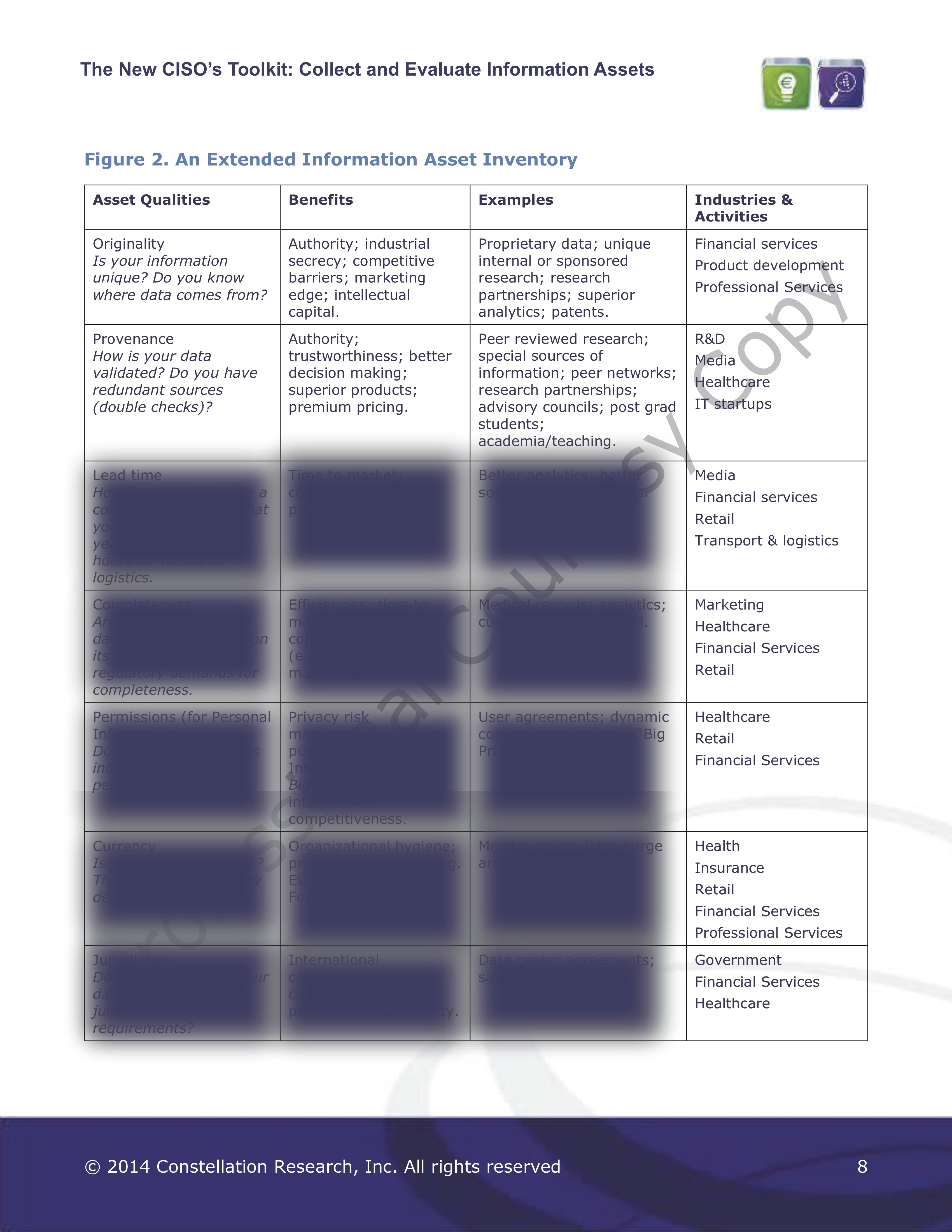
Information assets are almost endless: accounts, ledgers and other legal records, sales performance, stock lists, business plans, R&D plans, product designs, market analyses and forecasts, customer data, employee files, audit reports, patent specifications and trade secrets. But what is it about all this information that actually needs protecting? What exactly makes any data valuable? These questions take us into the mind of the CISO.

Read the research report Strategic Opportunities for CISOs in a Digital Age 

Security management is formally all about the right balance of Confidentiality, Integrity and Availability in the context of the business. Different businesses have different needs in these three dimensions.

Think of the famous industrial secrets like the recipes for KFC or Coca Cola. These demand the utmost confidentiality and integrity but the availability of the information can be low (nay, must be low) because it is accessed as a whole so seldomly. Medical records too have traditionally needed confidentiality more than availability, but that's changing. Complex modern healthcare demands electronic records, and these do need high availability especially in emergency care settings.

In contrast, for public information like stock prices there is no value in confidentiality whatsoever, and instead, availability and integrity are paramount. On the other hand, market-sensitive information that listed companies periodically report to stock exchanges must have very strict confidentiality for a relatively brief period.

Security professionals routinely compile Information Asset Inventories and plan for appropriate C-I-A for each type of data held. From there, a Threat & Risk Assessment (TRA) is generally undertaken, to examine the adverse events that might compromise the Confidentiality, Integrity and/or Availability. The likelihood and the impact of each adverse event are estimated and multiplied together to gauge the practical risk posed by each known threat. By prioritising counter-measures for the identified threats, in line with the organisation's risk appetite, the TRA helps guide a rational program of investment in security.

Now their practical experience can put CISOs in a special position to enhance their organisation's information assets rather than restrict themselves to hardening information against just the negative impacts.

Here's where the CISO's mindset comes into play in a new way. The real value of information lies not so much in the data itself as in its qualities. Remember the cynical old saw "It's not what you know, it's who you know". There's a serious side to the saying, which highlights that really useful information has pedigree.

So the real action is in the metadata; that is, data about data. It may have got a bad rap recently thanks to surveillance scandals, but various thinkers have long promoted the importance of metadata. For example, back in the 1980s, Citibank CEO Walter Wriston famously said "information about money will become almost as important as money itself". What a visionary endorsement of metadata!

The important latent skill I want to draw out for CISOs is their practiced ability to deal with the qualities of data. To bring greater value to the business, CISOs can start thinking about the broader pedigree of data and not merely its security qualities. They should spread their wings beyond C-I-A, to evaluate all sorts of extra dimensions, like completeness, reliability, originality, currency, privacy, and regulatory compliance.

The core strategic questions for the modern CISO are these:

  • What is it about your corporate information that gives you competitive advantage?
  • And what exactly makes your information valuable?

The CISO has the mindset and the analytical tools to surface these key questions in the C-suite and positively engage their executive peers in finding the answers. By applying their skills to map out all the value-creating qualities of enterprise data, the CISO can build a comprehensive "Enterprise Information Catalog" (thanks to Troy Braban at Australia Post for that term!) and grow into a broader, more strategic Chief Data Officer style of role.  The future of the CISO is to shift from purely defensive security modus opeandi to take on responsibility for the pedigree and competitiveness of enterprise information. 

Read my research report Strategic Opportunities for CISOs in a Digital Age for more information.

Data to Decisions Digital Safety, Privacy & Cybersecurity Matrix Commerce New C-Suite Next-Generation Customer Experience Security Zero Trust AI ML Machine Learning LLMs Agentic AI Generative AI Robotics Analytics Automation Cloud SaaS PaaS IaaS Quantum Computing Digital Transformation Disruptive Technology Enterprise IT Enterprise Acceleration Enterprise Software Next Gen Apps IoT Blockchain CRM ERP CCaaS UCaaS Collaboration Enterprise Service developer Metaverse VR Healthcare Supply Chain Leadership Chief Customer Officer Chief Information Officer Chief Information Security Officer Chief Privacy Officer Chief Technology Officer Chief Data Officer

First Take - Top 3 Takeaways of Workday Rising Day 1 Keynote - The dawn of the Analytics era - time to deliver Insight Apps

First Take - Top 3 Takeaways of Workday Rising Day 1 Keynote - The dawn of the Analytics era - time to deliver Insight Apps

We had the opportunity to attend Workday’s Rising conference held at Moscone Center in San Francisco this year. It was good to see that the conference is growing - we are lacking official attendee numbers - but it is the first time that Workday needs both Moscone North and South - in previous years Moscone South sufficed for expo area, food and keynote area. Always a good sign for customers, partners and prospects when conferences grow.


Here are my Top 3 takeaways from the Day 1 Keynote:
 
  • It’s all about Analytics - Back in January Workday acquired Identified (my blog post is here), which was largely seen as an acquihire. 10 months later we see the biggest pitch for Analytics delivered by a major (non analytical per se) vendor this year. Aneel Bushri expanded the so far cloud and mobile DNA picture of Workday with the addition of (analytical) Insights. And these analytics products were part of both Dave Duffield’s and Bushri’s keynote parts, had a lot of stage time with Dan Beck and Ademey Ajao and were prominent in the respective product areas of both Leighanne Levensaler (HCM) and Betsy Bland (Finance). Workday showed analytical capabilities to predict retention risk, enable better Succession Management and likely Expense Deviations.
    Given the audience was mixed technical and business it was no surprise that Workday did not go down  more into the details than mentioning Identified’s SYMAN, and the power of ‘data science and machine learning’. It would have been good to open the ‘Pandora Box’ a little more in regards of the analytical algorithms Workday plans to use - while Workday gave ample room to data ontologies around the by now ‘famous’ nurse example.
    The six Workday Insight Apps coming in Workday 24 and 25
    But kudos go to Workday to frame analytical apps first in the industry in a major keynote - a good move. But the road seems to be long with the Insight Apps (as Workday calls them) almost a year out, slated for Workday 25. And Analytics was so prominent, other new functionality took a backseat in the HCM and Financials areas. But then I did not have a chance to attend follow up sessions due to travel schedules and my impressions and takeaways are strictly limited to the keynote.
The Career Path Recommendations Insight App demo
  • Student Roadmap - Duffield updated the audience on the Workday Student roadmap, and credit goes to Workday to share a long running roadmap all the way to 2017 with Workday 28. In a nutshell 2015 will see Admissions and Curriculum Management, 2016 will see the launch of more Financial centered offerings with Financial Aid, Student Records and Academic Advising and finally 2017 will see Student Financials. Offering longer term roadmap is something we generally applaud at Constellation Research, as it gives customers and prospects the opportunity to align roll out priorities and plans, so a good move that we would like to see in the Financials and HCM areas as well. And finally we will need to check with Workday for similar roadmaps for the other key verticals of Workday.


The Workday Student Roadmap

  • UI innovation remains in full swing - It’s less than a year ago that Workday released a brand new user interface. With the current innovation rate happening in the user interface space, time is flying (as we noted in our takeaways of Workday Tech Summit here) - so it is good to see that Workday not only keeps improving the overall UI, but release innovations continuously and in this case immediately. The new Org Chart UI mechanics, always a tricky area of user interface design, will ship immediately to the customer’s sandboxes. A powerful proof point for the cloud delivery and it is good to see that Workday - probably enabled also by the one code line release model - can deliver innovations continuously. I didn’t have a chance to play with the new org chart control, but the first impression of how it was demoed in the keynote was that it may be too scroll intensive. But then a lot of web (site) design becomes pretty scroll intensive these days and Workday maybe walking the walk of time. The other major change is coming in the Notifications area, an equally tricky user interface area.
The new Org Chart

Tidbits

  • Good Housekeeping on the HR side - A lot of ‘Tools for you’ got announced by Leighanne Levensaler, like Mass Changes, Mass Actions, Data Purging etc. - which are a sign of Workday looking at customer productivity beyond the individual user, so for the HR professional. Not a surprise, but a typical priority a few quarters after a user interface upgrade. On the functional side it’s also no surprise that aiding the new Recruiting module (launch covered here) is a new Insight App for the HCM area. The other three Insights Apps for HR are Retention Risk (there is a need to de-dupe how that works with the existing flight risk functionality), Career Path Recommendations (demoed) and Workforce Scorecards. Equally very well received - applause by audience - was the commitment to support local, state, province tax elections and an effective change stack for payroll integration. Definitively an area we need to learn more about given Workday’s dependency on partners for many payroll implementations.
Employee Retention Insight App
  • Finance goes global and more - On the Financials side Workday is doing a good job and listening to customers with the addition of Document Sequencing (Workday 24) and pre-packaged Localizations (Workday 25). And on the Insight Apps side there will be analytical applications for Financial Scorecards, Customer Collections and Employee Expense Deviation.
Expense Deviation Insight App
  • Inventory Management !? - To my surprise we saw Workday announcing Inventory Management. We can imagine that e.g. Healthcare customers may be demanding functionality in this area - but it is a first move by Workday outside the so far declared functional realm of Financials and HR (adopting to the sequence switch that Workday has undertaken). Certainly an area to watch, and as certain is that Workday executives will staunchly deny any move into Supply Chain Management.
 

MyPOV

A good start for Workday’s Rising conference. Tapping into the potential of analytical apps early is a very good move, now Workday needs to deliver tangible benefits fast. Equally Workday will need to do a lot of explaining and evangelism around analytical applications - but that’s something Workday has done well in the past, most prominently shouldering most of the load to make cloud an acceptable delivery platform for sensitive HR data.
 
On the flipside Workday is slowing down on the HR functionality side, the ecosystem e.g. waiting for a statement of direction in the Learning area will - barring any surprises - not see a Workday Learning module in 2015. On the major building block side we can only track the UK Payroll and now the newly announced Insight Apps. Innovation happening in HR best practices like it the combination of Talent Management functions (we e.g. suggested Transboarding here) is at least not on the publicly shared roadmap.
 
Overall it’s impressive to see how Workday is thriving in the market, the show floor saw pretty much every HR vendor partnering with Workday both on the Learning, Workforce Management and Payroll side. The only absentees being - again no surprise - SAP, Oracle and Infor. Customers of these vendors will (and have been) the likely replacement targets for Workday, so 2015 will be another interesting year as enterprises revisit and renew their commitments to HCM automation.

The move to (true) analytical apps is a bold move by Workday - now as every vendor making bold moves - it needs to deliver. A much better start than last year's Rising announcement of BigData Analytics, which was not enough of both, much improved this year as most of the show cased analytical apps are 'true' analytics applications (based on my tough grading, more here). You bet we will be watching closely the next quarters. 

---------

More on Workday
 
  • Progress Report - Workday supports more cloud standard - but work remains - read here
  • Workday 22 - Recruiting and rich Workday 22 are here - read here
  • First Take - Why Workday acquired Identified - (real) Analytics matter - read here
  • Workday Update 21 - All about the user experience and some more - read here
  • Workday Update 20 - Mostly a technology release - read here
  • Takeaways from the Salesforce.com and Workday parnership - read here
  • Workday powers on - adds more to its plate - read here
  • What I would like Workday to address this Rising - read here
  • Workday Update 19 - you need to slow down to hurry up - read here
  • I am worried about... Workday - read here
Find more coverage on the Constellation Research website here.


Future of Work Data to Decisions Tech Optimization User Conference Oracle SuccessFactors workday AI Analytics Automation CX EX Employee Experience HCM Machine Learning ML SaaS PaaS Cloud Digital Transformation Enterprise Software Enterprise IT Leadership HR LLMs Agentic AI Generative AI business Marketing IaaS Disruptive Technology Enterprise Acceleration Next Gen Apps IoT Blockchain CRM ERP finance Healthcare Customer Service Content Management Collaboration CCaaS UCaaS Enterprise Service Chief People Officer Chief Information Officer Chief Technology Officer Chief Customer Officer Chief Human Resources Officer Chief Information Security Officer Chief Data Officer Chief Executive Officer

Weekly Recap - Week ending October 31st 2014

Weekly Recap - Week ending October 31st 2014

Here is my weekly recap of the week of October 31st:


  • First Take about IBM Insight Day 1 Keynote - read here
  • Constellation Research Connected Enterprise event at the Ritz Carlton on Half Moon Bay
  • The winner of the Constellation SuperNova Award in the category 'Consumerization of IT & The new C-Suite' - Robin Jenkins of RMH Franchise, see the video here
  • The webinar about 'Globalization, HR and Business Model Change' - see here 
  • My Event report of IBM Insight - read here

Fashion Observation of the Week


  • My colleague Terence Vaughan wins the sock challenge - no socks at all!

Catch me next week at Workday Rising in San Francisco, Infosys Analyst Summit in Orlando and then off to a (private) trip to London.


New C-Suite Tech Optimization Innovation & Product-led Growth Data to Decisions Digital Safety, Privacy & Cybersecurity Future of Work infosys SuccessFactors workday IBM SAP AR Executive Events Chief Information Officer Chief Technology Officer Chief Information Security Officer Chief Data Officer

Event Report - IBM Insight 2014 - Is it all coming together for IBM in 2015? Or not?

Event Report - IBM Insight 2014 - Is it all coming together for IBM in 2015? Or not?

We had the chance to attend IBM Insight, which was attended by well over 12000 attendees at the Mandalay Bay convention center in Las Vegas. I already blogged my Day 1 takeaways here.

After many IBM events this year (Connect, Impact, Pulse, Enterprise, analyst summits on BigData & Analytics, the STG products) etc. – it became clear to me with Insight, that maybe everything is coming together for IBM in 2015.

Fresh off the abandonment of 20 cent EPS goal – here are the three strongest arguments for IBM that it's all is coming together, and the three strongest arguments why maybe not: 

Top 3 positive signs

  • Partner Power - IBM has the gravitas in the IT space to make deals and partnerships that no one else has done and may not get done. I see the Apple as well as the SAP and Twitter partnerships in that category. Wondering why these partnership happened now is one question, but the dynamic and sequencing gives reason for optimism that more will be coming. If IBM can monetize these early partnerships, IBM will do well. But first you have to have them in place and here IBM has a leg up in the competition.
  • Product Synergies - The synergies between the SoftLayer powered IBM Cloud, the march to 40 data center locations (that is formally un-answered in the cloud industry), the addition of Power to these data centers and the ability to run Watson on Power and the dynamics around BlueMix form a powerful and compelling combination for enterprise who want to run their next generation applications in the cloud (and move some older loads there, too). IBM can play both the ‘bread and butter’ cloud game on x86 as well as the high end game with e.g. cognitive and analytical applications running on Power. In either case both data residency and performance requirements ask for ‘as local as possible’ data centers, which IBM is rolling out more and more right now.
  • Watson the Big Differentiator - Watson remains a strong differentiator for IBM – and with Insight it has become clear to me that IBM is pushing the envelope with enabling business end users, through normal sentence questioning to find the right (true) analytical insights (more on ‘true’ analytics here). So it is the combination of Watson linguistic capabilities and then (true) analytic offerings (e.g. built on Catalyst) that are the real power of the Watson platform. If IBM manages to bring (true) analytics in the hands of business users – this could then quickly become the strongest selling product for IBM.

    Top 3 remaining concerns

    • Service Business and Dependency - IBM has a strong service arm with GBS, which for the longest time was an area of growth for IBM. But with the disinvestment of the x86 servers the question is going to be – what are the low margin product / services in the IBM portfolio and my guess is that more and more services find themselves in the bottom third of profitability assessments. Not because IBM is running them badly, but because it has stopped selling or disinvested other products and services. However a certain amount of professional services is key to help customers with adoption, change management and to keep a pulse on innovative business best practices. But IBM is operating services at a far too large scale for that ‘tiger team’ approach and with that is faced with competition and margin erosion, triggered by ‘me too’ service offerings by the competition.
    • API Economy (too) unique? - The API economy vision is a toss-up and could be turned into a positive sign over the next years. It makes sense for IBM to push this and it has a maturing platform with BlueMix to deliver on it. But it remains a unique vision and hand in hand with that goes significant risks. In the past enterprises ultimately always selected integrated offerings over products they had to integrate themselves. There is no guarantee this will not change going forward, and IBM makes plausible arguments of that decision criteria to change. But until we see a shift in buying / investment decision it remains a risk and IBM is not hedging the decision by building a (massive) 21st century enterprise suite. Then again – IBM can of course well buy one of these suites in case executives realize they need to get a hedge in the next generation application game. 
    • A huge engineering quality challenge - IBM is facing a massive engineering challenge to make the whole product portfolio work together. In the industry only Oracle is trying to do something similar (see my latest here), and there I am equally concerned that it will be a huge challenge to make it all work. It’s not even 7 years ago when IBM divisions like WebSphere, DB2 and Rational were being ‘integrated at the customer’, and sound end customer advice was to best to treat these product areas as if they were separate vendors. Today’s IBM scope is significantly larger and the delivery cycles are faster, both not friendly forces to deliver end to end quality. But that said, IBM has senior management team on this and profound quality experience – so it may well overcome these challenges.

    MyPOV

    As product cycles get faster and enterprises need to accelerate, the IBM product portfolio is nicely coming together, assuming a mildly optimistic approach to art of future telling. The integrated portfolio, engineered from the hardware up (e.g. Watson on Power) and combined with attractive services (e.g. SoftLayer) and coupled with the right mix of open source vs. proprietary (e.g. BlueMix) are certainly coming together. But it remains a massive undertaking that needs to be more integrated and better working together than any other IBM product offering before.

    The strong services arm, while an advantage in the past, could become a hindrance, as IBM needs to partner with other service providers to gain market share for its products and cannot accept an ‘ok’ outcome if its products would remain to services intensive. To a certain point IBM product leadership needs to engineer products that make services more and more obsolete, or at least fundamentally change them, to service the 21st century business user, who no longer wants, accepts and can afford (more from a time, less from a budget perspective) lengthy service engagements.

    An important year for IBM ahead, which as a last observation has noticeably slowed down the acquisition machine in the last quarters. But then you need to slow down, even stop acquisitions, when you need to bring all things together, which IBM is certainly in the midst of doing right now. (Much) more than a penny for Steve Mills’ thoughts and plans. 


    ----------

    More on IBM :
     
    • First Take - Top 3 Takeaways from IBM Insight Day 1 Keynote - read here
    • IBM and SAP partner for cloud - good move - read here
    • Event Report - IBM Enterprise - A lot of value for existing customers, but can IBM attract net new customers? Read here
    • Progress Report - The Mainframe is alive and kicking - but there is more in IBM STG - read here
    • News Analysis - IBM and Intel partner to make the cloud more secure - read here
    • Progress Report - IBM BigData an Analytics have a lot of potential - time to show it - read here
    • Event Report - What a difference a year makes - and off to a good start - read here
    • First Take - 3 Key Takeaways from IBM's Impact Conference - Day 1 Keynote - read here
    • Another week and another Billion - this week it's a BlueMix Paas - read here
    • First take - IBM makes Connection - introduces the TalentSuite at IBM Connect - read here
    • IBM kicks of cloud data center race in 2014 - read here
    • First Take - IBM Software Group's Analyst Insights - read here
    • Are we witnessing one of the largest cloud moves - so far? Read here
    • Why IBM acquired Softlayer - read here
     
    Find more coverage on the Constellation Research website here.


    Tech Optimization Data to Decisions Digital Safety, Privacy & Cybersecurity Innovation & Product-led Growth Future of Work IBM softlayer amazon SAP Oracle ML Machine Learning LLMs Agentic AI Generative AI AI Analytics Automation business Marketing SaaS PaaS IaaS Digital Transformation Disruptive Technology Enterprise IT Enterprise Acceleration Enterprise Software Next Gen Apps IoT Blockchain CRM ERP finance Healthcare Customer Service Content Management Collaboration Chief Information Officer Chief Technology Officer Chief Information Security Officer Chief Data Officer

    Holidays Ahead: All aboard the content marketing express

    Holidays Ahead: All aboard the content marketing express

    1

    At the beginning of the year, Oracle Eloqua released a State of Content Marketing Survey Report that revealed the trends that were impacting content marketing and approaches that would be taken through 2014. And now, as we are closing in on what is possibly the most explosive time of year for content marketing (yes, I mean the Christmas/Holiday period), I thought it worth running a fine toothed comb across the findings to consider what has changed and what hasn’t. In doing so, we may find a worthwhile insight to drive our holiday content marketing efforts.

    Some of the things to consider in your own content marketing include:

    • Grow your own content: With 93% of respondents creating their own content in-house, 2014 was set to be a strong year for client-side marketers. However, just a little over half are regularly creating content for sales enablement. This leads to a disconnect between marketing and sales which can cause internal challenges and misalignment between business and marketing objectives. Lesson: Work with external agencies to expand content creation capabilities
    • Tool-up to measure effectiveness: Almost 50% of respondents expected to successfully align content with the buyer’s journey by mid-2014. However, only 22% have an effective measurement strategy, and 23% don’t have the tools they need for measurement. This further exacerbates the disconnect between marketing and sales. Lesson: There are increasingly powerful measurement tools available. Now is the time to invest, evaluate and refine your measurement approach ahead of the holiday period
    • Feed your marketing automation machine with quality content: Just like data, you get out what you put into content marketing. It’s not just a matter of “pumping out” content – the challenge for marketers is creating a centre of gravity which attracts customers, leads and opportunities to engage. This is done with quality content, and with 24% of marketers indicating they struggle to engage their audiences, it’s clear there is work to be done here. Lesson: The dream of one-to-one conversations at scale is only possible with a deep understanding of your customer’s journey, marketing automation that has been tuned to that path, and quality content that nurtures leads and moves your audiences from anonymity visitors to known customers. 

    Most marketers will have clear plans for the next two months, but it’s worth pausing and asking the question “Are we doing the right things and doing things right?”. In this digital age, strategy, execution and measurement are no longer time consuming – and marketers must learn to iterate their marketing at the speed of their customers’ lives. Find people who can help you experiment and climb aboard the content marketing express.

    Beutler_Eloqua_LookBookHQ_v10

    Marketing Transformation Sales Marketing Next-Generation Customer Experience Innovation & Product-led Growth Tech Optimization Oracle Marketing B2B B2C CX Customer Experience EX Employee Experience AI ML Generative AI Analytics Automation Cloud Digital Transformation Disruptive Technology Growth eCommerce Enterprise Software Next Gen Apps Social Customer Service Content Management Collaboration Chief Customer Officer Chief Marketing Officer

    Customer Case Study - Constellation SuperNova Award Winner - RMH Franchise Corporation

    Customer Case Study - Constellation SuperNova Award Winner - RMH Franchise Corporation

    Once a year - at the yearly Constellation Connected Enterprise conference, we award innovative executives in each of our research areas. It was my honor this year to award the winner in our research area of 'Consumerization of IT / The new C-Suite'.


    This research area focuses on the force field created by the desire to bring modern technology, influenced by what is available for consumers, to the workplace, while balancing the need of enterprise IT to provide scale and secure computing environments.

    This year''s winner, Robin Jenkins (@RobinJenkins) of RMH Franchise Corp. balanced these two forces perfectly. 

    I had the pleasure to do a short video interview with Jenkins, that you can watch here:


    Highlights in the video are

    • RMH Franchise operates over 130 Applebee's franchises in 15 states across the Midwest
    • Faced with 120% employee attrition RMH decided to use the power of gamification to increase employee engagement and ultimately retention
    • Previous system were back to managers abilities and not being successful. 
    • Jenkins researched the topic and stumbled across a game called 'Dino Dash' - which created the idea to use gamification as an instrument to increase employee engagement
    • RMH Franchise ultimately selected Bunchball as the vendor showed more commitment than its competitors. visiting locations, making best practice suggestions and helping the small RMH Franchise IT team.
    • RMH Franchise went live in June 2014, it's too early to see formal results but overall employee engagement is already up 
    • With the industry average being 92%, RMH Franchise will see significant savings reducing attrition. The company has calculated that a 10 percentage point reduction will equate to 1M US$ in savings, paying fully for the project.

    • Jenkins recommends other practitioners to look into gamification as a tool to get employees more engaged. The value is not in the software, tools and leadership boards, but in the change of the thought process and shift in values of employees facing customers.
    • The biggest challenge Jenkins sees is the change management to get executives, managers and employees on board to use the system.  
    2012, 2013 & 2014 (C) Holger Mueller - All Rights Reserved


    New C-Suite Chief People Officer