Results

News Analysis: In Search Of Growth Amidst Digital Disruption

News Analysis: In Search Of Growth Amidst Digital Disruption

Organizations In Search Of Growth Must Consider Macro Forces

Burgeoning money supplies in both the US and China have fueled an indefensible growth post Global Financial Crisis.   Since 2000, the money supply has tripled from $6000 USD billion to 12288.10 USD billion in November of 2015 (see Figure 1).   Since 2005, china’s money supply has grown 7X from 20000 CNY Billion to 137400 CNY Billion in November of 2015 (see Figure 2).  While this level of money supply growth would normally cause inflation, income inequality has played a key role in keeping inflation in check because the richest 1% of people in the world now own more than 50% of global wealth (see Figure 3)

20160107 News Analysis: In Search Of Growth Amidst Digital Disruption from Constellation Research on Vimeo.

Figure 1. Massive Growth In US Money Supply M2 Shows Tripling since 2000

Money Supply United States

Figure 2. Chinese Money Supply (M2) Has Increased Seven Fold Since 2005

Chinese Money Supply

Figure 3. By 2016, The Top 1% Will  Have More Than 50% Share Of Global Wealth

Wealth Inequality 2016

Lesson 1 – Transform Business Models And Engagement

Lesson 2 – Keep The Brand Promise

Lesson 3 – Sell The Smallest Unit You Can

Lesson 4 – Know That Data Is The Foundation Of Digital Business

Lesson 5 – Build For Insight Streams

Lesson 6 – Win With Network Economies

Lesson 7 – Humanize Digital With Digital Artisans

Lesson 8 – Democratize Distribution With P2P Networks

Lesson 9 – Deliver Intention Driven, Mass Personalization At Scale

Lesson 10 – Segment by Digital Proficiency Not Age

Digital Disruption, Technology Startups, And Mergers Drive Growth

Investors tasked to achieve growth have mostly approached the challenge by:

  1. Pushing for mergers and acquisitions
  2. Investing in technology startups
  3. Investing in startups with disruptive business models

The result has been an average age of company on the S&P 500 down from 60 years to 15 years and 52% of the Fortune 500 merged, acquired, gone bankrupt, or fallen off the list since 2000.   Even worse, the proliferation of bets in these three categories is exacerbating the number of organizations in the market and reducing the number of growth options

The Bottom Line: Digital Darwinism Is Unkind To Those Who Wait

Organizations focused on jump starting growth must begin their transformation to a digital business.  With fewer and fewer companies surviving as margin based businesses, those organizations building new digital business models will be rewarded with growth valuations.  As the winner takes all market continues, digital transformation is a key lever in the ability to grow profits, expand markets, and dominate a market.

Get The Book Now Before Digital Darwinism Impacts You

Purchase on Amazon
Bulk Orders: contact [email protected]
About Disrupting Digital Business

Join the Digital Disruption Tour. Events in San Francisco, Atlanta, London, and Amsterdam!

Your POV.

Are you ready to disrupt digital business?  Have you ordered the book?

Add your comments to the blog or reach me via email: R (at) ConstellationR (dot) com or R (at) SoftwareInsider (dot) org.

Please let us know if you need help with your Digital Business transformation efforts. Here’s how we can assist:

  • Developing your digital business strategy
  • Connecting with other pioneers
  • Sharing best practices
  • Vendor selection
  • Implementation partner selection
  • Providing contract negotiations and software licensing support
  • Demystifying software licensing

Resources

Reprints

Reprints can be purchased through Constellation Research, Inc. To request official reprints in PDF format, please contact Sales .


New C-Suite Innovation & Product-led Growth Tech Optimization Future of Work Data to Decisions ML Machine Learning LLMs Agentic AI Generative AI Robotics AI Analytics Automation B2B B2C CX EX Employee Experience HR HCM business Marketing Metaverse developer SaaS PaaS IaaS Supply Chain Quantum Computing Growth Cloud Digital Transformation Disruptive Technology eCommerce Enterprise IT Enterprise Acceleration Enterprise Software Next Gen Apps IoT Blockchain CRM ERP Leadership finance Social Healthcare VR CCaaS UCaaS Customer Service Content Management Collaboration M&A Enterprise Service Chief Information Officer Chief Technology Officer Chief Digital Officer Chief Data Officer Chief Analytics Officer Chief Information Security Officer Chief Executive Officer Chief Operating Officer Chief Experience Officer

Social and Digital Media Requires Brands to Become Publishers

Social and Digital Media Requires Brands to Become Publishers

I think most brands, when they started in social and digital media didn’t realize the commitment they were heading into to be content creators or essentially publishers. But what the recent past has shown is that engaging customers in digital and social is that great content is key – for  engagement, interaction, thought leadership, social selling and being on customer’s radar as relevant and authentically genuine in this new digital era. And interesting chart by SmartInsights, shows what happens every 60 seconds:

Content management positing dr natalie

Potential and current customers use social and digital media to research and compare products and services. The chart shows that from 2013- to 2016 the amount of content created and posted is growing nearly exponentially. The difficulty for brands is that there’s some much content out there, that it can be difficult to ensure that the content they are creating is cutting through all the noise and is not only noticed but taken seriously. It’s a whole lot of creative going to waste otherwise. And that’s one of the reasons it is so important for brands to really understand storytelling and the mix of content they are using — it can’t be all “buy our stuff.” It has to be a combination of inspiration, motivational, information, humor as well as fun.

Part of the reason that the type of content brand’s publish is so important is that studies show that people have limited attention spans and time to pay attention to all the content that is posted. It’s not possible for humans to cognate all the digital and social content being posted. And research by Moz and Buzzsumo shows that the majority of content marketing has limited impact with 75% of blog posts they analysed getting fewer than 10 social shares and zero links from other domains. It also presents an issue for marketers who are researching best practice in different areas, as often there are so many different messages it is hard to know where to begin. And that’s where storytelling, branding and brand personas come into play. That’s part of what I teach in my UCLA course in digital media. And it’s not just important to marketing, customer service and sales and other departments need to be paying attention to this content conversation. If your brand was a person, what would its voice be like? Snarky? Smart, Goofy? Funny? Brainiac, Sweet, Kind…. Those are only the beginnings of what storytelling and brand personas need to be considering….

If you are a brand, it’s time you looked at your content, and your content and digital engagement strategies (marketing, sales and service) and make sure you are providing what customers need and want to stand out in a very crowd space.

@drnatalie, VP and Principal Analyst, Constellation Research

Covering customer experience in the digital era of a service economy

Share

Marketing Transformation Next-Generation Customer Experience Chief Customer Officer Chief Marketing Officer

Salesforce 2016: Intelligence, Analytics and IOT

Salesforce 2016: Intelligence, Analytics and IOT

Earlier this week Salesforce held their 2016 Analyst Summit. At this event, they shared information about their product and marketing plans, we heard customer stories, and we were able to ask questions to several top executives. In the video below I provide an overview of the Salesforce product portfolio, explain some of the terminology they use (ex: Lightning, Thunder, Wave, Salesforce1), and highlight some of their strengths in the collaboration market. 


While not covered in the video, there are areas I would like to see Salesforce improve in their collaboration portfolio, such as:

  • Better project/task management
  • Real-time communication (1:1 or group video chat)
  • Long form content creation (i.e. notes/documents that are longer than Chatter posts)

I asked about each of these, and while I am not able to disclose Salesforce's replies, I can tell you they are aware of each of these shortcomings. In some cases these areas will be addressed by Salesforce building new features, some by product acquisition and some things will be solved by integration with partner products.

I look forward to seeing Salesforce's progress in 2016 around personal productivity, team collaboration and customer engagement. I'll be keeping a close watch on how they leverage intelligence (AI), analytics, and the Internet of Things (IOT) to improve each of these areas.


Sales Marketing Next-Generation Customer Experience Revenue & Growth Effectiveness Data to Decisions Future of Work Innovation & Product-led Growth New C-Suite Digital Safety, Privacy & Cybersecurity Tech Optimization Chief Customer Officer Chief Digital Officer Chief Executive Officer Chief Information Officer Chief Marketing Officer Chief People Officer Chief Procurement Officer Chief Revenue Officer Chief Experience Officer

Happy New Year 2016! Looking forward to a sweet 16 year for Supply Chains

Happy New Year 2016! Looking forward to a sweet 16 year for Supply Chains

Happy New Year to all, I hope that your 2016 is already off to a great start. Looking forward to this year there are some exiting changes as well and continued progress in other areas. Here are some trends we are focusing on for 2016:

  • Retailers will continue to seek new solutions and services to empower their stores: in 2015 we started seeing greater efforts and emphasis on the role of brick and mortar stores. Written off as irrelevant, even a burden a few years ago, retailers’ views of their real estate assets has taken a turn. Brick and mortar stores’ role in the retail supply chain will continue to grow in importance. This momentum is due to the evolution of how stores are being leveraged by retailers. Embracing show rooming, leveraging stores as distribution centers, creating contextual experiences within the store to drive traffic to name a few indextrends, are all making stores matter again. Most significantly the redefinition of the store’s role allows traditional retail to tackle the pure eCommerce players. 2016 will continue to see this evolution of the store. Gaining improved inventory visibility, empowering store associates with greater information, enhanced operational data to allow more business processes to be tested and adopted are all areas where retailers will be seeking appropriate solutions. Look for retailers to lean on their solution and service providers to bring them the necessary technology and business processes that can allow retailers to continue to transform their physical assets. Solution and service providers must work with their retail clients to not only provide technology or business process solutions, but to also offer strategic insights and ideas. Technology is not the panacea but the enabler for new ideas and processes.
  • Logistics continues to feel the strain: Your supply chain is only as strong as your ability to minimize the friction associated with moving inventory and products throughout your supply chain. This burden falls on logistics – rail, ocean, air, trucks even bicycles and donkeys are all part of our logistical network. This past holiday season witnessed another situation where the strain on the logistics network can rear its ugly head. eCommerce retailer Jet.com had to apologize to some of their clients for falling short on being able to deliver products in time for Christmas. Logistic giants FedEx and UPS had to jump through some hoops to meet the delivery crush. Coincidentally, over the holidays,  eCommerce giant Amazon announced it is exploring adding an air cargo arm to their distribution assets. While eCommerce is growing at a steady 1o-15% year over year since 2012, the strain it is placing on logistics is disproportionate – due in large part to seasonal aspect of certain package delivery. The strain is also starting to pop up in places such as college campus mail rooms where they are being overwhelmed by services such as Amazon Prime. This trend is not going to disappear once the calendar flips to 2016. Transportation and warehousing will continue to feel the strain of keeping up with the accelerated evolution of supply chain in 2016. Look for continued efforts from service and solution providers to work with their customers to continue to find innovate manners to handle the crush of logistics.
  • Explosion of disruptive technologies continue to grow: Whether it is IoT (internet of things), robotics, drones, 3d printing or virtual reality to name a few, these disruptive technologies will continue to grow in importance within supply chains. IoT is already well entrenched within manufacturing and logistics, in 2016 look for this technology to grow in importance with regards to the retail supply chain. Robotics are also well know within manufacturing, but look for this technology to play a greater role in places such as customer service and inventory management in retail. Drones are getting much attention, somewhat negative, post holidays as those who unwrapped them as gifts are wondering if they need to register with the FAA, there was even a near disaster during a World Cup skiing race when a drone literally fell from the sky, click here for video. Reality is drones have a role to play in our supply chains – the genie is out of the bottle and properly leveraged they can reduce friction from our supply chains. As indextechnology giants Amazon and Google continue to push on how to leverage these machines to address last mile delivery. Additive manufacturing will continue to play a role in the manufacturing process, but will also create new business models. Companies such as Lowes are already experimenting with 3D printers in their stores, allowing customers to have custom products manufactured on site.  3D printing is already playing a significant role with manufacturers such as Airbus and Boeing, but we are only at the cusp of how this disruptive technology will play in our supply chains. Finally virtual reality will continue to play a role in places such as retail – allowing customers to experience product as well as in supply chain design and CAD software. As mentioned above, we see warehousing and other logistics being strained as more companies look to add more of these assets, leveraging virtual reality allows for better testing and understanding of how these capex projects will turn out. Imagine being able to test and try out a full scaled model of a plant or warehouse via virtual reality. Look for these technologies and others continue to grow in importance within our supply chains.

Every year at this time it is always interesting to look back and see what the prior year held for us and more fun to look forward to the coming year. As I have become more of an optimist as I have grown older (is that normal?) I am looking forward to 2016 and some of continued evolution of these technologies and trends.

Happy New Year to you and your loved ones!


Tagged: 3D printer, Drones, IOT, Logistics, Retail, Robotics, Supply Chain, Warehouse

Matrix Commerce Chief Information Officer

IoT, Smart Cities and Virtual Reality with $29.99 Goggles A serious yet slightly fun piece to kick off 2016!

IoT, Smart Cities and Virtual Reality with $29.99 Goggles A serious yet slightly fun piece to kick off 2016!

A first post for 2016 aiming to start the year with a mix of fun and a serious point concerning a $29.99 virtual reality ‘toy’ that will have been Christmas present for a lot of kids. The View-Master is a toy only because it is being marketed that way, it is actually a quality product based on Google Cardboard. This is mass consumer market Virtual Reality ideal for Smart City Services!

View-Master provides a set of goggles for $29.99 into which most popular current Smart Phone fit making Virtual Reality a cost effective proposition to add value to many tasks, or to Smart Cities projects. A link in the last paragraph instructs on how to make a City weather map in Virtual Reality.

It’s not too easy to see in this photo, but there is a Smart Phone encased in the goggles providing a split image for the eyepieces. The genius of the approach is to make use of that most readily available piece of Technology; a Smart phone, to collect the images and deliver to the eyepieces.


For kids with non-techie fathers there are conventional round discs of photos, but a simple download gives the Smart Phone the ability to take photos, or download photos, before turning them into Virtual Reality scenes. Suddenly it doesn’t take huge expensive headsets to deliver Virtual Reality, instead the ubiquitously to hand Smart Phone acquires yet another useful function.

The use of pictures, which includes time lapse from Web Cams, would offer many possibilities for sharing information in a Smart City environment. In addition Virtual Reality also provides additional information when linked to IoT events, and actionable outcomes. As and example traffic and travel information on new road layouts of often includes 2D photos, how much better to be able to navigate the new junction in Virtual Reality.

For a Service Engineer receiving a call out on their Smart Phone, the notion of popping the Smart Phone into low cost Virtual Reality goggles to actually see location and other machine details makes sense. 

Asset Digitization implementations can readily include Photographs for Virtual Reality along with a mass of other data aligned to the specific IoT sensor reporting the event.

View-Master is based on the Virtual Reality approach pioneered by Google under the name of ‘Google Cardboard’. The picture shows the name to be descriptive of the innovative low cost approach taken to constructing the usually prohibitively expensive V-R Goggles, or Headset.  Google Cardboard was meant to be a game-changing move with a low cost mass-market uptake to encourage adoption in the consumer market.

Google offers a full range of support options including Software Developer Kits, though currently limited to Android, through to the Google Cardboard


blogs to share ideas and experiences. (View-Master also supports

Apple iOS 6 as well as Android, suggesting that this cannot be too difficult to achieve). The notion of Cardboard goggles may seem a little weird, even whacky, but the principle of creating highly affordable mass market Virtual Reality could well become achievable by this approach.


There is a further separate site apparently offering similar support to the Google Cardboard nominated above, but under the Chrome Browser heading, billed as Chrome Browser Virtual Reality experiments. A further useful link is the PC Advisor list of the twelve best consumer apps providing a good starting point to see some ideas of what can be achieved with the Technology. If you want to get started then there are recommendations for DoDocase as the place to buy the basic cardboard viewer, see some Apps, as well as get some support.

Over recent years many of the technologies that have transformed Business have started out as a consumer technology before being adopted by business. It would seem that Virtual Reality might be set to enter the mainstream in the same way.

Returning to conclude with the topic of Smart Cities; there is no shortage of research papers concerning the benefits that Virtual Reality can bring to Smart Cities.  (try googling Virtual Reality Smart Cities to see a good selection). The drawback has, up till now, been the cost and complexity of Virtual Reality goggles, or headsets. This is a problem conveniently bypassed by the Google Cardboard approach, which though not as sophisticated a solution, does bring the cost and availability down to suit consumers, or citizens.

This paragraph is for those technically interested enough to want to try out building a Virtual Reality App for City weather forecasts using Google Cardboard.  It’s fully spelt out as to how to write this App in detail by Patrick Catanzarti at Site point in a post entitled Bringing Virtual Reality to the Web using Google Cardboard.

The Internet of Things primarily provides awareness of remote events and situations that call for actions. As more and more devices provide visual data it is logical that Virtual Reality will become increasingly popular providing that a price point can be reached. View-Master and Google Cardboard bring that point within reach, and Smart Cities are a likely starting point for new Apps.

New C-Suite

Capgemini Expands Its Digital Growth Strategy With The Acquisition of oinio, a Leading European Salesforce Partner

Capgemini Expands Its Digital Growth Strategy With The Acquisition of oinio, a Leading European Salesforce Partner

Capgemini and onio: Capgemini announced the acquisition of oinio, one of Europe’s leading Salesforce partners. This acquisition will expand Capgemini’s Digital Strategy Group growth by augmenting Capgemini’s capabilities in providing digital transformation services around the Salesforce solutions and platform across Europe and Asia. Oinio, based in Munich, has become one of the major European players in the consulting and deployment of Salesforce cloud-based CRM and digital marketing solutions. Oonia has more than 600 projects for a portfolio of international clients in life sciences, manufacturing, financial services, high tech and utilities.

Statements from the Executives on The Acquisition: Maic Stohr, CEO of oinio commented, “As part of Capgemini, a global leader in digital business transformation, we’ll be able to offer Salesforce based agile innovation to enterprise customers at scale, to drive quicker business outcomes. It’s a commitment to our customers, our team and to the digital era.”

Dennis Flüchter, COO and CFO of oinio, said, “Joining Capgemini with its worldwide reach is an opportunity to accelerate our growth in Germany and on a global basis too. We’re proud to become part of the Capgemini family.”

And Jean Lassignardie, Corporate Vice President and Group Head of Salesforce Expert and Transformation Services at Capgemini stated, “The recognized expertise of oinio will allow us to reinforce our position in the European and Asian markets, while strengthening our partnership with Salesforce globally. Together, we will be able to quickly deploy the most innovative solutions to support our customers in their business transformation and growth acceleration.”

What Does This Mean? What I find interesting about this acquisition is the pace at which the foreign markets are understanding the value of digital transformation. This type of acquisition clearly shows that both Capgemini and oinio are seeing the desire and need for consulting services in the digital transformation area. System integrators of yesteryear were known for implementing large, on-premise solutions, taking years to implement, many of which were given up on.

Today, system integrators have had to reinvent themselves as the advent of SaaS / cloud solutions replacing the on-premise projects. But smart systems integrators have become trusted advisors in the role of aiding digital transformation. Because there is so much about a business that has to be transformed, in reality there is a huge market for systems integrators that realize that the transition from the old way of doing business, to truly being digital requires a transformation of people, process, leadership and technology. And there is no shortage of actual work that has to get done to make that all happen.

The future? Look to see which systems integrators are understanding what digital transformation means and who is leading companies to transform their culture, the mindset, their leadership, their workforce, their processes (how work gets done and how customers are interacted with and engaged) and what technologies are chosen to make this a reality in the short term. The longer companies wait to take on this type of endeavor, the more danger they put themselves in becoming extinct, i.e., irrelevant to their customers and unfortunately, for some really great brands, the certainty of going out of business.

@DrNatalie VP and Principal Analyst, Constellation Research

Covering Customer-facing Marketing, Sales and Customer Service Strategies and Technologies and System Integrators

Next-Generation Customer Experience capgemini salesforce Chief Customer Officer

#IOT CES 2016: Expect Everything That Can Be Connected Will Be Connected

#IOT CES 2016: Expect Everything That Can Be Connected Will Be Connected

CES: The Connected Internet of Things Dominates: Analysts predict by 2019 that only 49 percent of data in the cloud will be from PCs, and the biggest drivers of the shift will be smartphones and IoT.  They also expect the Industrial Internet (another euphemism for the Internet of Things) to generate over 500 zettabytes in 2019 — 49 times current cloud traffic. Big data? More like huge, vast, gigantic, massive, colossal, and maybe even titanic amounts of data. So yes, lot’s of it and the key is how to use it to make a customer experience – whether B2C or B2B – better. But will all that data help? It could — if we learn how to harness it. And we help translate what the data scientist know so well to the business people that need to use it to make better customer experiences in marketing, sales and customer service. I just hope things don’t get lost in translation.

My POV on #IOT? I’m not really that interested in the machine to machine part of #IOT. It’s not really my area of expertise how machines talk to machines. I am however, very interested in the experiences that are created when “things” get connected to other “things.” Will these connected machines make better experiences or will they just make more data? What does history tell us about our use of technology?

Our Connection to Tools and Data, Prehistoric and Historic: Our connection to tools, think stone spears and our partnerships with tools predates history. History is the study of the past using written records. Anything prior to the first written accounts of history is termed prehistory (meaning “before history”), including earlier technologies and tools. About 2.5 million years before writing was developed, technology began with the earliest of humans using stone tools to start fires, hunt, cut food, and bury their dead. These were basic materials and resulted in the first tools or technology.Screen Shot 2016-01-05 at 11.30.49 AM

If you don’t already know this, my engineering degrees are in material science and metallurgy. Why mention this you ask? Well because in archaeology and physical anthropology, human prehistory is divided into three consecutive time periods, eachnamed after the main material used in its respective tool-making technologies: the Stone Age, the Bronze Age, and the Iron Age — technology then was really about the materials humans could develop into tools. (Actually it still is – only now it’s about Silicon-based or other materials made into chips that run our software and hardware or used to make sensors, devices and the internet – that give us the ability to connect everything to everything and generate all that data.) The figure below from Pitkochart does a nice job of showing how “tools” evolved over time…

Screen Shot 2016-01-05 at 11.31.52 AM

And so the point is that what we see, as we traverse history is, that those  man/machine partnerships have and are being taken to a new level.  Today, for example service partnerships like Google and Apple Maps and WAZE help us to find our way. And in the future, those partnerships will be with self-driving cars, more advanced robots for manufacturing, anthropomorphic robots for companionship and game-play and much more helpful versions for housekeeping and other errands. At CES we’ll see semi-autonomous tools such as lane assist, self-parking and adaptive cruise control. And perhaps by 2020 the big car makers will have fully autonomous vehicles ready to go.

Screen Shot 2016-01-05 at 11.39.43 AM

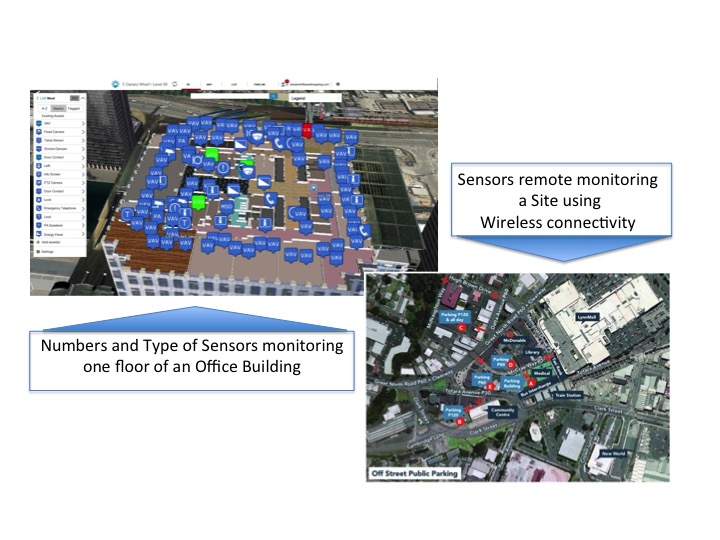
Sensors, Sensors, Sensors. And to power all of this? In part, sensors. A sensor is an object used to detect events or changes in its environment, which then provides a corresponding output. Depending on the type of sensor, it could have a electrical or optical signals. So to get the data, you need a sensor. If something can accommodate a sensor, it will have a sensor.  If the sensor can be computerize it, it will be computerized.  If the sensor would benefit from two-way communication, you’ll bet that will be something that will be included in its capabilities. These connections may also include dedicated systems for connected things with proprietary or standardized RFID, active RFID, real-time locations systems, mesh sensor networks, etc… But it will also be smart objects that will sense and communicate over the internet within human interaction. And it will also include internet-enabled personal electronics like cell phones, tablets and computers. The figure below from IDTechEx does a great job of breaking this down.

Screen Shot 2016-01-05 at 11.40.52 AM

So in short, CES 2016 is about everything that can be connected will be connected. It is about the Internet of Things #IOT connected. I just hope that we go that one step further, and not just rest on the ability to connect things to things, but we complete the circle and we clearly demonstrate the business value and the value to creating better customer experiences.

Creating an experience just because we can is not enough. Though I know we sometimes have to start there to develop the technology to get it to a place where it will benefit people and business. I just hope we don’t get lost in the mounds of data and forget what we were really aiming to do… which is to make better customer experiences… Because at the end of the day, the last variable for companies to compete on? Not product, not price, but experience. Customer experience is the deciding factor and the sooner executives really grasp the value of this, the sooner they will take the lead in their industry. And if not, as in Ray Wang’s book, Disrupting Digital Business, they will be become a statistic: since the year 2000, 50% of the Fortune 500 companies have been acquired, merged or gone completely out of business. It’s time to really understand why. The why? Customer experience. Period.

@DrNatalie

VP and Principal Analyst, Constellation Research

Covering Marketing, Sales and Customer Service and All things Connected to make better Customer Experiences through #IOT


Next-Generation Customer Experience Data to Decisions Future of Work Innovation & Product-led Growth New C-Suite Tech Optimization Chief Customer Officer

General Motors is Investing $500M in Lyft – Just The Beginning of the Sign Of Changes in 2016

General Motors is Investing $500M in Lyft – Just The Beginning of the Sign Of Changes in 2016

The Digital Disruption Is Here. The digital disruption is showing up in a very traditional industry, the auto industry. How? General Motors, with the $500 million investment in Lyft, is creating a wider-ranging strategic partnership that will include a rental program for drivers of the car-sharing service and the creation of an on-demand autonomous car network. Lyft and GM began their talks about three months ago at the Los Angeles Auto Show according to John Zimmer, Lyft president and co-founder. The move is part of a larger effort to increase the company’s heft via a number of alliances, such as one with Didi, Ola Cabs and GrabTaxi, in what amounts to a global anti-Uber effort.

Why GM And the Lyft Partnership?  Lyft added GM to its arsenal because according to Zimmer, “GM is the largest automaker in the U.S. We both see the future of transportation through a network versus ownership, and this is a step in that direction.” What’s most interesting is to note that GM is looking to the shift away from its main business until now — the sale of cars — to a more service-oriented one.

How Much Has Been Invested in Lyft?  The investment is part of a larger funding round of $1 billion for Lyft, including a previously reported $100 million from Saudi Arabia’s Kingdom Holding Company. Other existing Lyft investors will also participate, including Janus Capital Management, Rakuten, Didi Kuaidi and Alibaba. Post-money, Lyft will now be valued at $5.5 billion, which is still a fraction of the $60 billion-plus valuation of its rival Uber. So far, the startup has raised $2 billion since its founding in 2013

According to GM president Dan Ammann, Even for GM, $500 million is a lot of money, but investing in different business models [is] going to be an important part of our future. The car industry is going to change more in the next five years than in the past 50, noting it was eventually moving away from ownership and toward a more software and service business.”

But now, Lyft has something Uber does not yet have — the significant backing of a major U.S. automaker. In May, Lyft did garner an investment from Bill Ford, executive chairman of the U.S. automaker, but it came from a personal venture fund.

What About Self-Driving Cars? The partnership also marks Lyft’s boldest declaration yet that it intends to operate with self-driving cars in the future. Uber is already plowing significant resources into its own autonomous driving research, but it looks like Lyft will outsource this technology to GM. Google, the leader in autonomous driving tech, has also held talks with multiple carmakers about partnerships, including, reportedly, a big one with Ford.

For GM, the investment puts it squarely at a major crossroads. The Detroit behemoth has already made a recent push toward ride-sharing and self-driving cars, but it has moved slower than German rivals Audi and Daimler. In October, GM said autonomous fleets of its electric Chevy Volts would be on the road in 2017.

Presumably, that will be part of the “Autonomous On-Demand Network” that GM and Lyft said they planned to create, noting they “will work to help make this integrated network of on-demand autonomous vehicles part of people’s daily lives.”

What Does This Mean for You? What that means is unclear as yet, with few details about when and where and how. More concretely and immediately, GM and Lyft said they will also offer “rental hubs,” allowing Lyft drivers to rent cars on a short-term basis. While neither Lyft nor GM would confirm whether the deal was exclusive, Amman noted that the partnership would require a “deep level of cooperation and integration.” Neither he nor Lyft president and co-founder John Zimmer would comment as to whether this was a prelude to an acquisition.

On the other hand, what it does mean is that a business that has traditionally been in the business of selling cars is now transitioning into a service business. Which is a true indicator of the power service-oriented economy. How is your business shifting? Is it standing still, doing the same things it’s always done or is it looking into the future at a new version of itself? Perhaps it’s time for some new years resolutions?

@DrNatalie, VP and Principal Analyst, Constellation Research

Covering Marketing, Sales and Service in a Digitally Disrupted Business World

Next-Generation Customer Experience Innovation & Product-led Growth Tech Optimization Future of Work AI ML Machine Learning LLMs Agentic AI Generative AI Analytics Automation B2B B2C CX EX Employee Experience HR HCM business Marketing Metaverse developer SaaS PaaS IaaS Supply Chain Quantum Computing Growth Cloud Digital Transformation Disruptive Technology eCommerce Enterprise IT Enterprise Acceleration Enterprise Software Next Gen Apps IoT Blockchain CRM ERP Leadership finance Social Healthcare VR CCaaS UCaaS Customer Service Content Management Collaboration M&A Enterprise Service Chief Customer Officer Chief Information Officer Chief Technology Officer Chief Digital Officer Chief Data Officer Chief Analytics Officer Chief Information Security Officer Chief Executive Officer Chief Operating Officer

IBM Design Studio Austin - Site Visit

IBM Design Studio Austin - Site Visit

 
I finally got around to follow up on the invitation by IBM’s GM of Design, Phil Gilbert, to visit the campus in Austin, which hosts the nucleus of the IBM Design activities. Needless to say – it was an insightful visit. Here are some highlights:


The Austin Design Studio is where IBM’s quest to infuse more Design Thinking into its products began. The design center remains the core of the effort, though IBM has been opening more design centers across the globe – counting more than 30+ as of right now. And IBM keeps investing into these centers, with 11 of them becoming ‘flagship’ centers, a status that in 2015 only Austin holds.
 

The Space

Location and space is always a key decision to make for innovation and design centers, and IBM chose an unusual approach with opting to co-locate the design center into an existing IBM office and going to a ‘non-coastal’ location with Austin. A number of factors played a role to start in Austin, embedding the design center physically with a development office was a prominent factor and Gilbert did not want to create a satellite that could create a lot of ‘it can’t be done here’ syndrome. And Austin has a growing reputation in design cycles since quite a while, more importantly IBM sees no challenge to attract talent to the Austin locaton.

The Design Studio now occupies over 50k square feet on two stories and is expanding by another 25k square feet soon. A regular office building poses some challenges to create the wide open spaces with adjustable furniture as required by state of the art design centers, but the design center’s space architects found a way of working with Steelcase to allow for flexible, hanging partitioning walls. And the rest the design center does not differ from other places, with an emphasis on furniture on rollers, frugal means to create new furniture (for example Z-Bars with pipe plumbing to affix whiteboards) and the usual creative ‘hacks’ you find in design centers. And no surprises – designers in Austin gravitate towards the lounge setup as a working and review environment like their peers in Silicon Valley, Seattle, New York, LA and Potsdam (more site visits to come).

What is different in Austin is, that the key design teams for specific products are co-located on the floors, creating their own distinctive spaces. And while IBM ‘forward deploys’ designers into development locations, it maintains these core groups at design centers. It’s a sign for IBM’s outcome orientation when it comes to design, and likely a key contributing factor to the quick turnaround and immediate results in the usability of its products. At the same time IBM knows it has to collaborate across physical locations and time zones and it is good to see that designers are equipped with the necessary modern tools to make this happen.

Very tough to pick the top three takeaways – but here you go:

Pragmatic Approach – As mentioned above, IBM is pragmatic about using Design Thinking to move the bottom line regarding usability of its product. It’s pretty much a no-nonsense culture (saw a motto: ‘Don’t Ship Sh…!’) measured by product progress in usability. And the team’s charter is a focus on creating a global sustainable culture of design across the vendor.


Taking the approach of not limiting the physical design of its products through one common technical framework but opting for a ‘meta’ design language (learn more about it here) instead is a unique approach for almost all of the industry. Though sceptics thought a descriptive language would not be able to hold up uniformity of actual user interfaces, the proof of the contrary is by now in the famous ‘pudding’ – as the IBM products look more uniform across product families than ever. 

Design Infiltration – It is relatively easy to establish a new innovation / design center with a substantial investment, the key measure of success is a lasting ‘lift’ in product usability and quality as well as the moving of the overall product development organization to a higher level of performance. Never an easy task to solve, it looks like IBM has achieved the right balance between central product design teams and embedded designers at the various development locations. At the same time IBM has an ambitious hiring goal (ultimately 1000 designers) and has been able to train them, bring them up to speed and achieve a level of consistency that matters for making products usable for the same users across product groups. Using an incubation program at the same time to train the new hires – while supervised by senior designers – and allowing product team to ‘test drive’ for a limited time the design center is a win / win move.
 
Beyond Designers – It certainly helps that Design Thinking and the design centers have support from the top at IBM, CEO Rometty is a driving force behind the design approach. It is no surprise that the only 2nd time the worldwide IBM leadership team has come together in the same place other than Armonk, has been in Austin. And IBM has a lot of design tradition, starting with former CEO Watson’s memo of ‘design is good business’. Rometty sees client experience as the key path to future growth for IBM.
 
Even more interestingly IBM is implementing lessons learnt and best practices across more IBM offices, not only briefing centers (as IBM calls customer visit centers) but also regular office. More configurable space, more furniture on rolls is supposed to create an overall more agile, dynamic, project oriented IBM going forward. The success of this massive change management endeavor will be interesting to watch going forward.

MyPOV

Always great to visit design centers, especially when they are successful and have moved the needle for their respective organization. It is fair to say that Design Thinking, the IBM design centers, starting with Austin and the designers have made a substantial difference to current IBM products. When mainframe engineers use Design Thinking for a zOS upgrade – you know IBM is onto something that works and transforms the way how the vendor builds its products. It is also very good to see that the core design team is not resting on its laurels, but actively working on re-thinking (pun intended) the way how IBM practices Design Thinking, stay tuned for more in 2016.

Overall a very promising state of Design Thinking at IBM, but changing the way to work, do business, and how products are imagined and built for a 380k+ employee organization and their customers takes time – and the next years will show how lasting the new approaches are. 2016 with the rollout and upgrade of more design centers will be a key year. We will be watching.


If interested in more 'Site Visit' blog posts - many remain confidential (unfortunately) - but this one with ADP is public.
 
Find more coverage on the Constellation Research website here and checkout my magazine on Flipboard and my YouTube channel here
    Next-Generation Customer Experience Tech Optimization Data to Decisions Future of Work Innovation & Product-led Growth New C-Suite IBM Chief Customer Officer

    Blockchain: Linux Foundation Unites Industry Leaders to Advance Blockchain Technology

    Blockchain: Linux Foundation Unites Industry Leaders to Advance Blockchain Technology

    What’s the News?: The Linux Foundation, the nonprofit organization enabling mass innovation through open source, today announced a new collaborative effort to advance the popular blockchain technology. The project will develop an enterprise grade, open source distributed ledger framework and free developers to focus on building robust, industry-specific applications, platforms and hardware systems to support business transactions.

    Who is Invovled?: Early commitments to this work come from Accenture, ANZ Bank, Cisco, CLS, Credits, Deutsche Börse, Digital Asset Holdings, DTCC, Fujitsu Limited, IC3, IBM, Intel, J.P. Morgan, London Stock Exchange Group, Mitsubishi UFJ Financial Group (MUFG), R3, State Street, SWIFT, VMware and Wells Fargo.

    What is BlockChain?: Blockchain is a digital technology for recording and verifying transactions. The distributed ledger is a permanent, secure tool that makes it easier to create cost-efficient business networks without requiring a centralized point of control. With distributed ledgers, virtually anything of value can be tracked and traded. The application of this emerging technology is showing great promise in the enterprise. For example, it allows securities to be settled in minutes instead of days. It can be used to help companies manage the flow of goods and related payments or enable manufacturers to share production logs with OEMs and regulators to reduce product recalls.

    Why Did the Founding Members Come Together?: To standardize the potential savings, use cases and ensure the orders come into the system and the code execution are standardized and to improve hardware. For supply chain and IOT and the financial industries, this is very important. Many of the founding members are already investing considerable research and development efforts exploring blockchain applications for industry. IBM intends to contribute tens of thousands of lines of its existing codebase and its corresponding intellectual property to this open source community. Digital Asset is contributing the Hyperledger mark, which will be used as the project name, as well as enterprise grade code and developer resources. R3 is contributing a new financial transaction architectural framework designed to specifically meet the requirements of its global bank members and other financial institutions. These technical contributions, among others from a variety of companies, will be reviewed in detail in the weeks ahead by the formation and Technical Steering Committees. This collaboration is expected to help identify and address important features and currently missing requirements for a cross-industry open standard for distributed ledgers that can transform the way business transactions are conducted around the world.

    A note from the executive director at The Linux Foundation, Jim Zemlin: “Distributed ledgers are poised to transform a wide range of industries from banking and shipping to the Internet of Things, among others. As with any early-stage, highly-complex technology that demonstrates the ability to change the way we live our lives and conduct business, blockchain demands a cross-industry, open source collaboration to advance the technology for all.”

    Many CFO are Interested. Why?” Distributed ledger systems today are being built in a variety of industries but to realize the promise of this emerging technology, an open source and collaborative development strategy that supports multiple players in multiple industries is required. This development can enable the adoption of blockchain technology at a pace and depth not achievable by any one company or industry. This type of shared or external Research & Development (R&D) has proven to deliver billions in economic value.

    Who is Linux Foundation?” The Linux Foundation is the organization of choice for the world’s top developers and companies to build ecosystems that accelerate open technology development and commercial adoption. Together with the worldwide open source community, it is solving the hardest technology problems by creating the largest shared technology investment in history. Founded in 2000, The Linux Foundation today provides tools, training and events to scale any open source project, which together deliver an economic impact not achievable by any one company. More information can be found at www.linuxfoundation.org.

    My POV: Blockchain has the potential to change how we operate on a financial level. This comes with great responsibility and also great promise. But where there is promise, there is also risk. It will be very interesting to see how this group evolves and how standards are created and if it does do the transformative work it’s set to do. It’s always interesting when money is involved.

    For more information about the project and how to participate in this work, please visit: https://blockchain.linuxfoundation.org/

    @Drnatalie VP and Principal Analyst, Constellation Research

    Covering Customer-Facing Applications, IOT and how Blockchain may change the future of our financial backbone


    Next-Generation Customer Experience Digital Safety, Privacy & Cybersecurity Innovation & Product-led Growth AI Blockchain Chief Customer Officer Chief Executive Officer Chief Information Officer Chief Technology Officer Chief AI Officer Chief Data Officer Chief Analytics Officer Chief Information Security Officer Chief Product Officer