


Stanford study: AI is eating entry level jobs
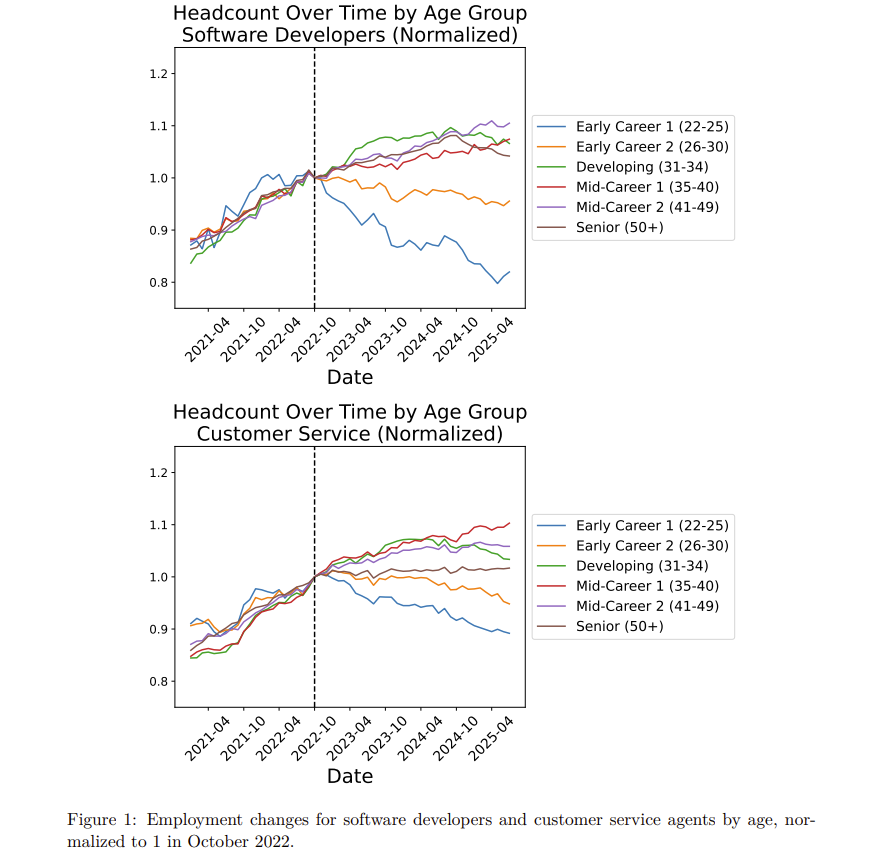
A Stanford University study found that generative AI is eating entry level jobs for workers 22 to 25 year old. The paper, which is based on ADP data, found that early career workers in occupations exposed to genAI have seen a 13% relative decline in employment.
Some of the occupations with the biggest genAI hit included software development and customer service.
The findings aren't terribly surprising for anyone that knows a recent university graduate. It's tough sledding out there as entry level work is being automated.
Stanford researchers found that that generative AI didn't have as large of an impact among more experienced workers. The open question with AI and human labor is this: If AI takes entry level jobs what happens to the bench of workers needed to take on more complex roles?
According to researchers:
"While we find employment declines for young workers in occupations where AI primarily automates work, we find employment growth in occupations in which AI use is most augmentative. These findings are consistent with automative uses of AI substituting for labor while augmentative uses do not."
Keep that quote in mind as vendors dance around automating work and eliminating jobs to talk more about augmenting human labor.
The paper outlines six facts about genAI's impact on young workers.
- Employment for young workers has declined in AI-exposed occupations. By July 2025, employment for software developers aged 22 to 25 declined by nearly 20% from its peak in 2022.
- Overall employment is growing, but growth for young workers has been stagnant. AI takes some of the blame here, but researchers said other factors could be driving the lack of growth.
- Entry level employment has declined in industries where AI is being used to automated work. If AI is being used to augment humans, the impact is muted.
- The employment declines hold even when adjusting for other factors.
- Employment is declining, but compensation isn't.
- The patterns in young worker employment declines hold across multiple samples and conditions.
Larry Dignan is Editor in Chief of Constellation Insights at Constellation Research, where he leads editorial coverage focused on enterprise technology, digital transformation, and emerging trends shaping the future of business. He oversees research-driven news, analysis, interviews, and event coverage designed to help technology buyers and vendors navigate complex markets with clarity and context. ...
Read morePublished
Author
