Results

SAP Q1 solid amid uncertainty

SAP in the first quarter delivered cloud revenue growth of 27% from a year ago with total revenue growth of 12%.

The company reported first quarter earnings of €1.796 billion, or €1.52 a share, on revenue of €9.01 billion. Cloud revenue was €4.99 billion, up 27% from a year ago. Cloud ERP revenue was €4.25 billion, up 34% from a year ago.

CEO Christian Klein said the first quarter results show that its "success formula is working." Current cloud backlog was up 29% at constant currencies. CFO Dominik Asam said the first quarter was "a solid start to the year in a highly volatile environment."

SAP maintained its 2025 outlook, but Asam noted that the company remains "mindful of the broader environment and are approaching the rest of the year with vigilance, continuing to safeguard both profit and cash flow."

The enterprise software giant added that it is adding customers to its RISE with SAP program including Hyundai and Kia, Mazda, Molson Coors and Tyson Foods to name a few. The company recently outlined the SAP Business Cloud via a partnership with Databricks and a stack designed for agentic AI.

"No one can really predict how the global economy will develop throughout 2025 without any doubt, uncertainty in the market remains high," said Klein, who said SAP's business model is resilient and the pipeline looks strong. "Our globalization team localizes SAP portfolio, including solutions like global trade services management that enables our customers to manage every single global transaction in real time steer their companies in uncertain times. Our customers can run real time financial simulations based on internal and external data."

Other items from the call:

  • Klein said Sapphire will include deep dives into agents and core areas as well as "the next chapters of the SAP growth story."
  • SAP customers are building use cases around supply chain, productivity and AI and processes such as order-to-cash. Those use cases haven't diminished amid geopolitical risks, said Klein. 
  • The promise of the SAP Business Cloud partnership with Databricks revolves around customers match SAP data with other system. "This is a real 360 that doesn't require an arm

SAP is also using its own software to highlight returns for customers.

As for the outlook, SAP projected cloud revenue at constant currency of €21.6 billion to €21.9 billion in cloud revenue, up 26% to 28%. Cloud and software revenue at constant currencies will be up 11% to 13% for 2025. SAP projected operating profit excluding items of €10.3 billion to €10.6 billion in 2025. SAP said the outlook will vary depending on currency fluctuations.

Constellation Research analyst Holger Mueller said:

"It looks like SAP is starting to pick up speed convincing its customers to move to the cloud and S/4HANA. AI has come to the rescue for SAP, with customers realizing that with AI they need to run SAP, data and automation in the cloud. The launch of the SAP Business Data Cloud should invigorate the trend. Now SAP of course has to show in Q2 that Q1 was no fluke."

A screenshot of a computerAI-generated content may be incorrect.

Data to Decisions Digital Safety, Privacy & Cybersecurity Innovation & Product-led Growth Tech Optimization Future of Work Next-Generation Customer Experience SAP ML Machine Learning LLMs Agentic AI Generative AI AI Analytics Automation business Marketing SaaS PaaS IaaS Digital Transformation Disruptive Technology Enterprise IT Enterprise Acceleration Enterprise Software Next Gen Apps IoT Blockchain CRM ERP finance Healthcare Customer Service Content Management Collaboration Cloud CCaaS UCaaS Enterprise Service Chief Information Officer Chief Technology Officer Chief Information Security Officer Chief Data Officer Chief Executive Officer Chief AI Officer Chief Analytics Officer Chief Product Officer

What Should The Board Worry About Today?

This is one of the first times I apply the distilling framework to a recommendation, please let me know in the comments what you think.

(Also, this is a summary without sources or links, nor detailed analysis... if you think that would be useful... well, let's talk. I have a service that does that... Let's leave shameless plugs behind, focus on distilling).

I have spent the last two weeks going through vast noise repositories looking for the five topics that matter to a board right now. There are three caveats to these exercises: topics change almost daily given the global economic instability, there is too much content to analyze, and most of it does not correspond at the level (board members) of my focus. This makes the process long and tedious, almost impossible without a framework. The distilling framework helps me focus on a two-horizon recommendation (9-12 and 12-18 months) which are both actionable and plan-ready, and relevant to a board focus between near-term and short-term.

As I started this exercise, five topics appeared based on three key criteria: long-term investment, board-level interest, and reflecting the current "market interest" (you can read hype if you want...). The top five topics were:

  1. Cloud Infrastructure
  2. Cybersecurity  
  3. Generative AI
  4. SupplyChain
  5. Edge Computing

My friend ChatGPT and I had a back-and-forth conversation on this topic based on two different scenarios: one where I fed it the links of what I read and listened to, and one where I asked it to do the same exercise by "themselves". This is about validating my thinking more than lazily adjudicating it to "them"… and also about validating the process, methodology, and framework I am using.

(NE - without making a political statement, I will use they/them to refer to ChatGPT and other inanimate AI agents going forward. I will also always tell you when I used GenAI models to help with the distillation, that's part of the framework)

The results were interesting (as to modification of the investment priorities), and challenging (the difference between the final outputs were very close, but then again -- I had to feed the right information, caveats, and context to get the "right" output, that is one that matched what I had concluded).

Truth be told, I was hoping for something more controversial and different, more of a debate... my guess is we are not there yet, as GenAI has very limited critical thinking (read: none) and reasoning (real reasoning, not what we call it for the purpose of GenAI glorification) capabilities. If you feed it the right information, with its own biases, it will agree with your biases... that's a core feature of GenAI.

But I digress...

The investment allocation was then modified, bure more important - and this is something I got from ChatGPT and not my input - the order of the priorities did not change, the amount allocated from the total budget did.

This was a promising twist, and this is where we are... the table below reflects the change in priorities and budget allocation.

Area

Prior %

New %

Δ

Cloud Infrastructure

40 %

35 %

− 5 %

Cybersecurity &

25 %

20 %

− 5 %

Generative AI

20 %

30 %

+ 10 %

SupplyChain

10 %

10 %

± 0 %

Edge Computing

5 %

5 %

± 0 %

The change was very interesting, but when I asked for justification, this is what It said

Why This Shift Matters

  1. Competitive Parity & Differentiation
    With a significant portion of peers adopting generative AI today, under‑investing risks ceding efficiency gains and new product capabilities.
  2. Acceleration of High‑ROI Use Cases
    Many organizations report measurable productivity boosts (up to 20–30 % time savings) once generative AI is embedded in workflows.
  3. PESTEL Alignment
    • Technological: AI is no longer experimental—it’s core to digital strategy.
    • Economic: High adoption drives down tooling costs and accelerates vendor maturity.
    • Social: Customers and employees expect AI‑enabled experiences.

By reallocating an additional 10 % of our IT budget to generative AI, we both defend against “AI laggard” risk and position ourselves to capture its outsized productivity and innovation dividends—while still safeguarding our cloud foundation, security posture, and supply‑chain resilience.

Which, astonishingly… I agree.  Investing in a mainstream technology is a safer alternative to investing in infrastructure for competitive reasons, better ROI, and meeting expectations.  Those were my reasons for the change, I am glad ChatGPT agrees.

This was an exercise in validating my thinking.  Remember that I fed it the information, and selection biases, as input.  I also asked it to do the same exercise on its own – and provide sources for its thinking… and the sources were similar…. I like the results of the experiment, and like the validation of the methodology… non?

Is this framework and process interesting? Want to see the back notes and research on this? contact me... this is not a sales pitch; it's a search for interested parties to discuss the findings.

Thanks for reading, talk soon.


New C-Suite Chief Data Officer Chief Digital Officer Chief Executive Officer Chief Information Officer Chief Information Security Officer Chief Marketing Officer Chief Procurement Officer Chief Revenue Officer Chief Sustainability Officer Chief Technology Officer

BT150 zeitgeist: Agentic AI has to be more than an 'API wearing an agent t-shirt'

CxOs in the BT150 are starting to push back on agentic AI washing from enterprise vendors.

Our April BT150 meetup touched on multiple topics including tariff volatility on projects and costs (everyone flying blind) and ascending cloud vendors (Google Cloud and Oracle Cloud Infrastructure have momentum), but agentic AI again was the big theme.

Agentic AI has been a running topic among the BT150 and the biggest issue is discerning what's real, what's hype and are the data ducks in order at their enterprises. Our CxO call, which is operated under Chatham House rules, summed up the skepticism about the short- and mid-term returns on agentic AI. Overall, CxOs buy into AI agents, but you can quibble all day about timelines.

2025 BT150 zeitgeist:

One CxO summed up the state of agentic AI: "I have struggled to find an agent that wasn't an API that was just wearing an agent t-shirt. I'm still struggling to find one." 

That take is worth a mention because last BT150 call there was a few questions about whether RPA is a way more cost-effective approach to some of these issues. CxOs said that vendors are often touting agents when it's click automation or just an interface that doesn't scale.

There also needs to be a lot more work on API automation, finding the right ones and connecting APIs while negotiating credentials and data exchange.

The big takeaway is that CxOs need to beware of agents that are just dressed-up APIs.

"We had a lot of cloud washing. We had a lot of AI washing. And now we have a lot of agent washing," one CxO said.

Constellation ShortListâ„¢ Cross-Platform Agentic AI

Other tidbits on agentic AI include:

  • Horizontal players are likely to be your agentic AI most valuable players. Integrators and consultants--Capgemini, Cognizant, Infosys, Accenture and the like are going to be better at building agents than vendors who aren't going to resist the urge to keep you on their platforms. ServiceNow and hyperscale cloud providers would also fit into those horizontal plays.
  • Boomi got a few shout outs as a layer to coordinate APIs and agents. In some ways, it's a twofer in that Boomi can manage APIs that are dressed up as agents if that's the shorter-term play.
  • Shadow AI agents are going to be an issue. If every business user and department can create an agent you're going to have governance headaches real soon.
  • In the meantime, make sure you have your data lakehouse architecture in place as well as your data foundation.
  • CXOs are finding niche consultants focused on agentic AI that are following a concept called "unconsulting" where it's a 90-day sprint or less to build agents on a few already identified use cases. Think of T-Mobile's uncarrier approach but for agentic AI.
  • Agents are a way of getting out of generative AI jail where there was a proof of concept that didn't scale and got held up in compliance.
  • Focus on the processes and the optimization so you can automate with AI agents.
Data to Decisions Future of Work Innovation & Product-led Growth Tech Optimization Next-Generation Customer Experience Digital Safety, Privacy & Cybersecurity ML Machine Learning LLMs Agentic AI Generative AI Robotics AI Analytics Automation Quantum Computing Cloud Digital Transformation Disruptive Technology Enterprise IT Enterprise Acceleration Enterprise Software Next Gen Apps IoT Blockchain Leadership VR Chief Information Officer Chief Executive Officer Chief Technology Officer Chief AI Officer Chief Data Officer Chief Analytics Officer Chief Information Security Officer Chief Product Officer

Financial services firms: The only certainty is investing in AI transformation

Financial services firms are navigating a volatile economic picture, but have no plans to scrimp on their transformation and AI efforts.

Big banks are among the more experienced enterprises working with AI and many of them are in the second or third phases of transformation projects. Quarter-by-quarter these financial services giants are laying out the blueprint for other companies to follow even as the economic picture looks dicey at best.

Where we are now:

Here's a quick tour of what financial services CxOs are saying about their AI plans economy be damned.

Citigroup

Jane Fraser, CEO of Citigroup, has been talking about technology transformation, AI and culling its legacy infrastructure for years. The results are starting to show up. In October, Citigroup laid out a multi-year partnership with Google Cloud to leverage Vertex AI, the provider's high performance computing infrastructure and analytics stack. 

Citigroup CTO David Griffiths was a speaker at Google Cloud Next. He outlined how Citigroup was working on horizontal use cases for AI models and then going with vertical specialized scenarios. Citigroup is embracing AI as "a universal enabler" across its businesses.

Fraser said: "Our transformation investments continue to modernize our infrastructure, simplify our processes, and reduce manual touchpoints. During the quarter, we retired legacy applications and automated reconciliations, to name but a few accomplishments."

Get the Insights newsletter

She added that Citigroup is "integrating AI directly into our business operations to improve the client experience." The bank is working on Agent Assist, a genAI tool for customer service in US Personal Banking. It is also being piloted in credit cards.

Fraser noted that the economy is volatile, but is "protecting necessary investments in our businesses as well as our transformation." "We shall not allow the uncertainty to distract us from executing our strategy and improving our returns," she said.

Citigroup’s journey

A screenshot of a computer

AI-generated content may be incorrect.

Goldman Sachs

Goldman Sachs CEO David Solomon also highlighted the company's AI investments while riffing on the economic picture that's uncertain.

Solomon said the priority is to "serve clients with excellence" while improving efficiency via technology and automation.

He said: "We are leveraging AI solutions to scale and transform our engineering capabilities as well as to simplify and modernize our technology stack. Today, many of our people have access to Generative AI powered tools to help them serve clients more efficiently and increase productivity. These include a developer co-pilot coding assistant and a natural language GS AI assistant. We continue to believe an acceleration in AI adoption will allow for further efficiencies for our own business and for companies large and small. As it is utilized more broadly, productivity gains for the economy will be significant."

Goldman’s journey:


A diagram of a company's efficiency

AI-generated content may be incorrect.

JPMorgan Chase

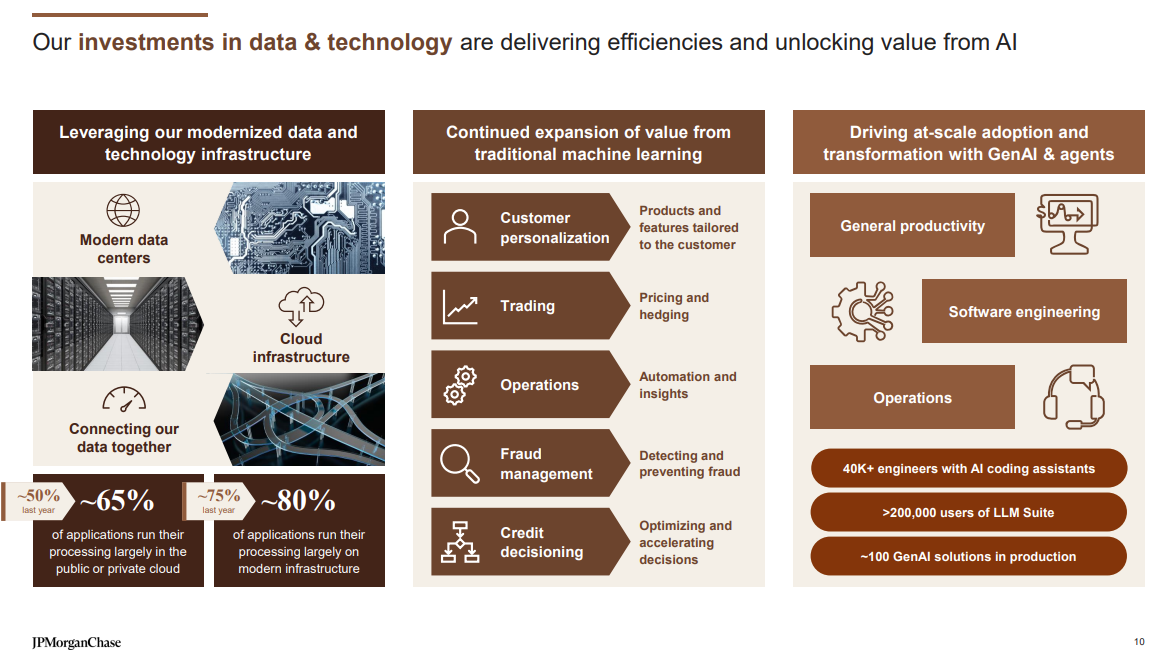
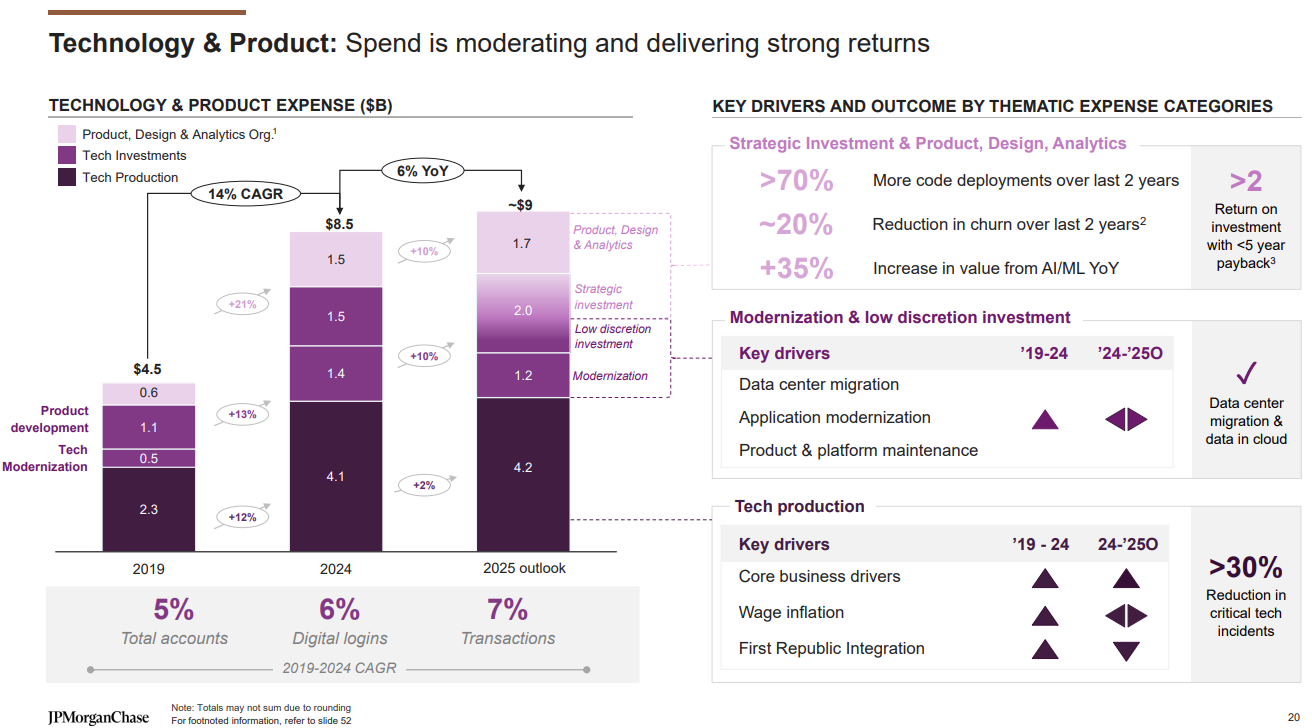
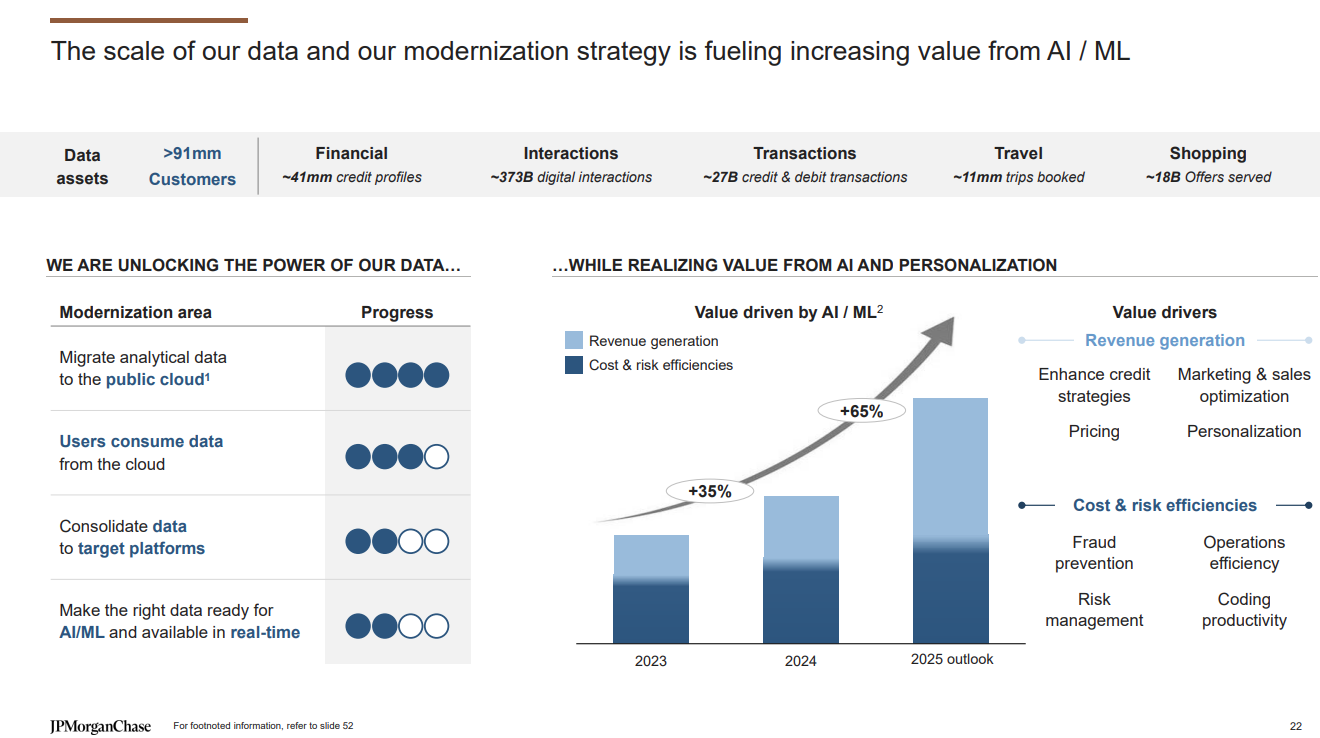
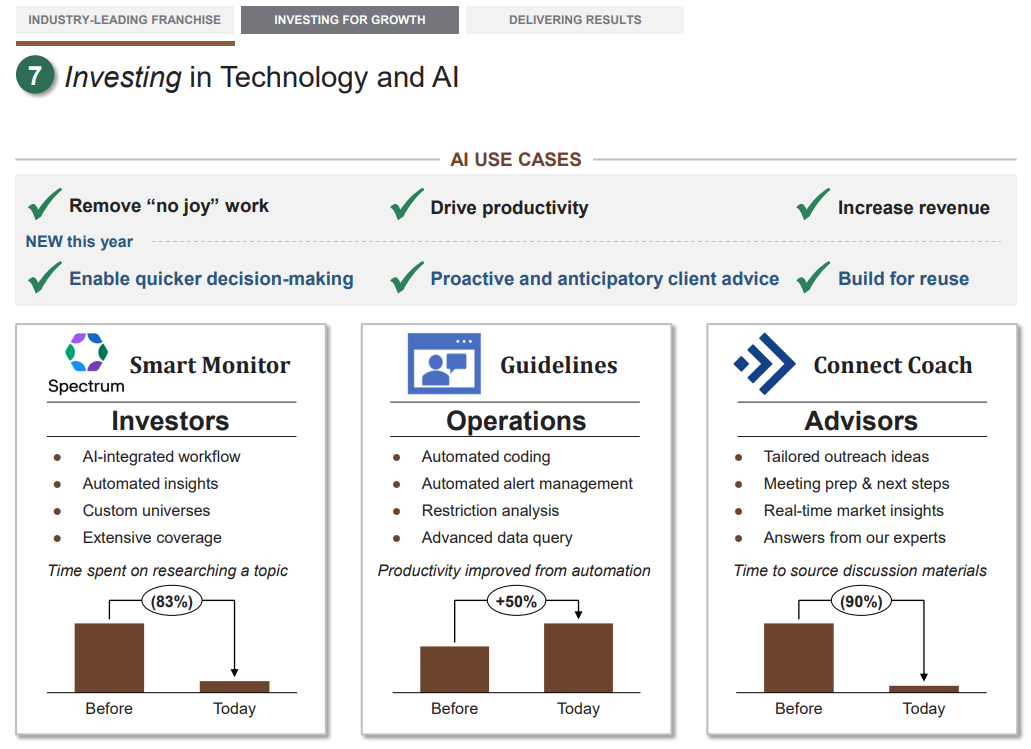
Yes, the economy may be a challenge for JPMorgan Chase. And yes, JPMorgan Chase will continue to invest in technology and AI, said CEO Jamie Dimon.

On the first quarter earnings call, JPMorgan Chase's Dimon was blunt as usual: "The investment that we do in banks, branches, technology, AI is going to continue regardless of the environment."

And Dimon will invest more if needed with JPMorgan Chase's fortress balance sheet. "Based upon the environment, the turbulence issues, I like having excess capital," said Dimon. "We are prepared for any environment and that's so we can serve clients. We have plenty of capital and plenty of liquidity to get through whatever the stormy seas are."

JPMorgan Chase outlines its technology and AI strategy annually at its investor day. The next update is May 19 at its investor day.

JPMorgan Chase's journey:

A close-up of a web page

AI-generated content may be incorrect.

The Bank of New York Mellon

The Bank of New York Mellon (BNY) has quietly built out an AI-powered operating model and recently announced a multi-year partnership with OpenAI to drive models for financial services.

Speaking on BNY's first quarter conference call, CEO Robin Vince said: "We've been taking a platform-based approach to AI capabilities, building and deploying solutions at scale with resilient, responsible guardrails throughout. We believe that our AI platform is going to be an important advantage for us as a large language model agnostic design, leveraging frontier models from multiple leading providers."

Vince added that the deal with OpenAI will give BNY access to cutting edge models and technology and advance use cases.

So far, Vince said that more than 80% of employees have created training to access its AI platform called Eliza. He added that 8,000 employees are experimenting with personal AI agents.

"We have deployed more than 40 AI solutions into production with a significant additional number at various stages of building and testing," said Vince. "Collectively, we expect these to drive productivity gains, improved risk management and to provide meaningful leverage to our people in the future."

A screenshot of a computer

AI-generated content may be incorrect.

BNY's journey:

Data to Decisions Future of Work Innovation & Product-led Growth Next-Generation Customer Experience New C-Suite Tech Optimization Digital Safety, Privacy & Cybersecurity AI GenerativeAI ML Machine Learning LLMs Agentic AI Analytics Automation Disruptive Technology Chief Information Officer Chief Executive Officer Chief Technology Officer Chief AI Officer Chief Data Officer Chief Analytics Officer Chief Information Security Officer Chief Product Officer

From Cost Center to Innovation Engine: Why GCCs Matter More Than Ever

Global Capability Centers (GCCs) have quietly transformed how enterprises operate, innovate, and scale. Once seen as offshore extensions for cost savings, GCCs today are deeply embedded in the digital strategies of Fortune 500 firms and mid-market players alike. They’re helping organizations prototype AI solutions, drive product development, and create global talent pipelines that didn’t exist a decade ago.

India remains at the heart of this movement—with over 1,700 GCCs employing 1.9 million professionals and generating $65 billion in revenue as of FY2024. But this is a global story now. More than 300 new GCCs were launched in 2023 alone, across regions including Eastern Europe, Latin America, and Southeast Asia.

So what separates a high-performing GCC from the rest? A few things stand out:

  • Location strategy matters – India leads, but regional hubs like Poland, Mexico, and Singapore play key roles in multi-hub models.
  • Funding and operating models vary – Captive, partner-assisted, and hybrid models each have strengths depending on your priorities (speed, control, or scale).
  • Talent is the foundation – Compensation arbitrage is still real, but companies now pay a premium to attract top-tier digital talent. GCCs often manage 30–40% of their parent’s global workforce.
  • Maturity is earned – The best GCCs move from task execution to full product ownership to enterprise transformation. Many now house global P&Ls, drive AI R&D, and lead innovation programs.
  • Best practices are well established – From playbooks and onboarding models to governance structures and innovation labs, there’s a growing body of benchmarks and lessons from the field.

Over the past several months, I’ve been speaking with GCC leaders, partners, and executives to understand how the model is evolving—and what’s working. The result is an upcoming research report on “Global Capability Centers: Strategy, Talent, and Innovation in a Multipolar World.” It covers everything from legal frameworks and talent strategy to benchmarking success and real-world case studies.

I’ll be publishing the full report soon. If you’re planning a GCC, already running one, helping a client, or simply want to understand how global operating models are changing—this report is for you.

I would love to hear your thoughts. If you have feedback, use cases, or lessons to share, feel free to reach out.

Innovation & Product-led Growth Chief Executive Officer Chief Information Officer Chief Data Officer Chief Information Security Officer Chief Technology Officer Chief Product Officer

Infosys, Wipro say clients hitting pause on transformation projects

Infosys and Wipro say that enterprises are pulling back on large projects amid an uncertain economy and tariffs, but are still looking to artificial intelligence to cut costs and automate operations.

The results from the two Indian outsourcing giants aren't surprising given Accenture also cited uncertainty even those its quarter results were fine. Accenture has a large US government business.

Infosys reported fourth quarter revenue of $4.73 billion, up 4.8% from a year ago, with net income of $813 million. For fiscal 2025, Infosys reported net income of $3.16 billion on revenue of $19.28 billion, up 3.6% from a year ago.

The earnings from Infosys landed along with two acquisition announcements. Infosys said it would acquire Australian cybersecurity services company The Missing Link, and energy consulting company MRE Consulting. The company also said that Mitsubishi Heavy Industries would join its HIPUS joint venture in Japan.

But the issue for Infosys was its fiscal 2026 outlook, which projected flat revenue growth to 3% in constant currency.

A screenshot of a computer

AI-generated content may be incorrect.

On a conference call, Infosys CEO Salil Parekh said customers are cutting back amid uncertainty. "The changes that we have seen in the economic environment impact has happened very recently and over a short span," he said.

CFO Jayesh Sanghrajka said financial services and manufacturing budgets were solid--especially with AI--but retail, auto and industrial manufacturing budgets were weak. "Recent challenges in terms of tariffs, market uncertainties and trade buyers are likely to lead to a subdued spend and delayed decision-making," said Sanghrajka. "Client budgets are expected to be tightened and there is increased caution. Decision cycles are getting stretched for discretionary spend and larger deals. Exiting FY '25, global uncertainties relating to tariffs and impact of debt on client sentiments and spend are taking center stage."

Sanghrajka noted that the company's outlook will be reassessed based on the economic environment.

Nevertheless, Infosys customers are upbeat about AI. Clients are "moving from a use case-based approach to an AI-led transformational approach with AI agents playing a critical role," said Parekh, who noted AI wins in financial services and manufacturing.

"Across geos, there is increased focus on AI cloud, asset modernization, cost takeout and investing in core tech capabilities," said Sanghrajka. Infosys has said that customers are seeing productivity gains ranging from 20% to 40%.

Parekh said the company is aligning around taking costs out for customers. "Learning from the past, we typically see that this sort of an environment will provide more cost takeout opportunities," he said. "Consolidation and automation lead. We have also pivoted our sales activities into focusing and building more proactive pitches to clients on that area."

Wipro

Wipro reported fourth quarter revenue of $2.63 billion, down 1.3% from a year ago, with profit of $420 million. For fiscal 2025, Wipro reported profit of $2.05 billion on revenue of $10.43 billion.

As for the outlook, Wipro projected second quarter revenue to be $2.5 billion to $2.58 billion, or down 3.5% to 1.5% sequentially.

On a conference call, CEO Srinivas Pallia said customers were pulling back on big projects. He said:

"The global industry environment remained uncertain for most of the year and the recent tariff announcements have only added to that. I have been speaking to clients across sectors to understand how things are playing out on the ground. Even though the underlying demand for tech reinvention remains strong, clients are approaching it more cautiously. In fact, they are focused on cost, speed and AI-led efficiency, and that's exactly where we are leading it."

Pallia added that AI is part of every deal conversation and the focus is productivity and efficiency. He added that clients are going to "take a more measured approach going forward, especially on large transformation programs and discretionary spending."

A screen shot of a chart

AI-generated content may be incorrect.

According to Pallia, Wipro's fourth quarter started well, but sentiment gradually turned negative due to tariffs and their impact.

He explained:

"This has definitely impacted our revenue growth momentum across sectors and markets. We were doing a large SAP program, which was very critical for the client, and this was in the consumer sector. When the client heard about the tariff situation, they put the whole program on pause, not because they don't want to do the program, but they wanted to understand, get the certainties of the tariff situation."

In Europe, clients have also slowed down transformation projects. These customers are reassessing timelines and delaying projects.

Pallia was asked about the outlook for the full year and the Wipro CEO noted that visibility was murky.

"With the recent developments, especially the macroeconomic situation, the tariff situation, we are keeping a very close watch on how the situation is evolving and how our clients are responding," he said. "At this stage our quarter of guidance represents the best visibility we have and definitely we will share all the updates coming quarters as we get clarity on the situation."

Data to Decisions Future of Work Innovation & Product-led Growth New C-Suite Tech Optimization wipro infosys Chief Information Officer

TSMC's Q1: Takeaways on tariffs, AI demand and alleged Intel partnership

Taiwan Semiconductor reported strong first quarter results, but most of the questions on the earnings recall revolved around tariffs, global expansion and AI infrastructure demand.

The quarter was carried by high-performance computing. TSMC reported first quarter earnings of $2.12 per ADR on revenue of $25.53 billion, up 35.3% from a year ago, but down 5.1% from the fourth quarter.

TSMC projected second quarter revenue of $28.4 billion to $29.2 billion. The company didn't provide an outlook for the second half of its fiscal year. TSMC results are being closely watched given that it sits in the middle of AI processor manufacturing and faces a lot of economic uncertainty.

Here are the takeaways from CEO CC Wei and CFO Wendell Huang:

TSMC sees strong demand from AI infrastructure. In the second quarter, TSMC sees strong growth for its 3nm and 5nm technologies. TSMC expects revenue from AI accelerators to double in 2025 including GPUs, TPUs, ASICs and HPM controllers for AI training and inferencing in data centers.

Tariffs. "We understand there are uncertainties and risk from the potential impact of tariff policies. However, we have not seen any change in our customers behavior so far, therefore, we continue to expect our full year 2025 revenue to increase by close to mid-20s percent in US dollar terms," said Wei, who added that next few months may give a better picture of any tariff hit.

DeepSeek and other reasoning models are bullish for AI long-term demand. "The impact from AI reasoning models including DeepSeek will drive greater efficiency and lower the barrier to future AI development," said Wei. "this will lead to wider usage and greater adoption of AI models, which all require the use of silicon."

US and global expansion. TSMC's Arizona fab has entered high volume production and the construction of a second fab with 3nm technology is complete. TSMC has two more fabs on decks, an advanced packaging facility and R&D center planned.

Wei added that TSMC is building out facilities in Japan and Germany. "Geographic manufacturing flexibility is an important part of our value proposition to the customers," said CFO Wendell Huang. "We are already discussing this with our major customers, and the progress is so far so good."

Wei said TSMC's 4-year growth forecast for AI includes geopolitical risks but is mindful of potential impacts and end-market demand.

Sorry Intel. TSMC and Intel were reportedly in talks for a joint venture for chip manufacturing, but Wei shot that down. "I would also like to mention that TSMC is not engaged in any discussion with other companies regarding any joint venture technology licensing or technology transfer," said Wei.

Pulling forward of demand due to tariffs? Wei said TSMC hasn't seen changes in customer behavior and there doesn't appear to be purchasing ahead of tariffs.

Data to Decisions Tech Optimization Innovation & Product-led Growth Future of Work Next-Generation Customer Experience Digital Safety, Privacy & Cybersecurity Big Data ML Machine Learning LLMs Agentic AI Generative AI AI Analytics Automation business Marketing SaaS PaaS IaaS Digital Transformation Disruptive Technology Enterprise IT Enterprise Acceleration Enterprise Software Next Gen Apps IoT Blockchain CRM ERP finance Healthcare Customer Service Content Management Collaboration Chief Information Officer Chief Technology Officer Chief Information Security Officer Chief Data Officer Chief Executive Officer Chief AI Officer Chief Analytics Officer Chief Product Officer

OpenAI launches o3 reasoning model, o4-mini as it aims for 'more agentic ChatGPT'

OpenAI released its o3 and o4-mini models that can reason and use ChatGPT's multimodal tools. The release of its latest models are designed to tackle multi-faceted questions more effectively, a step toward a more agentic ChatGPT."

Ultimately, OpenAI is planning to roll up its models to enable ChatGPT to complete tasks for you. OpenAI is billing its latest models as "the smartest models we've released to date."

The launches come just days after OpenAI launched ChatGPT 4.1. Perhaps the biggest takeaway (aside from OpenAI's model naming conventions are confusing) is that ChatGPT will be more agentic and ultimately abstract the various models underneath.

Latest LLM news:

According to OpenAI, o3 is its most powerful reasoning model and excels at coding, math, science and visual perception. OpenAI's o4-mini is a smaller model that's optimized for fast reasoning at a lower cost.

Here's what you need to know about the latest release:

  • The new models can integrate images into their chain of thought and can handle whiteboard photos, textbook diagrams and sketches.
  • OpenAI o3 has equal latency and cost with OpenAI o1 with higher performance.
  • Both models can deploy tools through reinforcement learning when there's something it doesn't know.
  • ChatGPT Plus, Pro and Team users will see o3, o4-mini, and o4-mini-high in the model selector to replace o1, o3mini, and o3minihigh.
  • Enterprise and education accounts get access in a week.
  • OpenAI o3-pro will be released next.

Separately, OpenAI announced Codex CLI, which is a lightweight coding agent that can run from terminals. It works on the computer and id designed for o3 and o4-mini with support coming for GPT-4.1.

Data to Decisions Future of Work Innovation & Product-led Growth Tech Optimization Next-Generation Customer Experience Digital Safety, Privacy & Cybersecurity openai ML Machine Learning LLMs Agentic AI Generative AI Robotics AI Analytics Automation Quantum Computing Cloud Digital Transformation Disruptive Technology Enterprise IT Enterprise Acceleration Enterprise Software Next Gen Apps IoT Blockchain Leadership VR Chief Information Officer Chief Executive Officer Chief Technology Officer Chief AI Officer Chief Data Officer Chief Analytics Officer Chief Information Security Officer Chief Product Officer

Docusign launches AI contract agents

Docusign launched AI contract agents, which will analyze agreements, highlight risks and surface issues that usually require human intervention.

The AI contract agents will be part of Docusign's Intelligent Agreement Management (IAM) platform. Docusign's AI contract agents highlight how the early versions of agentic AI are aimed a processes that are a real headache for enterprises. Contract management, procurement and customer support are all focus areas for AI agents.

Docusign's AI agents also highlight how the company is expanding beyond its e-signature services. DocuSign said its IAM platform is powered by Iris, an AI engine that leverages the company's knowhow in contracts and agreements. Iris can use the right models for specific use cases revolving around contract needs.

According to Docusign, the first AI contract agents will be available by the end of 2025 and focus on procurement and sales workflows. Docusign's AIM platform is focused on sales, procurement, HR and legal.

The company has added the following to its AIM platform:

  • Agreement Prep, to create contracts via templates.
  • Agreement Desk, a collaboration tool for sales, procurement and legal teams.
  • AI-Assisted Review, to summarize contracts, compliance gaps and risks.
  • Workspaces, which bring together teams on multi-step agreements.
  • Identity verification via CLEAR.
  • Obligation management tools for tracking contractual commitments, renewals and other deadlines.

Allan Thygesen, CEO of Docusign, said the company's plan is to lean into IAM and build an ecosystem around it. He said on Docusign's fourth quarter earnings call:

"At the end of the year, we launched department-level deployments to enterprise customers while also opening up IAM availability globally. The initial launch delivered Docusign Navigator, our intelligent agreement repository; Docusign Maestro, our automated workflow builder; and the Docusign App Center, where ISV partners deliver third-party apps to customers."

The company initially launched IAM to SMB and midmarket customers in June and then expanded into large enterprises in December. For fiscal 2026, Docusign is targeting annual revenue of $3.13 billion and $3.14 billion.

Data to Decisions Future of Work Innovation & Product-led Growth Tech Optimization Next-Generation Customer Experience Digital Safety, Privacy & Cybersecurity ML Machine Learning LLMs Agentic AI Generative AI Robotics AI Analytics Automation Quantum Computing Cloud Digital Transformation Disruptive Technology Enterprise IT Enterprise Acceleration Enterprise Software Next Gen Apps IoT Blockchain Leadership VR Chief Information Officer Chief Executive Officer Chief Technology Officer Chief AI Officer Chief Data Officer Chief Analytics Officer Chief Information Security Officer Chief Product Officer

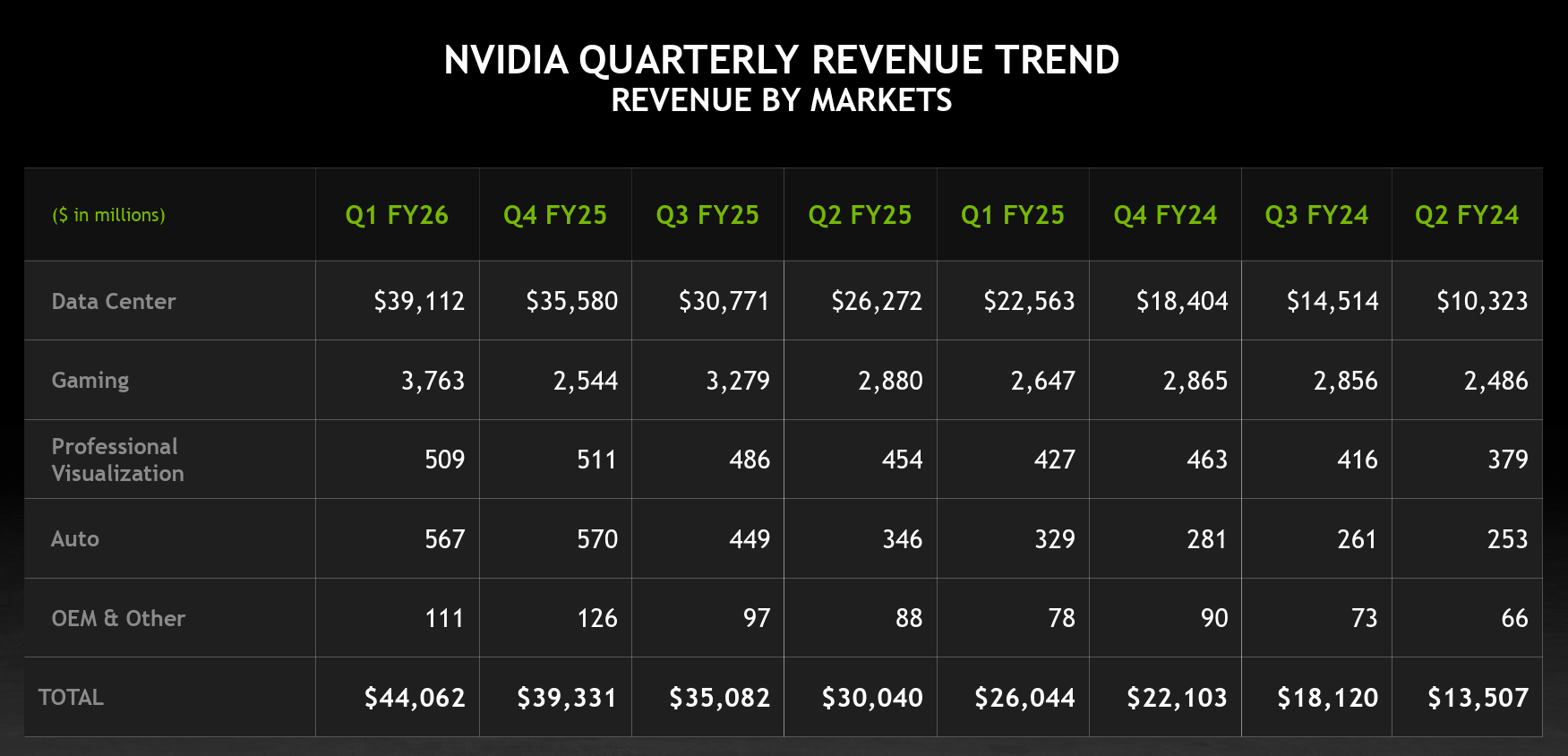
Nvidia to eat $5.5 billion in H20 inventory over new US export rules

Nvidia illustrates the difficulty operating as US government rules, tariffs and other policies change almost daily.

In an SEC filing, Nvidia said it will take a first quarter charge of $5.5 billion due to new export rules on its H20 chips to China. Nvidia sold its H20 chips into China because its more powerful GPUs and accelerators were banned.

China vs. US AI war: Fact, fiction or missing the point?

According to Nvidia, the US government informed the company April 9 that its H20 chips would require a license to be sold in China for the "indefinite future." As result, Nvidia will take a first quarter charge of about $5.5 billion associated with "H20 products for inventory, purchase commitments, and related reserves."

That news came two days after Nvidia said its Blackwell chip production will start in Arizona at TSMC's chip plant. Nvidia said it is also building supercomputing manufacturing plans with Foxconn in Houston and with Wistron in Dallas.

Nvidia said the plan is to ramp production at both Texas plants in the next 12 to 15 months.

The GPU giant's whiplash is a microcosm of what other enterprises are facing. Tariffs are on, off, and on again with exceptions sometimes within the same day.

See:

Despite the charge, Nvidia demand looks strong. Enterprises have said despite uncertainty they are proceeding with AI projects. Citigroup CEO Jane Fraser summed up the consensus among CEOs. She said Citigroup is protecting necessary investments in our businesses as well as our transformation." "We shall not allow the uncertainty to distract us from executing our strategy and improving our returns," she said.

More Nvidia:

Constellation Research analyst Holger Mueller said:

"These export restrictions are actually good news for enterprises located in North America, Europe and other geographies, as it may make more Nvidia chips available. The question is always - will Nvidia become a victim of the Osbourne effect, but with on premises demand being alive and well, there will be a number of CxOs who will be more than happy to get these H20 chips. Nvidia may well come out with a little bruise from this situation."

Data to Decisions Tech Optimization Innovation & Product-led Growth Future of Work Next-Generation Customer Experience Digital Safety, Privacy & Cybersecurity nvidia ML Machine Learning LLMs Agentic AI Generative AI AI Analytics Automation business Marketing SaaS PaaS IaaS Digital Transformation Disruptive Technology Enterprise IT Enterprise Acceleration Enterprise Software Next Gen Apps IoT Blockchain CRM ERP finance Healthcare Customer Service Content Management Collaboration Chief Information Officer Chief Executive Officer Chief Technology Officer Chief AI Officer Chief Data Officer Chief Analytics Officer Chief Information Security Officer Chief Product Officer