Results

SAS updates Viya platform for intelligent decisioning, AI agents

SAS launched a bevy of updates or its Viya platform including synthetic data, tools for building and deploying AI agents, and managed cloud services. The company also launched new AI models and digital twins for manufacturing.

The news, announced at SAS Innovate, aim to position SAS more in the AI technology stack.

Here's a look at what was announced:

  • SAS Viya said its SAS Data Maker, a synthetic data generator, will be generally available in the third quarter. SAS Data Maker was announced in private preview last year.
  • SAS Viya Intelligent Decisioning, which will incorporate the ability to build and deploy AI agents. SAS' approach revolved around balancing LLMs with humans to determine the right levels of autonomy and governance based on tasks.
  • SAS Viya Essentials, a managed cloud services offering aimed at smaller enterprises, includes a hosted version of select SAS Viya products.
  • SAS Viya Copilot, a conversational assistant that's embedded throughout SAS Viya, is available in private preview with availability in the third quarter. The SAS Viya Copilot was built on Microsoft Azure AI Services.
  • SAS Viya Workbench, a cloud-based coding environment, will get support for R coding to complement Python through Visual Studio Code or Jupyter Notebook. Viya Workbench will now be available on AWS Marketplace as well as Microsoft Azure Marketplace.
  • The company launched new models for AI-driven entity resolution and documentations, medication adherence risk in healthcare, supply chain optimization in manufacturing and payment integrity for food assistance and tax compliance for sales tax in the public sector.
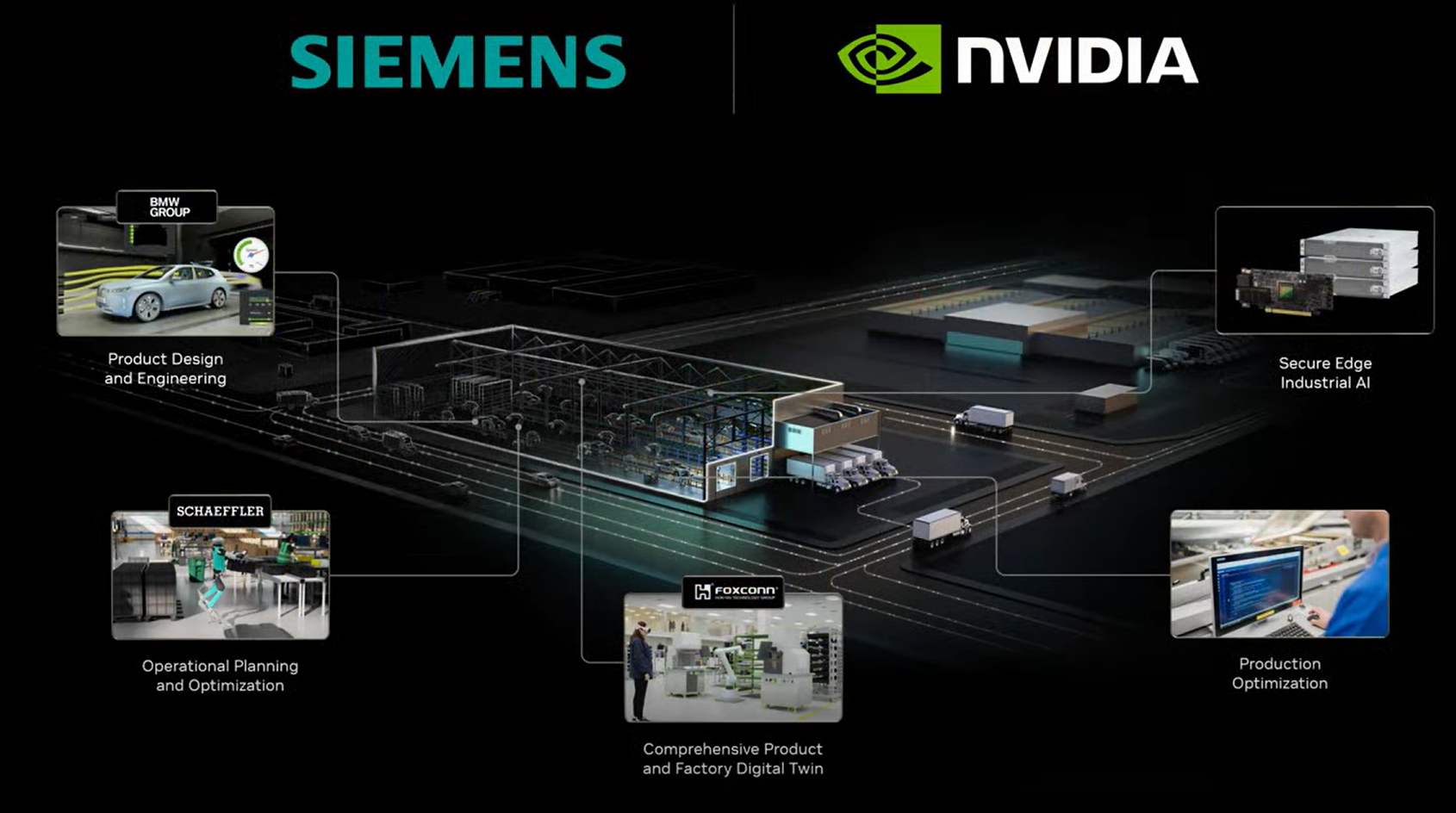
  • SAS Digital Twins for manufacturing. SAS has developed enhance digital twins for manufacturers in a partnership with Epic Games.  Georgia-Pacific was cited as a customer.
Data to Decisions Innovation & Product-led Growth Future of Work Tech Optimization Next-Generation Customer Experience Digital Safety, Privacy & Cybersecurity ML Machine Learning LLMs Agentic AI Generative AI AI Analytics Automation business Marketing SaaS PaaS IaaS Digital Transformation Disruptive Technology Enterprise IT Enterprise Acceleration Enterprise Software Next Gen Apps IoT Blockchain CRM ERP finance Healthcare Customer Service Content Management Collaboration Chief Executive Officer Chief Information Officer Chief Technology Officer Chief AI Officer Chief Data Officer Chief Analytics Officer Chief Information Security Officer Chief Product Officer

AMD’s data center sales surge in Q1

AMD saw a data center surge in the first quarter as sales grew 57% compared to a year ago. AMD's PC chip business saw sales growth of 28%.

The chipmaker, which is playing catch up to Nvidia in AI infrastructure, reported first quarter earnings of $709 million, or 44 cents a share, on revenue of $7.4 billion, up 36% from a year ago. Non-GAAP earnings were 96 cents a share.

Wall Street was looking for first quarter AMD earnings of 93 cents a share on revenue of $7.12 billion.

CEO Dr. Lisa Su said the company's growth continued to accelerate due to "strength in our core businesses and expanding data center and AI momentum." She added that the company's outlook reflects the ability to navigate "the dynamic macro and regulatory environment." What’s unclear is whether tariffs accelerated buying of AI processors.

AMD data center business continues to shine in Q4

AMD said data center growth was driven by AMD EPYC CPU and AMD Instinct GPU sales. Client revenue was $2.3 billion in the quarter, up 68% from a year ago due to demand for Zen 5 AMD Ryzen processors. The company also closed the purchase of ZT Systems.

As for the outlook, AMD projected second quarter revenue of $7.4 billion, give or take $300 million.

AMD's Su noted that AMD's fifth-gen EPYC server chip is being adopted by multiple cloud providers including new instances at Alibaba, AWS, Google, Oracle and Tencent. "Enterprise adoption of EPYC instances was very strong in the quarter. The number of EPYC-powered cloud instances activated by Forbes 2000 enterprise customers more than doubled year-over-year, including new wins with internet-native streaming, transportation, financial services, and social media companies," said Su. 

EPYC is now deployed by all of the top 10 telecom, aerospace, and semiconductor companies, 9 out of the top 10 automotive, 7 out of the top 10 manufacturing, and 6 out of the top 10 energy companies on the Forbes 2000. 

On the AI business, Su said MI325X shipments are ramping and more than 35 MI300 series platforms are in production at service providers. 

"We are actively working with multiple customers to scale Instinct from single-node deployments to distributed inferencing clusters. Training engagements also ramped in the quarter as multiple tier one hyperscale, AI, and enterprise customers scaled Instinct GPU clusters to train internal and next-gen frontier models," said Su. "In parallel, we're making meaningful progress with Sovereign AI deployments as countries expand investments to establish domestic, nation-scale AI infrastructure."

Looking forward, Su said MI350 series is garnering customer interest with second half deployments on tap. "Looking ahead, our MI400 series development remains on track to launch next year. The MI400 series is designed to deliver leadership performance for both inferencing and training, scaling seamlessly from single servers to full data center deployments. Early customer feedback has been very positive, marking a major step forward in our Instinct roadmap and significantly expanding our AI Accelerator TAM as customers plan broader Instinct deployments to power a larger share of their AI infrastructure," said Su. 

AMD will hold an event June 12 with more details about the roadmap. 

"While we face some headwinds from the dynamic macro and regulatory environments, including the recently announced export controls for Instinct MI308X shipments to China, we believe they are more than offset by the powerful tailwinds from our leadership product portfolio," said Su, who noted that AMD took out $700 million in revenue from the second quarter guidance due to the headwinds in China.

Data to Decisions Tech Optimization Big Data Chief Information Officer Chief Technology Officer Chief Information Security Officer Chief Data Officer

Distilling April 2025

Well, my first official month as Chief Distllier is over and it has been great.

Spent a long time combing through information, research, insights, data points, and talking to my community of executives and board members around the world and I concluded two things: I am overwhelmed by the need, and overjoyed by the pace of change.  Maybe the other way around?  Nah, that's right...

First impressions from following the topics, themes, and trends? Read on...

You may recall I wrote about what companies should be focusing on in 2025 in LinkedIn before I joined Constellation (growth, resiliency, sustainability).

Resiliency quickly became the key theme for 2025 mostly derived from tariffs wars (had my say about that also...). 

Shared the topics I'd cover a couple weeks ago: Cloud infrastructure in the enterprise (this is a hot, hot, hot topic for CIOs), Cybersecurity and Compliance (CISOs like this one, me -- the more time I spend in it, the more I want to be offline), GenAI adoption in the enterprise (mainstream you say? Yay, I say), Supply Chain Optimization (apply GenAI to it and -- wowzer), and Advanced Computing (now that GenAI hype is dying, Quantum Computing is heating up... but nowhere near there -- yet; don't forget about edge computing).

Readings through everything I found in April for these topics, after I recovered from that horrible flu-like thing...man, that was nasty, led me to three key cross-tabbed, correlated talking points:

Interoperability Across Cloud, AI, and Edge Ecosystems is critical.  As enterprises increasingly build their hybrid multicloud infrastructure, resulting in private and public platforms connectivity, the need for integrated edge computing and cloud-native tools is critical for enabling real-time decision-making, especially in areas like supply chain optimization and AI deployment. Successful organizations are those building interconnected, agile ecosystems that allow AI models and data flows to operate seamlessly across environments.  Shorter? cloud infrastructure + analytics / AI + edge = next generation of enterprise architecture (which you need in place before you can successfully deploy AI across the enterprise... which is what's next).

Generative AI is Driving Transformation—But Only When Operational Foundations Are in Place.  Generative AI has moved beyond experimentation into deployment (reaching mainstream adoption means that virtually all organizations have streategic, long-term initiatives on it - past proof-of-concept), yet many projects stall due to infrastructure limitations, governance issues, and unclear ROI (a move from ROI to TTV is underway, stay tuned for this shift). Orgnizations with high operational readiness are far more likely to scale and see measurable returns (Accenture said this, I agree). This signals that GenAI's value is not just in the model but in the enterprise’s ability to deploy it effectively.  This is interlacing cloud infrastructure and GenAI (see above).

Data and Trust are Emerging as Strategic Differentiators in Advanced Computing.  As AI and edge technologies expand across enterprise functions, organizations must address trust gaps—whether related to data sovereignty in the cloud, the ethical use of GenAI, or privacy and compliance transparency. The alignment of compliance, cybersecurity, and sustainable practices is becoming central to technology adoption decisions.  If you add AI to this, watch out for the catastrophe that it can generate if you don't tackle it at the operational level (versus, each project or provider doing their own thing).  The creation of private platforms by smart CIOs over the last 5 years (and next 15 -- defining the next generation of IT investment) to power complex ecosystems is driving enterprise investment for those who pay attention and get past the shiny beads.  And -- governance.

Want data points for these? More details? See how it applies to your organization?  Ping me...

Things I am keeping my eyes + ears on for May: GenAI mainstreaming, trade wars and cybersecurity, private plaforms, and --- sigh, quantum.  

More to come...

New C-Suite Chief Analytics Officer Chief Data Officer Chief Digital Officer Chief Executive Officer Chief Financial Officer Chief Information Officer Chief Information Security Officer Chief Marketing Officer Chief Product Officer Chief Revenue Officer Chief Supply Chain Officer Chief Technology Officer

ServiceNow, UKG integrate AI agents across platforms

ServiceNow and UKG, a human resources and workforce management software provider, said they will integrate AI agents across their respective platforms using Google Cloud's Agent2Agent protocol.

The announcement, made at ServiceNow's Knowledge 2025 conference, is notable on a few fronts.

  • UKG has its own AI tools and UKG People Fabric will integrate with ServiceNow's AI Agent Fabric.
  • The two companies will streamline tasks and workflows across payroll, workforce management and HR.
  • ServiceNow CEO Bill McDermott and UKG CEO Jennifer Morgan both were executives at SAP at the same time.
  • For UKG, the ServiceNow partnership can give the company more exposure and reach. ServiceNow expands its HR footprint.

The integration between ServiceNow and UKG is enabled by multistep A2A that can be started and finished within either application. Each platform will also have its new agents. The news lands as ServiceNow announced its expansion into CRM.

During a keynote with Amit Zavery, ServiceNow's Chief Product and Chief Operating Officer, Morgan said UKG is already a ServiceNow customer. The goal is to connect front line workers to "the technology and insights they need."

Morgan said:

"Frontline workers feel that they're very disconnected from the enterprise, and so our opportunity is to create that single point of interaction that really connects our joint customers who are out in the field with our customers back into the enterprise. It could be as simple about a question about pay, hours and schedules. Rather than logging a ticket or figuring out how I need help, it's immediate."

Holger Mueller, analyst at Constellation Research, said:

"Enterprises want and need to use agents to achieve what matters, Enterprise Acceleration. Recreating the data islands of the past as AI agent islands is not going to achieve the transformation and deliver the return of AI that people and enterprises need. It is good to see ServiceNow and UKG partnering to provide out-of-the-box and vendor maintained agent-to-agent integration. What it will mean for the respective vendor’s agent population remains to be seen. We just heard the starter pistol for the race of the ultimate agent control plane."

As for the use cases, ServiceNow and UKG AI agents are working together as part of the AI Agent Framework.

A screenshot of a computer

AI-generated content may be incorrect.

Use cases include:

  • Employee experiences including onboarding, leaves of absence, internal job changes and time off requests.
  • Payroll that leverages AI agents to connect systems, end manual processes and keep pace with tax laws, regulations and wage mandates across jurisdictions.
  • Industry specific agents able to forecast and optimize scheduling, absences, time management and frontline workers.

Also see:


Data to Decisions Future of Work Next-Generation Customer Experience Tech Optimization servicenow AI Analytics Automation CX EX Employee Experience HCM Machine Learning ML SaaS PaaS Cloud Digital Transformation Enterprise Software Enterprise IT Leadership HR Chief Information Officer Chief Customer Officer Chief People Officer Chief Human Resources Officer

ServiceNow launches ServiceNow CRM: Aims to redefine category with platform, AI, workflows

ServiceNow unveiled ServiceNow CRM in a move that aims to expand its total addressable market, leverage its ability to automate workflows with AI and couple selling, servicing and marketing across multiple functional groups.

The launch of ServiceNow CRM, outlined at ServiceNow's Knowledge 2025 conference, was one of the most telegraphed launches ever. On the company's first quarter earnings call, CEO Bill McDermott made the company's CRM ambitions crystal clear. "There's not a day that passes when we don't hear from customers who are dissatisfied with their status quo," said McDermott. "For a long time, I've been saying no one has to lose for us to win. Our customers have now adjusted me. They want someone else to lose, so they can continue to invest more in ServiceNow."

Also: ServiceNow, UKG integrate AI agents across platforms

McDermott, speaking at ServiceNow Knowledge in a keynote, said that "AI is the absolute requirement for survival." "You've got to balance the audacity of the dream with new business models driven by AI so you grow for 10 years from now," said McDermott. "That's why we're going to bring AI agents to every corner of your business."

There's no need to name what vendors McDermott expects to lose in CRM, but you can connect the dots. It's obvious ServiceNow is going after Salesforce. ServiceNow is coupling lead and opportunity management, configure, price and quote, order management and fulfillment, customer service and support, field service and customer success and renewals. ServiceNow also can connect CRM across other functions, inventory and supply chain.

Amit Zavery, ServiceNow's Chief Product and Chief Operating Officer, said "let's face it, traditional CRM is broken. It is a patchwork of point solutions held together with duct tape and chewing gum. The result more complexity, more cost and less value."

In a briefing, ServiceNow CRM cited customers including Xerox, National Hockey League, Lumen and Kainos as well as Pure Storage. In the first quarter, ServiceNow said CRM is its fastest-growing workflow business.

The secret sauce for ServiceNow is its AI and workflow platform, which has expanded into multiple functions and use case from its IT service management days. By working horizontally across multiple data stores, ServiceNow's approach has been to connect systems, processes and workflows without needing you to move into one data store.

ServiceNow's CRM's pitch is relatively simple: Solve issues fast, adapt, run customer operations at half the cost and go live quickly. The approach is to service, sell and deliver on one platform that combines AI, data from multiple systems including inventory, contracts and operations and workflows.

ServiceNow said its CRM is aimed at a seamless experience that integrates processes and uses AI eliminate multiple screens, applications, spreadsheets and "human middleware." According to ServiceNow, CRM's limitation is that it is a system of record that ends at the front office. John Ball, ServiceNow EVP and GM of CRM and Industry Workflows, said ServiceNow can deliver "complete workflow automation from order capture through fulfillment, allowing customers to focus on value-added selling and delivering exceptional service to their own customers, not wasting time tangled up in out-of-date systems."

Differentiating with platform

ServiceNow's approach with CRM is enabled by a series of efforts outlined at Knowledge 2025 and put in place over the last two years.

The big message from Knowledge 2025 is that ServiceNow's Now Platform can be leveraged for any industry, any AI, data platform, workflow, cloud and system. Chief Innovation Officer, Dave Wright, said ServiceNow has the right to play in CRM because "we're the only company that unites AI, workflow and data on one enterprise platform."

"All our AI is delivered natively in every layer of the platform whether it's the UI, database, or automation layer, it's enterprise grade from day one," said Wright. "We can consume all the data that AI needs. We develop the workflow data fabric to be able to connect to all the data, to be able to unify it, and then be able to activate it."

This platform approach is also enabling AI agents and models on a broad level and combining to manage a digital workforce. Here’s a look.

AI Control Tower, which is a hub to govern, manage and secure any AI agent across IT, HR and CRM, model and workflow. The system covers multiple models from OpenAI, Google Gemini, Meta Llama and more, integration with AI systems from Google, Microsoft, LangChain and Amazon Bedrock. Key points about AI Control Tower include:

  • Centralized monitoring of all AI systems (ServiceNow and third party).
  • Ability to track AI asset adoption and usage.
  • Risk and compliance.
  • Value metrics to understand AI business impact.
  • A single interface for different roles that oversee AI assets with data such as number of AI systems onboarded, deployment status, risk and compliance.

AI Agent Fabric, which connects agents across applications, provides interoperability and orchestrates agent workflows and data access on Now Platform and externally. Key features include:

  • Dynamic layer so AI agents to communicate, coordinate and learn from each other.
  • Coordinates ServiceNow and third party AI agents and external systems from the likes of Microsoft and others.
  • Support for Model Context Protocol and agent-2-agent protocols and standardization of communication and partnerships with the likes of Box, Google Cloud and Microsoft.

AI Orchestrator, which was announced in January along with a broad partnership with Google Cloud. Features include:

  • Ability to create teams of AI agents.
  • Specialized agents across functions.
  • Out of box agents for IT, CRM, HR and other enterprise workflows.

Those three capabilities, along with the data and workflow tools underneath, are powering CRM AI Agents, which are a suite of specialized agents that are designed to autonomously orchestrate and complete tasks from selling and fulfilling to servicing.

According to ServiceNow, its CRM AI Agents can do the following:

  • Determine best course of action by resolving inquiries instantly, routing complex cases with full context, and managing workflows across departments.
  • Start with conversational interactions to capture requests.
  • Take that data and manage the fulfillment process and coordinate with humans when intervention needed.

The other enabling features behind CRM AI Agents is the broader platform as well as ServiceNow's efforts with its Workflow Data Fabric, announced in 2024. This data fabric was later enhanced with the Yokohama release. RaptorDB is also critical to the Workflow Data Fabric effort as well as connectors to multiple enterprise systems.

Zavery said the company is expanding its AI agent and workflow footprint due to its platform. He said:

"I'm here to show you exactly how we are delivering that platform to our customers and why we are different from all the AI pretenders out there. The reality is that today, AI is scattered across enterprises in silos, fragmented, disconnected, and to truly transform your business, we are bringing AI, data and workflows into the enterprise, enterprise grade platform you already rely on."

Zavery worked through AI agent orchestration, agent studio and connections to other agents from third parties via the AI Control Tower. "All others are building AI agents for their silos. Our AI agent orchestrator ensures the right agent handles the right task at the right time. It works behind the scenes, coordinating, resolving and accelerating work across the enterprise. It truly is AI intelligence built for scale," he said.  

Data to Decisions Marketing Transformation Next-Generation Customer Experience Future of Work Innovation & Product-led Growth New C-Suite Sales Marketing Tech Optimization Digital Safety, Privacy & Cybersecurity servicenow ML Machine Learning LLMs Agentic AI Generative AI AI Analytics Automation business Marketing SaaS PaaS IaaS Digital Transformation Disruptive Technology Enterprise IT Enterprise Acceleration Enterprise Software Next Gen Apps IoT Blockchain CRM ERP finance Healthcare Customer Service Content Management Collaboration Chief Customer Officer Chief Data Officer Chief Executive Officer Chief Financial Officer Chief Information Officer Chief Marketing Officer Chief Revenue Officer Chief Technology Officer Chief AI Officer Chief Analytics Officer Chief Information Security Officer Chief Product Officer

Cisco launches quantum lab, unveils quantum networking chip

Cisco is entering the quantum computing networking ring with a lab and prototype processor.

The move is notable since Cisco is a networking giant in the enterprise. In addition, quantum networking has been seen as a key piece of infrastructure. IonQ has highlighted the promise of quantum networking with acquisitions. However, it’s likely that your quantum vendors will be familiar since they are also in data centers.

Cisco said its quantum networking chip prototype was developed with UC Santa Barbara and generates up to 1 million entangled photo pairs per second at room temperature. The chip also features telecom compatibility so may be of use to classical computing too.

Other things to note:

  • The prototype has energy efficiency under 1mW.
  • Fidelity up to 99%.
  • The Cisco Quantum Lab will create networking components including quantum entanglement source chip and quantum switches with academic partners.

In a blog post, Vijoy Pandey, Senior Vice President, Outshift by Cisco, said quantum networking could accelerate quantum applications. He added that Cisco has more prototypes on deck including a distributed quantum computing compiler, Quantum Network Development Kit (QNDK) and Quantum Random Number Generator (QRNG).

"More components of our quantum data center infrastructure roadmap will be announced soon as we complete our vision of the quantum networking stack. In parallel, Cisco teams are implementing Post-Quantum Cryptography (PQC) NIST standards across our portfolio, ensuring classical networks remain secure in a post-quantum world," he said.

A screenshot of a computerAI-generated content may be incorrect.

Pandey added that Cisco is looking to develop quantum networking for quantum computing as well as classical computing for immediate benefits. He also said that Cisco is building a vendor-agnostic framework to work with any technology. Quantum computing vendors range from approaches based on superconducting, ion trap and neutral atom approaches. "We don't need to pick winners among quantum computing platforms because we're building the networking fabric that will enable all of them to scale," said Pandey.

Constellation Research analyst Holger Mueller said:

"Cisco wants to be the network supplier in the quantum age beyond its mainstream networking technology. Cisco has developed networking technology that has to be quantum proof and safe and is now looking inside quantum machines. Cisco has its set of challenges, so it is a welcome change to see the network giant moving into new innovation fields."

Here's a look at Cisco's strategy.

Data to Decisions Innovation & Product-led Growth Tech Optimization Quantum Computing Chief Information Officer

Microsoft raises prices for Dynamics 365 Business Central

Microsoft said it is raising prices effective Oct. 1 for Dynamics 365 Business Central as it incorporates AI features into its platform.

The price increases, the first in five years, will hit smaller enterprises that typically rely on Microsoft Dynamics 365 Business Central.

Microsoft said Business Central now has Copilot and AI powered features for analytics, financials, account reconciliation, master data management and better interoperability with Microsoft Power Platform.

According to the company, Business Central will also have more storage per user license. Here's a look at the changes, priced in US dollars on a per user, per month basis unless otherwise noted.

A table with price list and price tags

AI-generated content may be incorrect.

Data to Decisions Future of Work Next-Generation Customer Experience Innovation & Product-led Growth Tech Optimization New C-Suite Sales Marketing Digital Safety, Privacy & Cybersecurity Microsoft Chief Information Officer

IBM CEO Krishna: Now is the ROI stage of enterprise AI

IBM CEO Arvind Krishna said there is no law that enterprise AI has to be expensive, pegged to large language models and experimental.

In a keynote at Think 2025, Krishna outlined IBM's strategy and rollout of tools to build AI agents quickly and then orchestrate them.

"I think that the era of AI experimentation is over. Success is going to be defined by integration and business outcomes," said Krishna. "There is no law of computer science that says that AI must remain expensive and must remain large."

A white letters on a blue background

AI-generated content may be incorrect.

That theme played a big part of the news flow from Think 2025. At a high level:

  • IBM's unified platform for building and managing AI agents, watsonx Orchestrate, will offer pre-built agents with use cases for industries with skills, integration and capabilities in HR, sales and procurement. There are also tools to build agents, orchestrate them and monitor and optimize with observability tools. Krishna said Watson Orchestrate Agent Builder can enable business users to build their own agent in 5 minutes.
  • IBM launched next-generation Granite models. The company launched Granite 4.0 Mixture-of-Expert models and a new runtime engine.
  • Watsonx.data will get new integration features to orchestrate data access and engineering in one interface and data governance software to curate, manage and use data.
  • IBM announced GenAI Lakehouse to unify, prepare and govern structured and unstructured data for generative AI.
  • The company launched IBM LinuxONE Emperor 5, IBM's next-gen Linux platform.
  • A partnership with Lumen Technologies to bring IBM's portfolio of AI products and models to Lumen's Edge Cloud network.
  • Expanded partnerships on AI agents with AWS, Oracle and Salesforce.

Krishna featured interviews with customers such as the Ferrari race team, Lumen and PepsiCo on managing data and AI agents.

For IBM, the company is trying to leverage horizontal and business expertise via its consulting unit and integration knowhow. Krishna is also talking business value given that projects are moving out of proof-of-concept mode.

Here’s a look at some of the key points from Krishna's keynote:

  • "As I think about last year compared to this year, the one big difference is that AI has moved from experimentation to business value. What is the use case? How do I get my business to scale leveraging AI? We're thinking about ROI. We're thinking about business value," said Krishna.
  • Success is defined by integration, intelligence and automation in enterprise workflows. AI is an accelerant, said Krishna.
  • Smaller, special purpose models will be critical to drive more cost effective AI, he said.
  • "IBM is incredibly focused on enterprise AI. We do not focus at all on consumer AI, and that is why you see our focus on purpose built models, cost, effectiveness, sovereignty, and security. How do we make and decrease the cost of enabling AI inside the enterprise?" said Krishna.
  • Speed of inference will depend on hybrid infrastructure that brings data closer to the edge.
  • "Quantum is no longer science fiction. It's now in the realm of engineering. And when you're in the realm of engineering, the question becomes, how do you get that next step? And then these systems are going to be at a scale that is going to be truly remarkable and truly surprising. We are building these full stack quantum systems," said Krishna.
Data to Decisions Innovation & Product-led Growth Future of Work Tech Optimization Next-Generation Customer Experience Digital Safety, Privacy & Cybersecurity IBM ML Machine Learning LLMs Agentic AI Generative AI AI Analytics Automation business Marketing SaaS PaaS IaaS Digital Transformation Disruptive Technology Enterprise IT Enterprise Acceleration Enterprise Software Next Gen Apps IoT Blockchain CRM ERP finance Healthcare Customer Service Content Management Collaboration Chief Information Officer Chief Executive Officer Chief Technology Officer Chief AI Officer Chief Data Officer Chief Analytics Officer Chief Information Security Officer Chief Product Officer

Palantir Q1 commercial momentum continues to run, ups 2025 outlook

Palantir continues to land US commercial accounts as it raised its outlook for the second quarter and 2025.

The company reported first quarter non-GAAP earnings of 13 cents a share on revenue of $883.86 million, up 39% from a year ago. GAAP earnings for the first quarter were 8 cents a share. Wall Street was expecting Palantir to report first quarter earnings of 13 cents a share on revenue of $862.13 million.

Palantir CEO Alex Karp said the company is projecting 2025 US commercial revenue growth of 68% and total revenue growth of 36%. Karp said, "we are delivering the operating system for the modern enterprise in the era of AI" and there is a "a tectonic shift in the adoption of our software."

Recent:

On a Rule of 40 score basis, Palantir scored 83% in the first quarter. Rule of 40 is a SaaS financial metric that dictates a healthy SaaS company should have a combined growth rate and profit margin of 40% or more.

As for the outlook, Palantir projected second quarter revenue between $934 million to $938 million with adjusted income from operations between $401 million and $405 million. For 2025, Palantir projected revenue of $3.89 billion to $3.902 billion with adjusted income from operations between $1.711 billion to $1.723 billion.

The numbers for the first quarter were impressive.

  • US revenue was up 55% in the first quarter compared to a year ago to $628 million.
  • US commercial revenue was up 71% to $255 million. US government revenue was up 45% to $373 million.
  • The company closed 139 deals of at least $1 million, 51 deals of at least $5 million and 31 deals of at least $10 million.

A graph of growth with numbers and textAI-generated content may be incorrect.

In his shareholder letter Karp noted the following:

  • Management: "This breed of company will never spring from the mind of a committee; it would never have been permitted to endure in its current form, with thousands of employees organizing themselves around problems at hand, if we had submitted to the conventional managerial model in American corporate life."
  • US government spending: "Our software systems for planning and executing special forces and other military operations, and for assessing and selecting targets, has been embraced by the American defense sector."
  • AI and LLMs: "The rush towards large language models, as well as the foundational software architecture that is capable of making them valuable to large organizations, has turned into a stampede. What was once a relatively orderly process of assessment and evaluation of these novel technologies has evolved into a ravenous whirlwind of adoption as an increasing number of institutions grasp the magnitude of the shift that is washing over industry and government."


Data to Decisions Future of Work Next-Generation Customer Experience Tech Optimization Innovation & Product-led Growth Digital Safety, Privacy & Cybersecurity ML Machine Learning LLMs Agentic AI Generative AI AI Analytics Automation business Marketing SaaS PaaS IaaS Digital Transformation Disruptive Technology Enterprise IT Enterprise Acceleration Enterprise Software Next Gen Apps IoT Blockchain CRM ERP finance Healthcare Customer Service Content Management Collaboration Chief Information Officer Chief Executive Officer Chief Technology Officer Chief AI Officer Chief Data Officer Chief Analytics Officer Chief Information Security Officer Chief Product Officer

AWS preps healthcare, life sciences AI agent with Wiley content

Amazon Web Services will launch an AI agent for scientific literature via a partnership with Wiley, a publisher of journals.

The announcement will be made at the AWS Life Sciences Symposium in New York on Tuesday. The AWS conference will feature a bevy of big name customers including Merck, AstraZeneca, Genentech, Pfizer and Johnson & Johnson.
AWS has been developing a horizontal approach to AI agents via Amazon Q, which has gained momentum and a story after re:Invent 2024. The collaboration with Wiley highlights how AWS wants to also take AI agents into various industries.

According to Wiley, the literature search agent is available as part of an AWS open source toolkit for healthcare and life sciences agents. AWS' toolkit has a catalog of starter agents and frameworks for building and orchestrating them. Use cases include biomarker discovery, clinical trial protocol generation and detailed content searches.

Here's a look at a sample agent for healthcare and life sciences from AWS.

A diagram of a companyAI-generated content may be incorrect.

Wiley and AWS said that full-text content from the publisher can be integrated into AWS' agent stack including Bedrock Agents.

More on AI agents:

More on healthcare:

Data to Decisions Next-Generation Customer Experience Future of Work Innovation & Product-led Growth Tech Optimization AR Chief Information Officer