Results

Shiny New Toy Season

Shiny New Toy Season

1

We’re a little more than 24 hours away from Applepalooza and the rumors have hit the fan. Shiny new toy syndrome is about to kick in at work and hundreds of devices are accidentally going to fall from pockets or into toilets etc in the next few days in hopes of getting one of these new toys before anyone else. While I am hugely excited to see what Apple has to offer, a few phones I’m sure, a wearable maybe an iPad or a Mac, working in enterprise mobility, I am even more excited by the possibilities that the new season brings us.

shiny object warningTo be sure, it’s not just Apple’s announcements that have me excited, Google  has a big role to play as well. Enterprise mobility is truly entering the phase of secure enablement for all of our users. If we start by looking at Google’s announcements from June about Android L, we will finally see Android devices that can be secured for work. We will get to spend a lot less time worrying about which manufacturer we are looking at (this hurts Samsung) when we allow Android phones into the enterprise and we will get to start concentrating on what we can securely enable people to do with their Android devices now. This will be a huge weapon in our arsenal for moving away from the department of no and becoming the department of know.

Apple has been on this doorstep for awhile but with their announcements from WWDC, also in June, around iOS8 we see them moving even closer to the enterprise. The volume purchasing program is now easy to use (and cost effective). The APIs available for deep linking and extensibility are key to creating awesome business workflows and yet still being able to concentrate on what the users need. The fact that Apple’s ‘widgets’ allow material to be quickly edited and moved between apps means that data becomes information and knowledge must faster moving us closer to true enablement of our users.

Apple has gone further, if rumors are to believed, with both their wearable and their new payments system. If we start with their wearable, it may give organizations the ability to implement two factor authentication (2FA), even while using SSO in a way that is almost transparent. We only need to look at devices like the forthcoming Nymiauthentication wearable that checks your EKG to make sure that you are you and can we begin to see the possibilities for 2FA that truly authenticates you as you. If this type of authentication is available with the Apple wearable it will be a boon to the enterprise. We are also hearing rumors of their new payment system which leads one to believe that NFC might finally become part of the apple device ecosystem. This has uses beyond just payments and can replace things such as company ID cards (I’ve never left my phone in my car or at home, I have left my ID though) and also enable other forms of 2FA for company use.

One also expects that the TouchID capability that was introduced in the iPhone 5S will spread across the Apple ecosystem, to include iPads and maybe even Macs. This will allow more options in the identity and access management arena as the capability will be opened up to third party app use. Imagine pairing that with your business apps and SSO strategy.

One of the bigger issues that many enterprises have is that their folks just cant remember their passwords, even when SSO works well, they may still have 4 or 5 passwords although some people have orders of magnitude more. We only need to look at 1Password’s iOS8 implementation to see that we can make it easier through widgets and API calls to actually reduce the burden on our users and make work almost fun.

So while I am looking forward to tomorrow’s Apple announcements just so I can enjoy the sheer ludicrousness and number of excuses of how people have manage to break, destroy, or otherwise lose their devices so they can get a new toy, I am even more excited by the new possibilities we will see to improve our users’ experiences around their everyday work through mobile.

New C-Suite Chief Information Officer

Do Supply Chain Planning systems generate any value?

Do Supply Chain Planning systems generate any value?

1
I have been in the advanced planning and scheduling (APS) space since 1995 when I joined i2 Technologies in Europe. Before that I was in management consulting doing what would be called supply chain design or reengineering today.

While MRP and S&OP were defined as early as the 1980s, these provided rough cut analysis at the aggregate level, nowhere near the level of detail that is possible today. The diagram below by Oliver Wight, with some enhancements by me, captures the progression of capabilities since the 1970s. My enhancements were to add the underlying technology and company information at the bottom which gives some context.

 Oliver Wright S&OP IBP

The key point is that I have spent a lot of my working life focused on the value generated by more advanced planning solutions.

It has been with some shock, therefore, that over the past few months I have come across a number of prospects, partners, and analysts that question whether any real value has been generated by all the investments in technology over the past 25 years. I have come to the conclusion that this needs some further analysis, which I won’t be able to complete in a single blog.

Let me start with the confusion between planning and execution. I was on a call last week with a large company in the food and beverage space that has spent $100s of millions, and many years, on an ERP deployment. And of course during the deployment their organizational structure has changed and they have gone through some M&A activity in that time. Needless to say they have a continued multi-year deployment of the supply chain planning system provided by the ERP vendor. And they are still a long way from complete from deploying the ERP modules let alone the supply chain planning modules. Now they want to deploy an S&OP process. They have piloted the process in Excel and know that they need an enterprise level solution for a global roll-out of S&OP. The issue is that none of their IT investments in the last 10 years have moved the needle on operational metrics such as inventory levels, case fill rates, and other operational metrics. Their words. As a consequence they are looking for tangible evidence of value before progressing with a global deployment.

paul meyer productivity quoteAbout a week before that I was at dinner with Mo Hajibashi of Accenture. Mo has been around this space about as long as I have and has seen all the changes. We were reminiscing about the trade exchanges that were so much part of the discussion in the late 1990s. Of course these largely went the same way as the rest of the dot com bubble. But Mo went on to say that many companies have struggled to quantify value from their investments in supply chain systems. We were there to discuss other topics so we did not dig too deep into his statement, but it stuck, and came roaring back when I was in discussion with the company I mention above.

In July, Lora Cecere of Supply Chain Insights kicked this all off with a blog on the Forbes web site titled “My Quest to Know …” in which she seemed to question the value of IT in driving value in corporate performance. She states that

As technologies evolved over the course of the last decade, there was a promise that investments in software like Enterprise Resource Planning (ERP), Supply Chain Planning (SCP) or Business Intelligence (BI) would improve corporate performance. I was a research analyst in the throes of this movement, writing article after article on how IT projects will drive corporate performance improvements. I believed it. I was a prolific writer and a committed disciple. I thought it would transform organizational capabilities.

While Lora and my paths are different, our trajectories are the same. I studied Industrial Engineering and Operations Research focusing on Optimization Theory. I lost faith in optimization early when I realized that the uncertainty in our knowledge of true capacity, yield, lead times, and hundreds of other variables drowned out the promise of optimization. And that is assuming that we have a good handle on demand, which we don’t. However, I still believe in the promise of greater productivity through replacement of slow and manual processes with fast and agile digital processes.

In other words, while I didn’t dispute Lora’s findings, I was puzzled by her conclusions of supply chain planning systems. She seemed to be saying that benefits have not been realized from deploying planning systems, which didn’t fit my understanding of her position. When I asked Lora about her blog she replied that:

Supply chain planning, while over-hyped, and under-delivered by many technology vendors and consultants, adds value. The companies that achieve the highest levels of performance, and balance, in corporate performance make the design of their networks and their planning processes a priority. It does not happen overnight, and does require the right fit of technology to drive greater potential. The factors are the right data model, a frequency of planning that reflects the rhythms and cycles of the supply chain, and the right level of granularity of the modeling. The best planning systems are implemented carefully based on conference room pilots and focus on modeling the business. As a result, the best implementations are usually not the fastest.

The market has been scarred by two issues: the bad behavior of the best-of-breed solutions in the first generation of solutions, and the lack of depth of the extended ERP solutions. As a result, there currently a gap between what companies want and what they have. However, excellence in corporate planning matters. The concepts improve the potential of the organization to deliver higher levels of balance sheet performance. The greatest value today usually comes from a best-of-breed solution that is implemented by the same best of breed provider. The over-hyped promises of extended ERP implemented by large system integrators as advertised on signs in airports has not driven the levels of value that the best-of-breed solutions have.

Perhaps we have been looking at the benefits of  supply chain planning systems too narrowly. There have been additional benefits, and Lora points to two of them, namely our ability to absorb supply chain complexity – Lora refers to product complexity – and become a lot more efficient as measured by revenue per employee. I consider these huge gains. How could Apple have grown like it did both in terms of product and market expansion without greater efficiency and the ability to coordinate the flow of materials throughout the world? How could Procter & Gamble have expanded into the emerging markets without forming a number of regional planning hubs?  (Please note that I am using company examples which are not Kinaxis customers deliberately so that I cannot be accused of bias.)

Planning systems do improve supply chain performance when coupled with process and organizational change.  Did anyone see that wonderful spoof in which a daughter gives her elderly father an iPad who then uses it as a cutting board? This is Lora’s point. Lora is running the Supply Chain Insights Global Summit next week in Phoenix, and one of the agenda items is about the Supply Chain Index she has been working on. Unfortunately I cannot be there. I’d really like to be in the session that discusses the supply chain index Lora is developing.

us manufacturing output jobs

As I have stated already, the real question is what would have been the cost of running these massive supply chains without the IT investments? While we might have exhausted the benefits to be gained from large ERP deployments, I am not at all convinced that we have got even close to 50% of the efficiency gains we can achieve with new solutions based more on consensus building and collaboration than on optimization. I am one of those gray-haired men Lora’s refers to in her blog, but I am also a ‘digital native’, something that cannot be said about most of my contemporaries, who are typically ‘digital immigrants’ at best. Yet my contemporaries are the ones making large decisions about organizational structures, processes, and solutions that are rooted in mental models developed and perfected in the 1970s and 1980s. And far too many of the analysts and management consultants continue to position these mental models as best practice. They are not; They are yesterday’s practice.

digital natives versus digital immigrants

But let us step back from my polemic and look at the data. Of course it is impossible to separate out the investment in planning systems from robotics and other technology investments.  But we can look at the ‘digital revolution’ as a whole and make some pretty broad assumptions and correlations with planning systems. First of all this isn’t a recent topic. As early as 1990 Erik Brynjolfsson of MIT published an article titled “The Productivity Paradox of Information Technology: Review and Assessment” in which he cites even earlier analysis of the topic. Erik states that:

The relationship between information technology (IT) and productivity is widely discussed but little understood. Delivered computing-power in the US economy has increased by more than two orders of magnitude since 1970 (figure 1) yet productivity, especially in the service sector, seems to have stagnated (figure 2). Given the enormous promise of IT to usher in “the biggest technological revolution men have known” (Snow, 1966), disillusionment and even frustration with the technology is increasingly evident in statements like “No, computers do not boost productivity, at least not most of the time” (Economist, 1990).

erik brynjolfsson raching with the machine

However, in a subsequent article published in 2003 and titled “Computing Productivity: Firm-Level Evidence” Erik states that

We explore the effect of computerization on productivity and output growth using data from 527 large US firms over 1987-1994. We find that computerization makes a contribution to measured productivity and output growth in the short term (using one year differences) that is consistent with normal returns to computer investments. However, the productivity and output contributions associated with computerization are up to five times greater over long periods (using five to seven year differences). The results suggest that the observed contribution of computerization is accompanied by relatively large and time-consuming investments in complementary inputs, such as organizational capital, that may be omitted in conventional calculations of productivity. The large long-run contribution of computers and their associated complements that we uncover may partially explain the subsequent investment surge in computers in the late 1990s.

In other words:

  • There is a sufficient business case in the short term (12 months) to justify IT investments
  • While there is a significant delay between the investment and the full gains in productivity, the gains too are massive, much greater than first assumed

In the paper “Computers, Obsolescence, and Productivity” published by the Federal Reserve Board in 2000, the author, Karl Whelan, states that:

Real business expenditures on computing equipment grew an average of 44% per year over 1992-98 as plunging computer prices allowed firms to take advantage of ever more powerful hardware and, consequently, the ability to use increasingly sophisticated software. These developments have helped improve the efficiency of many core business functions such as quality control, communications, and inventory management, and, in the case of the Internet, have facilitated new ways of doing business. They have also coincided with an improved productivity performance for the U.S. economy: Private business output per hour grew 2.2 percent per year over the period 1996-98, a rate of advance not seen late into an expansion since the 1960s.

This is enough evidence for me. At the same time I have no doubt there has been extensive over promising and under delivering, and bungled deployments. Do we really want to go back to typing letters and mailing them to customers and suppliers? Do we really want to use a manual planning board to plan the purchase of components and assembly of a tablet that occurs in multiple continents across many organizational boundaries?  I am highlighting where many of the productivity gains have already been realized.

It is going to require a new generation of ‘digital natives’ in senior positions making decisions about organizational structure, processes, and supporting technology before we realize the full potential of IT investments. And the benefits we have realized so far are enough to justify continued investment.

human evolution technology

Matrix Commerce Tech Optimization Data to Decisions Innovation & Product-led Growth Supply Chain Automation Cloud Digital Transformation Disruptive Technology Enterprise IT Enterprise Acceleration Enterprise Software IoT Blockchain ERP Leadership Collaboration M&A Chief Information Officer Chief Procurement Officer Chief Supply Chain Officer

What is the destination of our “supply chain journey?”

What is the destination of our “supply chain journey?”

The term journey carries many connotations. In one sense it defines an epic trip. Something that one might look forward to as a once in a lifetime adventure. For others, a journey might be seen as a difficult and arduous trip – think the Mayflower crossing the Atlantic. These connotations are not that different when it comes to supply chain. In particular with regards to such adoption as S&OP. There seems to be more S&OP journeys than any other. But are we looking at this with the wrong lens?

mayflower-sailing-pictures

The other aspect that is implied with a journey is that we have a clear destination – a final goal. For those of use that see journeys as wonderful adventure – the destination maybe a tropical island for holiday or hiking in the Andes. For the passengers on the Mayflower that journey was a new home far from the oppression of England. A journey filled with disease, boredom, fear and for some death.  But when it comes to technology adoption, for say S&OP, is there a true end goal? Or a constantly evolving and changing number of levels and stages we are looking to reach. With many of the systems we put in place for our supply chain, we are looking to add efficiencies in how we handle inventory, make our production more profitable, meet customer demand faster and better and the lists go on. However these are not goals, but more continuously evolving aspirations and stages. We might want to attain a 98% customer satisfaction, but once we achieve it, we cannot stop there and gloat in our achievements. The business environment is constantly shifting, so we need to maintain our nimbleness. Supply chains look to rid themselves of excess inventory, but once they have reach a specific number…the work does not stop.

Now the fact that there cannot be a true “end goal” with this journey, it does not mean service providers do not need to be held to a high level of expectations and demands from their clients. From the user stand point they must have a frank discussion with their service providers about what is realistic for different results at stepped stages.

Both service providers and their customers need to change their perspective when they mention a “journey.” Easier said than done, but don’t think about reaching an end goal but really about the key steps in that journey.

Matrix Commerce Innovation & Product-led Growth Supply Chain Automation Cloud Digital Transformation Disruptive Technology Enterprise IT Enterprise Acceleration Enterprise Software IoT Blockchain ERP Leadership Collaboration M&A Chief Supply Chain Officer

Balancing security and usability

Balancing security and usability

1

I spend a lot of my time talking about mobility and enablement. When I’m not doing that the talk usually turns to security. So I had to pause today when someone asked me how do you balance mobility and security. I didn’t really understand the question. Why were people worrying about balancing mobility and security? Then I realized this was one of the basic issues that most companies face. It’s not a new issue either.

seesaw 2The old question used to be how do we balance security and access. It’s what led to draconian measures on owning laptops, requiring them to be encrypted, have antivirus software, anti-malware software, and a firewall installed as well. This legacy approach reminds me of the bubble boy, who had to be protected from all pathogens, so an impenetrable bubble surrounded him. When you put so many protections around people all that they want to do is experience the outside, hence the rise of shadow innovation. When the iPhone entered the business, security took the same stance. These mobile devices had to be completely owned. It was the rise of Mobile Device management (MDM).

The fundamental question though is wrong. It’s not how you balance mobility or access with security but rather how do you balance usability with security. People have to get their work done. It’s a fact of life. In this day and age of the itization of the consumer, where there are 50 apps for every task, you have to provide an easy way for people to get their work done or they will move onto the next app. The user experience is paramount. As Google found “Average increases in response time of only a tenth of a second have a negative effect on search usage.”

Yet as important as user experience is, we still need to find a secure way for people to get their work done. This is where the balancing act occurs. The security of the transactions that occur during the user experience must be weighed against the effect of that security on the user experience itself. This balancing act becomes a risk assessment that must be made by security in consultation with the business. It will be a rare occasion, if ever, that something can be completely secure and at the same time have a great UX.

The goal of enablement is to follow the FUN principle (focusing on the users’ needs) and meeting those needs in a simple, efficient and productive yet secure way. This is what a great UX is all about. The only way to provide that secure yet transparent experience is to start with security from the beginning. Only when they are involved in the design of the app and understand both the business requirements and the user needs can they contribute to secure yet seamless user experience.

Security isn’t really an IT function, it’s a business function. It involves understanding risks and seeking ways to minimize and/or mitigate those risks while still enabling the business to function. This is why it makes sense to get infosec involved in design andencourage them to become design thinkers. The ability to say no disappears when the business needs a job done. As those infosec people start working on projects from the beginning and embed themselves within the business and the developers, it no longer becomes an us for them mentality. The focus isn’t on saying no to an app or project when it is submitted right before it is to be rolled out but rather on designing it securely from day one.

It becomes very easy for infosec to become the department of no when they are focused on the audit at release time and checking off boxes to make sure an app is compliant and secure. Instead, they become the department of know, that helps to make great secure design decisions because they have considered the risks and found ways to minimize or mitigate them through good design decisions. They are also training the developers to develop and incorporate security into their design process. The audit at the end becomes pro forma, because the app wasn’t designed to meet the audit, it was design to provide a safe and secure, yet awesome user experience.

When everyone follows the FUN principle, and design isn’t limited to just developers, but incorporates infosec, the balance between design and usability is easy. The first step on the road to enablement moves from competition to cooperation between security and developers.

New C-Suite Digital Safety, Privacy & Cybersecurity Infosec Security Zero Trust Chief Information Officer Chief Information Security Officer Chief Privacy Officer

Data as a Service: Targeted to A Business Use Case & Integrated into Business Applications

Data as a Service: Targeted to A Business Use Case & Integrated into Business Applications

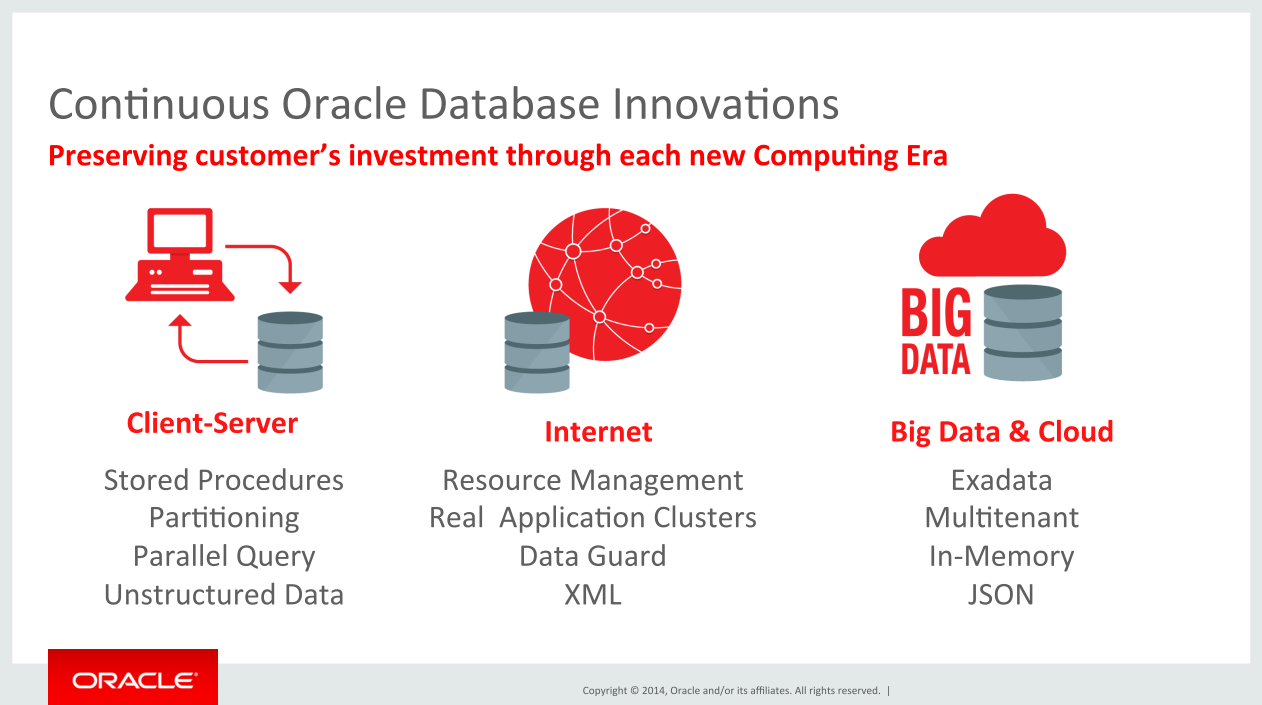
If you have not seen the Oracle Data as a Service offering, it maybe something you’ll want to consider. Why? Big Data is now one of the hottest topics. The issue is more data is not helpful unless the data is actionable and it provides insights to act on.  What seems to be on Oracle’s mind is:

  • Separating data services from applications
  • Allowing the data to be used by any application of your choice and
  • Offering external data to enrich business results.

In essence, what we are talking about is making data scalable, have interoperability, portability and well of course — last but not least, secure.

A data-driven business would need the answers to these types of questions, for instance for:

  • Marketing: Who should my prospects be? or How should I segment my list? or What should I say? or What have I said in the past that resulted in high lead conversions rates? The type of data Marketing would need would be information about a prospects shopping interests or past transactions
  • Customer Service: What are customers saying about my products / services/ our brand? Or What types of trends should I be looking for? The data the business would need would be around what are people saying about the brand and what are they sharing about the brand?
  • Sales:  How can I tell if I am talking to the right person in the organization who can answer my question or am I just wasting my time? Or what are all the ways I could get in contact with the company? The data needs there are things like business data and linked social handles to actual people in the company.

The outcome for Marketing would be that the Marketer would have the right prospective audience and be able to service up the right ads and content across any channel. The outcome for Customer Service might be the ability to increase retention with better social listening and sentiment or signals on how customers are feeling about the brand. For Sales the outcome might be improved sales efficiency with better insights and leads that convert to more sales, higher value sales or longer customer lifetime values.

But many businesses are lacking the competitive edge they should have when using data. This is often because the business:

  • Lacks a common data identifier across channels and across the enterprise
  • Finds it difficult to verify the quality of the data from the various sources of data (your own or data from 3rd party sources)
  • Has data in silos and it can not be easily transferable into an action across various platforms
  • Has a bunch of point solutions that don’t connect with enterprise-wide view of the data
  • Has not figured out the complex legal, commercial and privacy rights to navigate with the data and stay in compliance.

One solution to these issues appears to be what Oracle is presenting as Data as a Service (DaaS). This is where the data is offered as a service, and is uncoupled from any application and targeted to a buyer for a specific use case and easily integrated into a business application.

The four components of that are:

  • Data Ingestion
  • Value Extraction
  • Rights Management and
  • Data Activation

across all channels, with an ID unification system or process and a scalable infrastructure.

After the briefing, an example of the use of this type of system was shown for Marketing, where there was a 5x lift in performance vs traditional data and 2.5x in performance goals using data modeling. The audience for this type of Data as a Service for Marketing is targeted at Marketers, publishers, ad networks, exchanges and tech vendors and would be used to prospect at scale, serve up relevant ads and content across online, mobile, search, social and video.

An example of Data as a Service for Social showed a 5x in fan engagement, competitive intelligence, consumer intent capabilities and purchase language insights (i.e., know what your customers are saying when they actually are talking about buying something….) The ability to extract valuable information from unstructured social data is key to understanding consumer behavior and serve them well. The audience for this type of data is Marketers, customer service executives, Sales, e-commerce and social media managers.

To be able to give attribution to what is driving customer behavior, understand that and then use it to make real business decisions means that companies must be able to know more about who the data is coming from and what the data means, which leads us to the idea of  “addressability and ID (identification.) This ID graph is key to making the data operationalized, scalable and result in a business outcome. The question for you is, where are you on the maturity capability of your data and are you using a data as a service vendor or parsing through data in separate systems and trying to tie it together later?

Big data brings big promise. It also brings with it big issues if one is not skilled in the area of data addressability and ID to result in business outcome attribution. Where do you think most companies are on this Data as a Service maturity capability scale?

@drnatalie
VP and Principle Analyst, Constellation Research

See you at Constellation’s 4th Annual Connected Enterprise

The Executive Innovation Conference | October 29th-31st Half Moon Bay, CA, | Ritz Carlton 


Share


Data to Decisions Oracle AI ML Machine Learning LLMs Agentic AI Generative AI Robotics Analytics Automation Cloud SaaS PaaS IaaS Quantum Computing Digital Transformation Disruptive Technology Enterprise IT Enterprise Acceleration Enterprise Software Next Gen Apps IoT Blockchain CRM ERP CCaaS UCaaS Collaboration Enterprise Service developer Metaverse VR Healthcare Supply Chain Leadership business Marketing finance Customer Service Content Management Chief Customer Officer Chief Information Officer Chief Marketing Officer Chief Technology Officer Chief Information Security Officer Chief Data Officer

Constellation Welcomes 200 Early Adopters to Connected Enterprise, The Innovation Summit for the Enterprise

Constellation Welcomes 200 Early Adopters to Connected Enterprise, The Innovation Summit for the Enterprise

Constellation's Connected Enterprise Logo #CCE2014San Francisco, CA, September 4, 2014. Constellation Research, the research and advisory firm helping clients dominate digital disruption announced details of the fourth-annual Connected Enterprise innovation summit. Constellation’s Connected Enterprise is an immersive innovation summit for senior business leaders using digital technologies to transform their organizations. This three-day executive retreat features mind expanding keynotes from visionaries, interactive best practices panels, deep 1:1 interviews with market makers, new technology demos, The Constellation SuperNova Awards Gala Dinner, a golf outing, and an immersive networking event.

Connected Enterprise Details
When: October 29 – October 31 2014
Where: The Ritz Carlton, Half Moon Bay, San Francisco Bay Area
Who: 200+ future-minded business leaders. All innovation-minded executives welcome.
What: Three-day executive innovation summit and SuperNova Awards Gala Dinner in a luxury setting.
Register: https://connectedenterprise.ontrackevents.com/registration.cfm
Use code PRI814 for VIP privileges throughout the event

The theme of this year’s Connected Enterprise innovation summit is Dominating Digital Disruption. Attendees will discover how digital businesses can realize brand promises, transform business models, increase revenues, reduce costs, and improve compliance.
 

Featured Speakers

  • Rachel Botsman: TED Speaker. Global thought leader on the power of collaboration and the sharing economy. 
  • Raj Chetty: Economist, MacArthur Fellow, using economics to design more effective government policies.
  • David Pogue: Emmy Award-winning technology journalist. Founder of Yahoo! Tech. Formerly at The New York Times. 
  • John Hagel III: Chairman, Deloitte LLP Center for the Edge. Author of The Power of Pull
  • Robert Scoble: The startup kingmaker. Former technology journalist. Currently Startup Liason at Rackspace. 
  • Paul Greenberg: The Godfather of CRM. Author of CRM at the Speed of Light. 
  • Lauren Capelin: Catalyst for collaborative consumption. 
  • Dr. Janice Presser: Behaviorial scientist. Architect of Teamability®. Uncovering the elements to successful teamwork. 
  • Lawrence Coburn: CEO and co-founder, DoubleDutch, the mobile app for events and conferences. 

​Register before September 30, 2014 to take advantage of early bird pricing. Use code PRI814
https://connectedenterprise.ontrackevents.com/registration.cfm

View full speaker list here: http://connectedenterprise.ontrackevents.com/index.cfm#speakers

Sponsorship Information: contact us at [email protected]

About Constellation Research

Constellation Research is a leading business research and advisory firm that helps clients transform business models with disruptive technologies and progressive strategies. Constellation caters to clients who have talent, influence, and vision. This community of successful senior business leaders excel and continue to advance in their careers.  

***

Constellation Research, Constellation SuperNova Awards, Constellation Orbit, Connected Enterprise, Constellation Cosmos, and the Constellation Research logo are trademarks of Constellation Research, Org. All other products and services listed herein are trademarks of their respective companies.

Press Contacts: Contact the Media relations team at [email protected] for interviews with analysts.

Sales Contacts: Contact our sales team at [email protected].

Data to Decisions Future of Work Marketing Transformation Matrix Commerce New C-Suite Next-Generation Customer Experience Tech Optimization Sales Marketing Innovation & Product-led Growth Connected Enterprise Chief Customer Officer Chief Digital Officer Chief Executive Officer Chief Financial Officer Chief Information Officer Chief Marketing Officer Chief People Officer Chief Procurement Officer Chief Supply Chain Officer Chief Experience Officer

Guy Courtin Joins Constellation Research to Cover Matrix Commerce

Guy Courtin Joins Constellation Research to Cover Matrix Commerce

Guy Courtin Constellation ResearchSupply chain management expert Guy F. Courtin to cover nouveau commerce and delivery channels as Vice President and Principal Analyst

Constellation is happy to announce Guy Courtin will join the research team as Vice President and Principal Analyst. A veteran practitioner and thought leader in supply chain management, Courtin will cover the evolving commerce environment. Courtin’s appointment to the research team furthers Constellation’s ability to provide holistic coverage of the rapidly changing business environment to its early adopter clients.

As Vice President and Principal Analyst, Courtin’s research and advisory will focus on Matrix Commerce, the technology-driven evolution of the commerce supply chain. Courtin’s research agenda will instruct and inform customer officers, supply chain officers, and procurement officers of the changing demand patterns, buying behaviors, customer expectations, and technologies whose forces are combining to change commerce and its supply chain.

"We're excited to have someone who understands the implication of digital transformation for retailing, commerce, and supply chain.  More importantly, we're excited about Guy's passion for all things matrix commerce," noted R "Ray" Wang, Founder and Principal Analyst, "Guy's been a long time friend and now a trusted colleague. Our Constellation Executive Network clients also gain a trusted advisor in the Northeast." 

Courtin was previously Vice President of Research at SCM World as well as holding leadership roles at technology firms, Retail Solutions, Progress Software, Smartops and i2 Technologies.

COORDINATES

Twitter:  @gcourtin
Profile: https://www.constellationr.com/users/guy-courtin


Matrix Commerce Sales Marketing Innovation & Product-led Growth Chief Customer Officer Chief Information Officer Chief Procurement Officer Chief Supply Chain Officer

Unanswered Questions About The Internet of Things #IoT

Unanswered Questions About The Internet of Things #IoT

1

Internet of Things Bandwagon

The #IoT bandwagon is already full but looks like the one above.

On this proverbial bandwagon are herds of pundits, analysts and guys like me living in a rolling echo chamber. In our rolling echo chamber, questions are drowned by conjecture, stalwart claims, and empty predictions. Yeah, we seem to forget to answer the important questions.

There are more unanswered questions about #IoT than there are unique types of things other than computers connected to the Internet.

So lets talk about some of these unanswered questions …

  1. How will things be identified? Here is the basic premise; the idea of “connecting” something to the Internet needs to go away. Things need to be identified via proximity, connection type, or sensors. We have to get to a point where there are standards (yes, standards) for things to be sensed and connected. The physical connecting and disconnecting will become painful, and arduous.
  2. What will the word trust mean to “things” in IoT? In a world where we can get past connecting, we have to start thinking about trust. There will have to be trusted keys, or tribes or families of things where trust is inherent and understood. Take for example, my car is registered to “Richie Etwaru” and my phone is named “Richie Etwaru’s iPhone” still when I connect them via Bluetooth I need the silly numeric pins. IoT will require that we redefine trust in edge computing.
  3. How will connectivity work? If connecting and disconnecting are done with, and there is something like IoTML (The Internet of Things Markup Language) – yes I went there – to enable trust, then what does connectively mean? Is it permanent, transient? Can a thing connect just to inventory itself, or to send a message. In cases of emergencies, can things connect to other things quickly to transmit emergency messages? If there is a fire in my neighbors home, I can run over there and help in any way I want, call his/her family to alert them, lots of unusual connections can be made. Can things behave in the same way? Can the context of the moment things are in drive the extent of the connectivity things have with each other?
  4. What types of conversations can “things” have with each other? This one is my favorite, my phone wants to know something from my refrigerator, can they talk about it without bothering me? Conversations between things are important. Here is a negative bolt, just because I can see metrics about an analog device on an mobile App, does not mean that “thing” is now a part of IoT. For example, if I have a refrigerator App that tells me the temperature of my refrigerator -- does that mean my fridge is now a part of IoT? No, stop it guys, that’s just silly, when my fridge starts to converse with other “things” trusted and connected then it becomes an IoT citizen. Anything else is just a fridge with an App.
  5. How will things be policed? Naturally, things will behave badly. Things will break the rules, who will police this very loose and high context chatter? Will an entire tribe/brand of things be quarantined from connecting to other types of things? We are focusing so much on the “things” in the IoT paradigm shift that we are missing the most important premise of the entire paradigm, the network itself! The network will likely be the police.
  6. What will be the role of AI in IoT?
  7. How will societies of things form?
  8. What will awareness of each other mean to things?
  9. How will things pay each other for services procured? And with what currency?
  10. What happens to the desktop computer eventually?

In an effort to keep the blog short, I figured let us leave the last five questions unanswered for comments below.

I write as a labor of love, in exchange I ask that you share this writing if you think others may find value,

-Richie

New C-Suite Data to Decisions Next-Generation Customer Experience Future of Work Innovation & Product-led Growth Tech Optimization Chief Customer Officer

Connected Enterprise Speakers Announced

Connected Enterprise Speakers Announced

Connected Enterprise Disruptive Tech Speakers

Check who's speaking at this year's Connected Enterprise!

  • Rachel Botsman: TED Speaker. Global thought leader on the power of collaboration and the sharing economy. 
  • Raj Chetty: Economist, MacArthur Fellow, using economics to design more effective government policies.
  • David Pogue: Emmy Award-winning technology journalist. Founder of Yahoo! Tech. Formerly at The New York Times. 
  • John Hagel III: Chairman, Deloitte LLP Center for the Edge. Author of The Power of Pull
  • Robert Scoble: The startup kingmaker. Former technology journalist. Currently Startup Liason at Rackspace. 
  • Paul Greenberg: The Godfather of CRM. Author of CRM at the Speed of Light. 
  • Lauren Capelin: Catalyst for collaborative consumption. 
  • Dr. Janice Presser: Behaviorial scientist. Architect of Teamability®. Uncovering the elements to successful teamwork. 
  • Lawrence Coburn: CEO and co-founder, DoubleDutch, the mobile app for events and conferences. 

Let this extraordinary lineup of speakers challenge the way you think about innovation. Join us at Constellation's Connected Enterprise and learn how to Dominate Digital Disruption. 

Early bird pricing ends September 30, so register today!


Data to Decisions Future of Work Marketing Transformation Matrix Commerce New C-Suite Next-Generation Customer Experience Tech Optimization Innovation & Product-led Growth Connected Enterprise Chief Customer Officer Chief Digital Officer Chief Executive Officer Chief Financial Officer Chief Information Officer Chief Marketing Officer Chief People Officer Chief Procurement Officer Chief Supply Chain Officer Chief Experience Officer

Marketing Automation is Not Just For Marketers: Sales & Customer Service Need It Too!

Marketing Automation is Not Just For Marketers: Sales & Customer Service Need It Too!

As I was taking a briefing this morning by the CMO and team at Act-0n Software, I made the connection that is sorely needed between Marketing and Sales. Sales can often be found complaining that they’d have more sales if Marketing gave them better leads. And Marketing can often be found saying to sales, you’d have more sales if you just acted on the leads we provided.

What I saw in Act-on’s presentation was the fact that Marketing and Sales both benefit from marketing automation software. It’s not just Act-on’s software that provides this. What is really whether most spent on marketing, especially B2B marketing where a lot of money is spent on educating the buyer via webinars, white papers, case studies, etc… is whether that marketing activity is generating sales.

Marketing Automation is Not Just for Marketers Anymore

Marketing Automation is Not Just for Marketers Anymore

The point is really to make a great customer interaction experience. Marketing and Advertising let customers know what is new, exciting and available. But once that is done, how many Marketers know if so marketing “activities” really drove sales? Of if the Marketing Automation platform can connect with the CRM database is to see if someone who is receiving the marketing message is a customer already?

What helps sales is when they can see what the prospect (who is either a current or potential customer) has done with the company – i.e., what interactions they have had with the marketing content they were sent. Did that prospect one the emails, download the white papers, watch videos — i.e., that behavioral data is key to determining buying signals from a customer.

And today, the marketing funnel is not so linear. Someone who is having a customer service issue might display, right in the middle of a marketer’s campaign #fail with respect to the service they got that that service or lack there of can detour a customer from either turning from a prospect into a customer or from a current customer to a defector.

Software that connects separate databases and connects the ability of Marketing, Sales and Customer Service to connect and understand the behavioral data of prospects is key to a company’s success!

And that’s how I see it.

@drnatalie

See you at CCE: Constellation’s Connected Enterprise

Marketing Transformation Next-Generation Customer Experience Chief Customer Officer Chief Marketing Officer