


What if our AI infrastructure is already built?
If you're one of those people that watch what people do not what they say you may want to start paying attention to AI royalty right now. Why? Because the likes of Microsoft CEO Satya Nadella and Nvidia CEO Jensen Huang are kicking it like it's the 1990s with PC upgrade cycles, CPUs and on-premise infrastructure.
Yes, folks we have a problem. Tokenomics only works for a handful of companies (maybe) and unless you take compute out of the cloud for AI inference the economics aren't going to make sense. Makes you wonder about all those FOMO driven dollars being spent on AI factories and a centralized compute model that may already be outdated.
Nvidia's Huang kicked off with a Computex keynote that largely revolved around the CPU. Nvidia wants to be inside PCs and workstations with its Vera CPU. There's a reason for that: AI inference is all about the CPU. Huang also showed off a few PCs while he was at it.
Apparently, Nvidia wants to be the next Intel Inside even as it dominates GPUs and AI data centers. You could call Nvidia's move a nice hedge.
Nadella noticed:
"When I saw that Jensen picture from the weekend, where he had all the desktops, I felt like, man, I'm back in the 90s. It was so cool to see the lineup of all the machines that I loved, and I grew up with back yet again with new functionality. The same form factor, but unbelievable new functionality, because of the onboard AI capability."
- Why Microsoft AI's approach is right time, right place
- Microsoft Build 2026: Windows, Rayfin, Fabric IQ and more
- Microsoft rolls our Majorana 2 and bets new materials accelerate quantum computing
- Microsoft launches Project Solara: Are we ready for intelligent digital badges?
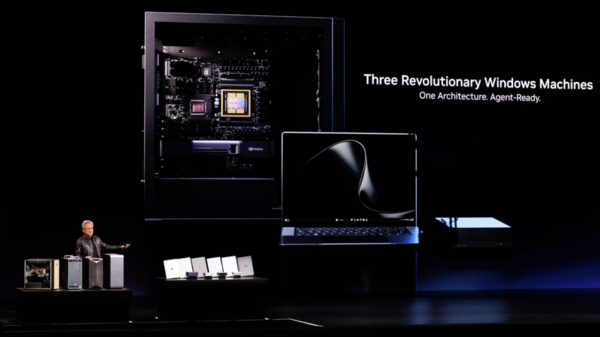
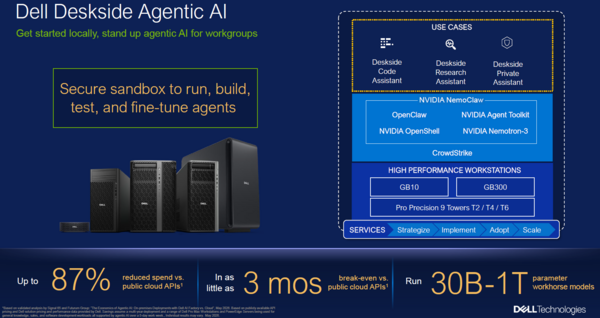
And this groundswell in retro infrastructure isn't just AI PCs. Did you see Dell Technologies blowout quarter? Yes, there was an AI infrastructure demand boom (and possibly some of it pulled forward), but traditional servers surged. HPE followed up with a strong networking and traditional server quarter.
Cisco talked about how the network is the cornerstone of AI (sounds familiar for you old heads eh?) at Cisco Live. Sure, Cisco CEO Chuck Robbins had a lot of agentic AI throughout his keynote, but this was more about systems (classic and newfangled AI factories) all aligning behind AI.
AMD CFO Jean Hu said at the Bank of America 2026 Global Technology Conference that the 1990s vibe isn't unexpected. AMD predicted CPUs would regain their standing two years ago even as everyone was GPU happy.
Hu said:
"You can see continued momentum from training to inference, from AI adoption, experimentation, to more adoption at scale. Agentic AI is not about answering questions anymore. It's about orchestration, it's about database access and a lot of tool execution. And all of those require significant CPU performance. And what we are seeing is very significant and incremental demand for our CPU platforms.
We also are seeing the economics of AI keeps changing. With the token generation going up so quickly, all the customers are really focusing on performance, TCO, and they're really trying to figure out how to use different computes to address different applications and workloads."
Dell Technologies' Arthur Lewis, President of Infrastructure Solutions Group, said the new model is cloud and edge. It's not either or.
Lewis said at an investor conference:
"We wrote down a couple of different hypotheses when we first started down this path of artificial intelligence in the beginning of '22. And one of them was that there's going to be strong gravity to data. And that's proven out to be the case. 83% of data sits on-prem today in the world across a majority of enterprises, and there's a strong proclivity to deploy on-prem for performance, cost and security reasons."
That bet has paid off as Dell is selling servers of all types at a rapid clip as well as PCs. It's all a bit client server.
Trillions of dollars on FOMO
When I look at the AI infrastructure market, I can't help but think this seems like real estate in 2006 and 2021. Both times, there was a rush on assets. In the first real estate bubble, there was FOMO about buying homes because they could only go up. Then came the mortgage-driven crash in 2008.
During the COVID pandemic there was a rush to buy homes in places with lots of sun. Austin and Florida boomed based on the premise we'd all never go back to the office. Ask those folks who bought in 2022 how it worked out.
Since we're talking hard assets, AI data centers rhyme a bit. There's no moderation in spending because we all assume OpenAI and Anthropic will grow forever and be able to pay their trillion-dollar tabs. It's FOMO-ish.
Alphabet did an $85 billion equity offering to raise money for its AI infrastructure investment. There's not a quarter where the AI infrastructure tab doesn't go up. Goldman Sachs is expecting a combined $7.6 trillion of capex on compute, data centers and power between 2026 and 2031.
The economics of artificial intelligence are more questionable today than two years ago, said Goldman Sachs Research's Jim Covello, Head of Research, in a podcast.
Covello said:
"There's a tremendous amount of FOMO at every level of the supply chain. And it doesn't mean that it's not justified. I just think that we're spending well in advance of where the economics are right now. And I think it's because everybody is afraid of what happens if the technology really takes off and finds significant positive economic use cases. And your competitors have that figured out and you don't. And I think that's everything from the enterprise level to the model layer to the hyperscaler layer."
- How to avoid vendor lock-in in the AI age
- BT150 zeitgeist: In search of AI agent ROI
- CIOs see AI agents as journey, token budgets a concern, says Box CEO Levie
- AI inference costs are going to be a big concern: What's the fix?
- AI Forum 2026: There isn’t an easy button for AI
- Constellation Research's Futures Forum: What CEOs are thinking
- Where’s tokenomics for the rest of us?
The big question
All this 1990s nostalgia spurs a very expensive question: What if our AI infrastructure is already built?
If AI inference is the thing that makes the agentic world go around, we're really talking about a massive upgrade cycle of CPUs instead of massive AI factories that have a massive gap between announcement, depreciation and actually turning on the lights. Sure, there's the cloud and there will be demand to ultimately justify the investment, but there's so much compute that's not being harnessed.
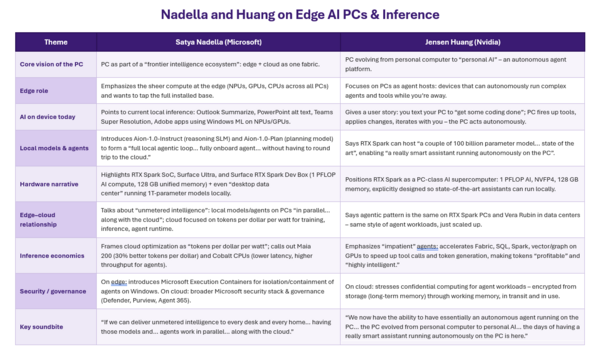
Nadella said: "Let's start at the edge with Windows, because when you step back, the amount of compute there is at the edge is actually astounding. Think about every NPU, GPU, CPU, even every PC. If you sort of aggregate that, that's a lot of compute power. If we can deliver unmetered intelligence to every desk and every home, it takes us all the way back to the very beginning."
Is the goal to spend a gazillion of capex on building AI factories or delivering the Nadella's "token per dollar per watt?" If it's the latter, we may need to think about the edge a lot more. There will be handoffs to the cloud for sure, but there's no sense in creating the next mainframe in the Midwest when there's a potentially more elegant architecture that's already in place.
Nadella repeatedly mentioned unmetered intelligence to describe his vision of edge AI working in concert with the cloud. "This idea of unmetered intelligence is about having those models and having the agents using the models work in parallel (at the edge) to what you may be doing along with the cloud as well," he said.
In other words, it's the orchestration stupid. Perhaps we need another Napster to aggregate and optimize the compute where some fancy LLM provider would actually pay you for spare compute.
Now if we play this theory out a bit farther just think about all of those edge data centers run by telecoms. Do those assets play an AI inference role? Of course, they do.
The more you go down this AI rabbit hole, the more the 1990s theme seems to make sense. That's why Huang is suddenly Captain CPU.
Constellation Research analyst Esteban Kolsky said it's likely the AI value is going to be some combination of server and edge. The 1990s model didn't quite work because we didn't have the "glue" between systems, which grew up in silos between compute, data, storage and networking. "It's more than power. It's how you concentrate it and how you leverage it. You need an orchestrator," said Kolsky.
"The 1995 vibe is true, but many cycles forward. The opportunity is still the same, but there's different market dynamics. You have to imagine the opportunities and possibilities," said Kolsky.

Larry Dignan is Editor in Chief of Constellation Insights at Constellation Research, where he leads editorial coverage focused on enterprise technology, digital transformation, and emerging trends shaping the future of business. He oversees research-driven news, analysis, interviews, and event coverage designed to help technology buyers and vendors navigate complex markets with clarity and context. ...
Read morePublished
Author
