


How to avoid vendor lock-in in the AI age
Technology vendors are barraging enterprise buyers with platform pitches that'll enable their agentic AI dreams and automate enterprises via private previews of products that'll be available at some point later in the year. But CxOs would be wise to hedge their bets with vendors that are neutral and give you some defense to lock-in.
The cleanest strategy in an AI-driven environment that changes rapidly is to avoid bets on any one platform. Also don't pick one LLM company even though your board would love an OpenAI or Anthropic press release. And don't bet that your long-term SaaS vendor who just discovered consumption models is going to future-proof you either. Build vs. buy is another argument, but let's get real: You'll do both. The pendulum shifts to build and open source if you really want to be agnostic.
In the end, the best bet to avoid vendors that box you in is to build a neutral enterprise control layer around integration, APIs, data access, identity, observability, governance and model routing. From there, you can let the applications, clouds and AI models duke it out.
Box CEO Aaron Levie on the company’s first quarter earnings call summed up the appeal of neutral layers. "You don't want to have your data stuck with one vendor that's going to sort of try and keep your workloads going down a particular path. You want to be able to have some flexibility of which agents you can use, which models do you choose based on the workload," said Levie. "As token budgeting becomes a bigger topic, you're going to see more value accrued to the layer that can really kind of swap out models for different workloads based on what the customer is trying to solve."
Meanwhile, there’s an urgency to get to an architecture that gives you options since AI is giving you a once-in-a-generation opportunity. SaaS and cloud computing gave you an opportunity to shed technical debt and lock-in only to get locked in again. Don’t make the same mistake twice.
Meanwhile, the stakes are simply higher. AI has compressed time. Constellation Research CEO R “Ray” Wang has a frequent riff on exponential efficiency. You’re either 10 X better or 1/10th the cost or you’re toast. Your legacy infrastructure needs to their get a lot cheaper or drive much better returns.
- AI inference costs are going to be a big concern: What's the fix?
- Why enterprise AI leaders need to bank on open-source LLMs
- AI Is the Enterprise’s Next Paradigm Shift
- Here Come the AI Exponentials
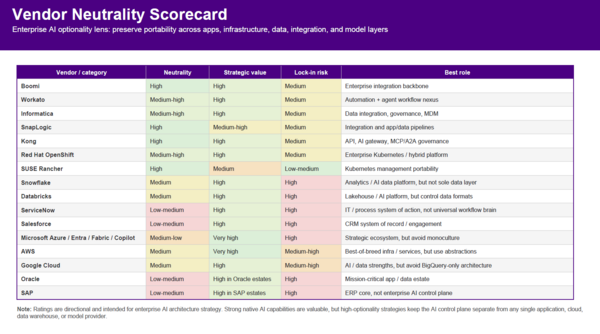
The word of the AI era for CxOs is optionality. Here's a look at the layers and vendors that'll give you options.
Integration, automation and iPass. Throughout Boomi World 2026, the word that kept coming up for me was "hedge." Your architecture needs to be neutral and Boomi, Workato and SnapLogic are vendors in this area.
API and AI gateway. API gateways become the nexus for models and agent calls as well as Model Context Protocol (MCP) and whatever standard there is. Kong is a key vendor on this level.
Hybrid app platform. AI workloads are likely to be on-premises and in the cloud and you'll want to enable hybrid approaches. Red Hat OpenShift and SUSE are options here.
Data lakehouse. Your data strategy needs to avoid a proprietary warehouse as the only version of the truth. Iceberg is the table format that gets you out of it and has broken down barriers even between fierce rivals such as Snowflake and Databricks.
Observability. Look for vendor neutral options based on OpenTelemetry. Players here include Elastic and Datadog.
AI model access and routing. You'll want to separate model choice from application logic. Kong AI Gateway and Langfuse are options. Humanloop, another option, was acquired by Anthropic.
Agent orchestration framework. Every vendor wants to be your agent orchestration layer, but you don't want to be pinned down to one vendor or cloud. LangChain and LangGraph are useful here.
Identity and access. Identity is critical for AI agents and your neutral choices are fairly limited to Okta and Ping. Microsoft Entra ID is a good choice, but increases your risk of Microsoft being the center of ID gravity.
Data governance, catalog and policy. The trick here is to keep data classification, lineage and access policy and compliance outside of any one warehouse, app or cloud. Collibra and Alation are options, but the big dog is Informatica, which was acquired by Salesforce.
Workflow and process layer. Camunda and Temporal are about preserving workflow logic outside of SaaS apps. Celonis is primarily process intelligence and UiPath is an orchestrator for apps. ServiceNow an option, but the platform has its own risks because it could become your de facto workflow brain.
- AI Forum 2026: There isn’t an easy button for AI
- Constellation Research's Futures Forum: What CEOs are thinking
- Where’s tokenomics for the rest of us?
- Disruption coming for ERP and not from where you'd think
Where does this leave your core vendors? The likes of SAP, Workday, Salesforce, Oracle and Microsoft all have embedded AI that's worth using in context of those applications. These vendors are systems of record not AI control planes. But keep in mind that they all want to be your AI control plane.
Going through this exercise proves that it isn't easy being neutral. A few rules of the road:
- No vendor should own control planes for identity, data storage, model routing, workflow orchestration, integration, observability and governance unless there's a business reason.
- Avoid farming out your universal AI layer to platforms that belong to your existing SaaS powerhouses or hyperscale cloud providers. It just results in lock-in.
- Your current roster of big vendors should be participants in the enterprise architecture not the architecture. They all want you to use them as the enterprise architecture to manage their inhouse AI agents as well as third-party versions.
Tales from the buy side
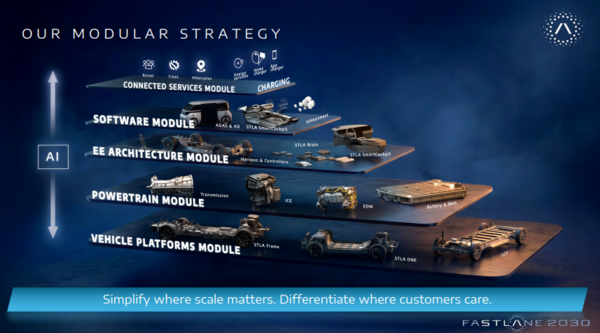
This modular and largely neutral architecture was highlighted in a few enterprise cases of late. Consider:
- Automaker Stellantis is betting that it can infuse AI and technology across its company to boost revenue growth and profits. The plan is to build and leverage a platform called STLA One, which includes a scalable compute layer (STLA Brain), a streamlined cockpit experience (STLA SmartCockpit) and an autonomous driving platform (STLA AutoDrive). "Reusable building blocks with standard interfaces allow us to scale and upgrade over time, and artificial intelligence acts as an accelerator across every layer," said Davide Mele, Head of Product Planning at Stellantis.
- Apartment rental giants Equity Residential and AvalonBay announced a merger of equals and the companies touted a data flywheel that’ll fuel AI and automation as they integrate. The big win is that Equity Residential and AvalonBay teamed up in 2019 to create Elise AI, a homegrown platform. "We can identify emerging technologies and spread the cost across a much larger base of homes. That investment benefits residents directly, faster response times, better digital tools, more consistent service, while also driving the operating efficiencies that benefit shareholders. We also expect a broader and richer set of data to optimize our operating and investment decisions and outcomes," said Ben Schall, President and CEO of AvalonBay. Schall will become CEO of the combined yet-to-be-named company.

- Retailers in their most recent earnings reports outlined their AI efforts across multiple areas including supply chain, customer experience, inventory, delivery and fulfillment. The big picture: Customer experiences need to be seamless across physical and digital channels. Supply chain, inventory management as associate productivity are all key areas for AI-driven automation and speed, delivery and fulfillment differentiate CX. Most of these retailers have strategic partner, but the architecture is set up for optionality as AI develops. For instance, Walmart is scaling its US-built technology platform around the world.
Larry Dignan is Editor in Chief of Constellation Insights at Constellation Research, where he leads editorial coverage focused on enterprise technology, digital transformation, and emerging trends shaping the future of business. He oversees research-driven news, analysis, interviews, and event coverage designed to help technology buyers and vendors navigate complex markets with clarity and context. ...
Read morePublished
Author
