


Why Microsoft AI's approach is right time, right place
Microsoft AI launched seven in-house foundation models at Microsoft Build 2026, but comparing benchmarks and the freedom the company has now that it's out of its OpenAI contract is the easy storyline. Microsoft is playing catch-up in foundational models, but the bigger story is that the company has the right approach at the right time.
At Build, Microsoft AI CEO Mustafa Suleyman took the wraps off the company's new in-house models.
- MAI-Image-2.5 / 2.5-Flash (image generation & editing)
- MAI-Transcribe-1.5 (speech‑to‑text)
- MAI-Voice-2 / Voice-2-Flash (speech generation)
- MAI-Thinking-1 (35B‑param reasoning model)
- MAI-Code-1-Flash (5B coding model)
"These models are all built with real attention to detail and a commitment to making very practical and efficient tools that are tuned to just how you work in the real world," said Suleyman.
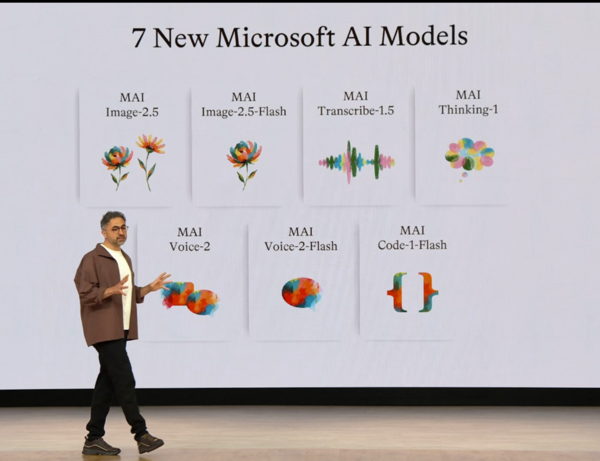
Microsoft CEO Satya Nadella emphasized real world use case and co-designing models that can adapt to "hill climb" and learn your enterprise from the bottom up because they are trained on verified and licensed data. Nadella said:
"We believe that time has come for every company to move from consuming a frontier model to fully participating in the frontier ecosystem. You can have your own private evals and outcomes."
Why does this Microsoft approach to models work? The Microsoft AI models and message land just as enterprises are freaking out over token costs, just as they are worried about being locked in with Anthropic or OpenAI and just as they're still hunting for returns and business outcomes. The free spending on AI is going to end in 3, 2, 1.
- How to avoid vendor lock-in in the AI age
- BT150 zeitgeist: In search of AI agent ROI
- CIOs see AI agents as journey, token budgets a concern, says Box CEO Levie
- AI inference costs are going to be a big concern: What's the fix?
- AI Forum 2026: There isn’t an easy button for AI
- Constellation Research's Futures Forum: What CEOs are thinking
- Where’s tokenomics for the rest of us?
Microsoft's job in the frontier equation is to provide the scaffolding for models that you can differentiate with IP that you own and control with efficiency, said Nadella, who noted that token costs and performance is critical. Microsoft announced a partnership with the Mayo Clinic to highlight the co-designed model approach. Microsoft also rolled out a private tuning service.
The introduction of Frontier Tuning from Microsoft means that MAI models can adapt to workflows and your data. Microsoft said Frontier Tuning has proven that custom models are better and more efficient.
- Microsoft Build 2026: Windows, Rayfin, Fabric IQ and more
- Microsoft rolls our Majorana 2 and bets new materials accelerate quantum computing
- Microsoft launches Project Solara: Are we ready for intelligent digital badges?
Here are the themes from Microsoft AI's approach from the Build 2026 keynote and blogs.
Microsoft is focusing in-house models on the edge as well as cloud. Nadella outlined Microsoft's small models that whip with Windows that run on device. Aion-1.0-Instruct (reasoning SLM) and Aion 1.0 Plan (planning model) to form a “full local agentic loop without having to round trip to the cloud," said Nadella.
These models will become more critical as edge inference becomes the norm. It doesn't hurt that Microsoft can preinstall those small models across the Windows ecosystem.
Efficiency matters. Microsoft AI are tuned for efficiency on Maia 200, Microsoft's in-house AI accelerator. Suleyman said: "We have been carefully co‑designing our models with our own silicon. We've optimized MAI Thinking One on our Maia 200 chip and benchmarked it. On top of the 30% performance improvement, we're now seeing a further 1.4x performance per watt gain when we run our MAI models on the Maia 200 end to end."
Microsoft's in-house foundation models can run on various use cases and deliver internal ROI running across the company's products. Microsoft's models are doing local inference across multiple applications. Microsoft's approach to its foundational models may also prove to be useful to enterprises looking to tailor them to individual use case. "We now have a roster of seven new world-class models to keep everybody working at the absolute frontier, and we're really looking forward to everybody being able to co-create your own unique agents adapted to you that you'll control. I really feel like this is a new era in AI, an era of AI that you control on your terms," said Suleyman.
Larry Dignan is Editor in Chief of Constellation Insights at Constellation Research, where he leads editorial coverage focused on enterprise technology, digital transformation, and emerging trends shaping the future of business. He oversees research-driven news, analysis, interviews, and event coverage designed to help technology buyers and vendors navigate complex markets with clarity and context. ...
Read morePublished
Author
