


Microsoft Build 2026: Windows, Rayfin, Fabric IQ and more
Microsoft at Build 2026 aimed to position itself as an end-to-end platform for building and operating agentic AI systems with a set of announcements on infrastructure, models, tools, security and observability.
The upshot from a series of Microsoft product announcements is that the company is aiming to move developers from writing code to orchestrating systems of agents. Indeed, Microsoft even recast Windows as a primary environment for AI agent development and local execution.
The company also launched new features for GitHub Copilot including a command line interface and desktop app as well as Rayfin, which is a managed backend-as-a-service (BaaS) for building agentic apps.
Context is seen as the differentiator for Microsoft as the company outlined Fabric IQ, its business context layer that works across Microsoft 365 work data, data estates and knowledge bases and connects to Microsoft IQ.
Although Microsoft Build is designed as a conference for developers, it's clear that the company was also courting CxOs looking to deploy AI agents with governance and cost controls.
Microsoft's strategy at Build revolved around the following:
- Pitching Windows as a trusted AI development platform.
- Arguing GitHub and Azure Fabric and Foundry are the build and run platform for AI agents and apps.
- Fabric IQ is the most fleshed out context layer to tie work, data and models together.
Here's a look at what was announced at Build 2026:
Windows can do AI agents too
You'd be forgiven for writing off Windows as an afterthought for Microsoft. After all, Windows gets little play relative to the rest of Microsoft's portfolio.
But the company is pushing Windows "as the most credible local environment for building, testing and shipping AI applications and running agents."
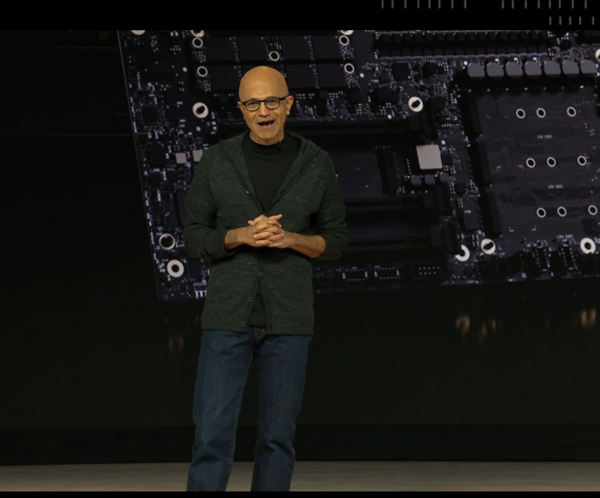
Microsoft CEO Satya Nadella said Windows can be critical to the AI infrastructure equation. "When you step back, the amount of compute there is at the edge is actually astounding. Think about every NPU, GPU, CPU, even every PC. If you sort of aggregate that, that's a lot of compute power," said Nadella.
The company announced the Surface RTX Spark Dev Box, a compact developer PC engineered with Nvidia RTX Spark superchip and built on the Windows developer platform.
Microsoft is offering Microsoft Execution Containers, which add an OS-level sandboxing and policy layer for agents. Developers can define agent containment requirements once and Windows will enforce isolation, identity, governance and permissions.
The goal for Windows is to run agents like OpenClaw or in-house agents on work devices without controlled access and observability via Agent 365.
Microsoft is also improving the Windows developer experience with enhanced WSL to run Homebrew inside WSL containers. The company is also improving Unix tooling in PowerShell with more than 70 Unix command line tools that can reduce friction for developers coming from macOS and Linux.
Much of the Windows news as previously highlighted by Nvidia.
GitHub Copilot app
For GitHub, Microsoft's goal is clear: Make it the agentic AI development build plane. The company launched a native desktop app in preview that goes beyond code generations to create isolated workspaces per task and session, support for multiple concurrent sessions and the integration of code generation, code review and agent-assisted handling of review comments and changes.
Microsoft is also adding built-in automations for personal workflows such as processing overnight messages, prioritizing work, searching local notes and generating reusable scripts.
The vision: Make GitHub the best place to build software end-to-end not just generate code.
- Microsoft Azure revenue up 40% in fiscal Q3
- OpenAI goes multi-cloud in amended deal with Microsoft
- Microsoft adds slew of AI agents in Dynamics 365 Contact Center, Sales, Customer Insights
- Microsoft 365 Copilot’s Researcher agent goes multi-model
- Microsoft launches new E7 suite to integrate AI agents, Work IQ
- Microsoft CEO Nadella: AI efficiency drive on deck
Rayfin
Microsoft launched Rayfin, which is described as a code-first, managed backend-as-a-service (BaaS) for agents, delivered via Microsoft Fabric. Rayfin is an open-source SDK and CLI.
The goal for Microsoft with Rayfin is to move agentic AI apps from prototype to production without teams having to build and manage backend infrastructure. Rayfin includes:
- Identity management and database authentication.
- Storage.
- Messaging.
- Observability.
- And GitHub integration.
Fabric IQ
No enterprise technology conference is complete without a bevy of announcements about context layers.
Microsoft is betting that Fabric IQ will be its differentiator and the context layer for business. Fabric IQ will be part of the Fabric platform and connect data, business meaning and operations.
Fabric IQ includes the following connected layers:
- Unified data in OneLake, which has all the enterprise data, events and graph in one foundation.
- Business intelligence through semantic models.
- Operational intelligence with real-time signals and ontologies.
Fabric IQ will extend to Microsoft IQ, which is the enterprise intelligence layer with three components.
- Work IQ, which is Microsoft's sweet spot with context over emails, documents, presentations, Teams meetings and transcripts. Work IQ is available via APIs and MCP so AI agents have proper context before acting.
- Foundry IQ, which is context for agentic apps and knowledge bases. Foundry IQ connects knowledge bases, runbooks, playbooks, operational guides and external vector stores. Foundry IQ is tied to more than 10,000 models.
- Grounding enhancements in preview that combine internal context with external sources. The goal is to ground agents in real-world data.
Microsoft said Fabric IQ updates include Operations agent, Graph, a relationship-first modeling engine, and Planning. Operations agent and Graph are generally available with Planning landing in June.
Azure HorizonDB
Microsoft launched the public preview of Azure HorizonDB, an enterprise Postgres-compatible database designed for AI applications. Microsoft also added enhancements to PostgreSQL in Visual Studio Code.
Azure HorizonDB is now available in public preview in multiple regions including Central US, Sweden Central, West US 2, and West US 3 regions. Additionally, East US, Canada Central, Indonesia Central, Italy North, Japan East, Korea Central, and Poland Central will be available in the coming weeks.
Next-generation Microsoft in-house models
Microsoft is advocating for a multi-model, multi-partner strategy that can mix and match models based on cost and performance. The argument from Microsoft is that enterprises should only spend "frontier dollars" on problems that can only be solved by the latest technology.
The company said it will provide auto-routing of models in GitHub Copilot or Foundry across multiple models.
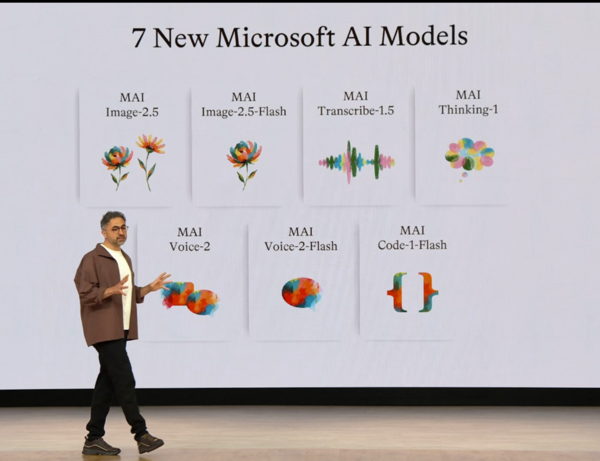
Microsoft's in-house models will be a part of the mix with a focus on clear data lineage, code generation, high-context models and multi-modal capabilities.
Frontier research
Microsoft also touted its research and development and ability to apply AI to healthcare, energy, agriculture and other science-based industries.
The goal is to shrink timelines and provide end-to-end workflows. Specifically, Microsoft talked up its quantum capabilities and how they reinforce efforts in AI.
Microsoft teased its quantum efforts and timelines for 2029.
See: Microsoft rolls our Majorana Two and bets new materials accelerate quantum computing
Larry Dignan is Editor in Chief of Constellation Insights at Constellation Research, where he leads editorial coverage focused on enterprise technology, digital transformation, and emerging trends shaping the future of business. He oversees research-driven news, analysis, interviews, and event coverage designed to help technology buyers and vendors navigate complex markets with clarity and context. ...
Read morePublished
Author
