


Meta releases open weight Muse Glimmer model with open Muse Spark 1.2 on tap
Meta is back on the open model bandwagon as the company released Muse Glimmer, an open-weight model released under the Apache 2.0 license, and said Muse Spark 1.2 will also go open source.
Previously, Meta was an open source champion with its Llama models, but then retooled its AI efforts under Alexandr Wang, who said Muse Spark 1.2 will have an open weight version. Meta initially appeared to go proprietary with its models in a bid to chase Anthropic and OpenAI. However, Meta has read the room now that AI inference costs have surged, enterprises want control of models and tokenomics doesn't appear to be beneficial.
Meta has been busy with its Muse Spark launches to play catchup, but it could accelerate its plans with an open approach. Meta can also be cast in a better light with open models given the US has ceded ground to China. This China vs. US storyline has some politicos talking about a ban on open models. Nvidia and others have supported open models and now want to better secure them and develop US-centric options.
For Meta CEO Mark Zuckerberg, Muse Glimmer represents his more optimistic view about AI. Zuckerberg penned a long thought leadership treatise on superintelligence.
A cynic (picture me raising my hand) would say Zuckerberg just wants to be in the conversation and all the cool AI kids (Dario Amodei) pen these long essays about the future of humanity and AI. Zuckerberg is proposing an AI philosophy "based on individual empowerment as the source of prosperity, invention as the primary purpose of superintelligence, and balance of power as the foundation of safety."
While long essays are nice, Meta's Muse Glimmer is far more interesting. Muse Glimmer, released on Hugging Face, is a 30-billion-parameter model optimized for local workflows and it can run on a single computer GPU. Given multiple enterprises and people want to run models locally for privacy and data control, Muse Glimmer may find an audience. The Muse Glimmer release is well timed.
Open models storyline
- Enterprises need better AI value metrics and vendors need better pricing models
- Enterprise AI grows up, vendors are noticing
- Anthropic: Opposed to open model ban, wants safety testing for all models
- Get ready for US open LLMs and just in time
- Rightsizing open models may cut your AI inference spend
- Moonshot AI launches Kimi K3
- DeepSeek's real impact happening now
- Here’s what we learned about AI projects from enterprise buyers so far
- AI inference costs are going to be a big concern: What's the fix?
- Why enterprise AI leaders need to bank on open-source LLMs
Meta Research said in a blog post that the local approach saves compute (and the cost that goes with it) and small models can perform well. Meta said:
"Foundation models have achieved remarkable capabilities across reasoning, code generation, and tool use — yet most deployments still depend on cloud infrastructure and network access. Running models locally enables you to use AI anywhere, anytime, with or without an internet connection. This is increasingly viable: the open source community has shown that smaller models, when trained effectively, can approach frontier-level performance on targeted tasks. Muse Glimmer is optimized for these local use cases."
Key points about Muse Glimmer:
- The model was trained on Muse Spark's outputs using distillation.
- Muse Glimmer was trained on longer-context and agent-heavy data.
- The model was fine-tuned with policy distillation and reinforcement learning.
- Meta's Muse Glimmer is designed for agentic task completion, reliable tool use, multi-step reasoning and compatibility.
- Based on benchmarks, Muse Glimmer outperforms Gemma4-31B and Qwen 3.6 27B.
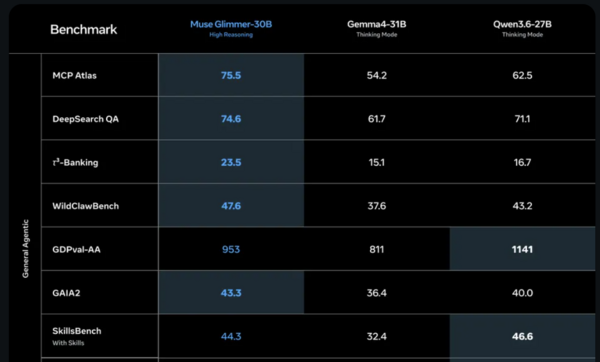
Muse Glimmer is likely to be the first open weight model installment from Meta. Zuckerberg said in his essay on AI:
"It is also important that the US and its allies lead the open source AI ecosystem that will make up a large percent of global AI use.
Foreign labs currently hold several advantages here since American labs have to comply with many additional restrictions on training data. US policy must reduce this additional friction if we want American open source models to lead over time. I do not believe restricting access to foreign open source models is an effective solution. Our goal should be for American open source models to be the best globally. This requires removing the hurdles that make it harder for American open source models to compete. Restricting people and companies from using the leading open source models -- wherever they come from -- will reduce the quality of AI accessible to them, and centralize AI rather than putting more power in people's hands.
For the US to lead in open source, we will need to rethink our policies in several areas, including distillation and data use in training. The ability for models to learn from other models is an important principle of how the open source ecosystem works. All AI models are derived from human knowledge. Some have tried to frame distillation as harmful, but I think it is important to protect the principle that you can learn from anything you can observe. This is how the world works, and the US will not be able to lead if we restrict ourselves on this front."
A few thoughts:
- Meta already monetizes with its core ad business and potentially renting out compute. The company can box in foundation labs because it doesn’t depend on selling foundation models. Being an open model champion could give Meta some much needed AI wins. Meta feels the AI squeeze in Q2
- Anthropic and OpenAI’s model increasingly looks tenuous. Google sells ads, cloud compute and TPUs. Meta can launch open weight models daily and not need the revenue. Nvidia just wants the ecosystem and to sell its integrated stack. SpaceX AI can be a thorn to the big foundation labs too. Whether it’s rhetoric or open models, there’s a lot of players gunning for Anthropic and OpenAI. Palantir: Worst nightmare for OpenAI, Anthropic? | SpaceXAI, Meta puts pricing squeeze on Anthropic, OpenAI
- Will these big US open weight model moves force OpenAI and Anthropic to also go open weight? OpenAI is a lock to release an open weight model, but the bet here is that Anthropic will be dragged kicking and screaming to some open weight option.
- You’d think Amazon and Google would be ramping up open models, but both are invested in the foundation labs and winner take all storyline.
- It’s possible that open and smaller models will lead to more distributed AI compute. That’s the big storyline since the AI bubble is really a commercial real estate and data center bubble.
Larry Dignan is Editor in Chief of Constellation Insights at Constellation Research, where he leads editorial coverage focused on enterprise technology, digital transformation, and emerging trends shaping the future of business. He oversees research-driven news, analysis, interviews, and event coverage designed to help technology buyers and vendors navigate complex markets with clarity and context. ...
Read morePublished
Author
