


Microsoft rolls our Majorana 2 and bets new materials accelerate quantum computing
Microsoft unveiled Majorana 2 a new generation of topological quantum computing hardware based on new materials and design. According to Microsoft, Majorana 2 has a 1,000x improvement in qubit reliability and can accelerate the company's quantum computing roadmap.
The announcement, revealed at Microsoft Build 2026, comes as enterprise technology stalwarts are increasingly upping their quantum computing efforts. For instance, IBM recently landed $1 billion from the US government to scale up a quantum chip foundry.
Speaking during a briefing, Dr. Chetan Nayak, Corporate Vice President at Microsoft Quantum, said Microsoft is using agentic AI to accelerate its progress in designing quantum systems and materials.
"We have a new material stack and a new device design... we're using agentic AI to accelerate our progress in designing materials and designing devices. The upshot of these new materials and design is 1,000x improvement in qubit reliability and shortening our roadmap to a scalable quantum machine," said Nayak.
Overall, Microsoft is doubling down on topological qubits as a differentiator. Nayak said the company is looking to get hardware-level protection and more reliable qubits without sacrificing size, speed or control.
"Topological protection enables you to make more reliable qubits without those painful trade-offs that actually you don't give up on size, speed, or controllability, and if anything, they're actually enhanced," said Nayak, who said reliable qubits are critical to error correction.
During his keynote at Build 2026, Microsoft CEO Satya Nadella said:
"With Majorana 1, we had proven out the foundational physics, and with Majorana 2 now we begin the engineering scale."
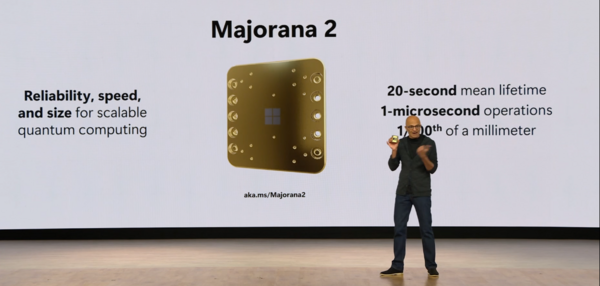
New materials and AI co-design speeds up roadmap
The technical story behind Majorana 2 revolves around materials innovation and using AI in design. Microsoft is moving from aluminum to lead as the superconductor, modifying the chip stack and using agentic AI to design and fabricate the devices.
Nayak said:
"We made some changes to the semiconductor stack to get larger spin orbit coupling and low disorder, and we replaced aluminum with lead. Lead is a much larger gap superconductor. This is very much driven by simulations and agentic AI, which enabled not only the development of the fabrication process."
Microsoft's bet was that new materials can boost performance. Now that wager is validated, Nayak said Microsoft is going to pursue similar improvements.
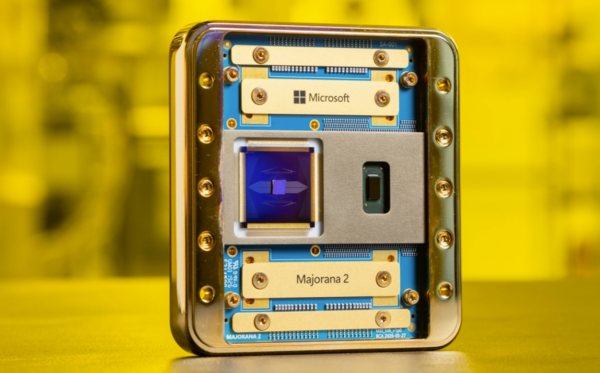
Nayak said the materials advance has sped up Microsoft's quantum roadmap. Microsoft is now targeting a utility-scale quantum computer in 2029 from 2033.
The vision for Microsoft revolves around packing more than 1 million qubits on a single chip. Microsoft is rejecting the modular multi-chip and multi-fridge architectures in favor of putting more than 1 million qubits on a single chip.
Microsoft is likely to deliver its quantum systems via Azure and a full-stack quantum ecosystem with agentic AI as the interface.
"We are not planning on a modular architecture where we spread out many of these chips into some kind of multi-chip module, or multiple chips spread across multiple dilution refrigerators. We're not going down that path," said Nayak.
Simply put, Microsoft is taking its shots with quantum computing. If the bet pays off, it will reap quantum computing rewards.
Constellation Research analyst Holger Mueller said:
“Right when you thought the quantum race is settled from a basic material basis, Microsoft comes along and shows a revolutionary level of error correction building a chip built on Indium Arsenide Lead tetrons. We will see if this move will spark new materials foundational research for quantum superconducting chips. Regardless all quantum roadmaps somehow lead to 2030 as they year for quantum superiority – and Microsoft is no exception here.”
Larry Dignan is Editor in Chief of Constellation Insights at Constellation Research, where he leads editorial coverage focused on enterprise technology, digital transformation, and emerging trends shaping the future of business. He oversees research-driven news, analysis, interviews, and event coverage designed to help technology buyers and vendors navigate complex markets with clarity and context. ...
Read morePublished
Author
