


Constellation Research's Futures Forum: What CEOs are thinking
AI has accelerated the rate of change for enterprises and CEOs and boards of directors need to keep up, lead and transform industries. Constellation Research brought together 120 public company CEOs and board members at its Futures Forum to empower the "responsible heretics" that will challenge the status quo.
The leaders at the Constellation Research's Futures Forum collectively oversee more than $500 billion in revenue. The three-day forum operated under Chatham House rules for many of the decision-makers and buy side.
Here are the takeaways from our inaugural class of senior leaders with significant impact and decision-making power as their companies grapple with unprecedented change. The goal is to navigate the next 5 to 10 years of disruption while also getting the pulse of CEOs right now.
The big picture
Constellation Research CEO R Ray Wang and Esteban Kolsky, chief distiller at Constellation Research, laid out the big challenges CEOs and boards are facing.
- Traditional incremental improvements are no longer sufficient. Markets are facing margin compression, and AI creates exponential advantages. Strategy and execution must collapse into one motion. "How many people feel like they're working 10 times harder but not going anywhere?" asked Wang. "This is what we call margin compression."
- There's no gap between strategy and execution. They've merged.
- Geopolitics directly shapes AI and business strategy. Once the global playbook is obsolete, companies need to adapt by region and move quarter-by quarter. "You may not care about geopolitics, but geopolitics cares about you," said David Bray, CEO of Stimson Center & LeadDoAdapt Ventures.
- This AI shift is comparable to the Industrial Revolution. Data is a commodity; value comes from infrastructure, platforms and organizational AI literacy. "You are living in the absolute best possible times for the last six generations," said Kolsky.
Here’s a look at the article stack from the Constellation Research Futures Forum:
- Workday CEO Bhusri on two-sided coin of agentic AI
- Boomi CEO on data movement, wrangling AI agents and SaaS
- ServiceNow's Tzitzon on AI's pace, teams and being multi-dimensional
- Cisco's Patel on space data centers, AI infrastructure and hiring young workers
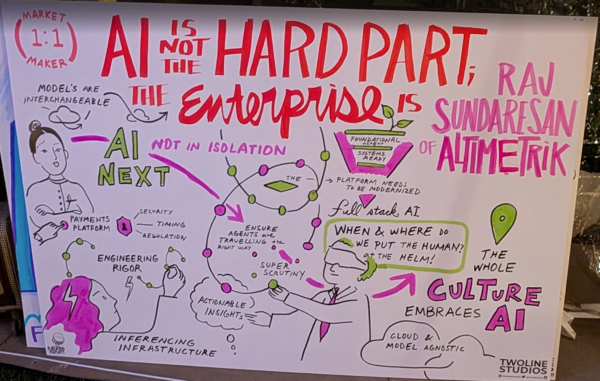
- AI doesn't replace engineering rigor, says Altimetrik CEO
CEO themes and insights
- Companies need to identify and empower "responsible heretics," or people willing to challenge legacy systems, sunk costs and sacred cows. It’s not enough to invite innovation in theory. You must give explicit permission (and a plan) to navigate stakeholder friction when sunsetting old systems.
- The main barrier to AI and transformation is often not the technology, but legacy processes, governance and budgeting cycles that span multiple years. Slow governance will be overtaken by faster competitors. If you have an AI committee you've already lost. Continually ask the following: Why do we exist? Are our processes, people, and talent still fit for purpose?
- Getting AI right is the most important job as CEO.
- Technical debt is a CEO problem now. "A lot of the things built in the past hold really critical information that they would like to expose to some of the LLMs or SLMs that they want to deploy in their business," said Thoughtworks CEO Mike Sutcliff. "But the architectures aren't really supporting that, so they've got a big technical debt issue to try and resolve."
- Tarkan Maner, President and Chief Commercial Officer at Nutanix, said that CEOs have to answer the AI question, but more pressing issues also include migrations from competitor VMware and others. "This Broadcom VMware migration is one of the biggest issues going to hit our industry in the next 20 to 24 months. And I don't think a lot of people are understanding this," said Maner. "This is going to create more opportunities for AI applications in the enterprise."
- Modern AI aligns to humans and natural language, so we should design systems that align to AI and human language, not to old software constraints.
- AI is framed as a utility and like electricity it should be everywhere, not a side project. Every system running a company needs AI integrated so you can create an enterprise brain that compounds intelligence over time.
- Focus on the business not the technology. One CEO noted that an early AI program revolved around debating software and data choices and not enough on business applications. The result was cool but misaligned use case. These projects have had less impact than expected.
- Explore dual use technologies and how they apply to your industry.
- Just saying AI is important from the top is not enough; if leaders don’t truly understand AI, they can’t credibly answer follow-up questions or set direction.
- Training matters. In some AI projects experts push ideas into the business. After training every employee on AI, business units now pull from AI teams to leverage new ideas.
- It's easier to use AI to cut costs and revamp processes than to redesign products, change business models and drive top-line revenue growth. One CEO said by 2028, his company will need to reset the mix of benefits to focus on growth not expense reduction.
- Hiring requires a different approach. Junior hires are still happening, but the profile is shifting. Pure analytical horsepower from a candidate is now less important than curiosity, open mindedness, emotional intelligence and willingness to experiment. Think interdisciplinary. Cognizant CEO Ravi Kumar noted that expertise is at your fingertips and commoditized. Interdisciplinary skills will matter. "If you're a biology major, you need computing skills to be differentiated. If you're a history major, you should put computational skills with history," said Kumar. "Sit at the intersection of a domain and technology."
- The future of applications will feature an AI‑driven observability layer that aggregates dozens of data domains (ops, financials, HR, board minutes, markets) into a conversational system that can answer, synthesize, recommend, and act (emails, docs, calendar).
Boards of directors’ themes and insights
- Boards often make the mistake of saying, "Do AI" rather than defining clear business outcomes. Boards should articulate the outcomes (efficiency, resilience, growth, new capabilities) and let management determine whether AI (and which kind) is the right approach.
- Board members need to resist executive leadership teams that “pitch” them. The best use for a well-run board is to shore up weaknesses. Boards would rather hear the weak spots so they can help with their experience and network.
- There is a knowledge gap at board level on AI, driving CEOs to take direct control. Companies must decide their core competencies and either double down or fully vertically integrate.
- When board members face a knowledge gap, they can slow down the company with handwringing.
- Knowledge gaps at the board level can be bridged with interactions between official meetings and potentially training.
- Enterprises often hold AI to a higher standard than people when it comes to mistakes. Clear guidance from the board on acceptable AI risk is essential.
- Board members are frequently bogged down with regulatory issues, compliance and risk management instead of focusing on broader strategic moves.
Manufacturing CEO themes and insights
Three CEOs from manufacturing talked about automation, AI and whether there's a US factory renaissance. Manufacturing insights include:
- The biggest constraints on US manufacturing resurgence are skills, legacy infrastructure, and the difficulty of adopting new technology fast enough.
- Lack of skilled labor for advanced equipment and processes is a bottleneck and existing education and training infrastructure isn't ready.
- Factories in the US are old and frankly being lapped by China. The US response typically revolves around arguments China is cheating, but it makes more sense to keep an open mind and learn from them.
- China has built long-term manufacturing "fitness" and is outpacing the US both in conventional manufacturing and now in AI-enhanced manufacturing.
- AI is being used to unify siloed systems and context across the manufacturing lifecycle. Owning the AI stack and context, not just the agents, is viewed as critical. AI can be used as a unifying context-driven layer.
- Expect more capital and more holistic AI-enabled factories, but progress depends on addressing the labor and skills challenge.
- Manufacturing success is a long game that requires learning and iterating not one-off efforts.
Supply chain CEO themes and insights
- Supply chain executives have become accustomed to constant shocks (tariffs, wars, pandemics) and now plan around volatility rather than trying to avoid it.
- Supply chains are shifting from pure just-in-time toward hybrid or just-in-case models, driven by COVID, tariffs, geopolitical risk, and chip shortages. Digital twins, universal BOMs and scanning tech are key to agility.
- Just-in-case models and local stockpiles are a response to supply chain fragility. However, geopolitics requires stockpiling.
- The market is trying to return to just-in-time supply chains, but there's risk. As a result, enterprises are deploying component-specific strategies to cover semiconductors. One CEO noted that just-in-time doesn't apply to chips.
- Over‑the‑road transportation has been in a prolonged downturn; fuel price spikes and excess capacity are squeezing small fleets and owner‑operators, while larger fleets can pass on costs.
- AI is being used in the supply chain to: (1) manage risk (credit, fraud, fuel exposure), (2) accelerate product development, and (3) optimize capital deployment and asset selection.
Energy CEO themes and insights
- For the first time in decades, electricity supply and grid capacity are a real constraint on growth. This constraint hits AI and data centers especially hard.
- The grid is still architected as a centralized, one-way system that looks like Edison’s original design, which is fundamentally at odds with how digital and AI systems evolve.
- A decentralized approach to the grid will help. Turning homes, campuses and facilities into intelligent nodes that produce, store, and flexibly consume energy can relieve pressure on the grid.
- Economics need to change for industrial loads. For industrial and data-center-like loads, the bill isn’t just about kWh; peak demand charges heavily penalize spiky AI workloads.
- Upgrading grids with the same old components is a wasted opportunity; the grid must become a software-defined, semiconductor-enabled, bidirectional and quality-aware system.
- Microgrids, which combine on-site generation and storage, are emerging as a practical way to bypass grid bottlenecks and replace legacy diesel backup.
- Companies need to be strategic about energy. Companies need to control energy costs and capacity via on-site storage, microgrids and intelligent power electronics rather than passively accepting utility bills.
Robotics CEO themes and insights
- Robotics isn’t one thing; it spans mature factory arms, widely deployed autonomous mobile robots (AMRs), and frontier humanoid/physical AI that is not yet ready for production.
- AMRs are deployed at scale in multiple industries and are economically compelling for repetitive, predictable tasks.
- The core value proposition is offloading dirty, dull, and dangerous tasks from humans to robots.
- Hardware is constrained by physics but software and AI are advancing quickly. Sensors are strong and improving, but actuators, tactile manipulation, and especially batteries are major bottlenecks compared with the rapid advance of AI brains.
- Simulation-to-real is advancing quickly (especially with Nvidia tooling), but robotics lacks the massive data scale that made LLMs so effective.
- Policy is the bottleneck. The technology is effectively “ready enough” to deploy, but standards, safety, and policy need to catch up.
Healthcare CEO takeaways and insights
- Healthcare is the largest and one of the most dysfunctional sectors in the U.S. economy, making it both a prime and a risky domain for AI.
- While technologists are bullish about AI, the public and governments are highly skeptical, especially around AI making diagnoses and coverage decisions.
- AI can predict clinical problems in advance, opening a new frontier of anticipatory medicine but only if data and training sets are balanced.
- AI is already alleviating documentation burden for clinicians and could expand care capacity, but healthcare remains fundamentally human.
- On the adoption curve, the biggest traction so far is with AI scribes; the next phase is AI actively nudging clinicians.
- Regulators can’t keep up with how quickly patients are self-applying general AI tools like ChatGPT to their own healthcare questions.
- AI has strong potential in mental health such as cognitive behavioral therapy, but U.S. payment models, not technology, are the main barrier.
Financial services CEO takeaways and insights
- CEOs in financial services recognize that the next chapter of money is digital and programmable money.
- Blockchain and the Genius Act will reshape how they operate.
- Legacy players in the financial sector have defensible advantages versus fintech startups due to trusted brands, deep regulatory integration and massive operational scale. Money movement is tied to virtually every serious crime, so regulatory capability is a moat.
- Stablecoins are seen as a growth vector for legacy banks and money movement enterprises. CEOs were bullish on blockchain infrastructure (especially stable coins and lighter chains) but skeptical of volatile assets like Bitcoin as a payment medium.
- AI can deliver measurable productivity gains by automating repetitive compliance tasks, allowing employees to better to serve clients.
- AI is critical for fraud detection, cybersecurity, and operational risk control in financial services.
Larry Dignan is Editor in Chief of Constellation Insights at Constellation Research, where he leads editorial coverage focused on enterprise technology, digital transformation, and emerging trends shaping the future of business. He oversees research-driven news, analysis, interviews, and event coverage designed to help technology buyers and vendors navigate complex markets with clarity and context. ...
Read morePublished
Author
