


AI Forum 2026: There isn’t an easy button for AI
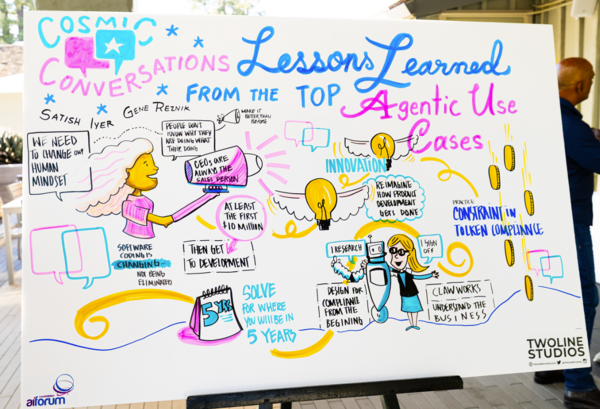
There isn’t an easy button for agentic AI and enterprises will need more discipline to implement it, not less. The difference between AI transformation and real returns is dependent on whether you do all the hard stuff such as process optimization, change management, workflows and architecture right.
In the meantime, we're going to see some great experimentation and potential trainwrecks with OpenClaw, AI agents that run amok and billions of dollars spent chasing that AI easy button.
The myth of the AI easy button is top down in the tech industry. To hit AI nirvana, all you have to do is spend $100 billion on an AI factory that depreciates after a year, generate tokens that miraculously turn to revenue and watch the magic happen. Simple right? Enterprises will then chase whatever agentic AI and digital labor fad promises utopia. It's OpenClaw today (or any of its derivatives) and whatever Claude feature from Anthropic blows up the SaaS market (again). And tomorrow, who knows?
AI will surely create winners and losers, but my bet is that the companies that can execute and do the hard stuff with discipline will win. The rest of the field will merely deliver exponential growth in token budgets with little to show for it.

Constellation Research's Futures Forum and AI Forum were illuminating. We've covered the takeaways from the Futures Forum and discussion that ensued among CEOs. This latest riff on the hard work of AI was inspired by a LinkedIn post from Gurvinder Sahni, CMO of Altimetrik.
At AI Forum, the CxOs that are tasked with executing plans from the CEOs at Future Forum had their say. Here's a look at the takeaways from AI Forum on the hard stuff.
Context, orchestration and architecture are the bottlenecks for AI and agents not just models.
Enterprises need to focus on the business logic and deterministic workflows more than non-deterministic agents that'll allegedly just figure it out.
For orchestration, the prerequisites are safe, governed and observable orchestration. LittleHorse Enterprises Founder Colt McNealy said orchestration shouldn't be based on a "YOLO" approach. "The only reason you give agents that much room to run is because you don't have the proper infrastructure to run automation on your own," said McNealy. "In a couple of years, we'll be seeing people get their affairs in order to fix YOLO security."
The AI control plane needs to be infused with context that can improve agent accuracy and enable them to scale.
See: AI Forum 2026: "There are claws everywhere now" | LittleHorse’s McNealy on Business-as-Code, AI agents, orchestration
All of the hard work enterprises have been avoiding such as collapsing data silos, access control and murky process maps are haunting companies in the AI era.
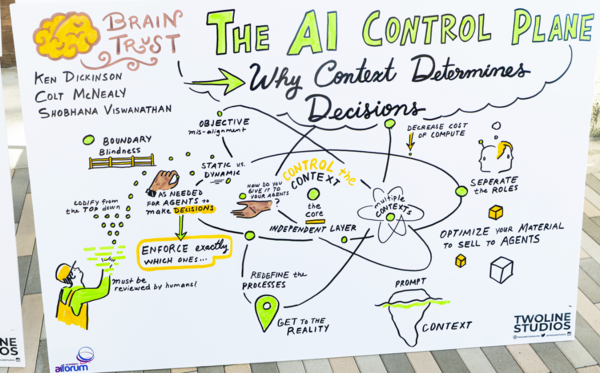
"To have a successful agentic solution, you need to understand the overlying rule set, which is your actual context, so that you can make the correct decisions," said Ken Dickinson, VP of Software Engineering for Jewelers’ Mutual.
To sum up. Your agentic architecture needs:
- Clear business workflows.
- A strong orchestration layer.
- Narrow decision surfaces instead of open-ended agent autonomy.
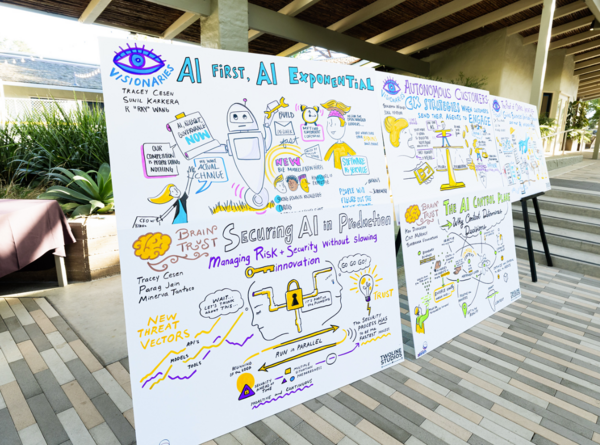
Enterprise AI in production revolves around security, guardrails and proof of control.
Multiple panels stressed security and risk procedures from day one not as an afterthought.
That means:
- Weekly "what could go wrong?" reviews.
- Security practices with continuous monitoring.
- Accountability.
- And proof of control. One session at AI Forum proposed proof of control as an emerging standard.
Proof of control standards, an emerging field, are framed by deterministic controls on non-deterministic AI and cryptographic independently verifiable proofs that systems behaved as intended. Michelle Dennedy, CEO of Stealthy Privacy and Partner of Privatus.Online, said:
"I'm looking at the agentic world today. If you have something of value, you have to know what it is. You have to know what its boundaries are, and you have to know how to demarcate and have some accountability and agency so that you can turn what is potentially an asset and prevent it from sliding into being a liability."
Digital labor will disrupt business models.
The narrative for digital labor is appealing for companies due to cost savings. Humans are simply more expensive. However, business models will need to be redesigned as agentic AI labor grows. That means the following:
- Compliance and oversight of AI agents will be required.
- Standardized management, identity and security will be needed for fleets of AI agents.
- Orchestration of work will be critical.
- Where do you keep humans in the loop?
- What are the new models for management and skills required to delegate to AI agents?
See: Thoughtworks data, AI chief Mohanty on how agentic AI will change leadership | Scenes from two AI-native services firms
Digital labor is also moving from experiment to operating model. The economics of digital labor revolve around revenue per employee and outcomes and require new organizational designs.
Data is still your biggest problem.
At AI Forum, there wasn't one AI discussion that didn't include data quality and governance.
See: CX strategies for agentic AI | Actian CEO Potter: AI driving a data governance renaissance
AI is forcing CxOs to get their data act together. CxOs need to:
- Understand data lineage, ownership and context.
- Discover, tag and map critical data before scaling AI.
- And take on a data as product approach that features clear consumers and contracts.
- Data-in-motion is the norm over dashboards.
- If the data strategy isn't right, you're just going to automate and scale bad processes.
Who is leading AI and the organizational change that goes with it?
Like Futures Forum, AI Forum attendees seemed to agree that the CEO's neck was on the line if the AI strategy wasn't right. The actual work in the trenches will belong to others.
Execution will depend on chief information officers, chief AI officers and dozens of business domain experts. New leadership skills will be required. Key points:
- Curiosity was frequently cited as an underrated leadership trait.
- CxOs in place today will be the last to manage all-human workforces. Leaders will need to manage human and digital workforces, rebalance roles and think through governance.
- Enterprises will need to invest in training, domain expertise and design thinking to get value.
Anil Cheriyan, Board Member at the Center for Astrophysics | Harvard & Smithsonian, said he has five questions when it comes to AI leadership.
"The questions that I ask whenever we're talking about AI is 1) what is the real business value that you're going to generate? 2) how are you managing risk, risk and governance? 3) Do you have the talent? What's AI going to do to the talent? What's it going to do for the human AI interface? 4) Do you have the data? 5) Do you have the money to do what you need to do?"
Cheriyan added: "All of those five tings require pretty much everyone in the business to manage. You need the chief businesspeople to drive value. You need the risk folks to drive governance. You need the coordination piece."
On a panel about AI accountability, Minerva Tantoco, CEO of City Strategies LLC, summed it up: "I'd like to see what each of the C-suite thinks they can do today that they could not have done two years ago. Then give me their vision for what they like to do with the new capabilities."
Larry Dignan is Editor in Chief of Constellation Insights at Constellation Research, where he leads editorial coverage focused on enterprise technology, digital transformation, and emerging trends shaping the future of business. He oversees research-driven news, analysis, interviews, and event coverage designed to help technology buyers and vendors navigate complex markets with clarity and context. ...
Read morePublished
Author
