


Salesforce's Agentic Work Unit: What you need to know
Salesforce has a new metric--Agentic Work Unit (AWU). The big question is whether enterprises will adopt it.
An AWU is one discrete task accomplished by an AI agent. These tasks can include decisions made, records updated and workflows triggered.
Salesforce pointed to its token consumption to highlight that it's AI savvy and customers are leveraging Agentforce. An AWU is a step beyond tokens and is designed to highlight the work actually being done.
"A token on its own doesn't know your customers, your pipeline, your org chart, but Salesforce does. And the value isn't in the token. The value is in what our platform does with it, the work," said Salesforce CEO Marc Benioff. "To date, AI agents on the Salesforce platform delivered 2.4 billion Agentic Work Units. That is where AI isn't just thinking or calling things, it's getting work done, work done, transactions."
In the fourth quarter, Salesforce delivered 771 million AWUs. "We're still trying to figure out exactly what these numbers mean for us. But what it means for me is that we are doing what we say. That is, we are explaining that humans and agents are working together," said Benioff. "We are showing you a business at scale, running them. We are showing them how we are making our business better."
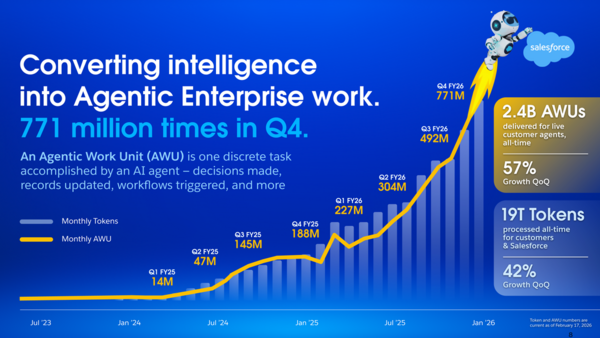
Later on, Patrick Stokes, President and CMO at Salesforce, outlined the following details about AWUs.
- AWUs are designed to look at how Salesforce consumes tokens from model providers and optimizes for intelligence. For instance, VentureBeat outlined how AT&T had to rethink its AI orchestration after it was consuming 8 billion tokens a day. It optimized with small models.
- The metric enables customers and Salesforce to optimize for token costs. "When we started looking at that across our customers, we see our top 10 customers are consuming this many tokens. We know how many tokens Salesforce is consuming internally. But it begs the question are they doing anything? Are they working? Are they providing any value? Or is it just input and output of intelligence? So, you can ask it a question, it can write you a poem, but that's not really all that valuable in the enterprise world," said Stokes.
- There's a relationship between tokens and AWUs and the ratio between the two matters. "That ratio starts to become really interesting because now we can look at our customers and say, 'Hey, Customer A, you have a really nice ratio. You're getting a lot of work done on the platform for the amount of tokens that you're consuming. And hey, Customer B, your relationship is actually not so good. You're consuming a ton of tokens and not getting a lot of work done, what can we do to help you?'"
- AWUs give Salesforce a touch point for ongoing customer dialogue because the metric helps the company show where the value is.
Robin Washington, President, Chief Operating & Financial Officer at Salesforce, said AWUs are being used internally. She said Salesforce is working with various partners to bring token prices down. AWUs is a vehicle to show Salesforce where value is being delivered so it can optimize.
As Salesforce executives were talking, Nvidia CEO Jensen Huang was giving a sermon on token-nomics. The general idea is that the more enterprises spend on AI infrastructure, the more tokens can be generated and tokens equate to revenue.
"We have now seen the inflection of agentic AI and the usefulness of agents across the world and enterprises everywhere. You're seeing incredible compute demand because of it. In this new world of AI, compute is revenues. Without compute, there's no way to generate tokens. Without tokens, there's no way to grow revenues. So, in this new world of AI, compute equals revenues," said Huang.
He cited Anthropic, OpenAI and cloud hyperscalers as examples. Here's the problem. AI inference means more tokens. However, you can't draw the line today between tokens and revenue beyond a handful of companies. It's also possible that tokens are a sign of inefficiency. Just because a token is generated doesn't mean there's return on investment.
Huang said "tokens" 26 times on Nvidia's earnings call for good reason: It benefits from the capital expenditures aimed at AI infrastructure chasing tokenomics.
For now, I'll take Salesforce's AWU metric as a great start for more discussion and hopefully a standard of some sort. Token talk benefits few and simply equates to more waste for most enterprises. The sooner we can measure real outcomes the better.
Larry Dignan is Editor in Chief of Constellation Insights at Constellation Research, where he leads editorial coverage focused on enterprise technology, digital transformation, and emerging trends shaping the future of business. He oversees research-driven news, analysis, interviews, and event coverage designed to help technology buyers and vendors navigate complex markets with clarity and context. ...
Read morePublished
Author
