


OpenAI launches OpenAI Frontier, aims to be AI agent orchestrator
OpenAI launched OpenAI Frontier, a platform to enable enterprises to build, deploy and manage AI agents, and cited flagship customers including HP, Intuit, Oracle, Uber and State Farm.
By itself, OpenAI Frontier is yet another agent builder and control tower tool. In the context of what has happened to SaaS companies and their stocks of late, OpenAI Frontier is more significant. OpenAI said that customers such as T-Mobile and Cisco have piloted the software.
For OpenAI, Frontier is critical. The company has to move up the enterprise stack beyond just LLMs. In a nod to that reality, OpenAI said the pressure for enterprises to leverage AI and boost returns is increasing. "What’s slowing them down isn’t model intelligence, it’s how agents are built and run in their organizations," said OpenAI.
- OpenAI's Altman on fully AI companies, open source, infrastructure
- OpenAI’s 2026 focus on practical AI points to enterprise
- OpenAI's CEO of Applications pens intro missive: 5 takeaways
- OpenAI touts enterprise mojo with 1 million business customers
- OpenAI sets SDKs for app integrations, agentic AI building blocks
That agentic AI orchestration is being targeted by multiple firms including Salesforce, ServiceNow and a host of others. Few enterprise software vendors lack an agent builder offering. OpenAI’s plan to AI agent orchestration is co-opetition. See: ServiceNow expands OpenAI partnership | Salesforce expands OpenAI, Anthropic partnerships, eyes Agentforce everywhere
According to OpenAI, Frontier, which is available to a limited set of customers, will include shared context, on-boarding, governance and security. "We've learned that teams don't just need better tools that solve pieces of the puzzle. They needed help getting agents into production with an end-to-end approach to build, deploy, and manage agents," said OpenAI.
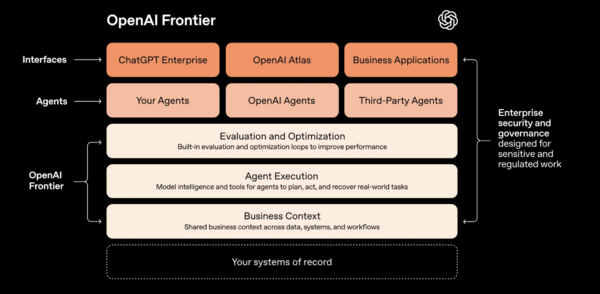
OpenAI's pitch for Frontier rhymes with other efforts, say ServiceNow's AI Control Tower. Frontier will connect and work with existing systems, tap into data and AI where it lives, leverage open standards and create context. "AI coworkers are accessible and useful through any interface, not trapped behind a single UI or application," said OpenAI, which noted Frontier can work with third party and custom AI agents too.
Frontier includes the following:
- Connectors to various systems including data warehouses, CRM, ERP, ticketing and internal applications to create a semantic layer for context.
- Enterprise teams can "hire AI coworkers" for tasks people do on computers. AI coworkers build memory to improve context and performance.
- OpenAI agents within Frontier can run locally, in the cloud or OpenAI-hosted runtimes. Frontier prioritizes low latency access to OpenAI models.
- Frontier provides built-in tools to evaluate and optimize performance.
- Security and governance built in for use in regulated industries.
- OpenAI Forward Deployed Engineers (FDEs) to help build and run agents in production and develop best practices. See: Forward deployed engineers: The promise, peril in AI deployments
- A small set of AI-first services firms including Abridge, Clay, Ambience?, Decagon?, Harvey? and Sierra? to deploy Frontier. See: Constellation Research's AI-First Service Firms
My take:
- Props to OpenAI for not calling Frontier “Agent Builder.”
- OpenAI Frontier will be part of a larger application portfolio that’ll need to appeal to enterprises.
- CIOs face a sprawl of orchestrators and most of them sound the same. Anthropic will have its own version in 3, 2, 1. See: Constellation ShortList™ Cross-Platform Agentic AI
- OpenAI may have some traction with Frontier in that enterprises may want to avoid SaaS platform lock-in.
- The competition with Google Cloud’s Gemini Enterprise, Microsoft Azure and AWS’ Amazon AgentCore will be fascinating. The hyperscalers simply look more neutral. You can toss ServiceNow into that mix too.
Related:
Larry Dignan is Editor in Chief of Constellation Insights at Constellation Research, where he leads editorial coverage focused on enterprise technology, digital transformation, and emerging trends shaping the future of business. He oversees research-driven news, analysis, interviews, and event coverage designed to help technology buyers and vendors navigate complex markets with clarity and context. ...
Read morePublished
Author
