


Anthropic vs. SaaS: A nuanced view
Anthropic is a) a SaaS killer; b) a disruptor of multiple industries with its Claude large language model and the agentic apps built around it; c) an ingredient brand for enterprise software; d) Already part of the enterprise technology establishment via a well-worn SaaS playbook; e) all of the above.
The correct answer would be "e" as multiple things about Anthropic can be true at the same time. Anthropic has been portrayed as a SaaS assassin. Anthropic launches connectors and plugins to various enterprise apps and SaaS stocks tank. Anthropic doubles down on Claude Code and Cowork and suddenly we're all expected to generate ERP, HCM and ERP systems on the fly. Anthropic rolls out security code checks and cybersecurity stocks stumble. Anthropic talks about modernizing COBOL and IBM shares collapse.
By next week, Anthropic will be making us dinner and collapsing restaurant shares, brewing beer on the fly and building houses via robots that run Claude as their brain.
- Anthropic expands Cowork plugins across enterprise functions
- SaaS under the microscope: How to evaluate your vendor
- Anthropic launches Claude Sonnet 4.6 with computer use upgrades
- Anthropic's Claude Code revenue doubled since Jan. 1
Simply put, we're nearing peak Anthropic hype if we're not there already. What's lost in all of these storylines is the nuance. After all, nuance isn't as much fun. Here's a nuanced view of Anthropic because multiple things are true about the LLM giant at the same time.
Anthropic isn't killing SaaS.
What?!? Of course, Anthropic is killing SaaS, fat margins and the existing state of enterprise software. Do we know how Anthropic will affect enterprise software? No. That's why SaaS stocks are a hard sell. There's a lot of uncertainty ahead.
Not surprisingly, SaaS CEOs have made their cases. Speaking on Workday's fourth quarter earnings call, CEO Aneel Bhusri said:
"You've all heard the narrative out there that HR and ERP will be replaced or relegated to the background by AI. I personally just don't see that happening. Our application domains are really, really hard to build. I've been working in the HR and ERP space for over 30 years. These are true systems of record that must process transactions with absolute accuracy and speed, enforce complex security models and comply with statutory and regulatory requirements all over the world. That kind of complexity is very hard to replicate. No amount of vibe coding is going to produce an HR or an ERP system."
Bhusri's argument is that business processes are deterministic and AI is probabilistic. The win is to marry AI and enterprise apps to redefine user experience, improve business processes by melding humans and AI agents and drive insights.
If anything, Anthropic's Claude could become the interface and door to enterprise applications and systems of record. The issue here is that SaaS vendors are often using Anthropic as an ingredient brand to retool their platforms. In that world, Anthropic is more of a SaaS enabler than killer.
Here’s a look at where Claude is being used.
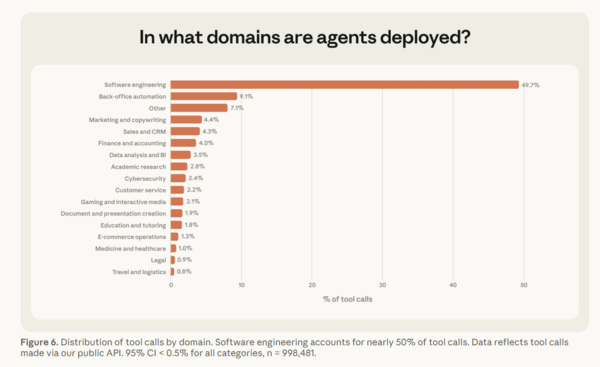
Anthropic is an ingredient brand.
The number of enterprise software companies working with Anthropic is vast. At a recent enterprise agent event where Anthropic announced new features and industry extensions for Claude Cowork, executives touted partnerships with SaaS vendors and outlined how models are embedded in the background.
Anthropic launched Model Context Protocol (MCP), quickly stood up an industry standard and now serves as the glue of agentic AI.
In addition, Claude is available on all three large hyperscalers. Simply put, Anthropic is everywhere. Ingredient brands generally don't destroy the partners that are embedding them.
Salesforce CEO Marc Benioff went with the apps, agents and models are better together theme. Benioff said Salesforce’s Agentforce platform uses multiple LLMs including Anthropic as part of the architecture. Now it’s possible that these LLM players develop platforms, but today these vendor are more of an ingredient.
“Our job, as a software company, is to help our customers to create success and to take that and help them connect with their customers in a whole new way,” said Benioff. “We'll deliver our products, our capabilities, our value proposition with our customer relationships. The current reality is about humans and agents working together. Our job is to take what's available today and make it successful.”
The list of SaaS vendors that count Anthropic as an ingredient includes ServiceNow, Salesforce, Snowflake, IBM, Docusign, Microsoft, Palantir, Intuit and a host of others.
Anthropic is a SaaS company.
Anthropic has followed and executed the SaaS playbook better than most SaaS companies. Consider:
- Much of Anthropic's revenue is recurring via seats and subscriptions.
- The company has rapidly expanded its partner network for sales throughput.
- Anthropic has systematically expanded beyond software development to financial services and healthcare.
- The company has hired executives that are experienced in building out ecosystems and broader platforms.
- Anthropic is a friend and foe for SaaS partners. One thing is clear: Anthropic's playbook rhymes with both SaaS friends and foes.
One nuance is that Anthropic's business model relies on API connections and consumption. The model isn't per user, but more per outcome and per token.
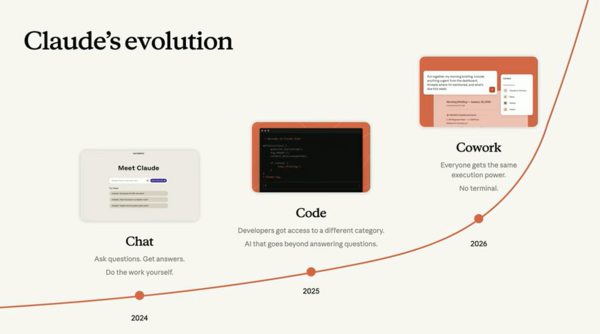
Anthropic is a friend and foe (depending on the use case).
Anthropic is both a friend and foe to SaaS and that nuance is often lost in play-by-play news and analysis. Consider:
- Integration: Claude is a friend to SaaS because it serves as a natural language layer for data. Anthropic is a foe because Claude Cowork allows users to bypass SaaS interfaces and lower seat counts.
- Ecosystem: Anthropic needs SaaS data to ground its reasoning so it's friendly with the enterprise software ecosystem. However, Anthropic's MCP standard makes it easier to bypass SaaS vendors.
- Innovation: Salesforce was cited as a key customer by Anthropic, which is used to enable Agentforce. However, Anthropic's specialized plugins for legal and HR could be used to take SaaS market share.
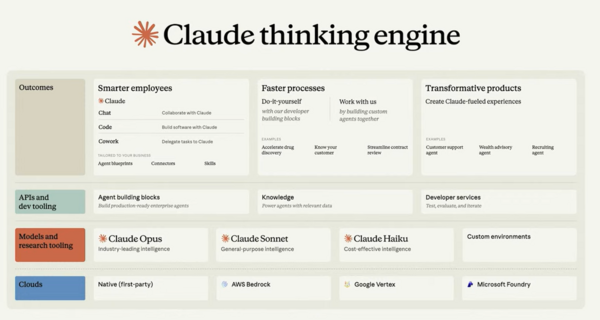
Anthropic is playing for the thinking engine layer of the emerging AI stack. Sometimes that thinking engine approach will make SaaS vendors better. Going forward, using Claude as a thinking engine can commoditize SaaS.
Anthropic's launch of new Cowork updates featured customers including Steve Hasker, CEO of Thomson Reuters, Sridhar Masam, CTO of NYSE, and Seth Hain, SVP of R&D for Epic. What's interesting about that customer panel is that Anthropic is an enterprise ingredient brand to those companies yet also viewed as a rival to something like Thomson Reuters Co-Counsel.
Key themes from the customer panel.
- Claude is being integrated internally. Masam said the NYSE has been using Claude Code to rewire "our engineering process with coding, writing tests, legacy codebases, refactoring documentation."
- Masam added that the NYSE has also built internal AI agents based on Claude. "Claude models are particularly effective in processing large documents and applying roles," said Masam, who noted that the NYSE has built new AI-driven workflows for proxy filing, auditing, SEC filings and news classification.
- Technology is outpacing change management. Hasker said AI developments are moving faster than change management. "A general counsel's office, a law firm, a tax accounting firm or an audit firm needs to rewire the processes to be able to take advantage of the benefits that the tools provide," said Hasker. "And I think that work is ongoing, but I think it's 18 months away before that sort of change management catches up with the standard of the tool."
- Claude can drive ideas from the bottom up. Epic's Hain said AI has shifted from being more assistive to becoming more of a collaborator. "As we're shifting into 2026 particularly with Claude 4.6 and Claude Code, they're able to do code exploration, compose and have a draft of their support ticket and their response right out of the gate. Giving tools where employees can create on their own is a real way to open up opportunities," said Hain.
- Trust is critical. Hasker said that Co-Counsel has more than 1 million users and trust is a big reason. Anthropic's tools leave an audit trail, which is a big feature for regulated industries.
Where Anthropic is really headed.
Anthropic operates like an enterprise software company but has characteristics of an ingredient brand. Anthropic doesn't own the system of record but wants to own the reasoning and orchestration layer that sits across systems.
Given that Anthropic is on all the cloud hyperscaler platforms, has deep integrator partnerships and is developing its own enterprise surfaces the company has the heft to pivot. It can be very disruptive yet also behave like enterprise software establishment.
In the end, Anthropic is going to help systems-of-record providers yet take away their user interfaces and potentially commoditize them. Anthropic will be a foe to providers that are workflow players over other systems and use case specific vendors.
Ultimately, Anthropic is likely to be an ingredient brand that has expanding enterprise SaaS ambitions and doesn't fit into a neat category. In the future, Anthropic likely becomes a platform.
Larry Dignan is Editor in Chief of Constellation Insights at Constellation Research, where he leads editorial coverage focused on enterprise technology, digital transformation, and emerging trends shaping the future of business. He oversees research-driven news, analysis, interviews, and event coverage designed to help technology buyers and vendors navigate complex markets with clarity and context. ...
Read morePublished
Author
