


Meta feels the AI squeeze in Q2
Meta's second quarter was mixed at best, the company's debt load surged and free cash flow tanked.
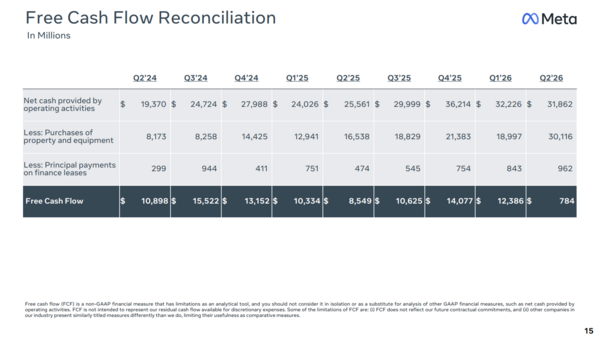
CEO Mark Zuckerberg said AI is driving the core business, but the numbers reveal some strain. Free cash flow of $784 million is pretty good for most companies, but Meta's free cash flow was north of $12 billion in the third quarter.
Meta reported second quarter earnings of $15.85 billion, or $6.18 a share, on revenue of $60.8 billion, up 28% from a year ago.
Wall Street was looking for non-GAAP earnings of $7.40 a share on revenue of $60.3 billion.
As for the outlook, Meta projected third quarter revenue of $61 billion to $64 billion. The company said it took a charge of $2.4 billion in the second quarter and that will raise 2026 expenses to $165 billion to $169 billion.
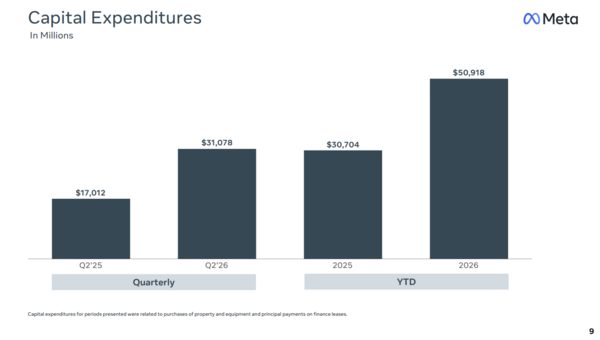
Meta said 2026 capital expenditures will be between $130 billion to $145 billion, up from the outlook of $125 billion to $145 billion.
In addition, Meta's long-term debt in the second quarter stood at $83.66 billion, up from $58.74 billion a year ago.
On an earnings call, Meta CEO Mark Zuckerberg did his best to show value from the company's AI spending. He said:
- "We are developing new personal agents that will be the foundation for our next wave of products and revenue lines in the months and years ahead."
- "We see a large enterprise opportunity to sell to businesses, including APIs, business agents, potentially selling compute directly and other services that we're building for large customers."
- "On a dollar basis, our ads business is reporting faster year-over-year revenue growth than any other company's reported ad business. So these AI investments are paying off. We are also seeing a lot of demand for our new AI-powered creative tools. Nine million small businesses on our platforms are now using at least one of our AI ad creative tools, and we're rolling out new end-to-end creative solutions that help advertisers translate performance data into their creative decisions."
- "As we move towards a future where we're all interacting with multiple agents, I think that WhatsApp and our other messaging surfaces are going to become increasingly important. WhatsApp is already the leading surface where people engage with Meta AI. And as we build out a platform for more agents across our messaging apps, we're going to innovate on how to deliver a private and secure AI experience."
Larry Dignan is Editor in Chief of Constellation Insights at Constellation Research, where he leads editorial coverage focused on enterprise technology, digital transformation, and emerging trends shaping the future of business. He oversees research-driven news, analysis, interviews, and event coverage designed to help technology buyers and vendors navigate complex markets with clarity and context. ...
Read morePublished
Author
