


Enterprise vendor pecking order will be upended by volatility, AI inflection points
IBM's second quarter clunker shouldn't be viewed in a vacuum even though some of the disappointing results are due to self-inflicted wounds. IBM is just the canary in the vendor coal mine as AI inflection points abound.
Simply put, IT budgets are becoming more dynamic and will likely adjust assumptions based on operational data, market conditions and various trends. Annual budgets are out. Monthly and quarterly pivots are in. And IBM is just the start.
IBM noted a pivot toward cybersecurity that you can credit to the Mythos moment and customers focusing on servers storage and memory. What caught Big Blue off guard wasn't necessarily the shifts in enterprise spending but the speed. It didn't help that IBM simply didn't have stuff to sell in the areas that benefited from the shifts.
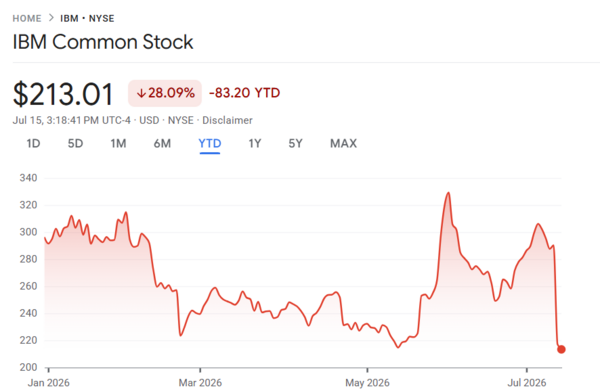
Arvind Krishna, CEO of IBM, said in a shareholder letter that the second quarter shifted in the last two weeks of June. “In the last few weeks of June, we saw clients shift their quarterly capex spend toward servers, storage, and memory purchases to secure supply-constrained infrastructure ahead of expected price increases. This dynamic impacted client buying patterns. While we anticipated some supply chain related impact in our expectations, we did not anticipate the magnitude of the capex reprioritization. In addition, clients were distracted with rapidly evolving, industry-wide cybersecurity concerns in the quarter,” said Krishna.
Nevertheless, every technology vendor earnings call will be colored by IBM’s disclosure.
Here's what's going on:
- IT budgets cannot operate on annual cycles anymore because AI is developing too quickly.
- Budgets will be volatile based on trends and developments. Three months ago, we were talking about tokenmaxxing. Tokenomics quickly wound up in the trash heap. Cybersecurity was the cost of doing business before Anthropic's Mythos moment and now matters more. SaaS was out. Then kinda in. And now it looks like SaaS is out again. Anthropic was thought to be a SaaS killer, but then enterprises revolted over costs and are looking for open model options.
- Enterprises want to control their own architecture fates. Hybrid stacks will rule because you can't run all of your AI inference in the cloud.
- Companies are playing catch up on distributed infrastructure because they are woefully underinvested.
- Volatility will be the norm.
- Vendor moats will disappear.
These enterprise technology crosscurrents have been building up for a while and we’ve touched on a few of them.
- Here’s what we learned about AI projects from enterprise buyers so far
- Don't let your vendor's AI strategy become yours
- What if our AI infrastructure is already built?
- How to avoid vendor lock-in in the AI age
- AI inference costs are going to be a big concern: What's the fix?
- SaaS under the microscope: How to evaluate your vendor
Where are we headed now? Here are some possibilities.
- Enterprises will focus on architecture that is vendor agnostic. As a result, the vendor stack will be focused on ‘what have you done for me lately?’
- Your stack will be a private platform ruled by the enterprise.
- Investment in infrastructure will be the linchpin in integrating the various platforms you've accumulated.
- Enterprises will be more inclined to build over buy with an assist from Anthropic Claude and OpenAI Codex.
- Workloads will go to the cloud as well as on-premises and edge based on costs and governance. Think distributed approaches.
- Vendors will lose leverage. The vendor A vs. vendor B storyline won't hold. Every vendor moat is fragile. What happens to vendor relations when you have the wiggle room to dump them?
What's the timing for this new enterprise technology new world order? Your guess is as good as mine, but don't be surprised if this paradigm shift happens faster than you'd think.
For more on these shifts see Esteban Kolsky’s series:
Larry Dignan is Editor in Chief of Constellation Insights at Constellation Research, where he leads editorial coverage focused on enterprise technology, digital transformation, and emerging trends shaping the future of business. He oversees research-driven news, analysis, interviews, and event coverage designed to help technology buyers and vendors navigate complex markets with clarity and context. ...
Read morePublished
Author
