


How Stellantis aims to leverage AI, technology for turnaround
Automaker Stellantis is betting that it can infuse AI and technology across its company to boost revenue growth and profits.
At an Investor Day, the company outlined its Fastlane 2030 plan that has a big dose of technology. The company has been working to become leaner and meaner and now has 15 executives on its leadership team, half what it was before.
Antonio Filosa, CEO of Stellantis, said Fastlane 2030 "is not the final destination, it is a journey."
"Over the next five years, we will invest more than 60 billion euros, 40% on global platforms, global powertrains, and global technologies to capture the full benefits of our unique multi-regional scale, and 60% crafting the brands and the products that define us," said Filosa.
Stellantis in its first quarter delivered revenue growth of 6% to €38.1 billion with a net profit of €400 million. In 2025, Stellantis reported a net loss of €22.3 billion on revenue of €153.5 billion, down 2%.
The tech stack
On the surface, Stellantis, which makes Chrysler, Dodge, Jeep, Opel, Fiat, Peugeot and Alfa Romero autos, is planning more than 60 new vehicle launches including a few that would actually be affordable. Stellantis said its global brands that will drive the most profits are Jeep, Dodge Ram, Peugeot and Fiat.
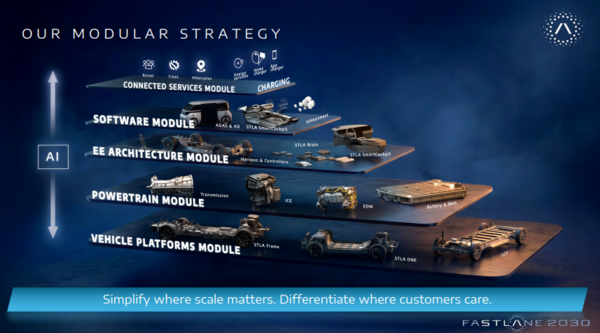
Under the hood, Stellantis is expecting to invest heavily in new technologies and a global platform called STLA One. The technology strategy revolves around embedding AI across its stack that'll include:
- STLA Brain, a scalable central compute system and software architecture.
- STLA SmartCockpit.
- STLA AutoDrive, an autonomous driving system.
To build out its computing, software, autonomous driving and AI systems, Stellantis announced a series of partnerships with Applied Intuition, Qualcomm, Wayve, Nvidia, Uber, Mistral AI, and CATL.
For Qualcomm, the Stellantis win is big for its Snapdragon Digital Chassis system-on-chips. Snapdragon will be integrated across Stellantis' software and electronics platform.
Stellantis said the goals of this technology overhaul is to accelerate development cycles to 24 months compared to 40 months today, improve quality and be more cost competitive. AI will complement these efforts and is being used in more than 120 applications across its operations.
Filosa said Stellantis' new technologies will launch in 2027 and by 2030, 35% of its annual volume will feature the new tech stack. In 2035, 70% of unit volume will have the new technologies.
The details
Stellantis executives Davide Mele, Head of Product Planning, and Ned Curic, head of Product Development & Technology, laid out the technology and platform plan.
Mele said the company's approach to technology will revolve around "real people and real use every day." He added that Stellantis is looking to build one scalable system that's built as a modular stack from the vehicle's physical foundation to the cloud.
"Reusable building blocks with standard interfaces allow us to scale and upgrade over time, and artificial intelligence acts as an accelerator across every layer," said Mele.
By 2030, half of Stellantis' volume will be on three global platforms with up to 70% component reuse. The STLA One approach will cut costs by 20% and enable a wide range of vehicles including electric and internal combustion engines.
Curic zoomed in on STLA Brain. He said:
“STLA Brain is a fundamental shift in how we design and operate vehicles, operating software, and electronics platforms. While the term software-defined vehicle is not very clear and really means so many things to different people, STLA Brain is our intelligent vehicle platform that puts our modern software at the heart of the vehicle. We are replacing dozens of fragmented systems with one unified, intelligent, scalable platform with native over-the-air capabilities. For our customers, this ensures that vehicles respond instantly and continuously improve over time.”
According to Curic, Jeep owners would be able to download off-road modes and generate videos after off-road trips. Pro One fleet managers will be able to update towing capabilities. STLA Brain will launch Europe next year with the US to follow.

The STLA SmartCockpit will replace 12 different separate systems with one cockpit platform that can be tailored to brands and regions. “STLA SmartCockpit is designed for 85% of software usability, driving efficiency again and cost discipline, which are still enabling our brands to provide specific customization,” said Curic.
STLA AutoDrive will focus on active safety and assisted driving experiences. “We invest where we truly differentiate, such as vehicle integration,” said Curic, who added that Qualcomm and Wayve will be key partners. Stellantis will launch STLA AutoDrive in 2028 in North America.
Curic also said AI is speeding up the product cycle. Key points:
- “AI accelerates simulation by up to 300 times and improves software productivity 37% thanks to the code generation and automation.”
- “We engineer better. AI helps us create simpler, cheaper, and more disruptive designs.”
- “We're combining simplified architectures we talked about with AI and virtual first development. We're tearing down the walls and integrating engineering, styling, purchasing, manufacturing to unified teams.”

Related:
Larry Dignan is Editor in Chief of Constellation Insights at Constellation Research, where he leads editorial coverage focused on enterprise technology, digital transformation, and emerging trends shaping the future of business. He oversees research-driven news, analysis, interviews, and event coverage designed to help technology buyers and vendors navigate complex markets with clarity and context. ...
Read morePublished
Author
