Results

Will the First Generation of Robot Laborers Be Ridiculed By Those Opposing Outsourcing?

Will the First Generation of Robot Laborers Be Ridiculed By Those Opposing Outsourcing?

1

2014-01-20-robolaborer.jpg
The word "robosourcing" is making its way into the technology media, and starting to skirt the fringes of the mainstream media via the help of Hollywood and other platforms like TED.

Just recently, a TED talk by Guy Hoffman on robots with "souls" tipped the scale (in my opinion) in conjunction with movies dating back to Star Wars and as recent as HER and Transcendence.

Somewhere between the noise and the hype is the tangible reality that if we continue to innovate in the direction and the pace of today, robotics, connectedness, artificial intelligence and automation will converge on a single truth.

The single truth is that robots will enter to workforce.

Before we wrestle with the 1st generation of robot laborers, let us realize that many of us use robots today. One can argue that my washing machine is a robot, my vacuum is a robot, the drone announced by Amazon is a robot, and for the most part in factories all across the world are generations of robots working on behalf of mankind; however, they are not seen as laborers, the are seen more as automation machines.

Henry Ford replaced horses with robots, we call them engines, and they still have horsepower.

I would like to explore the precept of a robot laborer, what will "it" (I don't think first generation robo-laborers will be gender aware) be capable of doing, how will it be paid, who will own it and who will repair it (robo-doctors)? All tough questions, but they trigger two discussions in my head. They trigger:

1. The outsourcing debacle we have delved into for two decades, and

2. The construct of Humans as a Service (HuaaS) as we think about a liquid cloud of human capacity.

Without digging too deep into the techno babble, this article on CIO.com simplifies the first part for us. We may be robo-phobic.

Outsourcing, or as we coined it on twitter, robosourcing.

First generation robot laborers will not replace knowledge workers, they will more than likely replace manual workers. While we all marvel in the capability of IBM's Watson to win chess and Jeopardy tournaments, first generation robo-workers will not be a workforce of Watsons, they will be more like a workforce of strong machines that can do laborious tasks that are easily repeatable and well defined.

The video below brilliantly describe the first generation robo-laborer world where robots can react to natural disasters, help in radioactive spills, etc. The world could be exciting ..


But not so fast, take for example mowing the lawn, or fetching boxes when moving, cleaning the floors (with mops and water) or feeding the homeless. Based on the state and direction of the science, innovation and technology, we will be using robots to outsource laborers in every day, not just in natural disasters. Here I see a backlash against said robo-laborers similar to those calling out against jobs being moved to India and China, and against recent immigrants taking work away from willing Americans.

Thankfully, the robots may not have feelings, or souls as yet, but they will be ridiculed. Their makers will be for sure.

Human as a Service, can we get to a liquid and contestable cloud of human capacity.

In the example above, it can be assumed that companies will own fleets of robots. Pontificate with me the notion that I may one day own a robot, more than likely a cheap, first generation robo-laborer, or if I'm affluent, a more expensive second generation unit all by myself. In a world where humans are becoming fungible, work is being broken into smaller repeatable tasks, supply and demand for work is completely flexible, and organizations can spin up and tear down teams of human capacity based on changing project demands and task requirements (think the future of taskrabbit.com, odesk.com, elance.com, etc.) Will my robot step in for me on days when I only have simple tasks to do? Man, think about the future state of working form home.

Will my robot be more of a clone of me, will I be able to program it to learn my skills/tasks (you bet I will) and will my personal robot simply be a swap in or out for me on the days where not too much thinking is needed, and only simple tasks need to be done, like create documents, make calls, write, read and summaries etc.?

I see this as a reality within reach during my lifetime, but I wonder about the social backlash. What will folks think of me and my one-on-one, outsourcing robo-laborer buddy? We have seen the negative perception of things like YourManInIndia.com and stories of professionals hiring others to do their jobs on their behalf for less then their salary. How will this be received?


  1. Will our ingrained negative perception of outsourcing create ridicule for first generation robo-laborers enabling robosourcing?
  2. Will we be snarky with those the use robots as personal staff augmentation, and is this good or bad?
  3. Will we see regulation on what jobs and categories of work robo-laborers will be allowed to do, the robo-sourcing act?


I can tell you this much, my friends, I thought I was incredible lazy (and crazy) when I got my first robo-vacuum in 2003. Today over 50 percent of us own one, or tried one and broken it.

Poor bots.


Future of Work Data to Decisions Innovation & Product-led Growth New C-Suite Tech Optimization Chief People Officer

News Analysis: VMware Signals Commitment To Mobility With $1.54B Intent To Acquire Airwatch

News Analysis: VMware Signals Commitment To Mobility With $1.54B Intent To Acquire Airwatch

Mobile Management Consolidation Continues And VMware Accelerates Mobile Efforts

On January 22nd, 2014, VMware (NYSE: VMW) announced the intent to acquire Atlanta, GA based Airwatch for $1.54B.  More than just an acquisition of a leading enterprise mobile management (EMM) vendor, the acquisition represents a cornerstone for VMware's mobile strategy for end user computing.  Should the deal close, co-founder Alan Dabbiere will report to VMware CEO Pat Gelsinger.  AirWatch will continue to be led by CEO John Marshall and included in VMware's end-user computing group, led by General Manager, Sanjay Poonen.  Upon completion of the acquisition, the market impact is significant because:

  • AirWatch users breath a sigh of relief amidst rapid market consolidation and uncertainty. AirWatch is a leading enterprise mobile management (EMM) vendor with over 10,000 customers and 1600 employees. The company has received $200M+ in Series A funding, delivered a global presence with 10 global offices and 16 languages, and achieved over a 90% customer retention rate.  AirWatch brings a rich ecosystem of device manufacturers, feature set partners, resellers, mobile operators, and managed services providers.  Despite these successes, the EMM space faces rapid consolidation and AirWatch is a constant candidate for acquisition.

    Point of View (POV): Citrix’s acquisition of Zenprise foreshadowed the EMM market consolidation and the acquisition of MaaS360 (Fiberlink) by IBM in November 2013 created some concern for existing customers and prospects about AirWatch's long term fate.  In addition, a price war in 2013 stalled a planned IPO process for AirWatch.  Many customers and prospects feared that AirWatch would remain the last EMM vendor standing.  Given the proposed management structure and VMware's history of mergers and acquisition, AirWatch users should feel confident that the technology and team are in good hands and that VMware intends to invest and grow the business.
  • VMware gains a mobility foundation and moves from feature set to end point management. AirWatch's EMM offerings cover a broad set of device and enterprise features.  Device features include MDM, MAM, MCM, MEM, SSO, OS Container, Enterprise Workspaces, App Wrapping/SDK, API Framework, and Device usage.  Enterprise features include API, PKI, DLP, NAC, Directory Services, Content Repositories, Event Management, SIEM, Business Workflow and Systems Management.  Other key areas include Platform Integration, Process Automation, Workflow Templates, and a Privacy Framework.

    (POV): VMware signals a commitment to mobility and goes head to head with Citrix.  The move raises VMware's total addressable market.  After some attempted efforts in mobility at VMware, an acquisition was required to accelerate entry in the market.  MobileIron, a key partner, was most likely a consideration.  However, the price tag could have been 4 to 5X the cost of AirWatch for similar capabilities.  In fact, AirWatch provides not only the technology and feature set, but also the human capital and know-how to take VMware's business into the mobile world.  In the long run, the acquisition of AirWatch's mobile offering will provide a key piece of end point management that moves beyond the bring your own device trend and into the wearable computing age, sensor analytic ecosystems, and the internet of things (IOT).

Recommendations.

As the acquisition has not closed yet, AirWatch prospects and users should reach out to their sales reps and:

  1. Lock in existing discounts and agreements prior to the VMware acquisition.
  2. Seek product road map clarifications and commitments where possible.
  3. Explore the VMware roadmap to anticipate future synergies

The Bottom Line: Mobile Management Is The Gateway Technology To Internet Of Things and Machine To Machine For The Future Of VMware

While acquisitions today address critical consumerization of technology (CoIT) and bring your own device (BYOD) needs, the core concepts behind enterprise mobile management have many key components required to build sensor analytic ecosystems.  How you manage a mobile device from security, identity, content, and monitoring has many features required for end point management. Acquisition by larger players bodes well for bringing key innovations to not only end user computing, but also a growing world of machine to machine interactions.  Coupled with a deep analytics capability, buyers can expect new business models to be created in this chapter of digital business disruption in the decade to come.

Your POV.

Are you looking at a mobile strategy? Do you see the link between mobility and digital business?  Do you see VMware succeeding in this shift to mobility? Add your comments to the blog or reach me via email: R (at) ConstellationR (dot) com or R (at) SoftwareInsider (dot) com.

Please let us know if you need help with your mobility and Digital Business transformation efforts.  Here’s how we can assist:

  • Assessing mobile readiness
  • Developing your digital business strategy
  • Vendor selection
  • Implementation partner selection
  • Connecting with other pioneers
  • Sharing best practices
  • Designing a next gen apps strategy
  • Providing contract negotiations and software licensing support
  • Demystifying software licensing

Related Resources

Reprints

Reprints can be purchased through Constellation Research, Inc. To request official reprints in PDF format, please contact Sales .

Disclosure

Although we work closely with many mega software vendors, we want you to trust us. For the full disclosure policy, stay tuned for the full client list on the Constellation Research website.

* Not responsible for any factual errors or omissions.  However, happy to correct any errors upon email receipt.

Copyright © 2001 – 2014 R Wang and Insider Associates, LLC All rights reserved.
Contact the Sales team to purchase this report on a a la carte basis or join the Constellation Customer Experience!

Data to Decisions Future of Work Innovation & Product-led Growth New C-Suite Tech Optimization Revenue & Growth Effectiveness vmware SoftwareInsider AI ML Machine Learning LLMs Agentic AI Generative AI Analytics Automation B2B B2C CX EX Employee Experience HR HCM business Marketing SaaS PaaS IaaS Supply Chain Growth Cloud Digital Transformation Disruptive Technology eCommerce Enterprise IT Enterprise Acceleration Enterprise Software Next Gen Apps IoT Blockchain CRM ERP Leadership finance Customer Service Content Management Collaboration M&A Enterprise Service Robotics Quantum Computing CCaaS UCaaS developer Metaverse VR Healthcare Social Chief Executive Officer Chief Information Officer Chief Technology Officer Chief Information Security Officer Chief Data Officer Chief Digital Officer Chief Analytics Officer Chief Operating Officer Chief Financial Officer Chief Marketing Officer Chief Revenue Officer Chief Experience Officer

Consolidation - Why VMware Bought AirWatch

Consolidation - Why VMware Bought AirWatch

1

Well, no one was expecting this. Everyone knew and had conjectured that VMware was going to be buying someone in the MDM (Mobile Device Management) space, but to be fair AirWatch was never on the radar. Some of that was due to the fact that CEO John Marshall had declared that he wasn’t interested in selling and other was due to speculation on MobileIron and Good being better fits to what VMware traditionally did.

The funny thing, despite all that VMware has proclaimed for the last three years, they really haven’t been doing mobile. They spent far too long developing a virtualization product for Android that carriers weren’t willing to push and OEMs didn’t talk about. They came up with a strategy for iOS devices that could work but very few were interested in and yet they continued forward with pieces that would fit very well within an encompassing mobile strategy such as parts of their Horizon suite.

The big thing with VMware is that they knew that they had to get a hand around mobile and we had heard about past overtures in this space. Their EUC (End User Computing) division had struggled with building a mobile solution themselves and this had led to a complete shakeup of the whole division bringing Sanjay Poonen in from SAP. Sanjay has a track record of knowing where to focus and it has been evident over the last few months that he understood the weaknesses of his EUC division.

So why buy AirWatch? Airwatch has a long history, starting as Wandering WiFi and then pivoting into the MDM space after the iPhone came out and smartphones became mainstream. John Marshall, their CEO, has been laser focused in building the “biggest and best” MDM company around and yet wasn’t afraid to be challenged and react to those challenges. What had started out as an MDM only company quickly morphed into and EMM (Enterprise Mobility Management) play where AirWatch took on the challenges of content and app management.

I sat with John Marshall a little over 3 years ago and asked him “MDM is dead, where are you going next?” His answer to my question was most telling. “Brian, I don’t quite agree with you that MDM is dead. It still has a lot of life in it, but, we are in this for the long haul and understand it’s more than just about devices.” John and I have had many debates like this over the years and it’s been fun watching them grow from a company of less than 500 people to one of more than 1600. Their goal has always been to be the “go to” company when it comes to mobile and they have embraced the whole EMM stack (well most of it, MIM isn’t there for anyone yet).

Sanjay, realizing what he had in VMware, has essentially thrown out the baby with the bath water and put a stake in the ground for VMware. AirWatch will be VMware’s mobile play and will eventually integrate other pieces of VMware’s EUC division as they fit into an overall mobile strategy. Airwatch gets more pieces to make its engine go faster, a great worldwide work force to augment what they have been building and some real talent to help with development for the pieces that they will integrate. VMware now owns the entire stack from (virtual) server straight through to desktop and mobile, essentially from the datacenter to the endpoint. This is huge for them and allows them to continue to on the enterprise money train. It also gives both of them the ability to leverage the other, VMware now has a cogent mobile story to walk into its many clients and AirWatch gets even more access to people who can make decisions and are already partnered with VMware.

It’s hard to see this as anything other than a win-win situation for both players, while other EMM players will have to work even harder to match the scope and velocity of the new VMware/AirWatch. Expect to see the remaining players become even more of an acquisition target as we move further into 2014.

New C-Suite Tech Optimization Innovation & Product-led Growth vmware Chief Information Officer

An Alien Tweet (Almost)

An Alien Tweet (Almost)

1
There is something that tickles me about this tweet from the (now) out of hibernation Rosetta space probe.

After three years of hibernation, the probe which is on a mission to intercept a comet (yes, in real life, not fantasy), was awoken and signalled its readiness with the classic Hello World message. If only all our efforts and communications were as simple and successful as this.

Marketing Transformation Future of Work Innovation & Product-led Growth New C-Suite Next-Generation Customer Experience Digital Safety, Privacy & Cybersecurity X Chief Marketing Officer Chief Customer Officer Chief People Officer Chief Human Resources Officer

Security Isn't Secure

Security Isn't Secure

That is, information security is not intellectually secure. Almost every precept of orthodox information security is ready for a shake-up. Infosec practices are built on crumbling foundations.

UPDATE: I've been selected to speak on this topic at the 2014 AusCERT Conference - the biggest information security event in Australasia.

The recent tragic experience of data breaches -- at Target, Snapchat, Adobe Systems and RSA to name a very few -- shows that orthodox information security is simply not up to the task of securing serious digital assets. We have to face facts: no amount of today's conventional security is ever going to protect assets worth billions of dollars.

Our approach to infosec is based on old management process standards (which can be traced back to ISO 9000) and a ponderous technology neutrality that overly emphasises people and processes. The things we call "Information Security Management Systems" are actually not systems that any engineer would recognise but instead are flabby sets of documents and audit procedures.

"Continuous security improvement" in reality is continuous document engorgement.

Most ISMSs sit passively on shelves and share drives doing nothing for 12 months, until the next audit, when the papers become the centre of attention (not the actual security). Audit has become a sick joke. ISO 27000 and PCI assessors have the nerve to tell us their work only provides a snapshot, and if a breach occurs between visits, it's not their fault. In their words they admit therefore that audits do not predict performance between audits. While nobody is looking, our credit card numbers are about as secure as Schrodinger's Cat!

The deep problem is that computer systems have become so very complex and so very fragile that they are not manageable by traditional means. Our standard security tools, including Threat & Risk Assessment and hierarchical layered network design, are rooted in conventional engineering. Failure Modes & Criticality Analysis works well in linear systems, where small perturbations have small effects, but IT is utterly unlike this. The smallest most trivial omission in software or in a server configuration can have dire and unlimited consequences. Look at the terrible "goto fail" bug in Apple's iOS7, resulting from a single silly line of code. It's like we're playing Jenga.

Security needs to be re-thought from the bottom up. We need bigger ideas.

We need less rigid, less formulaic security management structures, that allow encourage people at the coal face to exercise their judgement and skill. We need straight talking CISOs with deep technical experience in how computers really work, and not 'suits' more focused on the C-suite than the dev teams. And we need to equate security with software quality and reliability, and demand that adequate time and resources be allowed for the detailed work to be done right.

If we can't protect credit card numbers today, we urgently need do things differently, standing as we are on the brink of the Internet of Things.

Resources

Why Cloud Geography Matters in a Post Snowden/NSA Era

The FIDO Alliance

New C-Suite Future of Work Tech Optimization Digital Safety, Privacy & Cybersecurity Security Zero Trust Chief Customer Officer Chief Executive Officer Chief People Officer Chief Information Officer Chief Information Security Officer Chief Privacy Officer

Former Capgemini CTO Andy Mulholland Joins Constellation Research as VP and Principal Analyst

Former Capgemini CTO Andy Mulholland Joins Constellation Research as VP and Principal Analyst

Andy Mulholland headshotAddition of industry pioneer expands Constellation's ability to provide research and advisory to senior executives seeking to dominate digital disruption

London, UK  – Constellation Research, Inc., the award-winning research and advisory firm focused on how disruptive technologies transform business models announced today the addition of Andy Mulholland to the research team as Vice President and Principal Analyst. Mulholland, whose research focuses on Technology Innovation and its application to Innovative Business models in alignment with existing IT systems and services, expands Constellation’s ability to provide Digital Business research/solutions to its early adopter clients worldwide. 

The addition of Mulholland, who possesses extensive experience successfully leading organizations through periods of massive disruption, signals Constellation’s commitment to providing its clients with the most comprehensive analysis of disruptive business models. Mulholland will advise Constellation’s c-level clients on how to innovate in a manner aligned with their existing IT operations.

Since retiring from the role of Capgemini Group Global CTO in 2011 Mulholland has devoted himself to research on how Digital Business models will be built and deployed in conjunction with existing IT systems.

Comments on the News

“I have been working with Constellation as a client for several years and was delighted to take the opportunity to be even more involved with Constellation colleagues”, noted Andy Mulholland, “I’m looking forward to collaborating with them as part of their unique approach to delivering in depth practical experience.”

“Andy adds gravitas with both his experience with leading edge clients and a constant mindset for innovative ideas”, remarked R “Ray” Wang, Founder and Chairman of Constellation Research, Inc. “Our clients gain a trusted advisor who can co-create and co-innovate the toughest problems emerging from digital business disruption”

Andy Mulholland Biography

Prior to joining Constellation Research, Mulholland held the Global CTO position at Capgemini Group where he drove client understanding of technology adoption and deployment. Mulholland possesses over forty-two years of industry experience—a career that spans three major technology disruptions.  A widely respected thought leader, Mulholland is a member of many futurist technology organizations including the EU Horizon 2020 Panel, the Platform 3.0 Experts panel for the Open Group, and the Policy Board for the BCS, (British Computer Society). Mulholland has been ranked a top twenty-five CTO by InfoWorld and is a three-time recipient of Computing Weekly's Best Blog for Business Managers and CIOs award for his authorship of Capgemini's CTO blog.

COORDINATES
Profile
: https://www.constellationr.com/users/andymulholland
Geo: London, United Kingdom

ABOUT CONSTELLATION RESEARCH
Constellation Research is a research and advisory firm focused on disruptive and emerging technologies. This renowned group of experienced analysts, led by R "Ray" Wang, focuses on business-themed research including Digital Marketing Transformation; Future of Work; Next Generation Customer Experience; Data to Decisions; Matrix Commerce; Technology Optimization and Innovation; and Consumerization of IT and the New C-Suite.

Constellation's collection of prestigious analysts bring real world experience, independence, and objectivity to client solutions that span cross-role, cross-functional, and cross-industry points of view. Clients join Constellation Research for a fresh and business focused perspective.

Unlike the legacy analyst firms, Constellation Research is disrupting how research is accessed, what topics are covered, and how clients can partner with a research firm to achieve success. Over 100 clients have joined from an ecosystem of buyers, partners, solution providers, c-suite, board of directors and vendor clients.

***

Constellation Research, Constellation SuperNova Awards, Constellation Orbit, Connected Enterprise, Constellation Cosmos, and the Constellation Research logo are trademarks of Constellation Research, Inc. All other products and services listed herein are trademarks of their respective companies.

Press Contacts:
Contact the Media and Influencer relations team at [email protected] for interviews with analysts.

Sales Contacts:
Contact our sales team at [email protected].

New C-Suite Tech Optimization Marketing Transformation Innovation & Product-led Growth capgemini Chief Executive Officer Chief Information Officer

Time to Bring Down the Search and Social Silos

Time to Bring Down the Search and Social Silos

1
When I first joined the ADMA expert group for social media, there was a separate expert group for search. But as we met and discussions flowed, it seemed obvious that the two should merge. After all, when it comes to all things digital, search and social were – in most cases – essential collaborators. Or should be.

In many cases, however, search and social are kept at arm’s length – each claiming digital marketing top spot.

There is no doubt, however, that combining search and social has a much more powerful impact on almost any of your metrics. And with Google’s recent announcement around shared endorsements, this impact will become more formally entwined. Those who continue to resist social media’s siren call, or who keep the artificial silos in place across their marketing teams, will start to see performance of both search and social flounder.

The only way ahead for digital is integrated. And for 2014, you can expect this to accelerate and broaden. It’s time for the walls in your marketing silos to come down – and this is the year to do it as this infographic from Prestige Marketing shows.

2014-trends-in-social-search-infographic

Marketing Transformation Next-Generation Customer Experience Innovation & Product-led Growth Future of Work New C-Suite Digital Safety, Privacy & Cybersecurity Revenue & Growth Effectiveness Google Chief Customer Officer Chief Marketing Officer Chief People Officer Chief Human Resources Officer Chief Revenue Officer

Reduce Support Costs With A Customer Community: Increase Agent Efficiency (Part 2)

Reduce Support Costs With A Customer Community: Increase Agent Efficiency (Part 2)

Reduce One-Off Requests

Your support agents are knowledgeable about every aspect of your

business. They have extensive knowledge about your product, your

processes, and policies. So it’s an ironic twist of fate that (especially

as your business scales) they spend most of their time answering

simple, one-off questions.


Don’t get us wrong—it’s important that your customers are

supported as they purchase, set up, and begin using your products.

You want them to be as successful as possible, so they have a

positive experience and brand association. But does this mean your

support agents have to hold the hand of each and every customer

as they look for the “on” button? Absolutely not…at least not

anymore.


As you scale your business, you need to make sure that you’re

doing everything you can to reduce the number of simple,

repetitive questions your support staff is answering. A branded

customer community is ideal for this. It acts as a living, breathing

conversation library, hosting all the questions, answers, praise, and

ideas that have come before, while constantly being updated with

the most current topics of conversation.


Because community is designed to facilitate engagement around

the topics your customers care about (as opposed to Facebook or

Twitter, which are optimized for engagement around recent content

only), all conversations, whether they began two years ago or this

morning, are easy for search engines and hence people, to find.

Get Satisfaction customer communities take this archive capability

a step further. They search the entire community to see if an

answer may already be tucked away somewhere in the ghosts

of conversations past, before allowing a new topic to be posted.

This means that customers are automatically exposed to existing

questions and answers before they can open new issues.


This is beneficial for all concerned parties—your customers are able

to self-serve their own answers quickly and easily, which is what

most consumers prefer these days. And your support agents don’t

have to answer the same questions over and over again, because

there is a huge repository of content that exists already.

Empower Your Support Champions

Increasing agent efficiency is really a fancy way of saying reduce

agent tickets, calls, emails, and instances, freeing them up to

put their support super powers to work on more complex issues.

A great way to do this is by identifying the customers who are

naturally knowledgeable, enthusiastic, and vocal about your

product, also known as brand advocates or Champions.

It may seem unlikely that there are actually people out there who

are excited to speak up on your behalf, answer questions, and act

as impromptu support agents, but anyone who works in social

media will tell you that there absolutely are! Your job is to identify

them, incentivize them (even with a simple web badge—these folks

love a little recognition!), and connect them with prospects and

other customers. A customer community, with its wealth of people,

content, and analytic capabilities, is a natural place to do just that.

Get Satisfaction offers a Champs program, which allows you to

publically designate champions so the community knows who they

are. You can even give them special abilities so they can moderate

and curate as you see fit.


Champions are not the only ones who can help alleviate

the load on your support agents. The people interacting in your

community naturally bring with them varying experiences,

perspectives, and skills. From highly technical developer

communities, to those of companies that sell basic consumer

goods, bringing your customers and employees together to share

experiences and solutions is a solid base to build on for innovation,

development, and collaboration.

Stay tuned for part 3!

You are here: Home / Blog

Reduce Support Costs With A Customer Community: Increase Agent Efficiency (Part 1)

January 11, 2014 By Leave a Comment

increase agent 1

We love our customer support agents. Friendly, helpful, and patient by nature, these folks spend more time talking to your customers than
anyone else in your company. They truly understand the pain points of your business, and they’re the ones putting in long hours to resolve
them for your customers. It’s important, then, to ensure they have the tools and resources necessary to be truly effective.
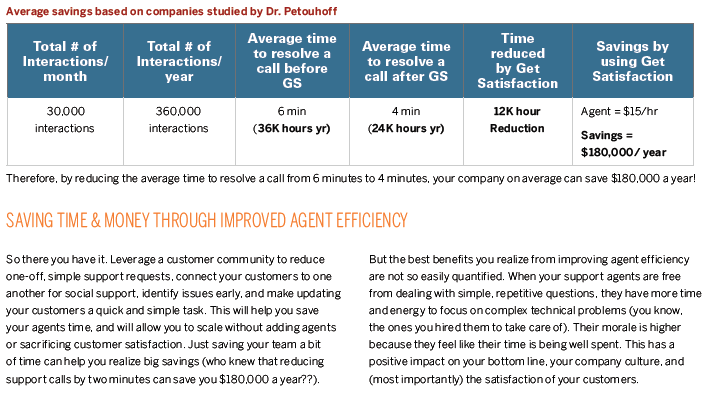
This isn’t just a good idea from a warm and fuzzy perspective. Agent salaries are the most expensive part of a support center. By ensuring
that they’re using their time efficiently—helping people solve complex, technical or individual problems, not responding to the same basic
questions over and over again—you can do a lot to maximize the value of your support agents, the satisfaction of your customers, and
minimize stress and pain points for both.
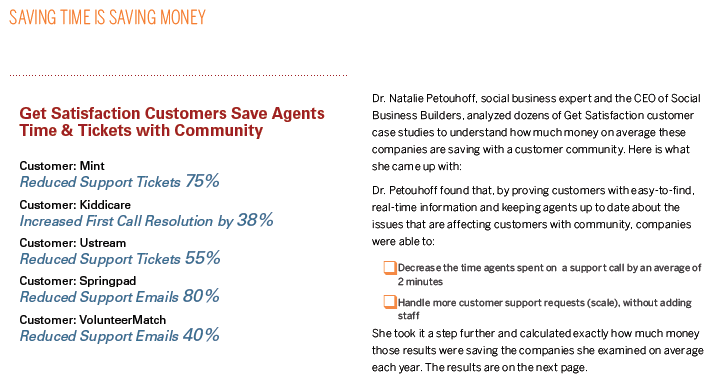
This eBook is the second in a series of three explaining how customer communities can help companies realize significant savings and
revenue sources, along with the metrics and calculations to measure the results. The first eBook focused on customer community as a
valuable resource for customer self-service support. This book focuses on the way companies can leverage community to improve agent
efficiency. Stay tuned for the final, which will discuss community as a means to improve customer retention and acquisition.

Customer Community: The Basics
Since this eBook is all about how you can leverage a customer community to improve agent efficiency (and reduce costs as a
result), we figured it makes sense to give a quick refresher course on what exactly a customer community is, just to make sure we’re
all on the same page.
So what is a community platform? It all started with some of the first technology that emerged on the web—the forums and
message boards of the 80’s and 90’s. These technologies were built to create online spaces where users could have threaded
conversations about the topics, products, and services that interested them. To have an identity across conversation, users
typically created a profile with a nickname, so that they could build their reputation. This primordial community technology worked
well for engineers, developers, and early adopters, but it was not designed to be easy-to-use by a mass audience.
A lot has changed in today’s community platforms, but the core conversational functions have remained the same. At Get
Satisfaction, we have a strong point of view that, for a community to be most effective and beneficial for customers as well as companies, it should have the following:

?User-friendly interface with a simple way for even tech-wary users to browse and search for relevant conversations
?Technical flexibility that allows business to embed community content and functionality across customer channels … on websites,
social networks, in digital campaigns, and on mobile and tablet devices
?Business features and tools (topic moderation, content curation, etc.) that allow for successful community management
?Ability for the community to be branded by the company that owns or sponsors it
?Content that is highly indexed by search engines (through SEO) and naturally appears in top search results
?Analytics tools that allow business users to assess community health and performance, determine the most relevant content, and
identify the community members who are mostly likely to become brand advocates
?Formal Champions program that allows you to identify, recognize, and allocate simple moderation capabilities to the customers who
act as informal leaders in your community

When equipped with these features and moderated and curated effectively, communities are great assets for customers to research
products, find answers to their questions, and act as resources for others. These conversations drive customer satisfaction and brand loyalty, while helping companies deliver great support, gather feedback to build better products, and acquire more customers.
Effectively, community allows you to deliver a better customer experience, while reducing costs and bringing benefits to multiple
departments across companies.

Stay tuned for Part 2!

Related articles
 
Share

Video Interview: Thought Leadership with Mitchell Levy and Michael Procopio

January 6, 2014 By Leave a Comment

Thought Leadership with Mitchell Levy http://MitchellLevy.com and Michael Procopio http://MProcopio.com covers all things around thought leadership, how to become one, how to use it as a form of communication, how to help others become one. I got to sit down with them for a Google Hangout and discuss customer service, social media, real-time marketing and more!

Dr. Natalie: voted Top 20 In Social Media HuffPo
Dr. Natalie’s ebook: voted as one of the Top Ten Most downloaded Social Media ebooks- On smROI

Click here to watch my videos on Social Media ROI:
Video 1: Building the Business Case for Social Media
Video 2: How to Measure the ROI of Social Media
Video 3: How Social Media Benefits the Whole Company


Dr. Natalie’s Executive Success Acceleration Firm™
Executive Business Strategy Advisor & Social Customer Experience Industry Authority & Consultant

The Doctor Knows Social Media ROI & Our Business Strategies Rx Get Results!
Our Motto? Be Awesome by: Learning, Sharing & Growing!

What we do: We work with companies to deliver increased revenue and decreased costs:

  • Executive Leadership Guidance on Strategy and Business Use of Social Media
  • Social Media / Business Benchmark Assessments – Tell you what you got/ what you might consider
  • Social Media ROI – set-up measurement capabilities and dashboards
  • Workshops on Business Strategy: Customer Experience, PR, Marketing, Customer Service & Internal Employee Advocacy
  • Instructor MEMES Summer Institutes at UCLA Anderson & UCLA Extension
  • Customer Experience / Social Customer Service Excellence Benchmarking Assessments & Advisory
  • Software Company Visualized-ROI, Persona-based Solution Selling w/ Targeted USP & Messaging / ebooks, White Papers, Webinars…
  • Social Media Training, Organizational Change, Motivation and Goal Setting

My book: Like My Stuff: How To Monetize Your Facebook Fans

Follow Me Here:
Twitter: @drnatalie
LinkedIn: DrNataliePetouhoff
G+ : Google Plus posts
Facebook: DrNatalie Petouhof

Enhanced by Zemanta

Share

Marketing Transformation Innovation & Product-led Growth Next-Generation Customer Experience Tech Optimization Future of Work B2C CX Chief Marketing Officer Chief Customer Officer Chief People Officer Chief Human Resources Officer

Message to CIOs, Stop Hogging Innovation: It's the Business of Everyone in the C-Suite

Message to CIOs, Stop Hogging Innovation: It's the Business of Everyone in the C-Suite

1

2014-01-16-iStock_000012681402Small.jpg"There's no 'I' in team," goes the old saying, but many seem to think there's a "1" in innovation. Maybe it's a side effect of the rise of savior entrepreneurs like Tesla Motors co-founder and CEO Elon Musk, but far too many seem to believe that innovation is the responsibility of one person within an organization, rather than something that's distributed throughout the leadership within an organization.

A perfect example of this can be found in "The New CIO: Chief Innovation Officer" a recent article in the the Wall Street Journal's CIO Journal blog. The piece highlights how CIOs can transition into a new role that puts them in the position to lead and drive change within their organizations.

The points made in the WSJ article are valuable insights for any CIO to absorb, but the idea that a CIO alone can enact sweeping, organization-wide change is a pipe dream.

Innovation Comes in Many Flavors

Innovation is not a monolith. Different types of innovation require different ingredients, but all innovation requires a set of correlated, systemic and deliberate structural organizational changes.

These changes go beyond conventional innovation tactics, such as employees having experimental free time (a la Google) for two hours on Fridays or innovation jams.

True innovation is difficult to define, test, perfect and install.

One easy way to think about innovation types is in the construct of a 2x2 matrix mapping outside-in, versus inside-out innovations, and evolutionary versus revolutionary innovations. Let's call it the c-level, four-quadrant innovation matrix.
 

2014-01-16-C4QInnovationMatrix.jpg


Mapping innovation types triggers thinking about the processes needed to capture and cultivate each innovation type.

What changes may be needed? Which new partnerships may be needed to cultivate each innovation type? The C4Q Innovation Matrix helps illustrate that innovation not only is the job of the CIO or CTO, but also requires the CEO, COO and CMO to make material contributions.
 

Innovation at the CEO Level

Inside-out innovations are stifled by traditional command-and-control organizational designs, and suffocated by incentive-model designs, where the larger a leader's proverbial ship, the larger said leader's compensation. CEOs must commit to an organization redesign in which the structure is informed by the strategy, rather than one in which the strategy is dictated by the structure.

The hard reality is that inside-out innovations drive efficiencies (especially revolutionary ones), potentially collapsing entire departments and product lines and eliminating career paths.

But the dividends of such innovation can pay off. Steve Jobs ax'ed more than 70 percent of the products [4] at Apple when he was reinstated as CEO in 1996. Jobs' belief that a focused product line-up was key to any business's success was something he shared with Nike CEO Mark Parker.

Jobs told Parker, "Nike makes some of the best products in the world. Products that you lust after. But you also make a lot of crap. Just get rid of the crappy stuff and focus on the good stuff."

Companies that succeed with organizational transformations encourage leaders to cannibalize their roles through innovation, which redirects their value to the company, away from a specific title. This shifts the conventional thinking from, "If I don't have anything to do, what is my value?" to "I can't wait to innovate away everything I do so I can deliver new value."
 

Innovation at the COO Level

Traditionally, project demand originates from business lines, and investment governance is ROI driven. From an operating-model perspective, a portion of the project spend must be earmarked for innovation beyond the research and development stages. In order for innovation to thrive, the investment-governance process must be deliberately designed to fund innovation projects past the ideation phase into championing and the execution phases; this is specifically a COO responsibility.

One key example of COO-led operational change is to design and install an innovation chargeback model similar to the line of business chargeback model for shared services such as network, storage and human resources. This allows lines of businesses close to the voice of the customer (VOC) to take innovation seriously as a shared service and better identify, prioritize and install VOC outside-in innovations.

These types of operating models and investment-governance changes are often best executed by a COO instead of a CIO or a CTO. Reorienting innovation funding via the operating model and investment-governance process also stops "un-innovation" via prioritization. Stopping un-innovation is an important element of innovating.

Facebook COO Sheryl Sandberg exemplifies innovation at the COO level, with the company's laser-focus on building a viable mobile business.

"Mobile is the top goal right now," Sandberg said at the All Things D Conference. "Every product team is focused on mobile," indicating horizontal buy-in, from ideation to execution.

Innovation at the CMO Level

As many management-consulting companies predicted, the CMO is spending more on technology and is many times closer to the customer than other c-level officers. In many industries, listening to customers is not new. However, where we listen and the veracity of the information we obtain, the new vocabularies we listen to and the speed by which we convert data sourced from listening to value have changed.

While this is very much a Big Data and social conversation, it is hardly a CIO -- or CTO -- only topic. CMOs are consistently pressed to listen to new types of customers, on new types of channels, for new data, with new vocabularies, driving new insight and helping deliver outside-in innovations.

Technology enchants consumers by serving everything they want, when they want it and how they want it. In some sectors, it's common to include these "emotional requirements" in the project lifecycle.

Traditionally, business requirements are written and converted to functional requirements and, eventually, to technical requirements. Emotional requirements are described as emotions an organization intends the consumer to feel when engaging with a product or a service, whether digital or physical.

The practice here is to add emotional requirements as a precursor to the business requirements in an effort to satisfy the consumer's new emotional thirst/outcome. CMOs are charged to innovate by listening more and in new ways and by catering to the consumer emotionally.

Tapping into the power of customers' emotions to develop game-changing marketing is exactly what Chipotle CMO Mark Crumpacker did with the fast-growing, fast-casual chain. Fast Company named Chipotle one of The World's 50 Most Innovative Companies last year, and in its profile of Crumpacker, they recounted one of his moments of epiphany:
 

[W]hen he hosted a series of screenings of the investigative documentary Food, Inc., Crumpacker understood that the only way to differentiate Chipotle was to replace traditional advertising with more emotionally engaging stories.

That's when Crumpacker turned to CAA Marketing, the arm of the Hollywood talent agency plugged in to the best storytellers in the world. Crumpacker told CAA he had seen a heart-tugging two-and-a-half-minute commercial for Chevron called "Human Energy." He wanted a Chipotle version.

'If a company like that can make you cry, imagine if we had something comparable for Chipotle,' Crumpacker says.
 

Innovation Requires All Hands on Deck


The examples of innovation at various levels of the c-suite should serve as a valuable lesson to any organization. Anyone, given the right tools, resources and smarts, can be a change agent within an organization.

While it's become a trend for companies to develop roles specifically for innovation, the real power of innovation comes through the integration of innovation throughout the entire c-suite.

Real innovation isn't in a job description or new title, it's a way of life.


Next-Generation Customer Experience Tech Optimization Data to Decisions Future of Work Innovation & Product-led Growth New C-Suite Chief Executive Officer Chief People Officer Chief Information Officer Chief Marketing Officer

IBM kicks off the 2014 cloud data center race - why being early and fast matters

IBM kicks off the 2014 cloud data center race - why being early and fast matters

In a press release today IBM announced it's intention to extend its current data center landscape from 20 to up to 40 data centers in 2014, effectively doubling the data centers running on SoftLayer architecture (our take on the acquisition is here). To get there IBM plans to invest 1.2B US$ in the coming quarters. 


And with that IBM kicks of the cloud data center monopoly race - as we borrow from the popular board game. Of course the board game's most prized possession - the Boardwalk - does not apply to cloud data center race - as the player will not be able to own a country exclusively. But a land grab it equally is - as you can only build a finite number of data centers in a year, and put only so much fiber in the ground. So being early and fast matters

Location, location, ....

We may be seeing the old brick and mortar retailer adage applied to cloud data center locations in 2014 and going forward. Location matters for a variety or reasons, the most prominent among them are:
 

  • Data privacy compliance - Many countries have strict requirements in regards of and where local data can be stored. The industry and customers have been largely ignoring this and been looking the other way. The conversation with prospects and customers to get cloud loads gets significantly easier when you have an in country data center.

  • NSA / PRISM fall out counter - The recent NSA / PRISM scandal gives a number of new and extra concerns to enterprises about naively using the cloud. Local and national data centers, under local jurisdiction, help to address this concern.

  • Performance gains - Quite rightfully many users in the world complain that a number of cloud apps work best in Silicon Valley, work ok in the US - but try them in Cape Town or Melbourne. As much as vendors want it - the internet is not a consistently performing system and placing data centers closer to users benefits their cloud application user experience.

  • Reliability gains - Ever since the widely publicized lessons learnt from AWS clients not using the AWS availability zones correctly - the smarter enterprises have realized that their cloud processes and data need to run in more than one location. Additional data center locations help enterprises to design an optimized reliability strategy.

What will be the 2014 prized possessions?

During 2013 the prized possessions for IaaS vendors were Australia and China. If memory serves me right, it was AWS to start the race for Australia and Microsoft to start the one for China. Now we see IBM leading for new countries like e.g. Mexico. The next week and other vendor announcements will show what the prized possessions will be in 2014.


IBM InfoGraphic from here


Load drives the location strategy

As in the past, IaaS providers will have to chase load to make their investments work. All of them bring significant load by themselves - IBM for instance has over 100 SaaS applications, AWS its online business, Microsoft the XBox, Outlook.com, etc, Google its search and apps load and of course SAP and Oracle their respective SaaS apps. 

What's interesting to note is, that when it comes to sources of different load - IBM has been able to conserve the strong SoftLayer gaming presence. This was and remains one of the fortes of the SoftLayer architecture and drives a valuable and high end load profile. It's good to see that game developers keep trusting SoftLayer after the IBM acquisition and IBM being able to expand this high end load profile. 

As an interesting side note - two of the data centers will be dedicated to US government cloud loads - a business all cloud infrastructure are competing for. 

IaaS vendors need to overlay their existing and expected load profiles (from new subscription revenue) - to chart their planned and next data center locations. As all the players move beyond 20 locations in 2014 - we do not expect the coverage to differ significantly yet - once we move post 40 locations we may see different worldwide coverage. 


Watson throws his weight in

With last week's IBM announcement to form a division around Watson - it's no surprise today's announcement includes using any Watson load to the new data centers. Depending on the success of IBM selling Watson, it could quickly become the largest driver of IBM cloud load. The interesting aspect to watch is that due to the high performance nature of the Watson applications, IBM maybe moving more into the direction of high end cloud infrastructure. It remains to be seen if IBM will join Google in that positioning - or if it will provide a two tiered cloud performance offering. Both require investment and that's what we are seeing. Going forward the location of new Watson clients may give an indication of IBM's further cloud data center locations. 


SoftLayer is key

As previously blogged, SoftLayer is central to IBM's cloud strategy. All new data centers will follow SoftLayer design and code, the separate, triple network architecture, the flexible and transparent deployment options, the single API design, the central admin console etc. 

Its impressive how fast IBM is moving to the SoftLayer architecture - and shows at the same time how high the table stakes in the cloud game are. Competitors still counting on IBM moving at former pedestrian speeds will be surprised. 

Challenges remain

In the past we have seen cloud vendors to use multiple data center locations - but then deployments decisions would usually put a single, main system into one location - with n backup sites. If IaaS and SaaS vendors want to be in line with local data privacy laws they will need to come up with an architecture to make their system run in a distributed data center environment. Many questions in regards of security, access, code and data replication, reporting etc remain. This will be a significant headache for many SaaS vendors and we expect the smarter, high end IaaS vendors to help their SaaS ISV clients to address these challenges more and more in the future.

As for IBM, it claims that SoftLayer addresses a number of these challenges and it will be key to follow how quickly IBM will be able to show uptake of these capabilities in real customer success stories - addressing these specific challenges e.g. in the vast IBM SaaS portfolio.  

MyPOV

All cloud infrastructure players need to continuously invest into expanding their locations and capacities. Credit goes to IBM for being first out of the gate in 2014 and moving the yardstick from around 20 to 40 cloud data center locations. It's now to the usual competitors to respond and we will see their response in the next weeks. Stay tuned. 

The other aspect is the strong commitment to the SoftLayer architecture - which seems to have invigorated IBM's cloud ambitions and accelerated its cloud roadmap. A lot of 1B+ US$ acquisitions have faltered in the high tech industry - by all indication the SoftLayer acquisition is not one of them. On the contrary. 


Other IBM related posts
  • Are we witnessing one of the largest cloud moves - here

  • First takes from IBM's Software Analyst Insights - here

New C-Suite Tech Optimization Innovation & Product-led Growth Future of Work Data to Decisions Digital Safety, Privacy & Cybersecurity Google softlayer IBM amazon SAP Oracle Microsoft SaaS PaaS IaaS Cloud Digital Transformation Disruptive Technology Enterprise IT Enterprise Acceleration Enterprise Software Next Gen Apps IoT Blockchain CRM ERP CCaaS UCaaS Collaboration Enterprise Service Chief Information Officer Chief Technology Officer Chief Digital Officer Chief Data Officer Chief Analytics Officer Chief Information Security Officer Chief Executive Officer Chief Operating Officer