Results

What Are the 4 Pillars Of Social Selling? What Creates Social Selling Success?

What Are the 4 Pillars Of Social Selling? What Creates Social Selling Success?

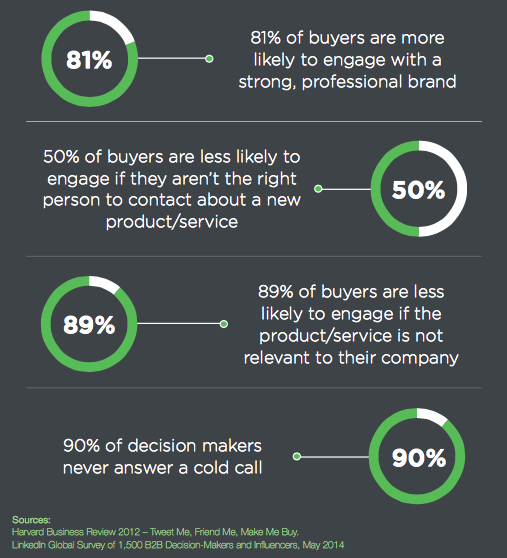
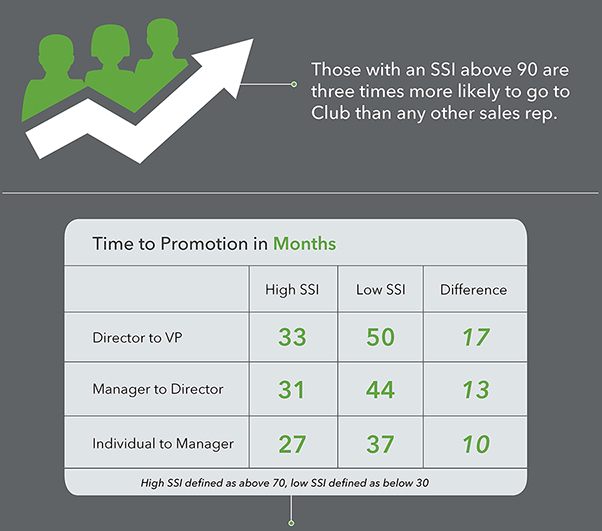
How to Create a Social Selling OrganizationMy latest report, How Sales Leaders and Sales Reps Can Create a Social Selling Organizationis a best practices guide for sales leaders and teams looking to use social to transform their average-performing sales teams into top performers 1-2. Did you know that seventy-eight percent of salespeople who use social media outsell their peers? 3 Nearly sixty percent of a typical purchasing decision—researching solutions, ranking options, setting requirements, benchmarking pricing, and so on—happen before the potential buyer even has a conversation with a supplier. 4 Research into actual use of social selling has revealed that sales professionals who use social selling are fifty-one percent more likely to exceed quota, three times more likely to go to a special sales event for top sellers and get promoted to vice president seventeen months faster. 5

Your social media presence will allow you to demonstrate your expertise and helpfulness to your potential customers. The result? They’re a warm prospect before your first personal interaction! The idea of using social to boost sales may seem like a no-brainer to you, but the reality is that many sales organizations feel they:
  • Could use social better
  • Experience difficulty with adoption, or
  • Unsure of how to start their social selling initiative.

This report addresses the concerns of the weary social selling novice to the experienced sales leader seeking to improve the efficiency of their social sales team. Here’s an excerpt from the report:

Four Steps to Creating a Social Selling Organization

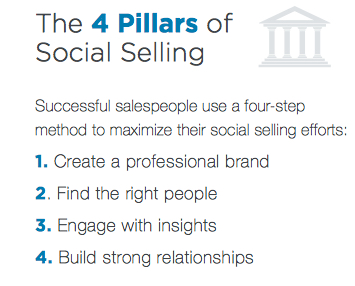
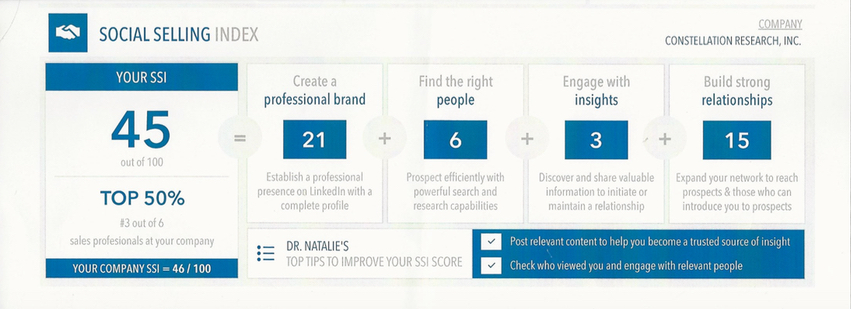
With billions of pieces of information being shared each week in social channels, you will want to organize and operationalize your approach to social selling. Use Constellation’s Social Selling Assessment to focus on four key steps:

1. Create a personal brand – Each sales team member should build a complete profile on key social networks.

2. Find the right people – Once you set up your professional brand, start using it with a network

3. Engage your prospects with insights – Read, participate and contribute in social networks
 
4. Build strong relationships – Cultivate prospects and people within your company.
 
Read more about my report How Sales Leaders and Sales Reps Can Create a Social Selling OrganizationA snapshot of the report and the table of contents is available

Download Report Snapshot

 
@drnatalie
VP and Principal Analyst, Constellation Research
Covering Marketing, Sales and Customer Service to Create Great Customer Experiences


References:

(1) The Sales Management Association survey, http://www.slideshare.net/TheSalesMgtAssoc/social-media-and-the-sales- organization

(2) Brian Fetherstonhaugh, Chairman and CEO, OgilvyOne Worldwide,”The Future of Selling”, http://www.slideshare.net/OgilvyWW/the-future-of-sell

(3) Mike Volpe, “Your Sales Strategy Shouldn’t Rely on a Cold Call”, Mashable, October 8, 2014, http://mashable.com/2014/10/08/better-sales-marketing-strategy/

(4) Brent Adamson, Matthew Dixon, Nicholas Toman, “The End of Solution Sales”, Harvard Business Review, July 2012, https://hbr .org/2012/07/the-end-of-solution-sales

(5) LinkedIn research surveys and analysis of using social selling tools, with LinkedIn data from 2014 and 2015


Next-Generation Customer Experience Marketing Transformation Marketing B2B B2C CX Customer Experience EX Employee Experience AI ML Generative AI Analytics Automation Cloud Digital Transformation Disruptive Technology Growth eCommerce Enterprise Software Next Gen Apps Social Customer Service Content Management Collaboration Chief Customer Officer Chief Marketing Officer

Is Social Selling Going to Make a Difference in Your Sales Organization?

Is Social Selling Going to Make a Difference in Your Sales Organization?

How to Create a Social Selling OrganizationMy latest piece of research: How Sales Leaders and Sales Reps Can Create a Social Selling Organization

In speaking to many sales leaders and sales reps (especially outside of Silicon Valley) they were wondering, “Would social selling make a difference to my sales organization and our sales results?” Having been in the “social media / digital world” for a while I found that an interesting question. But often if you are in the mix of something you can’t see what others can’t see. So I did some research on social selling to back up what my gut what was telling me, i.e., “Yes, social selling makes a tremendous difference to a sales organization’s bottomline.”

You might be wondering what types of statistics are out there around social selling and it’s effectiveness. Here are a few:

  • Sixty-five percent of the most successful sales people who use social media as part of the selling process believe social media is critical to their success
  • Studies show 78% of salespeople who use social media outsell their peers
  • Research into actual use of social selling has revealed that sales professionals who use social selling are 51% more likely to exceed quota, three times more likely to go to a special sales event for top sellers and get promoted faster*

Why might this be the case? Nearly 60% of a typical purchasing decision—researching solutions, ranking options, setting requirements, benchmarking pricing, and so on—before even having a conversation with a supplier. Sadly, however, 2/3 of firms do not have a social media strategy for their sales organization, even though 80% of the sales people surveyed believe the sales force would be more productive with a greater social media presence.

So I began looking at the critical components of social selling and found that sales managers, despite the few that are very successful, many are unsure how to use social selling. Sixty-eight to 84% of salespeople surveyed feel the sales process is changing faster than sales organization are responding. However, according to the report Powering Profitable Sales Growth: Five Imperatives from the 2014 Sales Performance Optimization Study, Accenture and CSO Insights, digital transformation, digital selling, applying digital tools, online and social media to enable digital relationships and drive sales across multiple channels is fast emerging as a primary driver of market differentiation, business growth and profitability.

Here’s some of the reasons sales team leaders and members are not leaving social media and social selling:

1. Sales leaders are not moving their teams to social selling.

2. Sales individuals and teams don’t have online professional brands.

3. Sales and marketing teams are not working together as a united front.

4. Salespeople don’t have the digital proficiency to develop an effective online brand to drive more sales.

Sales leaders must understand how to leverage social selling to advance the relationship between their prospects, potential customers and current customers. In addition, businesses need to learn how to make the most of each individual salesperson’s online brand while keeping the company’s social persona intact. And I will explore more about social selling and solving these issues in the next blog post.

A snapshot of the report is available. 

Download Report Snapshot


@drnatalie

VP and Principal Analyst, Covering Marketing, Sales and Service To Create Amazing Customer Experiences

Catch Constellation’s Connected Enterprise – The innovation summit for the enterprise November 4 – 6, 2015. The Ritz-Carlton, Half Moon Bay, California.

*LinkedIn Research Surveys and Analysis of Using Social Selling Tools Data 2014- 2015


Marketing Transformation Next-Generation Customer Experience Future of Work Innovation & Product-led Growth New C-Suite Digital Safety, Privacy & Cybersecurity Revenue & Growth Effectiveness Chief Customer Officer Chief Marketing Officer Chief People Officer Chief Human Resources Officer Chief Revenue Officer

Research Preview: Enterprise Healthcare Management (EHM) Market Overview

Research Preview: Enterprise Healthcare Management (EHM) Market Overview

Enterprise Healthcare Management Comes Of Age

Enterprise healthcare management (EHM) technology is a category of software that incorporates analytics into the typical employer-provided healthcare solution. EHM enables employers to maximize their healthcare investments by improving the delivery of healthcare for employees, and identifying previously unknown opportunities uncovered by data.

Enterprise healthcare management will help enterprises confront the healthcare affordability crisis by providing insights into usage and highlighting areas for optimization. Organizations should evaluate the benefits of enterprise healthcare management as the forces of healthcare technology and future of work trends continue to converge.

My latest report provides a market overview of the EHM market.  The report will be published February 23, 2015. Check back soon for more details.

Future of EHM Constellation Research

Report Highlights

  • Constellation expects healthcare expenditures by U.S. organizations to increase as total healthcare spending grows from 17.1 percent to a projected 25.8 percent of U.S. gross domestic product by 2025
  • Healthcare costs and efficacy of health and wellness programs remain top of mind for CEOs, CFOs, and Chief People Officers.
  • Business objectives of EHM
    -Incentivize employees to make responsible healthcare decisions
    -Guide employees to maximize available benefits
    -Improve healthcare efficacy for employee and employer
    -Reduce unnecessary care
    -Reveal usage patterns that create business opportunities
    -Five drivers of the Enterprise Health Cloud
  • Bottom line: EHM addresses the affordability crisis

The report will be available here on February 23, 2015

Your POV.

Ready to take on healthcare costs and improve health outcomes with technology?  Add your comments to the blog or reach me via email: R (at) ConstellationR (dot) com or R (at) SoftwareInsider (dot) org.

Please let us know if you need help with your Digital Business transformation efforts. Here’s how we can assist:

  • Developing your digital business strategy
  • Connecting with other pioneers
  • Sharing best practices
  • Vendor selection
  • Implementation partner selection
  • Providing contract negotiations and software licensing support
  • Demystifying software licensing

Resources

Reprints

Reprints can be purchased through Constellation Research, Inc. To request official reprints in PDF format, please contact Sales .

Disclosure

Although we work closely with many mega software vendors, we want you to trust us. For the full disclosure policy,stay tuned for the full client list on the Constellation Research website.

* Not responsible for any factual errors or omissions.  However, happy to correct any errors upon email receipt.

Copyright © 2001 -2015 R Wang and Insider Associates, LLC All rights reserved.
Contact the Sales team to purchase this report on a a la carte basis or join the Constellation Customer Experience

The post Research Preview: Enterprise Healthcare Management (EHM) Market Overview appeared first on A Software Insider's Point of View.


Future of Work Tech Optimization Next-Generation Customer Experience Innovation & Product-led Growth Digital Safety, Privacy & Cybersecurity Data to Decisions New C-Suite SoftwareInsider AI Analytics Automation CX EX Employee Experience HCM Machine Learning ML SaaS PaaS Cloud Digital Transformation Enterprise Software Enterprise IT Leadership HR LLMs Agentic AI Generative AI B2B B2C business Marketing IaaS Supply Chain Growth Disruptive Technology eCommerce Enterprise Acceleration Next Gen Apps IoT Blockchain CRM ERP finance Customer Service Content Management Collaboration M&A Enterprise Service Robotics Metaverse developer Quantum Computing Social Healthcare VR CCaaS UCaaS Chief Financial Officer Chief People Officer Chief Information Officer Chief Customer Officer Chief Human Resources Officer Chief Technology Officer Chief Digital Officer Chief Data Officer Chief Analytics Officer Chief Information Security Officer Chief Executive Officer Chief Operating Officer Chief Marketing Officer Chief Revenue Officer Chief Experience Officer

First Take - SAP Cloud for Planning - The next spreadsheet killer is off to a good start...

First Take - SAP Cloud for Planning - The next spreadsheet killer is off to a good start...

I had the pleasure of attending a FP&A conference yesterday (#FPAWest) – conveniently located here in San Diego. SAP chose the event to launch a new product – ‘SAP Cloud for planning’, so let me share my first take. The press release can be found here.


Many enterprise vendors (and others) have tried to crack the Microsoft dominance with Excel as the Swiss Army knife of the business professionals. Almost no vendor has even been able to put a dent in the armor (as I described here already). The main reasons why Excel has kept its dominant role are that it can be found on nearly every enterprise desktop in the world, the power of the Excel grid control and the functional richness of Excel itself (though most users use less than 5%). The irony of the Excel killers is, that they mostly start – and then even end in Excel – creating value add for users in between. Most enterprise vendors have found a way to co-exist with Excel – allowing for the popular import and exports of Excel spreadsheets.

But it is good that vendors are trying, with good success (see e.g. my take on Informatica Springbok here) and now we can see SAP throwing its hat in the ring with Cloud for Planning. (In good SAP tradition a confusing name, given the S4HANA launch, it needs an upgrade to Cloud 4 Planning maybe? Going forward I will refer to the product with C4P in this post).  [Update Feb 20th - SAP correctly reminds me that C4P was named before S/4HANA and is following the SAP product naming conventions. MyPOV - Fair enough, sill a mouthful.]

Here are my top 3 takeaways from meeting with the C4P team extensively yesterday:

HANA makes a difference – any spreadsheet maker’s dream – I have written, blogged and spoken about the pros and cons of HANA, SAP’s in memory database many times. But C4P is different than the traditional enterprise application, as it essentially stands and falls with memory capabilities. As every heavy Excel user knows, even on today’s generously endowed machines, memory can become an issue. But memory is available plenty with HANA, so to a certain point, HANA is any spreadsheet builder’s dream. But HANA also has a nifty calculation engine, and the C4P product takes advantage of SAP owning both the C4P product and HANA (many on the product team come from the HANA team originally), embedding and adding key spreadsheet capabilities right into HANA. Granular security, the flexibility of the columnar database help additionally to build what C4P is – a great spreadsheet that was not build by a productivity tool vendor (aka Microsoft) but an enterprise software vendor. Finally the nature of HANA of being a database, gives the C4P product a distinct different capability than the conventional approach to FP&A, holding large models / matrices in memory. By its very nature, certainly aided by the often mentioned compression algorithms of HANA, C4P has a much lesser footprint than its traditional FP&A competitors.
 

Ivo Bauermann kicks off the C4P launch

A great tool has many uses – Despite being just launched as a product, C4P does so many things right already, that additional planning usage scenarios will be in demand. It should be only a question of time when prospects, customers and internal SAP product teams will ask to use C4P for usage beyond the classic FP&A usage, looking at e.g. S&OP, Workforce Planning etc. At the same time the product certainly needs to keep growing, as it takes a delicate balance between capabilities in C4P vs Excel to win over the trust and then the brains of the business user. In the past most attempts failed, as vendors could not win over the business user. What makes me optimistic (for now) in the C4P case is, that the first version if already pretty rich as a spreadsheet, but even more that the product team though of the next step, beyond the spreadsheet. Finance professionals don’t create spreadsheets for themselves, but to share them and collaborate with other employees in the enterprise. With an inbuilt collaboration option, C4P becomes instantly more valuable. And yes, for the FP&A heavy users, I saw a calendar, too.

Screenshot from SAP website, here
A HCP showcase – For a long time SAP did not talk PaaS, good for the vendor those times are over with SAPtd fall of 2014 (my take here) which made clear that HANA Cloud Platform (HCP) is the PaaS platform (my First Take here). With the C4P product being developed on HCP (and HANA) it is a great showcase that (certainly) with a lot of hard work and dedication, you can build a very attractive product right from scratch in less than a year, even though not in the main use case for both HCP and HANA (which is building transactional enterprise applications).

MyPOV

A very good V1 product by any measure. Now SAP needs to find the customers and position right with its existing BPC offering, which the team reassured me is no problem. That would be the confirmation that SAP BPC users see C4P as what it is – a better way to do FP&A work than with Microsoft Excel. But always better to hear it from customers. My hope is also that SAP gets the pricing right, C4P lends itself to freemium, pay by the use sales models as well as a viral marketing and selling approach. And then every product needs a roadmap, C4P needs to balance out basic spreadsheet with more advanced analytical capabilities. Overall it needs to remain close to the needs of the business professional with a planning need.

I will keep an eye on the FP&A vendors, as the new technologies of cloud, BigData, Analytics etc. all lend themselves very well to build the next generation of FP&A applications, and as such it centers well in my nextgen Apps research area.

----------
And more on overall SAP strategy and products:
  • Progress Report - SAP HCM makes progress and consolidates - a lot of moving parts - read here
  • First Take - SAP launches S/4HANA - The good, the challenge and the concern - read here
  • First Take - SAP's IoT strategy becomes clearer - read here
  • SAP appoints a CTO - some musings - read here
  • Event Report - SAP's SAPtd - (Finally) more talk on PaaS, good progress and aligning with IBM and Oracle - read here
  • News Analysis - SAP and IBM partner for cloud success - good news - read here
  • Market Move - SAP strikes again - this time it is Concur and the spend into spend management - read here
  • Event Report - SAP SuccessFactors picks up speed - but there remains work to be done - read here
  • First Take - SAP SuccessFactors SuccessConnect - Top 3 Takeaways Day 1 Keynote - read here.
  • Event Report - Sapphire - SAP finds its (unique) path to cloud - read here
  • What I would like SAP to address this Sapphire - read here
  • News Analysis - SAP becomes more about applications - again - read here
  • Market Move - SAP acquires Fieldglass - off to the contingent workforce - early move or reaction? Read here.
  • SAP's startup program keep rolling – read here.
  • Why SAP acquired KXEN? Getting serious about Analytics – read here.
  • SAP steamlines organization further – the Danes are leaving – read here.
  • Reading between the lines… SAP Q2 Earnings – cloudy with potential structural changes – read here.
  • SAP wants to be a technology company, really – read here
  • Why SAP acquired hybris software – read here.
  • SAP gets serious about the cloud – organizationally – read here.
  • Taking stock – what SAP answered and it didn’t answer this Sapphire [2013] – read here.
  • Act III & Final Day – A tale of two conference – Sapphire & SuiteWorld13 – read here.
  • The middle day – 2 keynotes and press releases – Sapphire & SuiteWorld – read here.
  • A tale of 2 keynotes and press releases – Sapphire & SuiteWorld – read here.
  • What I would like SAP to address this Sapphire – read here.
  • Why 3rd party maintenance is key to SAP’s and Oracle’s success – read here.
  • Why SAP acquired Camillion – read here.
  • Why SAP acquired SmartOps – read here.
  • Next in your mall – SAP and Oracle? Read here.

And more about SAP technology:
  • HANA Cloud Platform - Revisited - Improvements ahead and turning into a real PaaS - read here
  • News Analysis - SAP commits to CloudFoundry and OpenSource - key steps - but what is the direction? - Read here.
  • News Analysis - SAP moves Ariba Spend Visibility to HANA - Interesting first step in a long journey - read here
  • Launch Report - When BW 7.4 meets HANA it is like 2 + 2 = 5 - but is 5 enough - read here
  • Event Report - BI 2014 and HANA 2014 takeaways - it is all about HANA and Lumira - but is that enough? Read here.
  • News Analysis – SAP slices and dices into more Cloud, and of course more HANA – read here.
  • SAP gets serious about open source and courts developers – about time – read here.
  • My top 3 takeaways from the SAP TechEd keynote – read here.
  • SAP discovers elasticity for HANA – kind of – read here.
  • Can HANA Cloud be elastic? Tough – read here.
  • SAP’s Cloud plans get more cloudy – read here.
  • HANA Enterprise Cloud helps SAP discover the cloud (benefits) – read here.
 
Find more coverage on the Constellation Research website here.
2012, 2013, 2014 & 2015 (C) Holger Mueller - All Rights Reserved


Data to Decisions Tech Optimization Digital Safety, Privacy & Cybersecurity Innovation & Product-led Growth Revenue & Growth Effectiveness New C-Suite Future of Work SAP SaaS PaaS IaaS Cloud Digital Transformation Disruptive Technology Enterprise IT Enterprise Acceleration Enterprise Software Next Gen Apps IoT Blockchain CRM ERP CCaaS UCaaS Collaboration Enterprise Service ML Machine Learning LLMs Agentic AI Generative AI AI Analytics Automation business Marketing finance Healthcare Customer Service Content Management Chief Information Officer Chief Technology Officer Chief Information Security Officer Chief Data Officer Chief Executive Officer

New Research Shows Mobile Transformation Prioritized in 80% of Organizations

New Research Shows Mobile Transformation Prioritized in 80% of Organizations

Research demonstrates workplace transformation resulting from mobile in healthcare, education, and retail

New research conducted by Constellation Research shows rapid change in the workplace as many companies adopt mobile technologies. Survey results revealed mobile transformation as a top priority for over eighty percent of respondents with eighty-two percent of responses indicating the presence of dedicated mobile transformation teams at their organizations. Data also indicated work trending away from the static desktop. More than fifty percent of respondents reported switching between devices more than six times per day, and traditional desktop computers are only used one-third of the time.

This data about the state of mobile transformation in the workplace comes from Constellation’s latest report, “The Strategic Impact of Mobile Transformation on Business Value”  by Vice President and Principal Analyst, Alan Lepofsky. Over 500 qualified participants from healthcare, education, high tech, or retail comprised the respondent pool. 

Fig. 1 Percentage of Time People Spend On Various Devices

Device switching Constellation Research

Strategic Impact of Mobile report The Report 

The Strategic Impact of Mobile Transformation on Business Value

Download Report Snapshot


Key findings:

  • Less than half of organizations have started to consider mobile transformation at the business model level. Only 48% of organizations have started to rethink the entire business process for mobile optimization
  • Communication and collaboration top priorities for internal mobile transformation projects. 50% of organizations consider collaboration a top priority. 
  • Mobile support trumps mobile sales and marketing. Mobile support considered the top external priority for 59% of organizations. 
  • Device switching is the norm (see fig. 1)
  • Challenges of mobile workplace include “always on”-related stress, connectivity concerns, and battery life
  • Diverse industries such as healthcare, education, retail, and high-tech should use mobile transformation to drive business value 
  • Constellation recommends using mobile transformation to enable greater organizational digital transformation


New C-Suite Future of Work Marketing Transformation Innovation & Product-led Growth Chief Information Officer

New Report: The Strategic Impact of Mobile Transformation

New Report: The Strategic Impact of Mobile Transformation

In Q4 2014 Constellation Research surveyed over 500 organizations of at least 1,000 employees in the education, healthcare, high tech and retail industries to determine the current state of mobile transformation. This report uncovers three core areas:

  1. Mobile transformation is top of mind for most organizations: 82% of organizations reported having dedicated teams for mobile transformation. From an industry point of view, education had the lowest rate, with only 68 percent of organizations reporting they have dedicated mobile teams in place, while not surprisingly high-tech companies led the way with 91 percent.
  2. Mobile is not a device but an effective way of working: When people talk about mobile computing, thoughts usually turn to smartphones and tablets. While devices do play a role, mobile describes the larger topic of how people work in motion. Increasingly, more time is being spent away from the confines of a traditional office/desk environment, and working in short bursts while between other tasks is becoming more common. Sometimes, these “on-demand moments” could be as simple as glancing down at an email, but they could also be participating in a customer meeting or collaborating on a project while working at a coffee shop. 
  3. Mobile provides a starting point for digital transformation: The top priority (50% of responses) for mobile usage with employees was improving communications, yet only 36% of responses indicated they are currently doing this well. The top priority (59% of responses) for mobile usage with customers was improving customer support, yet only 46% of responses indicated they are currently doing this well. Clearly a gap exists between the importance organizations see in mobile transformation and how effective they have been thus far in completing it.
     
mobile business
 
Although mobile transformation has clearly begun, few organizations have completed a successful deployment. To help guide organizations forward, Constellation Research has created a four stage framework to measure the state of mobile transformation:
Stage 1: Starting infrastructure (hardware and software) and resource (people and money) allocations to begin projects
Stage 2: Updating existing tools and processes to be accessible from mobile devices
Stage 3: Updating existing tools and processes to be leverage mobile specific features such as cameras, GPS, accelerometers, etc. and to work across a variety of device types
Stage 4: Implementing new tools and/or processes that change the core business (products, services, revenue models, etc.) of the organization
 
 
Table of Contents

Mobile Transformation Top of Mind for a Majority of Organizations
- Most Organizations Have Dedicated Mobile Transformation Teams
- Mobile Transformation Projects Slightly Favor Internally Facing Projects
- Organizations Slowly Progressing to Higher Levels of Maturity in Mobile Transformation Projects
- Internal Projects Favor Communication and Collaboration Tools
- Mobile Support Trumps Mobile Sales and Marketing
- Recommended Actions: Take Full Advantage of Mobile

Mobile Is Not Just a Device, But an Effective Way of Working
- The Growth of Anytime Anywhere Computing Is Clear
- Constant Device Switching Is The Norm
- Most Organizations Start with Basic Mobile Work Patterns
- Recommended Actions: Apply Advanced Mobile Work Patterns by Industry for the Future of Work

Recognize the Challenges of Working Mobile
- Cultural Challenges Reflect the Always-On, Immediate Response Way of Work
- Technical Challenges Split across Four Key Concerns
- Recommended Actions: Build a Program That Reflects the Company Culture

The Future of Mobile Transformation Is Just around the Corner
- Biometrics and Wearable Computing Top Emerging Trends
- Internet of Things Can Enable a New Era of Communication and Collaboration

Apply the Constellation Framework for Mobile Transformation


New C-Suite Future of Work Chief Executive Officer Chief Information Officer Chief Digital Officer

Understanding your Digital Business Model by its Business Functional Requirements for Operational Technology

Understanding your Digital Business Model by its Business Functional Requirements for Operational Technology

Part 4; The Enterprise Digital Business Platform; integrating the functions of a Digital Business together into a cohesive Enterprise.

The Digital Business transformation of how an enterprise does business through its Buy and Sell operations is frequently a creating of immense value and quite quickly too. However success brings its own challenges, namely the difficulties of integration an enterprise’s capability for order fulfillment via its internal processes for adding value.  

Parts 1, 2, and 3 in this series introduced the changes in the front and back office functions and technologies and here in Part 4 the focus becomes defining the functions required of for an Enterprise level integration. The functions as a group are usually defined as making up the Enterprise Digital Business Platform.

The definition of the capability of a ‘Platform’, and what it does, has changed considerably from the original early Cloud days introduced ‘Platform as a Service’, or PaaS concepts. Today the major Technology vendors are all introducing increasingly sophisticated multi function Platforms that are part Infrastructure, part Middleware and part a Management and Policy Control capability as increased understanding of ‘Digital Business drives new requirements.

Not surprisingly the established technology venders approach to Digital Business Platforms starts from the direction of their installed products with the desire to extend the functionality into Digital Business and its Technologies. This approach offers the obvious beneficial value of making the ‘new’ work with the established IT systems, and can be particularly attractive if the internal value adding processes are complex with stable products. Against this is the argument that this continues the use of unnecessary, and unwelcome, IT practices and constraints based on Legacy Back Office IT into the new and radically different environment of Digital Business.

Enterprises that have moved to embrace Chief Digital Officers, new development practices in line with Services from vendor, and have ‘separated’ the two business and technology environments s will be very wary of this approach. Instead they will look to continue a path of Digital Business leadership achieved through the deployment of the new wave technologies by selecting ‘Best of Breed’ products from leading new startups. In their thinking the capabilities of a Digital Business Platform by its support as a Business and Technology Infrastructure for externally oriented ‘Services’.

Both arguments relating to approach; Back Office legacy driven or Front Office transformation based, are equally valid, though reality for some years to come, suggests that there will be both a need for both. It’s best to start by defining the complete functionality set that will be required and working towards this rather than working from a short-term ‘handy’ product set fit.

This introduces the diagram below where the red layer represents the Enterprise Digital Business platform containing the core functions that a fully functional Enterprise Digital Business Platform will require as a minimum. The layer above in Blue contains the functions that will need to make use of the Enterprise Digital Business Platform capabilities, and the layer below in yellow contains the current Enterprise IT Applications. Part 2 of this Blog series relates to the functionality of the Front Office Blue layer, whilst Part 3 relates to the functions of the Back Office yellow layer. Part 1 explained the fundamental difference between specifying, deploying, and operating the two layers.

A simple overall definition of a Digital Business Platform is difficult primarily because some functions such as ID management, or connection of Internet of Things, IOT, Sensors are more akin to functions normally defined as ‘Infrastructure’. Others, particularly those relating to increasing enterprise value through better trading of the market involving customers and suppliers would normally be thought of as business requirement focused.

Labeling a Digital Business Platform with terms taken from existing Enterprise IT is dangerously misleading, and as the title of this series of Blogs points out there is a need to redefine the Business Requirements into new technology alignments that correspond to the new Digital Business functions. Todays Digital Business Platform will continue to evolve towards the delivery of the seven, and in time maybe more, key functions identified.

At most simple explanation, and indeed the critical core function is to connect, and integrate the two different environments of the externally orientated Front Office emerging on the back of new technologies as ‘Digital Business’; with the existing internally orientated Back Office charged with automating and efficiently maintaining the secure and controlled processes of an Enterprise’s own Operations. The difficulty that this introduces can be understood by starting with the two functions in the diagram above of Big Data (State-full) and Smart Data (Stateless). These two forms of Data correspond to the difference between the environments of the Front and Back Office.

Back Office Enterprise IT Applications are Close-Coupled in predetermined fully defined relationships, as Enterprise IT has absolute control of the internal Back Office systems they can ensure that their primary duty of maintaining State-full Transactional Integrity is achieved;

Front Office Digital Business is entirely the opposite as the relationships occur as an when needed with neither enterprise able to predetermine on whose technology, or other factors. As such it is, Interactional, intentionally State-less and Loose Coupled as the relationships between participants and their technology products continuously and dynamically change.

The least difficult functions to describe and understand are the two that relate to, and interconnect with, the existing internal Enterprise IT applications and infrastructure. As they are effectively extensions of these operations it is logical to presuppose that these two functions will be managed as part of the existing IT department activities. See Part 1 in this series to understand the difference in Technology provisioning and alignment between the new external ‘Digital Business’ focused Front Office activities and the existing internal Back Office Enterprise IT environment.

The Identity and Entitlement Management function builds on providing and managing an ID for use inside the Firewall to access legacy applications. However this is a separate ID purely related to the person and their Enterprise employee records to provide an external Digital Business ID. Great care should be taken to ensure that there is no connection possible from gaining use of the external ID to access legacy Applications through the internal ID.

Coupled to the verification of the person, as an employee acting on behalf of the Enterprise is the authentication of their role and authority to participate in doing Digital Business. Though practiced for a number of years in the financial sector Entitlement Management is relative new to many Enterprises, with its capabilities to provide a Business Manager, (rather than an IT manager), to define exactly what Business actions and outcomes an employee can execute in Services and Outcomes.

In the Digital Business market place of dynamic opportune interactions previously unknown partners have to be able to use Entitlement Management to understand the authority vested in an employee to make commercial commitments. Equally enterprises should be able to reassure Auditors of their abilities to control new paperless Digital Book to Bill as well as current paper based processes.

The second of the functions that links directly to the internal Enterprise IT operations is Computer Driven Data Transactions, or Ecommerce, the necessary interchange between enterprises to record their commercial transactions. Together with the management of employees’ authority in commercial transactions these transactions are defined by legal and compliance regulations. In addition, unlike the remaining functions of the Digital Business Platform, this is also a separate firewall channel to Business critical state-full Application transactions. However this does not mean that Book to Bill processing, or even ID management, has to be performed through traditional IT Applications from behind the Firewall.

BPO for Services such as Invoicing are morphing into a full range of BPO Services charged by usage, or by outcomes i.e. per invoice; and as such Computer Driven Data Transactions are most likely to take the form of consolidated data exchanges with a trusted BPO Services partner through a secure Firewall channel.

Some of the comments applied to the Computer Driven Data Transactions can be applied to data received from Internet of Things, IoT, Sensors through the Inter-Layer Data Link function. Called the ‘Inter-Link’ layer for two reasons; the first that data from sensors could be presented in a wide variety of formats and needs to be treated inflight transformation before use; and the second to describe its distribution function from various sources to various consuming servers/services.

Some of the Data distribution will be similar to Computer Driven Data Transactions, as it would be directly fed through the Firewall to the internal Enterprise IT ERP system. As an example; linking a sensor based supply chain, or external sub contractor manufacturing line, to SAP Connected Manufacturing ERP system. This is data used for State-full purposes, an important point to be expanded later, other, indeed probably the majority of the data will be State-less and not used by internal IT applications or data at all.

An example of the alternative use of data would be that originating from Internet of Things sensing on a vending machines being fed to a Salesforce Service Hub via the Digital Business Platform to evoke responses from people. This data does not need to confirm to the State-Full rules of transacted traditional IT application data and the whole Inter Layer transfer would take place outside the Firewall as a State-less Interaction. In reality this wont be an either/or operation as both types of data will be flowing through the Inter-Layer Data Layer at the same time.

These two Internet of Things, or IoT, examples illustrate the challenge for a fully functional Digital Business Platform to handle both State-full responses through the Firewall and Statesless responses outside the Firewall.

To understand more about the new and unique challenges of IoT sensing data origination based on Industrial Technology, and its use in Information Technology it is recommended to read the IoT blog published alternative weeks on this web site; example relating to IoT services.

Ad-hoc People Interactions function is often thought of as Collaboration, but in practice it is a much wider topic that relates to the manner in which people navigate, access, use and create a wide variety of Interactions. Unlike the data from the Internet of Things, IoT, handled through the Inter-Layer Data Link there is little to no structure to these Interactions that rely on People to make the context. The challenge is to provide access to a wide range of Services, and Apps, that allow people to decide what, and how, to provision the technology capabilities they need to operate effectively in the Front Office.

The great difference between this ‘Consumer Technology’ environment where users have both knowledge and the access to choose, deploy and use a ‘Services’ environment and traditional IT is the subject of Part 1 of this series. It is a hugely important point to grasp and brings an understanding about the all too frequent ‘battles’ between conventional IT, and newer ‘Digital’ Officers roles.

The all important point is that Ad-Hoc People Interactions are one of the key creators of value in Digital Business delivering the exploitation of their experience, and tacit knowledge to recognize and optimize opportunities. Front Office work depends as much, or more, on the empowerment of people as opposed to the automation of Back Office processes which are usually made more efficient by their removal.

In reaching this point it must have become clear that the complexities of the fully functional Digital Business Platform flow from the many different sub functions it must perform, but at its heart there must be a crucial capability to orchestrate these activities into a recognizable Enterprise beneficial structured set of capabilities.   This is what lies at the center of the final three functions; the successful management of State-full Big Data, plus the careful separation from State-less Smart Data, and the use of sophisticated Intelligent Integration Middleware.

Definitions of Big Data, or Smart Data, abound, but here the definition is provided by the functional use required in a Digital Business Platform; this in turn relates to the key characteristics of State-full close-coupled transactional processes versus State-less loose-coupled interactions.

The importance of State-full, and State-less, lies in their very different functionality in respect of the Digital Business Platform, and this relates to where, how, and with what aim in mind, the data is both used, and some is created.

Big Data (state-full) is part of deterministic processes that end with a transactional outcome in accordance with the principles of traditional Enterprise IT applications. To do so means that all elements of the process, and the data, are pre determined in Tight Coupled integration architecture, therefore allowing the Intelligent Integration function to act in a rule based manner recognizable to existing Middleware capabilities.

The Intelligent Integration function is very different in respect of how it handles the functionality required in respect of Smart Data (State-less). This more difficult role, indeed one that is still subject to different views from different Technology vendors, concerns providing linkage and context to Smart Data (State-less) which in turn is also unstructured. The huge pool of data accessible external, together with internal acquired data may be rightfully called Big Data, but the term Smart Data is intended to define a very different functional use from the conventions of Business Intelligence report generation.  The blog turning Big Data Upside Down into Smart data provides more detail on this critical point.

Stateless Smart Data is used in, and maybe even created from, Loose-Coupled Architectures, which in turn are Orchestrated from Services in response to an event. This dynamic, contextual response is the prime goal for Front Office Business Intelligence and is radically different from the use made of State-Full Big data in predefined Close-Coupled Architecture and traditional BI reporting.

Currently the development of Technology Intelligence Integration Middleware to provide dynamic loose-coupled Orchestrations is just starting to emerge, some from startups, and others such as IBM Blue Max, or SAP S/4 HANA, are defined directions for products sets that are just starting to ship. It is however crucial to recognize that Big Data and Smart Data should be understood by functional use in loose, or tight, coupled systems and with, or without State when examining the deployment of any new Middleware.=

The integration of the various new defined business functions and associated technology alignments of a Digital Business as identified in Parts, 1, 2, and 3 of this series, and as described in this Blog which is Part 4, are an emerging capability, but one that is in the longer term probably the single most crucial aspect of a Digital Business with its transformed dynamic business model.

Not surprisingly the major technology vendors recognize this, and want to see their Enterprise Platform as at the heart of a Digital Business. The challenge for an Enterprise is to recognize the highly strategic nature of their choice from the beginning and not to become committed/locked-in through miss-assessing an immediate tactical requirement.

This series of four blog posts under the title ‘Understanding your Digital Business Model by its Business Functional Requirements for Operational Technology’ attempts to provide a strategic view of the ‘big picture’ of how the technologies will be used, and the manner in which they are provisioned to successfully deliver the Business Transformation agendas that Business Schools and Management Consultants have identified. In past Business Transformations many of the problems have been shown after the event to be the impact of poor ‘big picture’, or strategic understanding of the necessary reorganization of Technology in the Enterprise.

Nobody can predict the detailed future, but fortunately the direction and principles are clear, and it is hoped that this series will provide the thoughtful Enterprise Transformation Team with important input to their work.


Innovation & Product-led Growth Tech Optimization Future of Work AI ML Machine Learning LLMs Agentic AI Generative AI Analytics Automation B2B B2C CX EX Employee Experience HR HCM business Marketing SaaS PaaS IaaS Supply Chain Growth Cloud Digital Transformation Disruptive Technology eCommerce Enterprise IT Enterprise Acceleration Enterprise Software Next Gen Apps IoT Blockchain CRM ERP Leadership finance Customer Service Content Management Collaboration M&A Enterprise Service Chief Information Officer Chief Technology Officer Chief Digital Officer Chief Data Officer Chief Analytics Officer Chief Information Security Officer Chief Executive Officer Chief Operating Officer

News Analysis - Pivotal pivots to Open Source and Hortonworks - or: Open Source keeps winning

News Analysis - Pivotal pivots to Open Source and Hortonworks - or: Open Source keeps winning

This morning Pivotal informed the world on three major announcements, the creation of a BigData Product Suite, a partnership with Hortonworks and the launch of an ‘Open Data Platform’. 


All three announcements tie together, but the product related one is the most important one, so let’s dissect in in our usual news analysis style:

San Francisco, February 17, 2015 – Pivotal, an open source pioneer, today announced a new release of Pivotal Big Data Suite, the next generation big data solution built to help customers accelerate the value they get from their big data. In an industry first, Pivotal will open source the core components of Pivotal Big Data Suite.

MyPOV – Certainly Pivotal has done a lot with open source – but they are not necessarily pioneers. This announcement is all about making the previous EMC acquisition of Greenplum and the previous VMware Spring Source acquisition of GemStone coupled with the HAWQ Hadoop SQL front end available on an open source core.

With over 25 years invested in development of Pivotal’s big data product portfolio and global customers across every industry, Pivotal brings forward extensive experience to now offer customers an open source choice to accelerate their data-driven applications. Core components of the Pivotal Big Data Suite – including world-leading, analytical MPP data warehouse Pivotal Greenplum Database, the world’s most advanced enterprise SQL on Hadoop analytic engine, Pivotal HAWQ; and the leading premium NoSQL in-memory database, Pivotal GemFire – will be, for the first time, based on an open source core. The contributions will be an open, fully functioning core that will provide mission critical resiliency, advanced client support, performance optimizations for demanding enterprise workloads and advanced operational tools.

MyPOV – The announcement effectively ends the rumors around what Pivotal will do with its BigData products, which never did as well as the sister PaaS product, ClououdFndry.  [Update Feb 17th - Pivotal correctly reminds me that in 2014 Pivotal had achieved roughly 100M US$ in data software bookings. Fair enough and important to mention.] The future will tell if Pivotal was slowed down by the late entry into the Hadoop Distribution market with Pivotal HD [Update Feb 17th - Pivotal states that Pivotal HD was never sold standalone after the Big Data Suite shipped last year. Fair point.], or if Pivotal overall has realized it cannot compete with open source, despite all the remarkable development process (e.g. pair programming, agile etc.) that Pivotal has put in place. For original Greenplum and Gemfire investors and employees it may be as well a remarkable day, as their work now becomes part of open source. EMC and VMware probably paid close to a half Billion for these assets (prices were never disclosed) back in 2010.

“Pivotal Big Data Suite is a major milestone in the path to making big data truly accessible to the enterprise,” said Sundeep Madra, vice president, Data Product Group, Pivotal. “By sharing Pivotal HD, HAWQ, Greenplum Database and GemFire capabilities with the open source community, we are contributing to the market as a whole the necessary components to build solutions that make up a next generation data infrastructure. Releasing these technologies as open source projects will only help accelerate adoption and innovation for our customers.”

MyPOV – Well said, note the acceleration that is expected by making the open source contribution, effectively saying that Pivotal itself was not working as fast, and maybe not fast enough. It takes less resources when the majority of code is in open source and a vendor only needs to truly work at the revenue generating add-ons.

Delivered On an Open Cloud Platform

Customer focus has moved from storing the data to unlocking its potential—demanding a more agile way to wield their data. Pivotal Big Data Suite also offers customers an agile data solution based on open source software that can be flexibly deployed using cloud technologies.

MyPOV – Marketing lingo…

Pivotal Big Data Suite will provide support for bare metal commodity hardware, appliance-based delivery, virtualized instances, and now public, private, and hybrid cloud support. In addition, Pivotal Cloud Foundry Operations Manager will be included to provide Pivotal Big Data Suite capabilities as services inside and with Pivotal Cloud Foundry applications.

MyPOV – Good move to team with the more successful Pivotal product, Cloud Foundry. We see the majority of next generation application projects being based on or needing in some shape BigData capabilities, so combining Cloud Foundry with this is a smart move.

[…]Choice and Flexibility with a Single Subscription

Pivotal Big Data Suite will be the industry’s first and only suite of enterprise class big data products based on open source at their core. Barriers to big data deployments will be removed through a single flexible suite, for both application developers and data practitioners. Enterprises now have access to the flexible deployment of data lakes, powerful tools for advanced analytics and data science, as well as a portfolio of building blocks for supporting custom data-centric scale-out applications in hybrid cloud environments.

MyPOV – One of the smart moves Pivotal made was to allow customers to trade data product licenses as they saw a need and their BigData projects evolved. Keeping the same in place now makes only sense. We wonder though how a recent paying customer for e.g. Greenplum may feel after this announcement.

Pivotal Big Data Suite to Include New Application Services

Pivotal Big Data Suite includes several new data services:
(New) Pivotal Big Data Suite on Pivotal Cloud Foundry — Leverage advanced data services using applications running in the leading open cloud platform as a service.
(New) Spring XD — Highest scaling open source distributed framework for data ingestion, batch processing and analytic pipeline management.
(New) Redis — Leading scalable open source key-value store and data structure server.
(New) RabbitMQ — Leading scalable open source reliable message queue for applications. 

MyPOV – Good to see Pivotal bundle more assets into the offering, searching synergistic benefits. All 4 increase the value and attractiveness of the new product suites.

Unified and Open Approach to Big Data

Responding to customer and market needs for unification in the Big Data space, Pivotal is joining forces with other data industry leaders to provide customers a stable, secure and interoperable foundation to build on.

In related announcements made today, Pivotal will be participating in the Open Data Platform to drive further collaboration and the adoption of modern, scalable data architectures by enterprises.

MyPOV – This is a smart move, combining all the forces of the ‘beyond #2’ runs in the market – the market leaders being Cloudera and AWS for BigData. But like with any other large group of otherwise competing vendors, it remains to be seen how long and how well these vendors can keep a working and the open platform going.

In addition, Pivotal announced a strategic alliance with Hortonworks to simplify the adoption of Apache™ Hadoop® by enterprises, which includes support for its advanced services like Pivotal HAWQ running on the Hortonworks Data Platform.

MyPOV – This is the 3rd announcement (next to this press release and the Open Data Platform being joined by Pivota). By making assets like HAWQ available on the Hortonworks’ Data Platform, Pivotal goes with the #2 Hadoop distribution, which makes sense for the vendor.

MyPOV 

Competing with open source is very hard, too hard for most vendors. When IBM started to use Pivotal’s CloudFoundry product for the new IBM PaaS BlueMix, it was clear that when super large vendors like IBM need to use open source, smaller ones will have to use it, too. Especially when the product is on a long downward trot as the former EMC and VMware BigData products (unfortunately) are. Even putting them into Pivotal, telling a new story that worked out very well for the PaaS offering – CloudFoundry – did not change their overall market success. So it is only the right consequence for Pivotal to make the open source move for them. Original investors and founders of e.g. Greenplum may wipe off a silent tear, but that’s how the BigData market works these days. The interesting question will only be if Pivotal will support the Cloudera ecosystem at some point – or not. Unlikely soon. In the meantime good luck to Pivotal with the new approach, it needs less developers to only focus on the add-ones that create revenue in an open source play, than building the overall platform. 

Resources

Inside the 9 Cloud Trends Every CxO Needs to Know in 2015

Download Report Snapshot


Tech Optimization Data to Decisions Digital Safety, Privacy & Cybersecurity Innovation & Product-led Growth Future of Work Next-Generation Customer Experience Hadoop vmware amazon SaaS PaaS IaaS Cloud Digital Transformation Disruptive Technology Enterprise IT Enterprise Acceleration Enterprise Software Next Gen Apps IoT Blockchain CRM ERP CCaaS UCaaS Collaboration Enterprise Service Chief Information Officer

Business Users Vs. Data Scientist: Will Business Ever Prosper From Big Data?

Business Users Vs. Data Scientist: Will Business Ever Prosper From Big Data?

While Data Scientist and Business Analyst are uncovering incredible insights, the big question is how useful is that information to the business and business user? Data Scientists understand the analytics and the data, often using data science language. This can create a barrier to business users. They don’t want to say they don’t understand it or that they don’t have the aptitude or desire to become a Data Scientist. The fact is if you are not a data scientist you probably don’t want to become one. If  you wanted to be one, you would become one. 

So how can business users make sense of all the data that is being collected? Business users speak in business terms – lead conversion rates, reducing churn, increasing customer lifetime value. And that is NOT SQL language. However, to make better decisions about their campaigns and their overall business, they do need to use big data insights. I emphasize insights, but data itself is not helpful unless it provides actionable insights. To use the data, business users are craving an easy to use interface and interactions through visualizations. And they need it to be convenient to use, so they can get the answers they need whenever they need it.

Teradata, for instance, has taken a step forward to solve this dilemma with a new solution by expanding its technology solutions to include applications that make the analytics accessible and consumable for the typical business user. It’s very important to assure business users that the data is in scalable and reusable apps that so that it makes sense to business users.

Teradata calls this capability Big Data Apps. They are purpose-built apps designed to answer specific business questions. They were created by the data science experts who were focused on solving a business issue, like understanding the path of a customer who is about to churn and customer sentiment. In other words, they see these big data apps as a self-service big data discovery designed for non-data scientists to be use specifically by business users to delivers powerful, interactive visualizations to enable quick, impactful decisions and provide the fastest time to value.

Often extracting value from big data requires specialized skills & resources. The big data apps expand big data access to a broader set of users. The industry specific big data apps provide a number of vertical industries support to make better business decisions. Those include: retail, telco and cable, healthcare, travel and hospitality, entertainment and gaming as well as consumer financial institutions.

As an example, for retail, the business issues the big data apps are designed to solve are:

  • Paths to Purchase
  • Attribution (multi-channel)
  • Shopping Cart Abandonment
  • Checkout Flow Analysis
  • Website Flow Analysis
  • Customer Product Analysis and
  • Market Basket & Prod Recommendations.

In the retail sector, for instance, the retail app could be applied to shopping carts and product recommendations. For example, determining the affinity between specific products plays an important role in understanding what products should be recommended to consumers based on past and current purchases and where products should be placed on store shelves. In this scenario, the way the big data app would work is that it would use the Aster Collaborative Filter and Recommender functions to output recommendation data and a visualization of the data.

how to use teradata output

In the healthcare industry, the big data apps provide information on:

  • Paths to Surgery
  • Admission Diagnosis Procedure Paths
  • Patient Affinity of Symptoms and Medicines and Cures
  • Patient Compare of Illnesses and Symptoms
  • Impact Analysis of Patient Care and
  • Drug Prescription Affinity Analysis among similar and dissimilar patients.

And in Travel & Hospitality, the big data apps provide:

  • Customer Review Text Analysis
  • Website Conversion Paths
  • Diminishing Loyalty and
  • Customer Review Sentiment Analysis.

So the question is – is this enough? Will this help business people find big data useful. Everyone was in the race to get big data. Now the race seems to be for the ability to make big data useable. Looking forward to talking to some of Teradata’s customer who are using the big data apps to hear what they think.

@drnatalie

Constellation Research

Data to Decisions Next-Generation Customer Experience AI ML Machine Learning LLMs Agentic AI Generative AI Robotics Analytics Automation Cloud SaaS PaaS IaaS Quantum Computing Digital Transformation Disruptive Technology Enterprise IT Enterprise Acceleration Enterprise Software Next Gen Apps IoT Blockchain CRM ERP CCaaS UCaaS Collaboration Enterprise Service developer Metaverse VR Healthcare Supply Chain Leadership B2C CX Chief Customer Officer Chief Information Officer Chief Technology Officer Chief Information Security Officer Chief Data Officer Chief People Officer Chief Human Resources Officer

Income Inequality Is A Sustainability Issue

Income Inequality Is A Sustainability Issue

1

In January, Aetna CEO Mark Bertolini announced to employees that the company was raising its minimum wage from $12 to $16 per hour, and announced an improved health benefit for lower-income employees.

Why? "The turnover, lost productivity and recruitment costs that this should help address are significant. I'm willing to make this investment," he said. "I hope it benefits our employees, and we will learn how it helps our overall business. That is the nature of innovation versus just managing a business." This cost-benefit approach doubtless plays well with business analysts. But it turns out there was more on Bartolini’s mind. “Companies are not just money-making machines,” he told James Surowiecky a month later. “For the good of the social order, these are the kinds of investments we should be willing to make.”

What’s going on?

Since 2011, the issue of income inequality in the United States has moved from the surprise of Occupy Wall Street to the forefront of a national conversation. Oxfam recently reported that between 2009 and 2014 the share of wealth owned by the top 1 percent has increased from 44 percent to 48 percent, and the World Economic Forum put the issue first on this year’s list of global trends.

Income inequality

Nixon-era Economic Advisor Herbert Stein had a wonderful saying: “If something cannot go on forever, it will stop.”

So how will it end? With legislation, as in the creation of Anti-trust laws to curb the market power of monopolies in the Gilded Age?  With legal action, as in the efforts to act on the research showing tobacco caused harm to its users? With self-regulation, as when the food industry phased trans-fats out of its offerings as evidence mounted that they were unhealthy?  (For completeness, we can add revolution, as in France or Russia when the elite became disconnected from the rest.)

The issue is economic as well as political: Recent research has suggested that societies with more equal income distributions have better outcomes in terms of physical and mental health, crime and imprisonment, and other social problems, and that, contrary to economists’ prior beliefs, the savings from these outcomes add to the efficiency of these countries’ economies.

This is a question for policy-makers and society at large.  But for corporations, the trend poses substantial risks:

·       Reputation. The ubiquity of information now leaves companies with little room to hide when their activities are perceived to be harmful. Public pressure is in play with respect to all kinds of  corporate behavior: General Motors hurt its standing by suppressing recent safety problems; Apple, on the other hand, responded in a matter of months to concerns about working conditions in the factories of their Chinese suppliers. Income Inequality will join the list of issues customers care about, and   corporations risk being seen as a contributor to the problem if they do not take control of the narrative.

·       Demand. Companies serving mass markets may see no growth in demand as their customers’ consumption expenditures stagnate.

·       Talent. Data about the values of the next generation of talent in the U.S. suggests that a company’s social posture affects its desirability as an employer.

·       License to Operate. For decades, host countries have imposed requirements on foreign investors with respect to local content or ownership; might India, say, begin to insist that companies meet certain standards of compensation equity in order to do business locally?

How should companies respond to these risks?

Over the past fifteen years or so, corporations have increasingly embraced their “externalities,” that is, the costs they impose on others who have no power to prevent them.  Most visibly, mainstream companies have taken ownership of their environmental externalities, establishing efforts to be “green” under the banner of CSR. On balance, corporate behavior has evolved from denying responsibility, to challenging evidence of impact, to embracing sustainability.

But even for these companies, Social sustainability is not a recognized concern—yet. As noted, recent research finds that income inequality creates externalities: higher rates of murder, teenage pregnancy, mental illness, imprisonment, obesity, etc., causing both suffering and expense.  Richard Wilkinson’s book The Spirit Level  is analogous to Rachel’ Carson’s Silent Spring, the 1962 book that documented environmental concerns  for the general public.

I’ve interviewed a handful of corporate executives about social sustainability. Thus far, all concur with the diagnosis that income inequality: (1) presents an increasing risk, particularly with respect to reputation and demand and (2) could be treated as a sustainability issue. However, although companies reported internal conversations about these issues, I found none that have made a commitment (internal or public) to any systematic program to address them. Some expressed fear that raising awareness further will just exacerbate their exposure. Nonetheless, some are engaged in activities that could ameliorate the problem—Whole Foods, Walmart, the Container Store, and others who embrace “Conscious Capitalism” take increasing responsibility for their externalities.  But they have not named income inequality among them.

Companies are still coming to grips with the scope of corporate responsibility, and adding social sustainability to the mix increases the challenge.  Companies cannot take ownership of every perceived social concern, but need to be seen as rationale in the choices they make.  One framework (described in this HBR “Big Idea”) distinguishes three levels of responsibility:

·       Taking Ownership: When an externality is clearly traceable to a company’s operations, someone will measure and publish the impact, and expect the company to remediate it. P&G has taken responsibility for keeping its packaging out of landfills, for example.

·       Taking Action: Coca Cola’s operations in India were lowering the local water table, but they were far from the only water user. The company acted to convene the stakeholders and develop a plan for sustainable use.

·       Taking an Interest: Royal Dutch Shell doesn’t sell cooking oil, but is committed to a goal of universal access to clean energy.  So the Shell Foundation supports NGOs that distribute cleaner stoves to families in Bangladesh.

What does this framework say about corporate responsibility for income inequality?  My interviews suggest the answers are far from complete, but they offer some hints.

Ownership

Companies control how they compensate their people. “The average multiple of CEO compensation to that of rank-and-file workers is 204, is up 20 percent since 2009,” according to Bloomberg. The Dodd-Frank law mandated that companies report this ratio, but “some of America’s biggest companies are lobbying against the requirement,” Bloomberg reports.

Meanwhile, some companies are taking positive steps, such as explicitly investing in the development of human capital.  The Brazilian company, Cosmeticos Natura, employs about one million women in Latin America. For many, it is their first job outside the home. About 30 percent move on to other employers each year.  But Natura doesn’t see departure as a profit leakage; they see the improved earning power of their former employees as part of their output, a contribution to the economies that give them their license to operate.  Is investment in people a cost, or an output?  Taking responsibility for growing the human capital they employ helps companies attract talent and increase productivity, while benefitting the society. Hyatt Hotels is training every employee to deal positively with customers, helping to promote porters to customer service representatives.

Action

Aetna, of course, represents a direct action to increase compensation at the bottom end. According to Surowiecky, Bartolini  simply “said that it was not “fair” for employees of a Fortune 50 company to be struggling to make ends meet.”

Supplier pay is a prime opportunity for action. Paying farmers a fair share for their products (Fair Trade for coffee, for example) and insisting that workers are paid what they are promised (the Electronic Industry Association standards) are examples. Whole Foods invests in its suppliers, in some cases overcoming their limited access to capital.

In the environmental sphere, Walmart used its leadership position to insist its suppliers’ packaging become less wasteful. Might another company similarly use its clout to establish a wage floor higher than the legal minimum wage?  Or perhaps lead a major franchise group to make such a commitment?

Take an Interest

Some businesses will argue that raising the wages of its lowest paid employees, or restraining the compensation offered to its leaders, or investing more than its peers in employee development will put it at a competitive disadvantage.  These propositions are seldom tested, but clearly it takes courage to flout this view and invite shareholder scrutiny. 

But there is safety in numbers. Industry groups have an opportunity to get in front of the issue of sustainable income distribution, rather than be dragged into it.

From Isolated Action to Consolidated Effort

As with anti-trust and labor issues during the early industrial age, society will likely reign in this trend through some combination of regulation, legislation, court action, and social pressure.  To be perceived on the right side of this issue, at a minimum, businesses can begin to mitigate the risks posed by continuing concentration of income by coming together to take a position that the sooner the curve is bent, the lower the risk to all businesses.  And rather than opposing regulation like an increase in the minimum wage that might raise short term costs, they might look at the whole system and see, as they have come to in the case of “green,” that getting in front of, or at least joining, the parade will be good business in the long run.  Kraft, Nestlé et al had replaced transfats long before the first state regulation banning them was passed.

If this sounds unlikely, consider the Risky Business Project., an effort led by financial heavyweights including Mike Bloomberg, Bob Rubin and Henry Paulson urging corporations to begin today to do what’s necessary to manage the risks of climate change—an externality issue once too contentious to to deal with has evolved into the motivation for long-term business strategy. The same will happen with social sustainability and income inequality in particular.

Facing the issue head on can create a new consumer segment, grow markets and build a trajectory of profit sustainability. And according to “The Good Jobs Strategy,” better paid workers contribute to profits, rather than diminish them.

The corporate sector has more to gain than to lose by embracing social sustainability alongside of environmental sustainability. And beyond their narrow interests, they could take the initiative where political leaders seem unable to. Because it is not just corporations that are at risk, but the societies in which they operate.  To quote the Commission on Inclusive Prosperity:

History tells us that societies succeed when the fruits of growth are broadly shared. Indeed, no society has ever succeeded without a large, prospering middle class that embraced the idea of progress. Today, the ability of free-market democracies to deliver widely shared increases in prosperity is in question as never before.

Future of Work Chief Executive Officer