Results

Five Life and Leadership Lessons From The Billionaire's Club

Five Life and Leadership Lessons From The Billionaire's Club

Over the past year, I’ve had the pleasure of speaking with 19 billionaires.  I took the opportunity to ask them for their life lessons and leadership advice.  Because these uber successful individuals came from varied backgrounds and industries, I was expecting many different answers.  However, I was proven wrong.  In fact, the majority of their conversations fit into five common nuggets of wisdom:

Insights Remain Consistent Among The Uber Successful

Billion dollar screenshot

  1. You can never think big enough.  Despite how big you think or how large a problem you hope to solve, there is always a bigger one ahead.  Don’t let the challenge keep you back.  More importantly, don’t let yourself go unchallenged.
  2. Do not settle for second best.  Life is short.  Don’t be a maniac but expect more from yourself and others around you.  If you keep high standards, you’ll be surrounded by others who keep high standards in business and life.
  3. Remember all you ever have is your health.  When you realize you are on borrowed time, then you’ll change how you live.  Health should never be taken for granted.  Start thinking about how to prolong and improve your quality of life in your 30’s and 40’s not your 60’s.
  4. Invest in your offspring and next generation.  Many wish they spent more of their times shaping the next generation including their kids.  Most felt they did not do a great job while focused on their career. Some even suggested that you not have kids unless you are ready to invest the time.
  5. Find out who your real friends are earlier than later.  Many mentioned that you only know who your real friends are when you are poor, sick, and unemployed.  Surround yourself with people you can trust with real friendships, not business or social interests.

Do these resonate with you?  What do you think?

Your POV.

Got some nuggets of wisdom to share?  Add your comments to the blog or reach me via email: R (at) ConstellationR (dot) com or R (at) SoftwareInsider (dot) org.

Please let us know if you need help with your Digital Business transformation efforts. Here’s how we can assist:

  • Developing your digital business strategy
  • Connecting with other pioneers
  • Sharing best practices
  • Vendor selection
  • Implementation partner selection
  • Providing contract negotiations and software licensing support
  • Demystifying software licensing

Resources

Reprints

Reprints can be purchased through Constellation Research, Inc. To request official reprints in PDF format, please contact Sales .

Disclosure

Although we work closely with many mega software vendors, we want you to trust us. For the full disclosure policy,stay tuned for the full client list on the Constellation Research website.

* Not responsible for any factual errors or omissions.  However, happy to correct any errors upon email receipt.

Copyright © 2001 -2015 R Wang and Insider Associates, LLC All rights reserved.
Contact the Sales team to purchase this report on a a la carte basis or join the Constellation Customer Experience

The post Quips: Five Life and Leadership Lessons From The Billionaire’s Club appeared first on A Software Insider's Point of View.

New C-Suite Next-Generation Customer Experience Marketing Transformation Data to Decisions Innovation & Product-led Growth Revenue & Growth Effectiveness Tech Optimization Future of Work SoftwareInsider AI ML Machine Learning LLMs Agentic AI Generative AI Robotics Analytics Automation Cloud SaaS PaaS IaaS Quantum Computing Digital Transformation Disruptive Technology Enterprise IT Enterprise Acceleration Enterprise Software Next Gen Apps IoT Blockchain CRM ERP CCaaS UCaaS Collaboration Enterprise Service developer Metaverse VR Healthcare Supply Chain Leadership Marketing B2B B2C CX Customer Experience EX Employee Experience Growth eCommerce Social Customer Service Content Management business HR HCM finance M&A Chief Information Officer Chief Technology Officer Chief Information Security Officer Chief Data Officer Chief Marketing Officer Chief Executive Officer Chief Digital Officer Chief Analytics Officer Chief Financial Officer Chief Operating Officer Chief Revenue Officer Chief Experience Officer

Enterprise Healthcare Management (EHM): Healthcare Meets Analytics

Enterprise Healthcare Management (EHM): Healthcare Meets Analytics

EHM Market Overview

The Healthcare Affordability Crisis Can Be Addressed With EHM Solutions

An affordability crisis has created chaos in the employer-provided healthcare market. With $620 billion in employer-paid costs to U.S. healthcare in 2014 and an annual increase that ranges from 4.7 percent to 10.3 percent a year, employers seek both improved utilization of programs and cost reductions. In addition, 55 percent, or more than half of all Americans, receive healthcare benefits from employer-sponsored programs. 

While early solutions provided transactional management and benefit design, newer solutions have incorporated insight and analytics to improve not only the efficacy of healthcare for employees, but also identify new opportunities. These opportunities not only reduce costs, but also create new programs based on usage patterns, identify opportunities to improve health and wellness, and allow employees to balance out the cost versus quality equation.

Enterprise Healthcare Management (EHM) is a new category of software that helps organizations select, deploy, manage, and influence the outcomes of their healthcare investments to align with business goals such as incentivizing employees to make responsible healthcare decisions; guiding employees to obtain and maximize available benefits; improving visibility into healthcare efficacy for employee and employer; reducing unnecessary or inappropriate care; and revealing usage patterns that could result in new programs.

Constellation expects this category to play a key role in improving the future of work by improving the efficacy of health benefits programs while driving down cost through transparency.

Insights into the Future of Cloud-Based EHM

DOWNLOAD SNAPSHOT

Signs the healthcare system is not working efficiently:

  1. Steadily rising cost of healthcare. Healthcare costs increase on average from 4.7 percent to 10.3 percent a year. While costs go up, quality remains consistent to worse for some employees.
  2. Massive underutilization and disproportionate usage of benefits. The lack of insight into program efficacy leads to underutilization and waste.
  3. Increasingly complicated regulatory compliance. The Affordable Care Act (i.e. ACA or Obamacare) has created a complicated tangle of healthcare policies and services. Compliance becomes increasingly costly and difficult.
  4. Growing complexity of benefits programs. Public and private benefits overhauls led to complexities. These overhauls add costs for or organizations that lack a platform to address the resulting complexities.
  5. Rising number of integration challenges. More technology, more integration problems.

Enterprise Healthcare Management Strategically Addresses Health and Welfare of Employees

Recent Constellation inquiries and advisory discussions with clients reveal that both healthcare costs and efficacy of health and wellness programs remain top of mind for CEOs, CFOs, and Chief People Officers. Given the pending retirement of Baby Boomers, the changing business models across industries, and the increasing pace of change, the ‘war for talent’ has intensified across all industries in the United States.

Enterprise Healthcare Management (EHM) helps organizations select, deploy, manage, and influence the outcomes of their healthcare investments so they better align with business goals. Common business objectives of EHM solutions include:

  1. Incentivize employees to make responsible healthcare decisions. EHM solutions enable employees to evaluate cost and quality when making healthcare decisions.
  2. Encourage employees to maximize available benefits. The best EHM solutions will provide employees access to eligibility and benefit information in an intuitive UX. No more digging, no more ambiguity. Information is available anywhere, anytime.
  3. Improve visibility into healthcare efficacy for employee and employer. The most beneficial EHM solutions deliver healthcare usage data to employers, so they may improve the health and productivity of the workplace.
  4. Reduce unnecessary or inappropriate care. Using insight and analytics, organizations can identify where and when care was delivered and identify how care can be optimized and when care is excessive or unnecessary.
  5. Reveal usage patterns that could result in new programs. Data, insights, and employee engagement can drive future programs based on patterns of use. Applying context that includes location, time, role, gender, relationship, marital status, and other indicators can proactively drive new programs.

Preorder Disrupting Digital Business, published by Harvard Business Review Press In Q2 2015.  Learn more.

The Constellation View: EHM Addresses the Healthcare Affordability Crisis

EHM is a critical technology that will enable organizations to not only survive the massive changes in healthcare, but also succeed as companies are making a shift from:

  • Cost to value
  • Employer-defined benefit to employer contribution
  • Single carrier to multi-carrier private exchanges

The healthcare affordability crisis faced by employers impacts organizational productivity, creativity, and competitiveness. For example, many studies estimate that the average cost of healthcare for active and retired U.S. auto workers is around $1,700 a vehicle, while foreign companies operating in the U.S. pay only $250 per active worker. The lower costs come from not paying the healthcare of retirees.

U.S. healthcare spending was estimated at $3.1 trillion in 2014. Of that massive number, employers paid $620 billion. Add in the confluence of changing payment models, provider shifts, and consumer behaviors, and the private health insurance market faces massive disruption in the next 36 months. While ‘fixing’ the healthcare system requires systemic change, EHM will provide the technological support to organizations navigating the massive transitions ahead.

Resources:

Insights into the Future of Cloud-Based EHM

Download Report Snapshot


Your POV.

Ready to take on healthcare costs and improve health outcomes with technology?  Add your comments to the blog or reach me via email: R (at) ConstellationR (dot) com or R (at) SoftwareInsider (dot) org.

Please let us know if you need help with your Digital Business transformation efforts. Here’s how we can assist:

  • Developing your digital business strategy
  • Connecting with other pioneers
  • Sharing best practices
  • Vendor selection
  • Implementation partner selection
  • Providing contract negotiations and software licensing support
  • Demystifying software licensing

Resources

Reprints

Reprints can be purchased through Constellation Research, Inc. To request official reprints in PDF format, please contact Sales .

Disclosure

Although we work closely with many mega software vendors, we want you to trust us. For the full disclosure policy,stay tuned for the full client list on the Constellation Research website.

* Not responsible for any factual errors or omissions.  However, happy to correct any errors upon email receipt.

Copyright © 2001 -2015 R Wang and Insider Associates, LLC All rights reserved.
Contact the Sales team to purchase this report on a a la carte basis or join the Constellation Customer Experience

The post Research Report: Enterprise Healthcare Management (EHM) – Healthcare Meets Analytics appeared first on A Software Insider's Point of View.

Future of Work Tech Optimization Next-Generation Customer Experience Innovation & Product-led Growth Digital Safety, Privacy & Cybersecurity Data to Decisions New C-Suite SoftwareInsider AI Analytics Automation CX EX Employee Experience HCM Machine Learning ML SaaS PaaS Cloud Digital Transformation Enterprise Software Enterprise IT Leadership HR LLMs Agentic AI Generative AI B2B B2C business Marketing IaaS Supply Chain Growth Disruptive Technology eCommerce Enterprise Acceleration Next Gen Apps IoT Blockchain CRM ERP finance Customer Service Content Management Collaboration M&A Enterprise Service Robotics Metaverse developer Quantum Computing Social Healthcare VR CCaaS UCaaS Chief People Officer Chief Information Officer Chief Customer Officer Chief Human Resources Officer Chief Technology Officer Chief Digital Officer Chief Data Officer Chief Analytics Officer Chief Information Security Officer Chief Executive Officer Chief Operating Officer Chief Financial Officer Chief Marketing Officer Chief Revenue Officer Chief Experience Officer

IBM InterConnect 2015 - The Power Of One

IBM InterConnect 2015 - The Power Of One

IBM's newest event, IBM InterConnect is the combination of multiple conferences that used to be held separately throughout the year. In its inaugural run, IBM did an excellent job in telling a consistent story to their customers that spanned all of the IBM software brands. No longer is there one message about security, another about social, another about mobile, etc. Instead IBM is now combining the products and services of the entire company to creating solutions that leverage all of what IBM has to offer.

IBM Watson, BlueMix and Verse were the stars of the show from my perspective, but they were just a small part of what was covered.

Below are the highlights I posted to Twitter during the IBM InterConnect keynotes. Depending on your browser, you may have to scroll down to see all of them.

Future of Work Marketing Transformation Next-Generation Customer Experience Revenue & Growth Effectiveness Data to Decisions Innovation & Product-led Growth New C-Suite Digital Safety, Privacy & Cybersecurity IBM Chief Marketing Officer Chief People Officer Chief Revenue Officer

MWC15 Prep Guide: Disruptive Technology for the Enterprise

MWC15 Prep Guide: Disruptive Technology for the Enterprise

Next week 86,000 people will attend Mobile World Congress in Barcelona. This conference strives to cater to EVERYONE--thus it's easy to lose your focus in the deluge of information. For those interested in disruptive technologies for the enterprise, Constellation Research's early adopter's guide to MWC will keep you on track. Keep these disruptive trends in mind while you're walking the floor, and have a successful MWC.

                                                              Mobile World Congress 2015

Mobile Workplace

Alan LepofskyOrganizations Must Embrace Mobile Not Just As A Device, But As A Way of Working

By Alan Lepofsky

When people talk about mobile computing, thoughts usually turn to smartphones and tablets. While devices do play a role, mobile describes the larger topic of how people work in motion.

Although mobile transformation has clearly started, few organizations have completed a successful deployment. In a recent Constellation Research survey of 500 organizations, mobile transformation registered as a top priority for fifty percent of organizations, yet only thirty-six percent of organizations perceived their transformation projects as progressing satisfactorily.

Before attending MWC evaluate your organization's mobile transformation progress by identifying its position on Constellation's four-stage mobile transformation framework. Set your goals to advance stage by stage until transformation is complete.

Stage 1: Starting infrastructure (hardware and software) and resource (people and money) allocations to begin projects

Stage 2: Updating existing tools and processes to be accessible from mobile devices

Stage 3: Updating existing tools and processes to be leverage mobile specific features such as cameras, GPS, accelerometers, etc. and to work across a variety of device types

Stage 4: Implementing new tools and/or processes that change the core business (products, services, revenue models, etc.) of the organization

While browsing the floor at MWC remember that while devices are critical components of mobile transformation, devices themselves do not represent true transformation. Devices, including smartphones and tablets represent only the tangible side of mobility. Holistic mobile transformation a simultaneous implementation of devices with the changes in work patterns they enable.

IoT for Matrix Commerce

Guy CourtinBy Guy Courtin

This year's Mobile World Congress will heavily emphasize what else...the Internet of Things (IoT). Expect to hear a lot about connected homes, connected cars, and how IoT is spilling beyond these areas deeper into the supply chain.

Early adopters should keep their eyes peeled for next generation IoT applications in transportation, manufacturing, warehousing and other parts of the extended supply chain.

The IoT market for commerce isn't as solid as the futurists speaking at MWC will have you believe. Players are still jostling for position, making planning for IoT a little tricky. Try to get a sense for the direction this budding technology market is heading when it comes to standards and IoT platforms. Are we moving closer to standards that will make the connectivity between networks simple? Or is IoT continuing down the path towards specific platforms and standards for different parts of the IoT ecosystem?

Nextgen Apps

Holger MuellerThe proliferation of mobile devices coupled with advances in cloud technology will push the development of nextgen apps. Mobile devices serve as modern mobile computing platforms. To serve these platforms, enterprises must build new applications to satiate the growing demands of devices and users. Enterprises will experience demand to iterate at an accelerating pace. Embrace these new demands as an opportunity to evolve and innovate.

Holger Mueller describes how organizations can harness trends in mobile to drive innovation.

1. Understand Mobile is more than Mobile. Given that modern mobile applications run in the cloud, they are mostly also created and built with cloud tools. Realizing that these development tools should be more than mobile only tools, but help to craft an overall nextgen apps strategy is a key aspect selecting these tools.

2. Embrace UI Innovation. Enterprises should plan for 6-9 month UI innovation cycles. The pace of innovation of UI is mostly seen as a burden, but Constellation views this as an opportunity to achieve better and more engaging user experiences. The readiness of users to consume apps is phenomenal -embrace the change and leverage it to an enterprise's advantage or risk being left behind.

3. Empower the business user. Most modern development tools have become so easy to use that a business user can build pretty robust and functional rich mobile applications. Empowering the business user is the right strategy as it empowers the business user to make first hand decisions on the respective mobile application, without the delay and risk of 'loss on translation' when working with a technical team.

Mobile Identity

Steve Wilson Constellation ResearchSteve Wilson makes the case for using mobile identification to phase out passwords.

One of the most important trends in the past 10 years is the adoption of smart mobile technology for identity management. The mobile phone is the ideal identity device. It integrates authentication directly with the apps that need it; it's a natural second factor; it's ubiquitous and you notice within minutes when it's lost or stolen; and a mobile phone's built-in cryptography provides smartcard-grade authentication. All those critical identity documents and credentials we carry around in our pockets will soon be managed in secure mobile wallets, with vastly improved privacy. All the major SIM card and mobile firmware providers have major plays in the identity management plumbing, including G&D, Gemplus, Oberthur and Trustonic. And they're all parlaying advanced SIM technology into Machine-to-Machine security in the Internet of Things.

Biometrics and mobile devices go together like strawberries and cream. Voice recognition leader and FIDO Alliance member AGNITiO will be demonstrating new technology to the "Showstoppers" press event on Sunday afternoon.

The GSMA has been collaborating in the past 12 months with the Open Identity Foundation - another sign of how identity and access technology is integrating in the personal device UX. So I'm looking forward to presentations from the likes of John Bradley from Ping Identity and David Pollington from GSMA.

Constellation likes to say that privacy is the inverse of identity: If identity management is what you need to know about someone, privacy management is what you don't need to know! And it's great that privacy gets its own sessions at MWC too. Check out the "User Centered Privacy" panel on Monday afternoon. A strong set of speakers will unpack transparency, choice and control over data in a connected world where information is being broadcast and absorbed more and more continuously.

Highlights:

  • Ensuring User-Centered Privacy in a Connected World Monday 16:00 - 17:30
  • Keynote: The New Mobile Identity Wednesday 9:15
  • SIM: Subscription, Identity and Money Wednesday 11:30 - 13:30
  • Navigating the Mobile Contactless Payments Landscape Thursday 11:30 - 13:00

And if you can't be there in person -- or if you just can't be in all places at once -- follow the privacy discussion on Twitter at #MWC15PRIV.

Customer Experience, Branding

Natalie PetouhoffSeamless customer experience means consistent branding (not to mention fulfillment of brand promises). Mobile means more channels to manage, but also introduces technologies that can efficiently deliver consistent customer experiences.   

In the digital era, customer experience determines winners and losers. However, as with marketing, analog methods will not work in a digital world.  Now is the time to embrace mobile customer experience.  Natalie Petouhoff explains how.

1. Evaluate your Mobile Customer Experience Strategy: Billions of people are going mobile, so consider how your company is (or isn’t) expanding it’s ability to use mobility to its advantage by examining how your customers will interact with your company via mobile. Strive to create ubiquitous customer experiences, be where your customers are, whenever they are there. Forget multi and omni-channel. Those are either company centric or not truly seamless. Invest in your customers where your customers are: in mobile ubiquity.

2. Prepare a Gameplan: Because some of the most innovative companies in the mobile space will be attending, you’ll want to really set your sights on exploring as much as you can over the four days. Prepare yourself by reviewing your current mobility strategies, set your mobile strategy goals, and then map out the gaps so you have a roadmap to advance from where you are today.

Is your company interested in app technology, cloud capabilities, sustainability or wearables? If you are not sure, there will be plenty of examples of leading brands, for example— AT&T, Jasper, KT Corporation, Oral-B, Sierra Wireless and Vodafone— demonstrating how to deliver fully-integrated, immersive experiences, and showcasing  technologies designed to make our cities a smarter, greener, and healthier places to live.

3. Consider new mobile-enabled realities.

The always-on, always-connected nature of mobile enables every employee to serve as a customer service representative, sales representative, or social media marketer. This shift, however, must run in the company’s DNA. Start planning your mobile transformation now so you can take advantage of this enormous opportunity to harness the power of mobile to transform your organization.

Post MWC Action Plan

R "Ray" WangDon't let all that inspiration go to waste. R "Ray" Wang explains how to translate inspiration into action.

Use Mobile As The Gateway For Your Enterprise Digital Transformation Projects

Constellation believes that mobile is more than just the device. While smart phones and other devices provide a key enabler, design in digital transformation should take into account how these technologies address the business value and business model transformation required to deliver on break through innovation. These devices provide the sense and respond, the interactivity, and the connectivity required for digital transformation. In applying mobile solutions to the solution design point, Constellation recommends that clients:

1. Assess how third generation enterprise mobile apps can change the business. Constellation recommends that clients seek the most common, cross-functional business problem that cannot be solved with linear thinking. Articulate the business problem and benefit. Show how the solution orchestrates new experiences. Identify how analytics and insights can fuel the business model shift. Exploit full native device features. Seek frictionless experiences.

2. Determine whether to build, buy, or modify. Given the scarcity of third generation enterprise mobile solutions, most organizations fear the need to staff up large mobile app dev shops. Where solutions have been developed, expect to take these solutions as a platform to expand from. Where solutions have not been developed, Constellation suggests that organizations who have strong app dev shops, standardize on a mobile app platform for development. For those who lack the resources or would prefer not to staff up for mobile app dev, Constellation suggests engagement with design shops and system integrators who have platforms that can scale for the rapid of pace of change in mobile development.

3. Plan for a mobile experience workshop. As part of the design thinking process, clients move beyond the inquiry or exploratory conversation to solidify objectives. The process starts with a proof of concept, road mapping engagement, and then the actual enterprise mobility project. The process often results in quick wins for the business side and cuts cost out of the IT budget.

Need additional assistance with your mobile strategy? Contact Constellation. 

REQUEST MEETING


Digital Safety, Privacy & Cybersecurity Future of Work Matrix Commerce New C-Suite Next-Generation Customer Experience Tech Optimization Innovation & Product-led Growth Event Report Executive Events Chief Customer Officer Chief People Officer Chief Information Officer Chief Marketing Officer Chief Supply Chain Officer Chief Digital Officer

IBM bets on the hybrid cloud

IBM bets on the hybrid cloud

I had the opportunity to attend IBM InterConnect in Las Vegas this week. The conference was very well attended with over 25k attendees, over 40% being first time attendees. That number has to be taken with a grain of salt, as the conference itself is new – combining the former IBM conferences called Pulse, Impact and Innovate. And while the event was spread out over the MGM and the Mandalay Bay conference centers, with frequent shuttle services, walks and related complaints, it makes sense to combine these events. Anyone complaining about the ‘commute’ should consider going to Las Vegas / Orlando for another combined 4-6 days, which effort wise makes the short commute on the Las Vegas Strip a worthwhile and easy endeavor.
 
 
In contrast to last year’s events, there were no major announcements – e.g. BlueMix was launched a year ago, but we saw a number of medium size announcements, which all point towards steady progress. And that IBM is staying the course, something the vendor would not do if they would not see good traction with prospects and customers.
 
So here are my top 3 takeaways (my Day #1 Keynote takeaways are here):
 
  • The products gets ready for the hybrid cloud – In hindsight it became clear to me that 2014 was all setup by IBM to show that the vendor understood cloud, was ready for it and a player in the public cloud game. With that established, barbs traded with Amazon, IBM can now pivot to where both business and expertise are – in the combination and co-existence of both on premise and cloud assets for its customers. In short the hybrid cloud scenario. More specifically this means that new code needs to run on premise, and as new code is built with BlueMix, it means BlueMix needs to run on premise. And that is exactly what IBM unveiled with BlueMix Local. BlueMix Local enables customers to deploy BlueMix on local hardware, with IBM taking over the maintenance of the environment from a product code support perspective. More specifically this means that IBM will upgrade all BlueMix Local instances for the customer, in synch with BlueMix cloud releases. Or maybe a few days later. Cloud Purists will be shocked, but customers are likely to see value, e.g. in regulated industries, government, cloud sceptic and high latency geographies. Once you have the infrastructure to propagate and install code like this, it is also easy to create dedicated managed instances of BlueMix, something IBM calls BlueMix Dedicated and has signed a first partnership on this with Indian SI Tech Mahindra.

LeBlanc kicks of with Airbus
  • The Organization gets ready for hybrid cloud – To enable the better support for hybrid cloud, IBM has re-organized its development organizations, pretty fundamentally. When a software vendor supports hybrid deployments, it can no longer align product organizations along deployment paths. Inevitably, the development organizations shifts into a matrix modus operandi, with assets being re-used in multiple product or deployment options. When the vendor, like IBM needs to execute a push in a certain direction (here cloud), it means that dotted reporting lines need to be created in the development organization. As such IBM has likely just done the most significant re-organization of its development organization. Speaking with IBM veterans the last similar re-organization of that scale was when IBM created the software group itself. More remarkably the newly created very large product teams have also gone new ways (for IBM) to organize themselves – one of the largest one opting for a functional organization with a centralized product management lead for the complete team. It’s good to see IBM taking bold steps to address the product development organization to align with what the vendor wants (and needs) to deliver to prospects and customers.
    Does it matter how vendors are organized in their product development organizations? Certainly, as software is still build by people and understanding as prospect, customer or ecosystem player how e.g. IBM is organized is important to understand when trying to predict future success, software quality and overall organizational agility.
Hybrid Cloud is the way forward
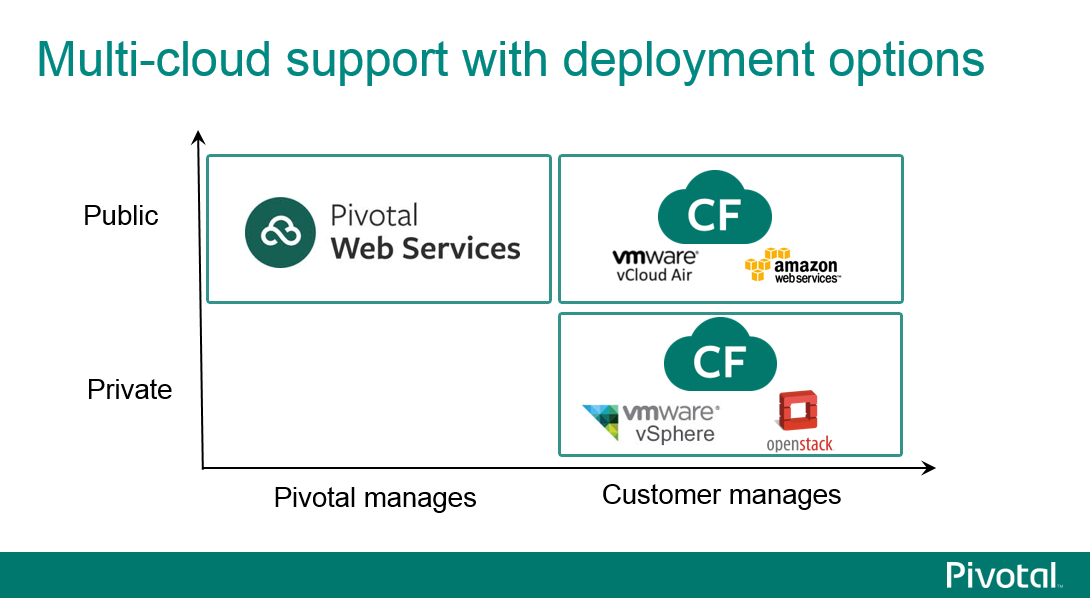
  • BlueMix is the Future – As mentioned above, BlueMix is the PaaS but also the 21st century Rational for IBM, running on premise with the announcement of BlueMix Local. BlueMix is the way how IBM wants customers and developers to build applications, regardless of the deployment and operational model. While BlueMix is based on Pivotal CloudFoundry, it was interesting to see how IBM executives kept stressing how much more IBM had to create around CloudFoundry to make it work for the IBM purposes. And while in the past CloudFoundry was the one and only deployment option, with InterConnect it was clear that IBM considers CloudFoundry only as one of three deployment options, as BlueMix applications can be delivered to run on OpenStack as well as container (Docker – what else) environments. Considering BlueMix is not even one year old (it was launched February 28th 2014) it has made massive progress. A year ago IBM needed partners like Twilio to show standard orientation, partner openness and cool tools, as the vendor had very little functionality / services compared to today… Today BlueMix has over 50 services, and they are not lightweight, but real and key components to build a next generation application.
     
    3 User Categories

    So let’s look at the key BlueMix additions beyond Local / Dedicated (see above and the press release here):
  • Container support – BlueMix goes the trend of time, but not without IBM making the containers ‘enterprise grade’ and containers deployable in a hybrid way.
  • DataWorks comes to BlueMix – Originally a new development from the former InfoSphere family, DataWorks was everywhere with its capabilities to make sense, transform and combine data value added services. Something a PaaS needs, and IBM did well leveraging this asset.
  • Collaborative Operations – With this IBM refers to the management tools for hybrid environments, a logical consequence from supporting hybrid.
  • Orchestration – Vendors that support hybrid deployments create an orchestration problem, and IBM does well addressing that.
  • Security – Always a potential concern and IBM is bringing its security assets to BlueMix, powered by analytics that predict threats and vulnerabilities.
  • Secure Passport Services – When enabling hybrid operations, another set of security issues is introduced, using the passport concept to regulate what users are allowed and now allowed to do is a key consequence of supporting hybrid.
  • API Harmony – No conference without API management these days and IBM is adding this service to BlueMix, too.
  • Watson Zone – Watson brings a significant attraction and differentiation to BlueMix and IBM is shrewd at leveraging this capability in the new BlueMix Watson zone.

So overall good progress with BlueMix, which has focused IBM’s effort more than any development platforms of the last years. The bigger work that is happening behind the scenes is that IBM is working hard to realize the vision it laid out almost two years ago, with the API economy direction. And while BlueMix can consume existing and create next generation application APIs, IBM still needs to make APIs available for its 100+ product SaaS portfolio. And the code and deployment behind these applications needs to become more elastic to allow for cost efficient operations. Moreover IBM is active at signing up data provider partnerships, though it has stopped short of declaring that it is in the DaaS (Data as a Service) game (maybe we see at Insights 2015?).


Analyst Tidbits

  • Has Watson stalled? In contrast to Insights 2014 we saw only little progress on the Watson side. And maybe the InterConnect dates came at a bad timing for the product, but it was disappointing to see the same partners and customer on stage at InterConnect as at Insights. And an exclusive Healthcare focus as in the keynote does not do a good service to the potential of Watson, something that was corrected in more detail sessions, but you only have one chance to make a keynote impression. More Watson APIs and Services in BlueMix is certainly the right direction, as it helps Watson adoption and gives BlueMix a unique differentiator in the PaaS market. And maybe we analysts just have too high expectations for Watson, the engineering challenges behind Watson are certainly not trivial.
Watson at MD Anderson Cancer Center
  •  IBM Design is on track for its massive objective – It is around 2 years that IBM has started a push into the design space. The vendor has raised its profile in the creative and design community that is taking note of new developments like the IBM Design Language and a massive hiring drive. Like all vendors IBM has to address the challenge to move 100s of products and development teams and it has opted into a central hiring and training model that later embeds the designers with the product teams. It was good to see what thought has been put into putting designers into the right locations, work environment and review processes. In the past many UI initiatives at many vendors have fizzled, faced with the sheer enormous task. But the ongoing IBM effort is roughly 1/3 on the way in terms of product team reach, and the first results are encouraging.
SoftLayer expanding global footprint
  • SoftLayer keeps plowing on – IBM announced new recent locations, as usual and seems to be on track for the declared 48 locations by end of 2015. When IBM finds something that works for its customers, it puts its weight behind it, and SoftLayer is a great showcase for that. The need for finding load remains and IBM keeps signing up large deals, but by mid-year it will really be time for a load check on how much runs in SoftLayer across the world. The addition of Power and Watson services will certainly help, with Watson IBM has the option to create a unique environment to operate cognitive (aka performance sensitive and potentially data sensitive applications) applications more locally around the world than any competitor. And the addition of container support in BlueMix allows for the operation of unique applications where the code comes to the data, not the classic model of the data having to find the code.
Tables + Power = Happy Analysts!

MyPOV

A good event for IBM, as with all first time conferences attendees struggle with change, but bringing three conferences together is the right step in my opinion. There is too much overlap between the constituents of line of business, IT and developers on the product side not to have these groups together – they need to work as a team in their day to day jobs at enterprises anyway. Sending them to separate events is counterintuitive and counterproductive to a certain point. Now IBM needs to work on a format to make each constituent group happy and engaged at the event. Developers remains the smallest group attending from my observations. I am not sure if IBM has fully tapped into the large rational developer base yet and needs to find ways to tap more into the large developer pools out there.
 
On the product side we did not see major, major announcements like in 2014 (BlueMix, Watson GA, Marketplace etc.) – but that is a good sign, as IBM focusses on creating additional value for customers and taking customers live. Apart from new concerns around Watson progress it is encouraging to see how fast IBM is moving in the last quarters.
 
On the bigger picture IBM needs to use the time as traditional (hardware) competitors have not become fully operational in their cloud business. When those competitors find their stride it will be interesting how much of a lead IBM has been able to create and how much traction it has established in the coveted enterprise market. Stay tuned. 
 
Check out my colleagues takeway - they defintively beat me in video (Ray - here) and pictures (Alan - here).
---------- 
 
More on IBM :
 
  • First Take - IBM InterConnect Day #1 Keynote - BlueMix, SoftLayer and Watson - read here
  • News Analysis - IBM had a very good year in the cloud - 2015 will be key - read here
  • Event Report - IBM Insight 2014 - Is it all coming together for IBM in 2015? Or not? 
  • First Take - Top 3 Takeaways from IBM Insight Day 1 Keynote - read here
  • IBM and SAP partner for cloud - good move - read here
  • Event Report - IBM Enterprise - A lot of value for existing customers, but can IBM attract net new customers? Read here
  • Progress Report - The Mainframe is alive and kicking - but there is more in IBM STG - read here
  • News Analysis - IBM and Intel partner to make the cloud more secure - read here
  • Progress Report - IBM BigData an Analytics have a lot of potential - time to show it - read here
  • Event Report - What a difference a year makes - and off to a good start - read here
  • First Take - 3 Key Takeaways from IBM's Impact Conference - Day 1 Keynote - read here
  • Another week and another Billion - this week it's a BlueMix Paas - read here
  • First take - IBM makes Connection - introduces the TalentSuite at IBM Connect - read here
  • IBM kicks of cloud data center race in 2014 - read here
  • First Take - IBM Software Group's Analyst Insights - read here
  • Are we witnessing one of the largest cloud moves - so far? Read here
  • Why IBM acquired Softlayer - read here
 
Find more coverage on the Constellation Research website here.
2012, 2013, 2014 & 2015 (C) Holger Mueller - All Rights Reserved


Tech Optimization IBM HP softlayer Google amazon Oracle Microsoft SaaS PaaS IaaS Cloud Digital Transformation Disruptive Technology Enterprise IT Enterprise Acceleration Enterprise Software Next Gen Apps IoT Blockchain CRM ERP CCaaS UCaaS Collaboration Enterprise Service Chief Information Officer Chief Technology Officer Chief Information Security Officer Chief Data Officer Chief Executive Officer

IoT Solution Building; Managing and Using Operational Data to change the game!

IoT Solution Building; Managing and Using Operational Data to change the game!

Your enterprise relies on sophisticated management of its manufacturing processes together with its network of sub contractors to utilize expensive assets. Increasingly you need to improve the cohesive operational management in response to calls for more ‘agility’ in responsiveness to market demands. Q. How do you really get the operational game change needed by using real-time IoT sensing data?

Research report now available: The Foundational Elements for the Internet of Things (IoT)

A. The key lies in utilizing ‘Operational’, or ‘Industrial’, data that describes machine, or other physical activities, as opposed to the process transaction recording data of IT. The manufacturer of a complex machine wants to monitor and record data about a series of operating parameters that relate to both setting, and managing, its operational efficiency.  The parameters and formats this requires are simply not the same as the data created and used by Enterprise IT applications. This difference introduces new terms to describe both the data itself, and the application of Internet of Things in this environment.

Terminology for this new environment would describe; Using the ‘Industrial Internet of Things’, IIoT, to manage with ‘Operational Data’ in an ‘Industrial Technology’ environment. Other terms in use include The ‘Industrial Internet’ referring to an US alliance started by General Electric, and ‘Industry 4.0’ started as an alliance of leading German manufacturing companies, but now including other European manufacturers.

There are numerous ‘standards’ emerging all of which focus on creating a data model with a dictionary that suit a particular industry, or type of application. A list of six major ‘standards together with their major technology vendors supporters can be found here, this is not an exhaustive list, but does show the some of the mainstream generic standards together with their major technology supporters.

Before getting into the detailed data aspects it is useful, or even necessary, to have gained a bigger picture of how sensors are connected in order to provide the data. The proceeding blog entitled IoT; Solution Architecture; Network Integration Groups and Fog Computing. provides this overview and is recommended reading. The blog on The Enterprise Digital Business Platform similarly provides good background on how Enterprise Architecture integrates IoT, or IIoT sensing, and other Internet based Front Office activities with Information Technology Back Office Enterprise Applications.

However, first moves into gaining the advantages of IoT, and IIoT data can be obtained relatively simply by using one of the ‘solution packages’ offered by Salesforce, SAP, and others. These provide for a number of permanently connected sensors on the customers own network using suitable, predetermined, formatted data outputs that support direct coupling to their products. These may be to a Services Hub to remain in the Front Office Services environment, or to feed data into a Back Office ERP suite. This closed internal use is often thought of as the ‘Intranet of Things’ due to the resemblance to first generation Internet based technologies of the past always starting as controlled local deployments on in-house networks.

The whole reason for adopting Internet based technology is to create ‘open’ environments that effectively scale externally, therefore the first generation ‘proprietary’ defined direct data connectivity deployments of the Intranet of Things quickly move to require access to a wider range data from increasingly specialized Internet of Things, or Industrial Internet of Things sensors. Data Models and a new form of Data Translation quickly becomes an important issue.

Various names are used to describe the challenge of collecting and rendering usable the data from a wide range of different types of IoT/IIoT sensors, ranging from ‘the final mile problem’, ending up with the more accurate description of the issue as requiring ‘Intelligent Integration’. A further term that defines the solution, and is easier to understand, is the use of an ‘Inter-Layer’ between the sensors, and the services, servers, or other destination devices, that collects, transforms, buffers and forwards the data when required in the format of the request.

There is an important first step in deployment before the data even starts to flow and that is to find, and align, relevant legacy data to provide the contextual information about each sensor and its location. As this data will be spread across the Enterprise in many different applications this is a costly and time consuming activity that needs to be included into the deployment cost cycle. It can be performed by a specialized set of tools or service provider to both drastically reduce both the cost and time; failure to do so can reduce, or defer, the cost benefit of large scale IoT/IIoT deployment.

The ‘Alignment of Sensors’, during deployment is a seldom-mentioned start-up cost and to gain a good appreciation of exactly what alignment delivers, and why it is important, the demonstration of ‘Aligned Sensors’ shown in this Building makes the point clearly. The three examples show the creation of a physical location, usually required to be a graphical display simply to make recognition faster and easier, followed by the alignment of existing data to the sensor. This data might include full details on the sensor itself including its data types and formats, but there will be a great deal of relevant data in legacy files. This might, as an example, include details on the machine type, its history, any service contracts, and similar data that will help to place context on the real-time data being provided by the IoT/IIoT device.

The task of Sensor Alignment results in what is generically known as Asset Mapping. The second task of the Inter-Layer beyond the primary role of managing data flows and formats, is to ensure that an Enterprise can identify in full all its information about each of its Assets which are deemed important enough to require sensing.

 Asset Mapping tools for Sensor Alignment may in time become part of the developing Enterprise Digital Business Platforms from major Technology vendors, but currently it is usually provided with the Inter Layer from a handful of specialist vendors such as the www.AssetMapping.city the source of the examples. A properly performed Asset Mapping deployment ensures that all IoT/IIoT sensors remain individually recognizable. This then leads to the prime role of the Inter Layer in providing usable data from the entire IoT/IIoT installation regardless of type and format, together with control over who may access what sensor data under what conditions.

IoT, and IIoT, devices will produce massive amounts of data, many analysts suggest huge, almost unmanageable, amounts, in reality most of this data will only be used after an event has occurred to provide the context as to why it and how it occurred.  The Inter-Layer also manages short-term buffering for the stream of small data direct from the sensors, consolidating and forwarding this data in blocks to be processed more efficiently.

There are three standard conditions that result in this collated data file in the buffer being sent to a nominated receiving Service, or Application. Firstly, and most obvious, is a preset trigger on an individual sensor, or a collective threshold on a group of sensors, being exceeded. The resulting data forward may be for the individual sensor, or more likely for a Network Integrated Group, (see proceeding blog on Fog Computing), of sensors that will help provide a broader, context on the circumstances surrounding the individual sensor data. At triggering event can also result in a shift from collating data to real-time forwarding of data from the selected sensors to allow continuous monitoring.

The second standard condition uses time stamped forwarding at pre-selected intervals such as once an hour, or once a day, for stable conditions where longer-term trends are of interest. In first generation Intranet of Things and Industrial Internet of Things this is the most likely sensing condition to be deployed.

The third type of request is a reverse of the first, created by an event at the receiving Service, or Application resulting in a call for the data file to be forwarded, and possibly a shift into real-time sensor data forwarding. This may be referred to as ‘taking the query to the data’ as it can be used to gain access to selected data without creating huge volumes of low value data flooding across the Network. Proactive requests from Services, and Applications as a crucial part of dynamic operational management is set to grow in importance. As the Internet of Things becomes established with a growing number of sensors accessable as part of sophisticated activity management. This relates to the example provided in the previous blog IoT; Solution Architecture; Network Integration Groups and Fog Computing.

The diagram below is taken from this blog and was used to illustrate how sensors are discovered, integrated into a Network Integration Group, to be a virtual network that relates directly to the activity of a single factory call off. This process would be repeated for other call offs, or any other process activity that gains from real-time, or near real-time data monitoring of process.

Building onto this the Operational data flow as outlined in this blog together with the use of the three standard conditions for data forwarding would present the following addition to the scenario;

  1. Time stamped forwarding would be used as routine background monitoring to make sure that progress of IoT/IIoT sensed activities were in line with planned expectations, and crucially match the planned manufacturing production schedule.
  2. If the logistics truck became caught in a traffic jam and fell behind schedule then a trigger event would result in notification to the Manufacturing Production scheduler.
  3. This would result in the Manufacturing Production scheduler requesting data to be forwarded from other call offs in order to plan a re scheduling of planned production based on their availability projections.

First generation deployments of IoT, and IIoT, sensing is straight forward resulting in immediate, usually impressive gains, though Asset Mapping and Sensor Alignment may be an unexpected, possibly costly, element. However, as with all rapidly developing technology that is forming the basis for transforming business capabilities it is necessary to have a broader understanding of the direction and types of capabilities that will be emerging.

In particular with any Internet based technology, where a significant part of the benefit in the longer term will be through external connectivity to gain participation with others, the importance of ensuring that your approach will not turn into a barrier preventing longer term advantageous capabilities, makes an understanding of direction absolutely critical.

Research report now available: The Foundational Elements for the Internet of Things (IoT)

Tech Optimization Data to Decisions Future of Work Innovation & Product-led Growth New C-Suite Chief Information Officer

Social Business / Collaboration Vendor List

Social Business / Collaboration Vendor List

Future of Work Data to Decisions Innovation & Product-led Growth New C-Suite Marketing Transformation Next-Generation Customer Experience Digital Safety, Privacy & Cybersecurity Chief Information Officer Chief Digital Officer

New Research: Inside the 9 Cloud Trends Every CXO Needs to Know in 2015

New Research: Inside the 9 Cloud Trends Every CXO Needs to Know in 2015

Last week I published a report, Inside the 9 Cloud Trends Every CXO Needs to Know in 2015. This report assesses the state of the cloud market and identifies nine trends influencing cloud technology.


Here’s an excerpt of the report. Over the next few weeks I’ll dive into detail on the trends outlined below.

Consumption at the Pace of Innovation Requires Adoption of the Cloud

Changes driven by innovation have affected IT since its very inception. Whenever a piece of hardware or software gets released to the enterprise, most vendors of these products are already working on the next release if not the next generation of these products. The result – generally available products are already “old” when released. Consequently, all constituents in the market know that the next and better product is right around the corner.

However, enterprise technology leaders must invest at some point with a bet on a distinct combination of hardware and software to accomplish their current and future business objectives. As of a decade ago, these projects required a sizeable capital expenditure (CAPEX) investment with a planned lengthy write-down period. Hence, IT leaders would cling to their IT infrastructure for as long as they could.

With Software as a Service (SaaS), leaders found an alternative to owning applications. Enterprises rejoiced at no longer having to pony up funds for large capital expenditures to purchase perpetual licenses. In fact, organizations celebrated access through subscription. CAPEX was saved, despite the fact that the behind-the-scenes hardware infrastructure of vendors was highly proprietary and tuned to the nature of their SaaS offerings. Only later did stand-alone Infrastructure as a Services (IaaS) offerings come into place.

To a certain extent, the IT world has come full circle. It was a best practice for owners of mainframes in the 1950’s, 1960’s and even 1970’s to rent out excess capacity of their mainframes to interested third parties. Today, the very same effect happens in the public cloud, with the difference that the providers have invested into their IT infrastructure for the sole purpose of renting it out. A number of now defunct players were doing the same last century - buying mainframes with the purpose of renting them out to other enterprises. With the public cloud here to stay, a business model emerges that actually is very familiar to IT leaders of two generations ago.

Looking ahead, Constellation identifies nine key trends in the state of the cloud for 2015:


Read more about the report: Inside the Nine Cloud Trends CXOs Need to Know in 2015

Download a snapshot of the report

Download Report Snapshot


Stay tuned. Next week I’ll dive deeper into the trends above.


Tech Optimization Data to Decisions Digital Safety, Privacy & Cybersecurity Innovation & Product-led Growth Future of Work HP Oracle Google IBM amazon Microsoft SaaS PaaS IaaS Cloud Digital Transformation Disruptive Technology Enterprise IT Enterprise Acceleration Enterprise Software Next Gen Apps IoT Blockchain CRM ERP CCaaS UCaaS Collaboration Enterprise Service Chief Information Officer Chief Technology Officer Chief Information Security Officer Chief Data Officer Chief Executive Officer

Drones still useful in supply chains despite FAA regulations

Drones still useful in supply chains despite FAA regulations

Last week the FAA (Federal Aviation Administration) published their rules and regulations for the oversight of drone usage within the United States. Many will and have argued that these rules are too restrictive for companies such as Amazon or Google to truly take advantage of the technology. The basic parameters of the guidelines set by the FAA:

  • Drones must be less than 55 lbs in weight
  • Can only fly during the day in good weather
  • Must not fly close to airports
  • Cannot fly faster than 100mph
  • And must be within visible site of the operator

On the surface these restrictions severely limit the dreams of the likes of Jeff Bezos. One of the great opportunities for drones within the supply chain and particularly with the delivery side – is the ability to enhance the last mile portion. The last mile is always a challenge since you have to break down the orders to the individual level. Drones seem to offer a affordable and flexible solution – but not necessarily if the FAA rules are in place. This does not mean there are not some use cases that supply chains can take advantage of immediately:

  • Asset monitoring – this is already taking place in agriculture, oil & gas, mining to name a few. Drones provide the flexibility for activities such as survey work, monitoring of assets, determining crop growth etc. In countries such as Australia, mining companies are already leaning heavily on the pilot-less aircrafts to assist with the activity on the ground. By some estimates the usage can save close to 90% of the $2000 an hour cost for a helicopter.
  • Remote delivery: Logistics firms such as DHL have been able to expand their reach via drones. The ability to connect remote German islands in the North Sea has enhanced the remote locations with a more regular delivery service. Of course these drones are clearly flying outside of site lines of the operator.

These use cases are not necessarily replicable under the FAA rules. However I have to believe that as the technology continues to evolve the FAA will loosen their grip on the regulations. So what could we expect from more open drone rules? If and when the drone rules become more open here are some opportunities that supply chains might enjoy:

  • Smaller window of delivery for certain items. Think of Kozmo.com with drones rather than people on bicycles. Companies from Amazon to CVS to Giant Eagle to Five Guys will be able to deliver a whole host of items to your door at the drop of a hat. Well maybe not that fast. But why couldn’t books or other items from Amazon be delivered within the hour? Or CVS deliver your prescriptions. Giant Eagle your groceries and Five Guys your cheeseburger. Once drones become a more viable delivery extension of the supply chain, look for businesses to take advantage of the new reach this provides into the home.
  • Untethering the consumer from a physical address. Drones, coupled with the explosion of mobile, will allow delivery systems to ignore the limitations of roads and physical addresses. Today deliveries rely on infrastructure such as roads, as well as fixed addresses in order to manage delivery of goods. What happens when you have a drone that has far fewer restrictions? Couple this with a mobile device that is provides the digital location of the recipient. Your mobile can send the drone the exact coordinates, GPS, and the drone can then fly its way to your location. We will not longer have to worry about having a package delivered to our home or office…we can just tell it what time to deliver it to us as it hones in on your GPS coordinates.

I realize these changes are a ways off. But these are examples of how the supply chain will be expanded beyond the traditional links – loading dock, retail store to name a few. These types of digital disruptions will begin to turn  our homes into an extension of our supply chains.

Now I wonder where I should build my drone landing pad… 

Resources

The State of Retail in 2015 and Beyond

Download Report Snapshot

The State of Post Sale Commerce

Download Report Snapshot

The State of Supply Chain Management

Download Report Snapshot


Matrix Commerce Google amazon Chief Customer Officer Chief Information Officer Chief Supply Chain Officer

First Take - IBM InterConnect Day #1 Keynote - BlueMix, SoftLayer, Watson

First Take - IBM InterConnect Day #1 Keynote - BlueMix, SoftLayer, Watson

It is end of February and it is time to make it to Las Vegas for IBM InterConnect, the new mega IBM event, combining three separate previous events. Spanning from Mandalay Bay to MGM Grand it will for sure get those health tracker stats up – but better one mega event than 3 trips… 


Here are my Top3 takeaways

PaaS keeps rolling - On the BlueMix side IBM announced key new capabilities for its PaaS product. DataWorks is a nice re-use from its data management group, which makes it easy to move, cleanse, mask (and more) data. In the demo data was then uploaded to the cloud and enriched with the capabilities of Cloudant. With API Harmony it will get easier for developers to publish and leverage APIs. Finally the local deployment option will be a welcome option for regulated industries, enterprises that hold out for cloud, but also sister applications that complement cloud applications with handling local processing
 
Jerry Cuomo built a nextgenApp with BlueMix

SoftLayer keeps rolling – IBM confirmed to be on track of the close to 50 data center location rollout in 2015, just announcing Montreal and Sydney as the next locations. When using the new container capabilities and BlueMix local it open new options for enterprises to deploy nextgen Apps locally – satisfying statutory demands (and potential out of country data center concerns). Moreover IBM is bringing its Power servers to more data centers, which is key for IBM's converged system strategy. It will be interesting to see how much load Power will run in the IBM Cloud by summer.
 
The growing #SoftLayer network

Watson pushes into healthcare – It looks like IBM wants to make healthcare the main thrust for Watson’s capabilities, certainly a noble cause. It was back to Coriell Life Sciences as partner to explain their approach – but it would have been good to see the next set of partners taking IBM Watson into healthcare. At the very end we learnt that Watson will be available as a Watson Zone in BlueMix. 
 
The NextGen App built with Watson and BlueMix (?) at MD Andersen
Cancer Center
MyPOV – A great start for the new IBM mega event, IBMInterConnected – bringing together the former IBM Impact, Pulse and Innovate conferences. A ton of announcements that we will try to take apart and validate with prospects, customers and partners in the next days. Stay tuned.
 
 
---------- 
 
More on IBM :
 
  • News Analysis - IBM had a very good year in the cloud - 2015 will be key - read here
  • Event Report - IBM Insight 2014 - Is it all coming together for IBM in 2015? Or not? 
  • First Take - Top 3 Takeaways from IBM Insight Day 1 Keynote - read here
  • IBM and SAP partner for cloud - good move - read here
  • Event Report - IBM Enterprise - A lot of value for existing customers, but can IBM attract net new customers? Read here
  • Progress Report - The Mainframe is alive and kicking - but there is more in IBM STG - read here
  • News Analysis - IBM and Intel partner to make the cloud more secure - read here
  • Progress Report - IBM BigData an Analytics have a lot of potential - time to show it - read here
  • Event Report - What a difference a year makes - and off to a good start - read here
  • First Take - 3 Key Takeaways from IBM's Impact Conference - Day 1 Keynote - read here
  • Another week and another Billion - this week it's a BlueMix Paas - read here
  • First take - IBM makes Connection - introduces the TalentSuite at IBM Connect - read here
  • IBM kicks of cloud data center race in 2014 - read here
  • First Take - IBM Software Group's Analyst Insights - read here
  • Are we witnessing one of the largest cloud moves - so far? Read here
  • Why IBM acquired Softlayer - read here
 
Find more coverage on the Constellation Research website here.


Data to Decisions Digital Safety, Privacy & Cybersecurity New C-Suite Tech Optimization Innovation & Product-led Growth Future of Work Next-Generation Customer Experience Oracle IBM softlayer Google amazon Microsoft AI Agentic AI LLMs Generative AI ML Analytics Automation SaaS PaaS IaaS Cloud Digital Transformation Disruptive Technology Enterprise IT Enterprise Acceleration Enterprise Software Next Gen Apps IoT Blockchain CRM ERP CCaaS UCaaS Collaboration Enterprise Service Chief Financial Officer Chief Information Officer Chief Supply Chain Officer Chief Digital Officer Chief Executive Officer Chief Technology Officer Chief AI Officer Chief Data Officer Chief Analytics Officer Chief Information Security Officer Chief Product Officer