This list celebrates changemakers creating meaningful impact through leadership, innovation, fresh perspectives, transformative mindsets, and lessons that resonate far beyond the workplace.
Vice President and Principal Analyst
Constellation Research
Holger Mueller is VP and Principal Analyst for Constellation Research for the fundamental enablers of the cloud, IaaS, PaaS and next generation Applications, with forays up the tech stack into BigData and Analytics, HR Tech, and sometimes SaaS. Holger provides strategy and counsel to key clients, including Chief Information Officers, Chief Technology Officers, Chief Product Officers, Chief HR Officers, investment analysts, venture capitalists, sell-side firms, and technology buyers.
Coverage Areas:
Future of Work
Tech Optimization & Innovation
Background:
Before joining Constellation Research, Mueller was VP of Products for NorthgateArinso, a KKR company. There, he led the transformation of products to the cloud and laid the foundation for new Business Process as a…...
We had the opportunity to attend Kronos' yearly user conference, Kronos Works, held from November 4th till 7th 2018 in Las Vegas at the Aria Resort. Attendance was similar like the year before with 3k+, usual influencer presence.
Prefer to watch – here is my event video … (if the video doesn't' show up – check here)
Here is the 1 slide condensation (if the slide doesn't show up, check here):
Kronos is doing really well – The vendor has record results and is doing well. That is remarkable, as it just has created a new product on a new platform and is moving customers towards it… while making the bulk of revenue on the old platform, that the vendor still supports. A 'dance' few vendors manage to dance without a revenue dip, so remarkable and kudos to the Kronos team.

Kronos is in HCM – For the longest time, Kronos has played the role of 'Switzerland' when it came to HCM vendors, providing them with Time and Attendance as well as Workforce Management capabilities. That has worked well for Kronos, who has become the proverbial "800-pound gorilla" in Workforce Management. With Kronos now competing, it will be interesting how the HCM vendors will react. Lack of good workforce management solutions that are standalone and customer install base are all key factors helping Kronos at the moment.
Aimee is Kronos' AI assistant – Somewhat late, but better late than never, Kronos unveiled Aimee, it's AI assistant. She will debut in 2019 and help people with 4 AI uses cases, that are the typical initial load of vendors getting started.
Workforce Dimensions has good traction – Launched last year, Kronos new flagship product suite, Workforce Dimensions is doing well, and has now 220 customers, fewer live, more implementing… for the count being at 10 implementing 12 months ago – that's very good progress.
Maintenance ROI – The key for Kronos doing well overall is that it keeps creating value for the customers on Workforce Central and Workforce Now. Taking a cue from the Oracle Apps Unlimited strategy (former Oracle executive Ron Wohl is an advisor) – Kronos is providing a rich roadmap for Kronos customers on the existing, older products. This takes the typical upgrade pressure out of the process and allows customer to upgrade at their own schedule, while not being 'stranded' on an old solution that see no longer advancement (as often the case in the enterprise software industry.
MyPOV
Kronos is doing well and is on a roll. The verdict on the HCM move is still out, but it was a logical step that Kronos had to take – to keep growing. CEO Ain negated the intention long enough, but now more than the writing is on the wall. Kronos customers like the move in general… they know that workforce management is key and usually most complex piece in their HCM automation puzzle… so it is relatively easy to expand into HR Core and Payroll… Roadmaps are rich, and customers are excited on what is to come… always an advantageous position for any vendor to be in.
On the concern side, Kronos needs to accelerate on the AI side, it is relatively late with Aimee and it needs to come up with a voice driven UI, which is key for end users. That is all not too far away for Kronos, but it needs to happen. Moving from Workforce Management to HCM means that vendors cannot hide under the complexity and compliance blanket but must show some style and appeal to motivate users… and we are not even talking Talent Management here. Kronos also needs to get their buying center to step up inside the HR buying center, quite a change for the current Kronos supporters.
But overall an impressive event, Kronos is on a roll, partners are interested, users energized. Interesting 12 months to come. Stay tuned.
Want to learn more? Checkout the Twitter Moment below (if it doesn't show up – check here).
Principal Analyst and Founder
Constellation Research
R “Ray” Wang is the CEO of Silicon Valley-based Constellation Research Inc. He co-hosts DisrupTV, a weekly enterprise tech and leadership webcast that averages 50,000 views per episode and blogs at www.raywang.org. His ground-breaking best-selling book on digital transformation, Disrupting Digital Business, was published by Harvard Business Review Press in 2015. Ray's new book about Digital Giants and the future of business, titled, Everybody Wants to Rule The World was released in July 2021. Wang is well-quoted and frequently interviewed by media outlets such as the Wall Street Journal, Fox Business, CNBC, Yahoo Finance, Cheddar, and Bloomberg.
Short Bio
R “Ray” Wang (pronounced WAHNG) is the Founder, Chairman, and Principal Analyst of Silicon Valley-based Constellation…...
The Future Of The Internet And Human Rights In A Digital Age
In an era where some believe privacy is dead and that human rights will be taken over by dystopian AI, the pioneers of the internet are convening on the 70th international human rights day to talk about the future of the internet and human rights in a digital age. By December 10th, 2018, almost 50% of the world will have access to the internet just as the world celebrates the 70th anniversary of the universal declaration of human rights by the United Nations.
Vint Cerf's non profit, the People Centered Internet is working with the Web Foundation and Constellation Research to convene many of the early Internet pioneers to not only share the lessons of how we got here, but more importantly determine where we need to go for the next 50 years. The conversations from this historic opportunity on December 10th, intend to raise a call to action in addressing this issue.
Key highlights of the event include:
A call to action by Tim Berners-Lee and Vint Cerf
Unveiling of the latest World Economic Forum report on Digital Economy and Society
Recognition by the United Nations as an official 70th anniversary event
Ready to start a discussion on the future of the internet? Where do you see human rights in a digital age? We’re more than happy to take a call and provide some perspective. Add your comments to the blog or reach me via email: R (at) ConstellationR (dot) com or R (at) SoftwareInsider (dot) org.
Please let us know if you need help with your Digital Business transformation efforts. Here’s how we can assist:
Developing your digital business strategy
Connecting with other pioneers
Sharing best practices
Vendor selection
Implementation partner selection
Providing contract negotiations and software licensing support
Demystifying software licensing
Negotiating your ServiceNow contract
Selecting and negotiating with competent implementation partners.
Reprints can be purchased through Constellation Research, Inc. To request official reprints in PDF format, please contact Sales.
Vice President and Principal Analyst
Constellation Research
Holger Mueller is VP and Principal Analyst for Constellation Research for the fundamental enablers of the cloud, IaaS, PaaS and next generation Applications, with forays up the tech stack into BigData and Analytics, HR Tech, and sometimes SaaS. Holger provides strategy and counsel to key clients, including Chief Information Officers, Chief Technology Officers, Chief Product Officers, Chief HR Officers, investment analysts, venture capitalists, sell-side firms, and technology buyers.
Coverage Areas:
Future of Work
Tech Optimization & Innovation
Background:
Before joining Constellation Research, Mueller was VP of Products for NorthgateArinso, a KKR company. There, he led the transformation of products to the cloud and laid the foundation for new Business Process as a…...
Taking a look back, we had the chance to attend AWS reInvent in Las Vegas in 2017. The conference grew beyond the original limits of the Sands Convention Center and sprawled all over Las Vegas - from the Mandalay Bay all the way to the Encore. reInvent has become the get together of the IT industry, effectively wrestling that crown from VMware's VMWorld. As we head into the 2018 event, let's reflect on my observations and analysis from last year. I'll cross compare and share my insights from this year's event soon.
Prefer to watch – here is my event video … (if the video doesn't' show up – check here)
Here is the 1 slide condensation (if the slide doesn't show up, check here):
4 Key Product Developments People Leaders need to track
Global Cloud Connect – Simplify Payroll Integration
AWS has used re:Invent conference as platform to launch new instance types – and 2017 was no exception: There is a new, general purpose instance with the new EC2 M5, that uses the new Nitro Hypervisor, giving customers more compute and memory than the older machines (see Fig #1). Bowing to the storage trends, AWS started a new instance line with EC2 H1, optimized for high disk throughput and high sequential disk I/O for very large data sets. And in preview, AWS is providing EC2 Bare Metal instances, something previously not expected, but likely a by product of the VMware partnership, and of course a great way to access hardware features (like all bare metal services). On the pricing side, AWS unveiled a new spot pricing model and is now offering hibernation for spot instances.
Figure 1 – Andy Jessy and all AWS instance types
Source: Twitter, @holgermu
Constellation POV:Necessary new instance innovation by AWS, but less than usual. Likely instance development cycles and the re:Invent schedule may not have aligned. But an era to watch. On the flipside CxOs will be happy if they number of instance types will reach a stable level, and with that make the choice, selection and operation of instance types a more stable business. In the past each instance type would cause a little bit of a 'head stir' to CxOs responsible for AWS deployments in regards of optimal allocation of budget vs. compute. Less new instance types and more learning will create a higher comfort level for CxOs to operate on the right instance mix in AWS. AWS did also not address the general instance refresh it promised in spring of 2017 around the S3 caused service disruption[i]. An opportunity to address this important housekeeping item that all IaaS vendors need to address – has been missed. And with that the opportunity to set the standard in the hardware replacement / refreshment debate that is going to happen soon given the general maturation of the industry.
Kubernetes becomes a 1st class citizen for AWS
At the core of IaaS providers are their methods to virtualize instances, achieved with hypervisors. Beyond hypervisors the questions are how can containers be managed efficiently at scale. And as IaaS load moves to microservices, the AWS answer was Amazon Elastic Container Service (ECS), but Amazon had to pay tribute to the rising popularity of Kubernetes, and announced Amazon Elastic Container Service for Kubernetes (EKS). Amazon ECS for itself has done well with user growth up over 450% since 2016 and over 100k active clusters managed by the service and customers launched hundreds of millions of containers each week. Nonetheless Amazon had to pay tribute to the popularity of Kubernetes, not being tired of mentioning that AWS runs more Kubernetes load than anybody else in the cloud. Amazon EKS provides a Kubernetes control plane that is highly available (HA) with three masters across three availability zones (AZs).
And with more container options, AWS also announced AWS Fargate (see Fig. #2), taking care of the often-arduous infrastructure management under a control plane for containers. Fargate supports ECS today, and support for EKS is planned in 2018.
Figure 2 – Andy Jassy announces AWS Fargate
Source: Twitter @holgermu
Constellation POV:At the end of the day, IaaS providers, like AWS, need to scale and scale comes from load that enterprise can / want to run on the respective IaaS. When certain forms of load, in this case Kubernetes container load become critically popular, IaaS providers – no matter how large – need to adopt the new form of load in order to participate in the potential growth. And even very large, even market leading IaaS providers like AWS need to acknowledge the popularity with EKS. Good for enterprises, that have compatible container support for Kubernetes across the popular IaaS infrastructures. Apart from cost, the competition now moves to ease of use of running these container loads, and there AWS has a made a good start with Amazon Fargate. Not surprisingly Amazon Fargate starts with ECS, pointing to the more recent addition of EKS, but with EKS support coming in 2018, this is history.
Databases remain key
One functional area that anchors enterprise load are databases, and Amazon knows that well, offering a large variety of database options on AWS. The one that recently had gotten the most attention has been Aurora, launched a few years ago. Every year Aurora sees new enterprises grade features being added and re:Invent 2017 was no difference, with Andy Jassy unveiling Aurora Multi-Master capabilities, that allows to run Aurora across multiple AWS AZs. And AWS also leverages benefits of a distributed system beyond the HA benefits, which are faster write performance across the instances. Moreover, Amazon wants to make Aurora adoption and rollout easier, making Aurora available serverless, in container, with by the second pricing. Both capabilities are projecting Aurora past market leader Oracle (Jassy mentioned RAC), for the first time – so the RDBMS replacement game that AWS is trying to play will get a little more intense in 2018. For now, both capabilities are in preview, which is AWS way of a controlled beta.
On the Amazon DynamoDB front, AWS caters to the enterprise demand of having to run more and more global systems, adding the ability of global tables. This is the ability of tables being replicated across global dispersed availability zones, taking care of mutual updates. And as enterprises put global applications on Amazon DynamoDB, they also want more efficient ways to backup data (and with a feature like Global Tables, that gets a magnitude more tricky) so Amazon announcing an on-demand backup for DynamoDB is a key and welcome new feature for Amazon DynamoDB.
Not enough with Aurora, Amazon also launched Neptune (see Fig. 3), its native graph database at re:Invent. Graph databases are seeing a recent renaissance, after being largely replaced by relational systems in the last 40 years. The reason for the rise in popularity of graph databases lies in their inherent capability to model relationship – and relationships matter when capturing complex social relations and IoT things relations. Traversing graphs turns out to be faster, more efficient and intuitive and it's clear that AWS wants to have a slice of the use case, announcing Neptune, AWS own native graph database offering. Neptune supports all the popular open source standard for graph database (Apache TinkerPop Gremlin and W3Cs SPARQL, making adoption easier. For now Amazon Neptune is in preview.
Figure 3 – Andy Jassy announces Amazon Neptune
Source: Twitter @holgermu
Constellation POV:Database are critical load anchors for enterprises. When considering moving an enterprise application to the cloud, the question of database portability, migration and replacement always comes up. Amazon has been playing the long game for databases, understanding the demand and continuing to innovate with its native database offerings, Aurora being the most prominent recent example. Good to see the innovation with Amazon Neptune as well, the graph database use case for next generation applications must have bene substantial and too hard to ignore for AWS not to have a native offering in place… we expect good uptake for Amazon Neptune for several next generation application use cases, most prominently IoT. Good to see the innovation on the DynamoDB side, the need for more global support and out of the box replication is very high on the list when CxOs select platforms and / or databases for next generation applications.
The question remains, when will it be enough of capabilities and AWS will be able to entice enterprises to move to e.g. Aurora with larger workloads. It's clear in the long run there need to be more migrations for AWS database bets to turn off – otherwise a lot on premise load will just go to the respective database vendor's cloud. But too early to tell and CxOs like that AWS keeps trying and keeps giving them options.
Machine Learning - Lots of new offerings - Sagemaker and Deeplens stand out
Machine Learning is the new crown jewel for IaaS providers to attract enterprise load, as enterprises need cheap compute and storage to feed their machine learning models. AWS had to reset its Machine Learning approach and strategy in 2016 when it re-positioned to MXNet. But at re:Invent MXNet did not feature very prominently either anymore. Instead, AWS was proud to mention multiple times that it runs the most TensorFlow models in the industry. More specifically, AWS focused on making it easier for enterprise and developers to become builders of machine learning modes, a general trend amongst IaaS providers. To that purpose, AWS made available Amazon SageMaker (see Fig. 4), its product to help both developers and data scientists to build, train and deploy machine learning models. We had time get a detailed demo and presentations and SageMaker is a sold V1 for the product category.
To help customers come up to speed with Machine Learning, AWS announced the Amazon ML Solutions Lab. Amazon machine learning experts will help customers come up to speed with AWS machine learning offerings and help to foster first solutions. Good to see AWS helping its install base get their heads and arms around a modern technology that has a lot of promise for much of software. Along the same intentions Amazon also announced the AWS DeepLens, a camera device that helps developers to build machine learning applications around image and video recognition use cases. In true developer ecosystem seed mode, AWS also offered a free AWS DeepLens to any participant of re:Invent who would pass many Machine Learning sessions.
Figure 4 – Amazon SageMaker and functionality it provides
Source: Twitter (@holgermu)
Constellation POV: Good to see AWS making Machine Learning a priority, one of the key areas of automation that is in high demand by enterprises, as it traverses all next generation application use cases. It's also important, as if one had to pick an area of relative weakness towards other IaaS competitors, then it is Machine Learning. Partnerships with other players around Gluon are the right direction to create value for customers. On the tool side Amazon SageMaker is a good start, first version to convert developers into AI developers. A long path, but definitively worth to try. AWS should and could have aimed higher at also targeting the (technically savvy) business users, who in Constellation view is the ultimate prize inmany dimensions: Propel their own business needs, help enterprises to accelerate with AI and give IaaS vendors the massive load from these applications.
Alexa comes to Business
Amazon has seen tremendous success with its Alexa platform. Not only from a design, technology and architecture approach, but also (and remarkably) from a go to market and partner perspective. Alexa stole the show at CES and MWC in 2017, remarkable for a vendor like AWS, who is not used to play big at these events. Partner enablement has also been a very strong point for Alexa.
But so far Alexa was a consumer, focused home appliance. At re:Invent AWS unveiled its more business-related plans with the voice assistant, starting with hospitality industry and business room use cases. Both are compelling usage of voice assistants, getting a hotel room or conference room to do what guests / users want to do is a substantial challenge, as many have experienced firsthand. Amazon has partnered with the Wynn in Las Vegas (see Fig. 5), and took groups of influencers over to the Encore resort, showing how Alex can automate a hotel room: Lights, drapes, TV, media, customer service andmore are working use cases and the roll out at Wynn resorts and other properties are on the way. Of course, Amazon had to provide some enterprise tweaks to the consumer device, such as mass management, updates and user drive resets, just to name a few.
Unfortunately, not shown (or I missed it) was the meeting room automation. Hours of productivity can be missed (multiplied by the number of participants) in meeting settings while participants are trying to figure out conference call and video conference equipment, display and projector management, AV settings and many more. Overall a very powerful use case for voice assistants.
Figure 5 – The announcement of Google as a IaaS and early adopter of Workforce
Source: Twitter (@holgermu)
Constellation POV: A good move by Amazon, keeping its lead with Alexa over the competition. And what was shared wasn't future, but ongoing projects. Once a vendor has technology that is successful, it only makes sense to apply to more use cases and distribute it widely. Especially when a vendor has done so many things right as Amazon with taking Alexa to market, especially with partners. Will be interesting to learn about more use cases and to follow adoption and rollout through 2018. Very much looking forward to sitting in the first voice assisted conference room.
A key AWS mover- an IDE
In summer 2016 AWS acquired San Francisco based startup Cloud9, who had created a cloud (that is browser) based IDE (Integrated Development Environment). AWS now used re:Invent to properly launch the IDE as an integrated offering with the rest of AWS (see Fig. 6).
A cloud based IDE is a powerful tool for developers, as traditionally all software development happened local to a machine. Moving the development artefacts to the cloud allows more points of access and faster sharing of development work. Collaborative aspects are easier to support, and AWS showed those successfully in the keynote at re:Invent. Cloud9 is well integrated into AWS. It supports all the latest FaaS (Function as a Service) development options and it gives direct terminal access to AWS. Finally, AWS has done well to allow developers to come up to speed quickly, as Cloud9 comes with tooling for over 40 programming languages. Provision, wait for servers etc. is not necessary with Cloud9.
Figure 6 – Vogels unveils Cloud9
Source: Twitter (@holgermu)
Constellation POV: A good move by AWS. Developers tend to stick with their IDEs for a long time, and not having an IDE was a gap for traditionally very developer friendly AWS. But IDEs are like living rooms or sofas – once you have moved in, it takes a lot of effort and motivation to move out. AWS provided all the enticements needed: Starting with programming language support and related tooling, it's easier for developers to try new things. Integration into AWS is another strong argument for Cloud9. Last but not least FaaS needs a hook / starting point and that's the IDE. AWS could simply not afford for developers to live in a living room (that is the IDE) from competitors. Future will have to tell how well Cloud9 gets adopted, but for now it is off to a strong start.
The Bottom Line: AWS executes on all fronts, few but key questions remain
Another record re:Invent, that has literally busted out of the seams of the original Sands Convention Center. It is now sprawling all over the Las Vegas strip. With over 60 product announcements, AWS has certainly not slowed down on the innovation side. With over 40000 attendees, re:Invent has overtaken VMworld and is becoming quickly the yearly get together of the IT industry, an advantageous position for AWS and testament to its relevance for enterprises and vendors.
Effectively, AWS is pushing forward on all fronts, instances, databases, serverless and microservices, machine learning, IoT (no space to cover here) and many more. Notably absent was the traditional new product going after the "old guard" vendors (as AWS likes to call them) as we had seen in past years, with AWS launching email, VDI, center and BI capabilities. The verdict is out if AWS management does not see the 1x% profitable software categories to go after, or if product development timelines and re:Invent collided.
We will see at the many AWS Summits coming in the next months.
On the concern side, AWS needs to keep working on simplification / packaging of the portfolio. The good news is that both Jassy and Vogels picked up on the need for better management and bundling, but that strategy has not reflected itself. The challenge for AWS is to transform itself from a developer's paradise into an enterprise platform that can deliver repetitive results to build next generation applications and puts CxO concerns in regards of replicability at ease. That does not mean the end of innovation, but an easier way for CxOs to choose AWS as a platform as it gives / shows repeatable paths to they desired solution.
One of the emerging concerns is around Machine Learning. Expectations that AWS may announces its own neural network and compete with Google's TensorFlow seem unlikely to happen at this point. Who would have thought that AWS would enter multiple partnerships with Seattle neighbor Microsoft on Machine Learning? The risks for AWS are tangible, if any other IaaS vendor can show faster, cheaper and better Machine Learning performance, it will create a magnetic effect on data. And with data goes load, not to mention that Machine Learning itself creates a lot of load. And load is the mother milk of IaaS vendors success.
Overall CxOs who are charged to build next generation applications for their enterprises, have few things not to like when considering AWS. AWS is doing well, often leading in regards of instance and location build out. If offers the largest number of instance types to match to specific load profiles. Its database offerings are maturing fast and becoming quickly a valid alternative to the traditional databases (that AWS is also more than happy to operate). AWS IoT offerings are doing well, combined with its Snowball appliance, that effectively is becoming more and more an application server. Lock-in concerns can be mitigated to a certain point with EKS, given the broad adoption of Kubernetes. AWS has a strong position on serverless and microservices with lambda and Kinesis, key ingredients for next generation applications. AWS and CxOs care for developer productivity, another key alignment and attraction point. The main concern for CxOs remains around their inhouse developer talent, if their team can find the path to a successful enterprise application – relying on their talent and intuition given the innovation maelstrom AWS presents itself as.
But for now, all things look up for AWS. Cloud9 is a strategic move that must pan out more before it can be fully assessed in regards of potential. Keeping developers happy is vital for AWS success. And Alexa's new use cases show with what laser like focus and industrial strength precision Amazon / AWS can execute. If the competition has not been on notice, it is now.
Vice President and Principal Analyst
Constellation Research
Holger Mueller is VP and Principal Analyst for Constellation Research for the fundamental enablers of the cloud, IaaS, PaaS and next generation Applications, with forays up the tech stack into BigData and Analytics, HR Tech, and sometimes SaaS. Holger provides strategy and counsel to key clients, including Chief Information Officers, Chief Technology Officers, Chief Product Officers, Chief HR Officers, investment analysts, venture capitalists, sell-side firms, and technology buyers.
Coverage Areas:
Future of Work
Tech Optimization & Innovation
Background:
Before joining Constellation Research, Mueller was VP of Products for NorthgateArinso, a KKR company. There, he led the transformation of products to the cloud and laid the foundation for new Business Process as a…...
We had the opportunity to attend Ceridian's yearly user conference Insights 2018, held from October 15th till October 19th at Cesar's Palace Hotel in Las Vegas. Attendance was over 3k, a new record for Ceridian, which has outgrown the Aria, the location of previous Insights conferences.
Prefer to watch – here is my event video … (if the video doesn't' show up – check here)
Here is the 1 slide condensation (if the slide doesn't show up, check here):
Good customer and prospect traction. When vendors do well, good things come to them, in form of more market traction. And Ceridian is doing well, signing up more customers, getting more interest of prospects and gaining in the partner ecosystem. It's frequent that I meet passengers on a plane ride to the event town, but I have had not had conversation with three prospects and one client - across seat rows - on the 50-minute short flight from San Diego to Las Vegas. Take it as an indicator for Ceridian traction. Moreover, Ceridian keeps up the impressive performance of actively converting its legacy payroll customers to its new platform, something I am not aware of anyone else doing in the industry at this scale… all signs of product strength resulting in customer traction.
On demand pay debuts, key for underfunded employees. Cash flow remains an issue for many employees in today's economy… it's the season of 'on demand pay' – as pretty much all vendors in the payroll business are delivering instant pay options to employees / workers. The winner is the employee / worker who can request effectively a cash advance on delivered work – before the pay day. It's an important contribution of the industry to get employees / workers out of the claws of the sometimes-shady paycheck advance industry. Behind the scenes the capability first and foremost requires an 'always on' payroll, meaning a payroll that is always ready to show employees / workers what their current and up to date earnings are. To be efficient, the functionality requires a payroll that is 'always on' – continuously updating earnings positions as payroll relevant events happen. This is what Ceridian has since a while (2012 to be specifc), so the technology behind this new capability is already available.
Ceridian goes deeper into Talent with Succession Planning. Ceridian has been on the long-term quest of completing its Talent Management suite capabilities, and with Succession Planning that journey is concluded. Succession Management remains an important, albeit not critical component of Talent Management, so customers and prospects took note, but were not overly excited about the new capability. Nonetheless, good to see Ceridian finishing up the Talent Management Suite capability now having capability for Recruiting, Onboarding, Performance Management, Learning (own and partners), Compensation Management and Succession Management.
MyPOV
Good to see the market traction for Ceridian, who is a vendor that needs to be shortlisted for any workforce management intensive industryas well as payroll selection scenarios (see the Constellation Shortlist here and here). The in-build combination of workforce management, an always on payroll and now a full Talent Management suite, makes Ceridian a very attractive player for enterprises in the industry. Good to see the vendor also getting the user experience in good shape, historically a challenging area of Ceridian.
On the concern side, Ceridian needs to push the envelope in the direction of Machine Learning / AI in general and voice as the new UI more. Last year at the user conference the vendor showed the most impressive voice demos of all HCM vendors in 2017 – a worker talking to Alexa (?) for an understanding of their shift situation and executing a shift swap. No demo this year, the vendor citing keynote time reasons… Behind an effective Machine Learning / AI strategy is the move to public cloud, to be able to leverage cheaper compute, spare capacity, low cost storage and overall compute elasticity. And Ceridian says the Dayforce suite runs on public cloud IaaS (Azure) but needs to move there for good. When the whole industry is moving to IaaS, it's time for all vendors to move there to level the field.
But overall an impressive event, Ceridian is doing well and for now the technology concerns mentioned do not concern customers and prospects, so Ceridian is … on a roll and critical to do what enterprises need to do move - be ready to accelerate and effectively accelerate in order to survive and / or thrive.
Vice President and Principal Analyst
Constellation Research
Holger Mueller is VP and Principal Analyst for Constellation Research for the fundamental enablers of the cloud, IaaS, PaaS and next generation Applications, with forays up the tech stack into BigData and Analytics, HR Tech, and sometimes SaaS. Holger provides strategy and counsel to key clients, including Chief Information Officers, Chief Technology Officers, Chief Product Officers, Chief HR Officers, investment analysts, venture capitalists, sell-side firms, and technology buyers.
Coverage Areas:
Future of Work
Tech Optimization & Innovation
Background:
Before joining Constellation Research, Mueller was VP of Products for NorthgateArinso, a KKR company. There, he led the transformation of products to the cloud and laid the foundation for new Business Process as a…...
We had the opportunity to attend Workday's Rising conference, held from September 30th till October 3rd, 2018, held at the Mandalay Bay resort in Las Vegas. The event had record breaking attendance, in every dimension: Attendees, hotel, partners, expos, conference program etc. always a sign of a growing vendor.
Prefer to watch – here is my event video … (if the video doesn't' show up – check here)
Here is the 1 slide condensation (if the slide doesn't show up, check here):
One more analytics push – Reporting, BigData, Analytics, Machine Learning are all topic that Workday has been addressing continuously across the 6 Workday Risings I have covered. No surprise, this year – given the recent acquisition of Adaptive Insights, the topic was given substantial keynote time. Question remain on integration, UI harmonization and it's too early to declare that Workday has solved the overall analytics challenge, but it is closer than ever to close this 6+ year journey.
Workforce Planning and Skills Cloud – A long term desire from HR practitioners is to solve the planning problem, that across the board has not been addressed well by the vendors in the market, leaving enterprises to use with 3rd party platforms and tools. Given the importance not a good solution, so good to see that Workday is trying to tackle this important area. The other key functional announcement was around the Skills Cloud – an area that as well has eluded practitioners in the past from a standpoint of out-of-the-box automation by all vendors. Skills have been a long-term ambition by Workday as well, trying to solve tricky ontology question with acquisitions and inhouse.
PaaS for Build gets Real – The move into PaaS is key for Workday customers, as for all SaaS vendors. In the era of business process uncertainty, a PaaS gives customers the confidence to use a SaaS vendor – as when automation does not fit, they can build what the need. In 2018 it requires also to build standalone apps, a capability that Workday promised at Rising in 2017, and delivered this year. Always good to see vendors keeping their roadmap promises.
Update from Rising 2018 – Vienna
Being uncharacteristically late with this job post, opened it to be overtaken news wise by Workday Rising Europe, held in Vienna, November 13th – 15th 2018. Largest user conference for Workday in Europe as well. The big news was Workday disclosing its progress moving its offering to AWS. First customers in North America are live, so no it comes to rollout. After Canada, USA is next, and Germany has been announced to come first half of 2019. The latter is key to allow customer to comply with GDPR and ease Patriot Act related concerns of running their servers in North America. Good to see Workday deliver on its announcement from AWS reinvent conference a year ago.
MyPOV
Good progress by Workday, pushing functionality across the board and (hopefully) solving the Analytics challenge now with Adaptive Insights, it's largest acquisition ever. Good to see the PaaS progress and interesting innovation with the Skills Cloud.
On the concern side, Workday for a long time claimed the thought leadership for HCM, but to keep that lead it needs thought leading functionality and innovation in the core business applications. This was missing (at both) Workday Risings, and it possibly caused by the re-platform efforts that are happening in the background. For 2019 Workday will have to deliver some big thought leadership functionality to keep that lead. That the competition is idling in this key department is a frustration for HR practitioners all across the world
But overall an impressive, well-choreographed event, as usual at Risings. Good news on customer traction, partner interest and platform /analytics innovation. Now it comes to see how customers and prospects will update the new capabilities.
Sales and marketing. Cats and dogs. Chalk and cheese. Oil and water.
For as long as there have been sales teams and marketing departments, there’s been friction. And yet, there’s magic in a simple vinaigrette, Vouvray and an aged chevre, even a cross-species best friendship. The same kind of synergy can and should exist between sales and marketing.
So why do they seem further apart than ever before?
Two words: technology distraction. The hundreds, even thousands of technology tools that are supposed to make the work of selling and marketing easier are driving a wedge between the two, not bringing them together.
Do any of these conversations sound familiar?
Sales: Why are these random names appearing in my pipeline? Marketing: They’re marketing qualified leads. Sales: What exactly makes them “qualified”? Marketing: Well, they opened eight emails, clicked on three of them, downloaded a whitepaper, and joined a webinar in our six-week campaign. Sales: So how do we know they’re actually ready to buy? Marketing: That’s your job.
-- Marketing: Hey, you didn’t give us any attribution for that big deal you just closed. We gave you leads on that one. What’s up? Sales: We knew everybody who had a role in making that decision and none of them were the names you gave us. Marketing: Yeah, but we still had an influence on the outcome. Sales: (silence)
-- Sales: Hey, I’ve got this deal I’d really like to accelerate and close. What can you tell me about key messages and conversations that will help? Marketing: Well, we can tell you what pages on our website people from that company domain have visited in the last month. Sales: Guess that’s better than nothing.
-- Marketing: Hi, can you put me in touch with a senior contact in your customer organization? We want to put together a case study on their use of our new offering. Sales: Uh…now’s not really a good time. The relationship is a little sensitive at the moment. Come back to me in a few weeks. (Three weeks later) Marketing: Hi again! So, I can see in the system that all of the trouble tickets seem to have been cleared in your customer account. Can you put me in touch? Sales: Yeah, sure. Let me get back to you on that. I’ve got a bunch of meetings today. Marketing: (to voicemail) Me again…I’ve left you a bunch of messages and sent emails, but haven’t heard anything back. Can you please, please, please give me a contact in your customer account for a case study??
--
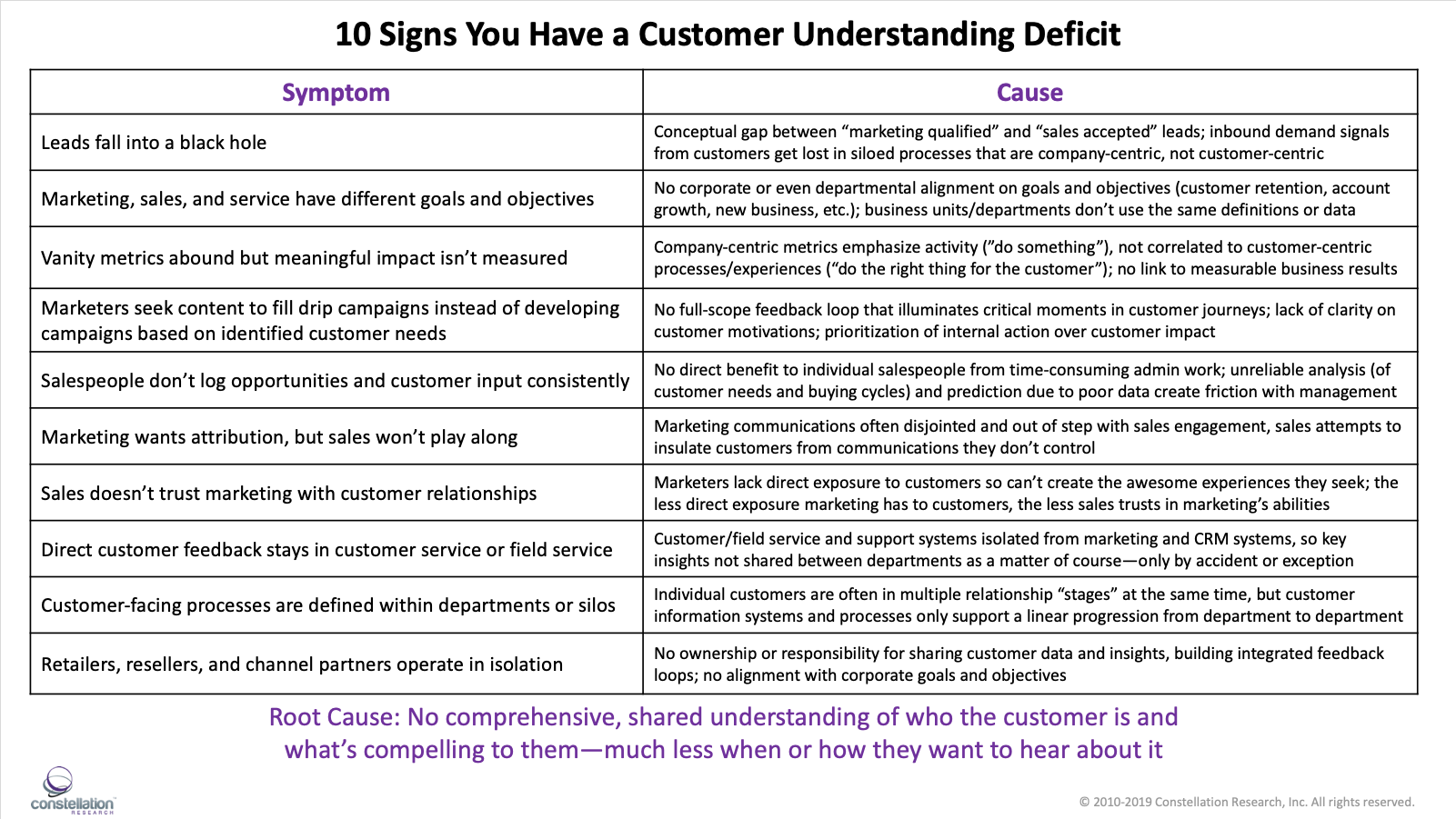
The problem here isn’t (necessarily) the technology. It’s the fact that we’ve lost sight of what really matters. We’ve been way too distracted by gaming the system and creating new metrics. Marketing is off doing one thing while sales is focused on another. Meanwhile, customer service is busy dealing with the everyday realities of customer issues.
Where do we go from here? The key is to focus on the most important fundamental of all: understanding customers.
The relationships and handoffs between marketing, sales, and customer service can be much smoother and more effective if everyone shares a clear, coherent understanding of customers. Truly understanding them means knowing who they are (organizations and individuals), their priorities, their competitors, their motivations and obstacles, where they are, how they think, and how they make decisions. Whether they’re current customers, dormant customers, or potential ones. It means knowing them well enough to anticipate their needs, sometimes even before they do themselves.
Customer Understanding
So what exactly is Customer Understanding?
As a concept, it is the construct behind an integrated, cohesive, holistic, and shared view of customers. This shared view of customers supports marketing, sales, and customer service, as well as strategy and product/offering development. Ultimately, it feeds into almost every aspect of a business.
Why do we need this concept? Because to really engage customers, we need to more clearly recognize that there are multiple elements to the customer relationship, and that they change over time. While this is equally true for both consumer and enterprise customers, the relationship elements and how they change can differ significantly.
In principle, Customer Understanding encompasses all of aspects of customer interaction. It also incorporates insights—both quantitative and qualitative—that build a clearer picture of customer priorities, needs, and preferences.
Building that understanding requires input from across all customer interactions. Using that understanding to best effect means creating feedback loops that inform how marketing, sales, and customer service operate. That includes inputting to strategy and product or offering development.
If Customer Experience describes the relationship from the customer’s perspective, Customer Understanding describes the flip side of the coin—the cross-enterprise experience of the same relationship.
CRM, customer engagement, sales effectiveness, customer service, and field service are critical elements of generating Customer Understanding and delivering Customer Experience. So is the ability to aggregate and analyze data from all of these different sources, as well as from customers themselves. Customer Understanding informs each of these areas and more. It is the unifying concept that determines the appropriate responsibilities and activities across the enterprise. It defines the criteria to design effective processes and make effective technology investments.
Done well, a shared Customer Understanding ensures offerings that meet customer needs, compelling messages delivered when customers are receptive to hearing them, and little or no friction in the sales process. It translates into happier, more loyal customers. It goes a long way toward bridging the gap between sales and marketing, too.
Former Vice President and Principal Analyst
Constellation Research
Steve Wilson is former VP and Principal Analyst at Constellation Research, leading the business theme Digital Safety and Privacy. His coverage includes digital identity, data protection, data privacy, cryptography, and trust. His advisory services to CIOs, CISOs, CPOs and IT architects include identity product strategy, security practice benchmarking, Privacy by Design (PbD), privacy engineering and Privacy [or Data Protection] Impact Assessments (PIA, DPIA).
Coverage Areas:
- Identity management, frameworks & governance- Digital identity technologies- Privacy by Design
- Big Data; “Big Privacy”- Identity & privacy innovation
Previous experience:
Wilson has worked in ICT innovation, research, development and analysis for over 25 years. With double…...
Two new Constellation Research reports of mine cover data protection, looking at the heightened need for privacy in the face of artificial intelligence and Big Data, and the sorts of systemic infrastructure needed to safeguard data supply in future.
Big Data and AI are infamously providing corporations and governments with the means to know us "better than we know ourselves". Businesses no longer need to survey their customers to work out their product preferences, lifestyles, or even their state of health; instead, data analytics and machine learning algorithms, fueled by vast amounts of the "digital exhaust" we leave behind wherever we go online, are uncovering ever deeper insights about us. Businesses get to know us now automatically, without ever asking explicit questions.
What are the privacy implications? The good news for consumers and privacy advocates is that general data protection and privacy laws are technology neutral; they extend essentially the same protections to Personal Data that is automatically generated as they do data collected manually. Long established privacy laws have been applied to curb the excesses of digital companies on the cutting edge of data processing. My report Big Privacy Rises to the Challenge of Big Data and AI examines the strengths and weaknesses of classical privacy laws.
The future of the digital economy depends on reasonable and equitable use of data as a resource. The early years of the Internet Age has seen significant exploitation of individuals by digital entrepreneurs, and stark imbalances in the riches that can be made from mining and refining information. But privacy laws are being reinforced in Europe (with the EU's General Data Protection Rule, GDPR) and extended to places like California. This is surely a sign of the law-and-order to come.
The early oil rush is instructive for how the digital economy should probably evolve from here. To bring oil safely to market, the petroleum industry organised itself into complex new supply chains, for moving and processing petrochemicals. Technical standards, enforceable rules, and even social norms (like good habits for handling gasoline) developed to help keep the new supply chains orderly.
Obviously data is quite different from oil, and the comparison isn't meant to be taken too far. So what practical lessons are there from the petrochemical experience for the future organisation of the digital economy? What would data supply chains actually look like? It seems likely to me that new laws and jurisprudence will emerge to deal with data as a intangible asset class, but that's another story. For now, I start to tease out the more technological aspects of data protection in How Data Supply Chains Must Be Safeguarded in the Digital Economy.
I start with the challenge of how to be sure about the people and entities we try to deal with in the digital environment. The Digital Identity industry has grappled with this for two decades, and its successes can be leveraged.
In the so-called "real world", commerce and government services revolve around established facts and figures about people (account numbers, customer reference numbers, employee numbers, professional qualifications, memberships, social security entitlements, driver licenses, and personal attributes like age, residency, health conditions and so on). But all these critical pieces of information lose their reliability and provenance online: we cannot tell where the information is supposed to have come from, much less can we distinguish clones and counterfeits from "originals". Nor can we be sure that data presented online truly belongs to particular individuals.
But in another setting, this is a solved problem. The susceptibility of Digital Identity data to fraud is very similar to that of credit card numbers, and we've secured them with integrated circuits and cryptography.
A credit card is nothing more than a data carrier used to present an account holder's bona fides to a merchant (within the context of an overarching scheme). Over time, the payment card industry has steadily adopted more robust forms of data carrier:
The original paper charge cards in the 1950s were transcribed by merchants by hand
embossed plastic cards were "read" by carbon paper click-clack machines
magnetic stripe cards were read automatically by electronic terminals which scanned data encoded in analogue magnetized patterns
now chip cards are also read automatically but using digital memory and mutual authentication between card and terminal
smart phones embody chips which can mimic smartcards, and bring added functionality, like a mobile wallet which can manage multiple accounts.
Magnetic stripe cards persisted for decades until criminal skimming and carding became unbearable. Magnetic stripe fraud is enabled because a card terminal cannot tell the difference between an original analogue stripe and a copy; the data encoded in the magnetic medium has no provenance.
The whole point of a chip or smart payment card is to protect the presentation of cardholder data, to prevent interception, tampering, illicit replay, cloning and/or counterfeiting. The cardholder data in a chip card is exactly the same as that in a magnetic stripe (or on the surface of either type of card for that matter) but the data transfer protocol from chip card to terminal is special.
A chip card holds the cardholder details within an embedded microprocessor, along with one or more private keys which are unique to each cardholder. Data is not passively transferred to the terminal as it is with a mag stripe card; instead, for each transaction, there is a handshake. First the terminal sends the purchase details into the card's microprocessor, which combines them with the cardholder data and digitally signs the combination before sending it back to the terminal. This operation renders each encoded transaction unique to the card and cardholder, and prevents substitution of stolen data or tampering with the transaction.
As the older technology is phased out, an overall systemic improvement is that raw data becomes useless, and valueless to thieves. Best practice is that no raw card details are relied upon but instead we expect transactions to employ chips and digital signatures, to ensure provenance.
The experience of progressively tackling plastic card fraud offers lessons for economy-scale digital identity, and data management in general. The core technique is digital signatures (applied and processed automatically by smart devices) underpinned by seamless key management (where cryptographic keys are registered to users for different applications). The provenance of all data could be safeguarded in the same way as credit card numbers are protected in the payments system.
In my two new reports I try to balance a positive view of classical privacy regulations, with a realistic, evidence-based vision of how standard cryptographic technology can protect the provenance of all data and systematise how it flows through the digital economy.
Research Unlimited and Executive Network members may access the reports here:
On November 11, 2018, SAP announced its agreement to acquire Qualtrics, a provider of customer and employee experience measurement, for $8 billion in cash. Qualtrics was set to IPO this week at a valuation of $5 billion with plans to raise $500 million. The company turned its first profit of $2.6 million in 2017 on revenue of just under $290 million. Qualtrics anticipated surpassing $400 million in revenue this year. Its key customer sectors include B2B technology, auto, travel and hospitality, financial services, government, media, airlines, and retail.
Key facts:
This is the second-largest purchase of a SaaS software company after Oracle’s acquisition of Netsuite for $9.3 billion in 2016.
SAP will retain Qualtrics CEO Ryan Smith, as well as the company’s dual headquarters in Provo and Seattle.
According to CEO Bill McDermott, SAP views experience management as “the groundbreaking new frontier for the technology industry.”
SAP Gains A Versatile Experience Management Platform
For SAP, Qualtrics solidifies its move into the customer experience management space. Qualtrics follows other recent acquisitions such as Callidus and Hybris, which added capabilities in sales effectiveness and customer experience, respectively.
Although the main focus in this acquisition is customer experience—including brand and product experience—it brings a broader set of capabilities. Qualtrics has expertise in comprehensive market research and data analysis. The same feedback-gathering abilities will also feed into HR with Success Factors and expenses with Concur.
Constellation POV:
SAP considers experience management to be a new market category and is prepared to pay a big premium to establish a position in it. The goal seems to be redefining the category, not just matching or bettering the offerings of other competitors.
Qualtrics Customers Gain Stability, SAP Customers Gain XM Capabilities
Current Qualtrics customers may well worry that acquisition by SAP will diminish the startup’s attitude thus far. Qualtrics has had a very customer-focused culture and an “anything goes, art of possible” approach to the world. By retaining the CEO and Qualtrics’ dual headquarters, the intent is to limit negative impact to customers.
Constellation POV:
SAP sees synergies with their sales and marketing suite C/4 HANA. Constellation sees opportunities in the SuccessFactors unit as well as the Concur unit given the dominance Qualtrics has in the travel sector. SAP customers who aren’t already working with Qualtrics can expect some heavy cross-selling for the next 12 to 18 months.
Upside and Downside Risks Enter The Calculus
SAP customers gain a new tool in the portfolio. Though customers will have to pay for Qualtrics, it won’t be coming free with maintenance. SAP has made a clear—and big—bet on the importance of experience management going forward.
Constellation POV:
Despite the high valuation, Qualtrics technology is behind others in the space, notably Medallia.There has been good adoption and saturation in the market already in some industries such as travel and hospitality. What remains to be seen is how long it takes SAP to realize the value of this new market segment that’s implied by the purchase price.
The Normal Is Beyond a 9 to 10X Valuation for Hot Feature Companies
Over the past 10 years, VCs and investors have effectively chosen the winners and losers in each of the major software market categories. New startups have been funded based on features, not necessarily new market categories. The result is fewer major acquisition targets and greater competition to buy them. It seems that the days of a 9X or 10X revenue valuation are over. At 20X revenue, the Qualtrics acquisition may be a harbinger of things to come.
Constellation POV:
Competitors such as Survey Monkey will face a tougher road winning the B2B enterprise market. Meanwhile, privately held startups such as Medallia and Clarabridge may benefit with higher valuations as they IPO. It’s time for internal software R&D teams to up their game—they might just have become a much more competitive investment option.
Thanks to R. "Ray" Wang for his contributions to this piece.