


Event Report Look Back - AWS reInvent 2017 - AWS grows and grows...
Taking a look back, we had the chance to attend AWS reInvent in Las Vegas in 2017. The conference grew beyond the original limits of the Sands Convention Center and sprawled all over Las Vegas - from the Mandalay Bay all the way to the Encore. reInvent has become the get together of the IT industry, effectively wrestling that crown from VMware's VMWorld. As we head into the 2018 event, let's reflect on my observations and analysis from last year. I'll cross compare and share my insights from this year's event soon.

4 Key Product Developments People Leaders need to track
Global Cloud Connect – Simplify Payroll Integration
Figure 1 – Andy Jessy and all AWS instance types
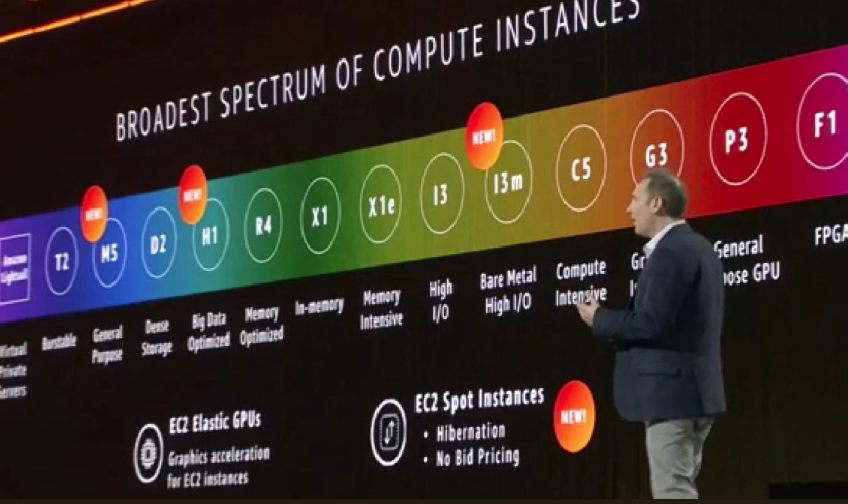
Source: Twitter, @holgermu
Constellation POV: Necessary new instance innovation by AWS, but less than usual. Likely instance development cycles and the re:Invent schedule may not have aligned. But an era to watch. On the flipside CxOs will be happy if they number of instance types will reach a stable level, and with that make the choice, selection and operation of instance types a more stable business. In the past each instance type would cause a little bit of a 'head stir' to CxOs responsible for AWS deployments in regards of optimal allocation of budget vs. compute. Less new instance types and more learning will create a higher comfort level for CxOs to operate on the right instance mix in AWS. AWS did also not address the general instance refresh it promised in spring of 2017 around the S3 caused service disruption[i]. An opportunity to address this important housekeeping item that all IaaS vendors need to address – has been missed. And with that the opportunity to set the standard in the hardware replacement / refreshment debate that is going to happen soon given the general maturation of the industry.
Kubernetes becomes a 1st class citizen for AWS
Figure 2 – Andy Jassy announces AWS Fargate

Constellation POV: At the end of the day, IaaS providers, like AWS, need to scale and scale comes from load that enterprise can / want to run on the respective IaaS. When certain forms of load, in this case Kubernetes container load become critically popular, IaaS providers – no matter how large – need to adopt the new form of load in order to participate in the potential growth. And even very large, even market leading IaaS providers like AWS need to acknowledge the popularity with EKS. Good for enterprises, that have compatible container support for Kubernetes across the popular IaaS infrastructures. Apart from cost, the competition now moves to ease of use of running these container loads, and there AWS has a made a good start with Amazon Fargate. Not surprisingly Amazon Fargate starts with ECS, pointing to the more recent addition of EKS, but with EKS support coming in 2018, this is history.
Databases remain key
One functional area that anchors enterprise load are databases, and Amazon knows that well, offering a large variety of database options on AWS. The one that recently had gotten the most attention has been Aurora, launched a few years ago. Every year Aurora sees new enterprises grade features being added and re:Invent 2017 was no difference, with Andy Jassy unveiling Aurora Multi-Master capabilities, that allows to run Aurora across multiple AWS AZs. And AWS also leverages benefits of a distributed system beyond the HA benefits, which are faster write performance across the instances. Moreover, Amazon wants to make Aurora adoption and rollout easier, making Aurora available serverless, in container, with by the second pricing. Both capabilities are projecting Aurora past market leader Oracle (Jassy mentioned RAC), for the first time – so the RDBMS replacement game that AWS is trying to play will get a little more intense in 2018. For now, both capabilities are in preview, which is AWS way of a controlled beta.On the Amazon DynamoDB front, AWS caters to the enterprise demand of having to run more and more global systems, adding the ability of global tables. This is the ability of tables being replicated across global dispersed availability zones, taking care of mutual updates. And as enterprises put global applications on Amazon DynamoDB, they also want more efficient ways to backup data (and with a feature like Global Tables, that gets a magnitude more tricky) so Amazon announcing an on-demand backup for DynamoDB is a key and welcome new feature for Amazon DynamoDB.
Not enough with Aurora, Amazon also launched Neptune (see Fig. 3), its native graph database at re:Invent. Graph databases are seeing a recent renaissance, after being largely replaced by relational systems in the last 40 years. The reason for the rise in popularity of graph databases lies in their inherent capability to model relationship – and relationships matter when capturing complex social relations and IoT things relations. Traversing graphs turns out to be faster, more efficient and intuitive and it's clear that AWS wants to have a slice of the use case, announcing Neptune, AWS own native graph database offering. Neptune supports all the popular open source standard for graph database (Apache TinkerPop Gremlin and W3Cs SPARQL, making adoption easier. For now Amazon Neptune is in preview.
Figure 3 – Andy Jassy announces Amazon Neptune

Source: Twitter @holgermu
Constellation POV:Database are critical load anchors for enterprises. When considering moving an enterprise application to the cloud, the question of database portability, migration and replacement always comes up. Amazon has been playing the long game for databases, understanding the demand and continuing to innovate with its native database offerings, Aurora being the most prominent recent example. Good to see the innovation with Amazon Neptune as well, the graph database use case for next generation applications must have bene substantial and too hard to ignore for AWS not to have a native offering in place… we expect good uptake for Amazon Neptune for several next generation application use cases, most prominently IoT. Good to see the innovation on the DynamoDB side, the need for more global support and out of the box replication is very high on the list when CxOs select platforms and / or databases for next generation applications.
Machine Learning - Lots of new offerings - Sagemaker and Deeplens stand out
Figure 4 – Amazon SageMaker and functionality it provides
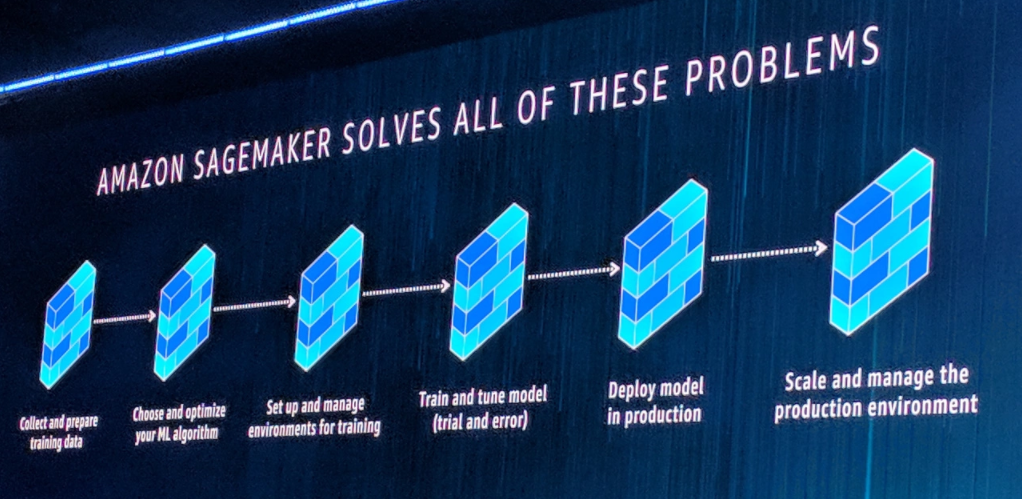
Source: Twitter (@holgermu)
Constellation POV: Good to see AWS making Machine Learning a priority, one of the key areas of automation that is in high demand by enterprises, as it traverses all next generation application use cases. It's also important, as if one had to pick an area of relative weakness towards other IaaS competitors, then it is Machine Learning. Partnerships with other players around Gluon are the right direction to create value for customers. On the tool side Amazon SageMaker is a good start, first version to convert developers into AI developers. A long path, but definitively worth to try. AWS should and could have aimed higher at also targeting the (technically savvy) business users, who in Constellation view is the ultimate prize in many dimensions: Propel their own business needs, help enterprises to accelerate with AI and give IaaS vendors the massive load from these applications.
Alexa comes to Business
Amazon has seen tremendous success with its Alexa platform. Not only from a design, technology and architecture approach, but also (and remarkably) from a go to market and partner perspective. Alexa stole the show at CES and MWC in 2017, remarkable for a vendor like AWS, who is not used to play big at these events. Partner enablement has also been a very strong point for Alexa.Unfortunately, not shown (or I missed it) was the meeting room automation. Hours of productivity can be missed (multiplied by the number of participants) in meeting settings while participants are trying to figure out conference call and video conference equipment, display and projector management, AV settings and many more. Overall a very powerful use case for voice assistants.
Figure 5 – The announcement of Google as a IaaS and early adopter of Workforce

Source: Twitter (@holgermu)
Constellation POV: A good move by Amazon, keeping its lead with Alexa over the competition. And what was shared wasn't future, but ongoing projects. Once a vendor has technology that is successful, it only makes sense to apply to more use cases and distribute it widely. Especially when a vendor has done so many things right as Amazon with taking Alexa to market, especially with partners. Will be interesting to learn about more use cases and to follow adoption and rollout through 2018. Very much looking forward to sitting in the first voice assisted conference room.
A key AWS mover- an IDE
Figure 6 – Vogels unveils Cloud9

Source: Twitter (@holgermu)
Constellation POV: A good move by AWS. Developers tend to stick with their IDEs for a long time, and not having an IDE was a gap for traditionally very developer friendly AWS. But IDEs are like living rooms or sofas – once you have moved in, it takes a lot of effort and motivation to move out. AWS provided all the enticements needed: Starting with programming language support and related tooling, it's easier for developers to try new things. Integration into AWS is another strong argument for Cloud9. Last but not least FaaS needs a hook / starting point and that's the IDE. AWS could simply not afford for developers to live in a living room (that is the IDE) from competitors. Future will have to tell how well Cloud9 gets adopted, but for now it is off to a strong start.
The Bottom Line: AWS executes on all fronts, few but key questions remain
We will see at the many AWS Summits coming in the next months.
One of the emerging concerns is around Machine Learning. Expectations that AWS may announces its own neural network and compete with Google's TensorFlow seem unlikely to happen at this point. Who would have thought that AWS would enter multiple partnerships with Seattle neighbor Microsoft on Machine Learning? The risks for AWS are tangible, if any other IaaS vendor can show faster, cheaper and better Machine Learning performance, it will create a magnetic effect on data. And with data goes load, not to mention that Machine Learning itself creates a lot of load. And load is the mother milk of IaaS vendors success.
Overall CxOs who are charged to build next generation applications for their enterprises, have few things not to like when considering AWS. AWS is doing well, often leading in regards of instance and location build out. If offers the largest number of instance types to match to specific load profiles. Its database offerings are maturing fast and becoming quickly a valid alternative to the traditional databases (that AWS is also more than happy to operate). AWS IoT offerings are doing well, combined with its Snowball appliance, that effectively is becoming more and more an application server. Lock-in concerns can be mitigated to a certain point with EKS, given the broad adoption of Kubernetes. AWS has a strong position on serverless and microservices with lambda and Kinesis, key ingredients for next generation applications. AWS and CxOs care for developer productivity, another key alignment and attraction point. The main concern for CxOs remains around their inhouse developer talent, if their team can find the path to a successful enterprise application – relying on their talent and intuition given the innovation maelstrom AWS presents itself as.
But for now, all things look up for AWS. Cloud9 is a strategic move that must pan out more before it can be fully assessed in regards of potential. Keeping developers happy is vital for AWS success. And Alexa's new use cases show with what laser like focus and industrial strength precision Amazon / AWS can execute. If the competition has not been on notice, it is now.
Holger Mueller is VP and Principal Analyst for Constellation Research for the fundamental enablers of the cloud, IaaS, PaaS and next generation Applications, with forays up the tech stack into BigData and Analytics, HR Tech, and sometimes SaaS. Holger provides strategy and counsel to key clients, including Chief Information Officers, Chief Technology Officers, Chief Product Officers, Chief HR Officers, investment analysts, venture capitalists, sell-side firms, and technology buyers. Coverage Areas: Future of Work Tech Optimization & Innovation Background: Before joining Constellation Research, Mueller was VP of Products for NorthgateArinso, a KKR company. There, he led the transformation of products to the cloud and laid the foundation for new Business Process as a…...
Read morePublished
Author
