Results

Certinia’s AI agent strategy kicks off with staffing, customer success

Certinia’s AI agent strategy kicks off with staffing, customer success


Certinia, which provides management software for professional services organizations, delivered its first installment of AI agents built on Salesforce's Agentforce platform as part of its summer release.

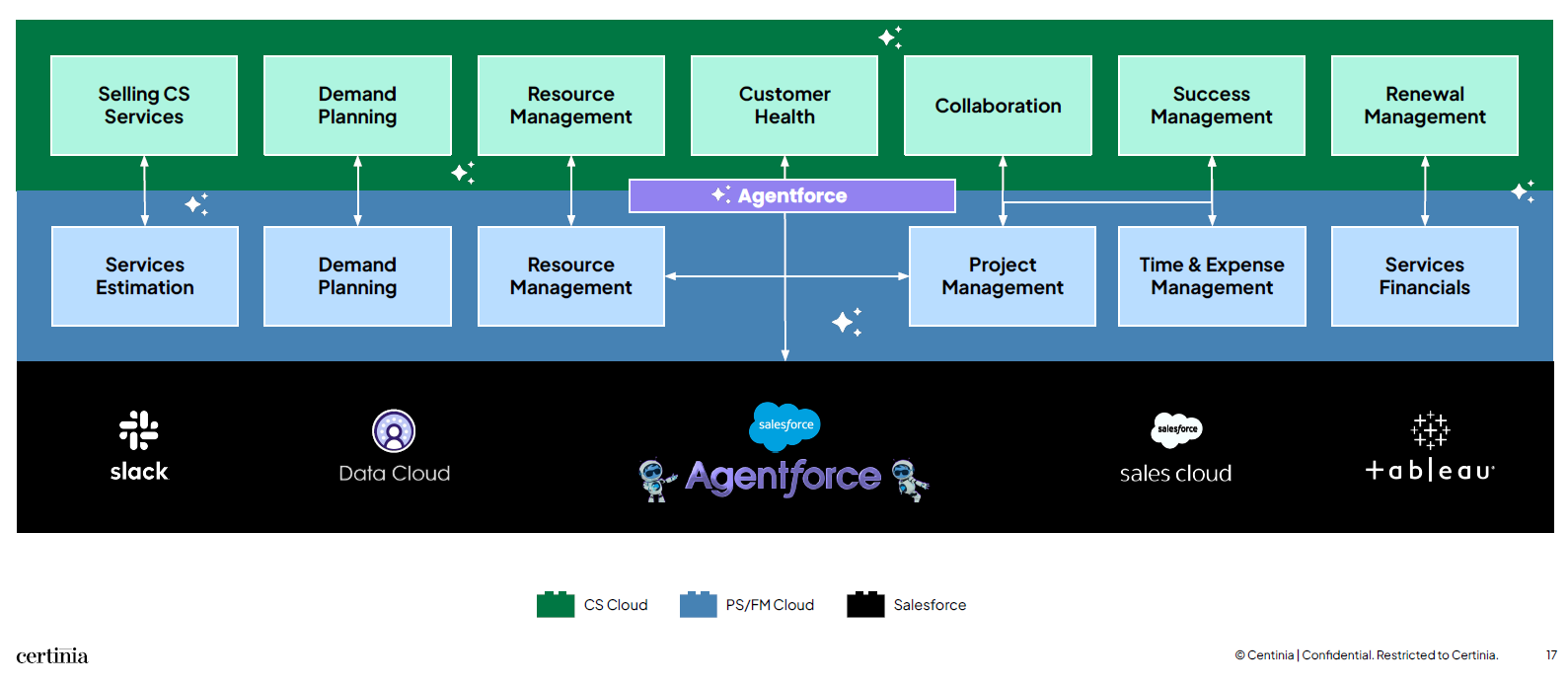
The company has three primary clouds--Professional Services (PS) Cloud, Financial Management Cloud and Customer Success (CS) Cloud--with Certinia AI layered throughout. Certinia, previously known as FinancialForce, is looking to address customers' need for productivity, AI innovation and rising labor costs. Certinia's platform plugs into enterprise ERP and CRM systems.

DJ Paoni, CEO of Certinia, set the backdrop. "Leaders are being asked to do more with fewer resources, and they know they need to hit the targets. They need better alignment across the whole company, sales, services, customer success. And interestingly, while most leaders agree that tight collaboration across these functions would drive higher margins and retention, only about a third are executing on it," said Paoni, speaking on an analyst briefing. "This gap of what you say and what we do is often a result of disconnected systems and processes that can create friction between all the different teams that you have."

According to Paoni, AI is what will be able to close the gap between promises and actual delivery. In the big picture, Certinia is betting that it can turn professional services organizations into profit centers instead of a cost center with a big assist from autonomous systems, said Paoni.

Raju Malhotra, Chief Product and Technology Officer at Certinia, said the company's vision is to "empower technology and services organizations to deliver customer value with certainty." The company has been building out its platform and its CS Cloud became generally available at Salesforce Dreamforce 2024.

Here's a look at the Certinia platform, which is designed to cover the services continuum from services estimating, resource and project management, billing, revenue management, collaboration and planning and analytics.
Certinia kicks off its agent parade

With its 2025 summer release, Certinia launched two AI agents, which were built on Salesforce's Agentforce platform, available for early adopters. Certinia will launch more agents in future releases.

The newly released AI agents include the Certinia Staffing Agent and the Certinia Customer Success Agent.

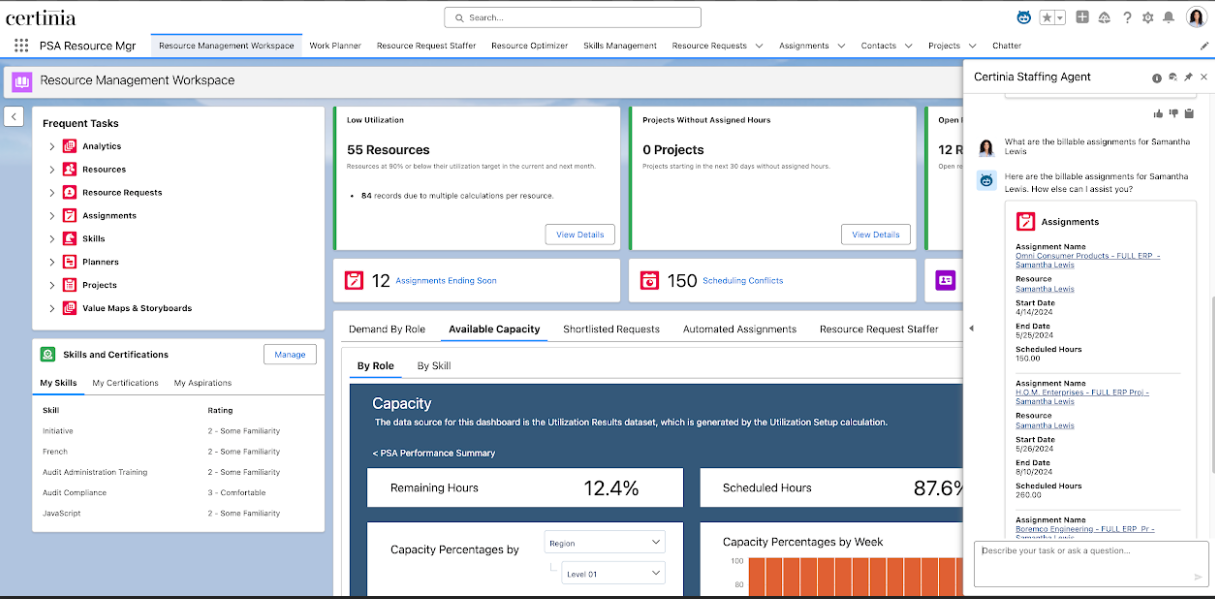
Malhotra said resource managers need an easier way to reallocate work when someone is out for a period of time to ensure projects remain on track.

Typically, a manual process searches for a resource's assignments and then workflows start to find a qualified replacement.

Certinia's Staffing Agent aims to begin resource allocation with a conversation. The staffing agent is native to Certinia's Professional Services (PS) Cloud. The agent will find billable assignments and provide a shortlist of suitable replacements. Once a manager makes a decision, the agent reallocates the work.
According to Malhotra, Certinia's early adopters have seen the new AI agents "reduce what used to take them hours into a few minutes."

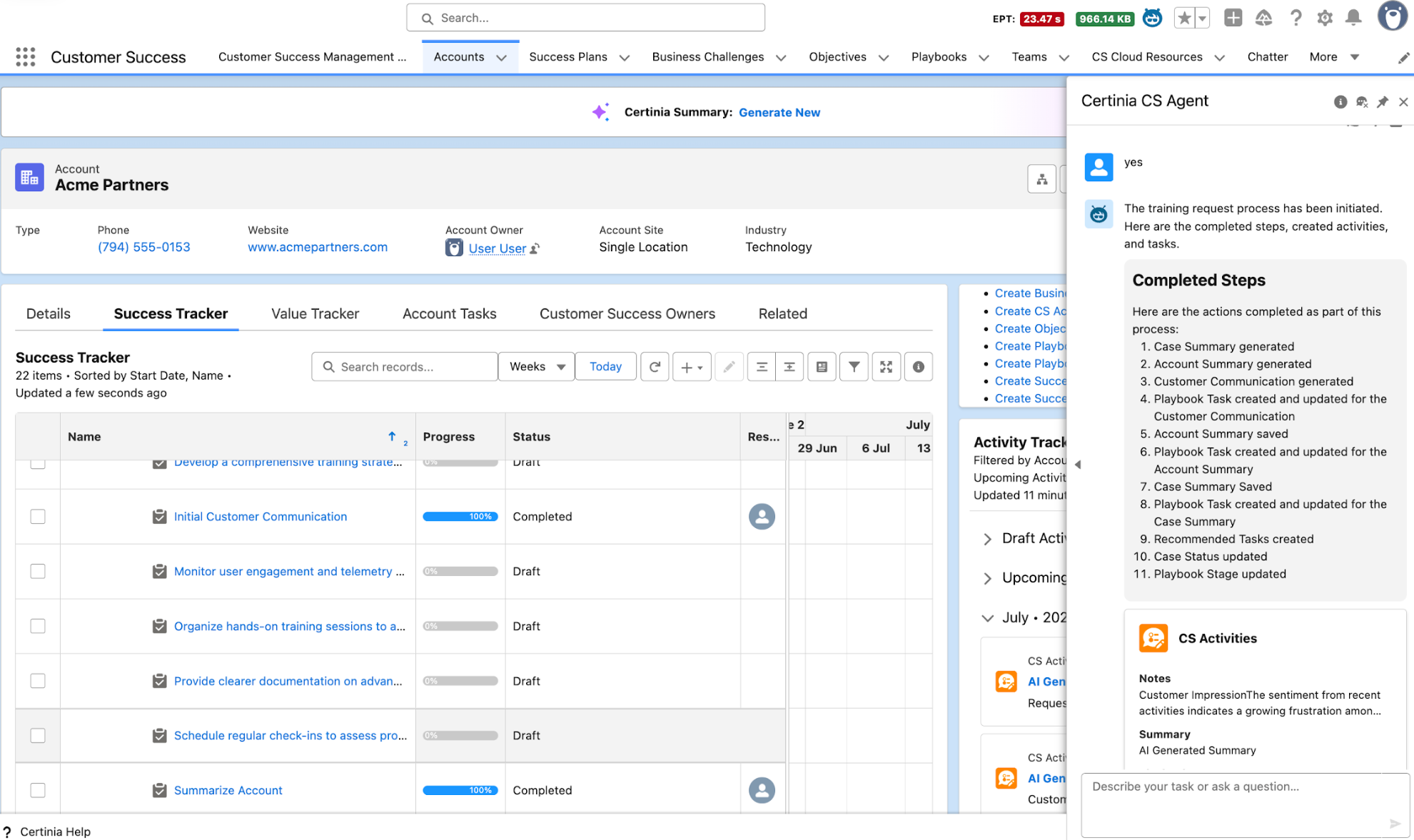
The company's second AI agent is Certinia Customer Success Agent, which aims to automate grunt work for customer success managers.

Certinia's Customer Success Agent is designed to enable success managers to cover more accounts in pooled models. The agent does the prep work for a case and provides a summary, drafts email to customer and creates a task list. When the work is finished, the agent handles closing admin tasks.
Malhotra said the two agents in the 2025 Summer release are just the start. Certinia is experimenting with more than 50 AI agents that will be built into the company's professional services automation software.

Certinia was an inaugural launch partner for the Salesforce Agentforce Partner Network and now is a Salesforce Agentforce Model Context Protocol (MCP) Partner.

Building on Agentforce

Since Certinia is built on the Salesforce platform and an early adopter of Agentforce, Malhotra has a front-row seat to how the AI agent market is developing. Key points:

  • Certinia's Staffing Agent and Customer Success Agent are built on Agentforce. "Agentforce has evolved from 1.0 to 2.0 and now it's the 3.0 and in terms of capabilities, has really come a long way," said Malhotra.
  • Building agents requires a strong foundation and focus on data quality, integrity and unification across disparate systems. Certinia leverages the Salesforce platform and Data Cloud but expects to work in third-party data sources on behalf of customers. "We expect that that this is a very heterogeneous environment. So, we expect that heterogeneity of data, system workflows, and we work within that construct, to make sure the personas we are serving have a very unified view of the data that they want to act on," said Malhotra.
  • AI agent platforms are developing rapidly and Certinia has a wish list that's often shared with the Salesforce platform team. Wish list items for Agentforce include improved ISV capabilities (packaging, monetization, telemetry), agent orchestration, performance and scalability, and enhanced enterprise security, said Malhotra.

As for Malhotra's wishlist for Agentforce. Here's a look at his punch list.

  • More data and tools to run Agentforce natively with independent software vendors. Malhotra said Salesforce has been working closely ISVs, but needs  to hone the packaging, monetization and telemetry and reporting for Agentforce so partners can make it available natively.
  • Data quality and integration. Malhotra emphasized the critical importance of having high-quality, unified data from disparate systems. He noted that building effective agents requires a comprehensive view of data from various sources including CRM, financial systems, and other enterprise applications to properly manage services projects.
  • Orchestration build out. Agent orchestration is going to be critical as Salesforce agents work with Certinia agents and then connect to others. To scale, orchestration via Agent2Agent or Model Context Protocol (MCP) will be critical.
  • Enterprise readiness, namely security. "Security is a big construct," said Malhotra. "We really need to think about security in a much more specific and significant way so it's baked into the platform." He said that security efforts go beyond Salesforce and Certinia and need to be an ecosystem effort on every level of the stack.

Most of Malhotra's wish list applies to the broader agentic AI landscape as well as Agentforce. Here’s a look at what agentic AI needs to scale.

More on Agentforce:

Scaling AI features

Certinia also launched a set of AI enhancements with the latest platform release. Throughout Certinia's clouds, the company has rolled out features to enhance resource management, optimize budgets and plans and simplify tax planning.

Here's a look:

  • AI-generated success plans in CS Cloud. The company said generative AI additions can create customer success plans and objectives from sales opportunities and business challenges. The plans connect sales, services and success teams in one place.
  • AI-generated summaries in PS Cloud. Certinia said genAI additions will provide project overview summaries, and individual summaries for deliverables, financials, risks, assumptions, issues and dependencies.
  • Automated project staffing. The latest Certinia release now has the ability to automatically hold or assign a resource request to reduce the time to staff.
  • Enhanced KPI tracking dashboards in CS Cloud with the ability to post a Value Tracker on customer community portals.
  • Estimate Control in PS Cloud with the ability to accelerate deal closing and modify estimates at once with discounts and billing schedules.
Data to Decisions Future of Work Innovation & Product-led Growth Tech Optimization Next-Generation Customer Experience Digital Safety, Privacy & Cybersecurity salesforce ML Machine Learning LLMs Agentic AI Generative AI Robotics AI Analytics Automation Quantum Computing Cloud Digital Transformation Disruptive Technology Enterprise IT Enterprise Acceleration Enterprise Software Next Gen Apps IoT Blockchain Leadership VR Chief Information Officer Chief Executive Officer Chief Technology Officer Chief AI Officer Chief Data Officer Chief Analytics Officer Chief Information Security Officer Chief Product Officer

Palo Alto Networks delivers strong Q4, outlook

Palo Alto Networks delivers strong Q4, outlook

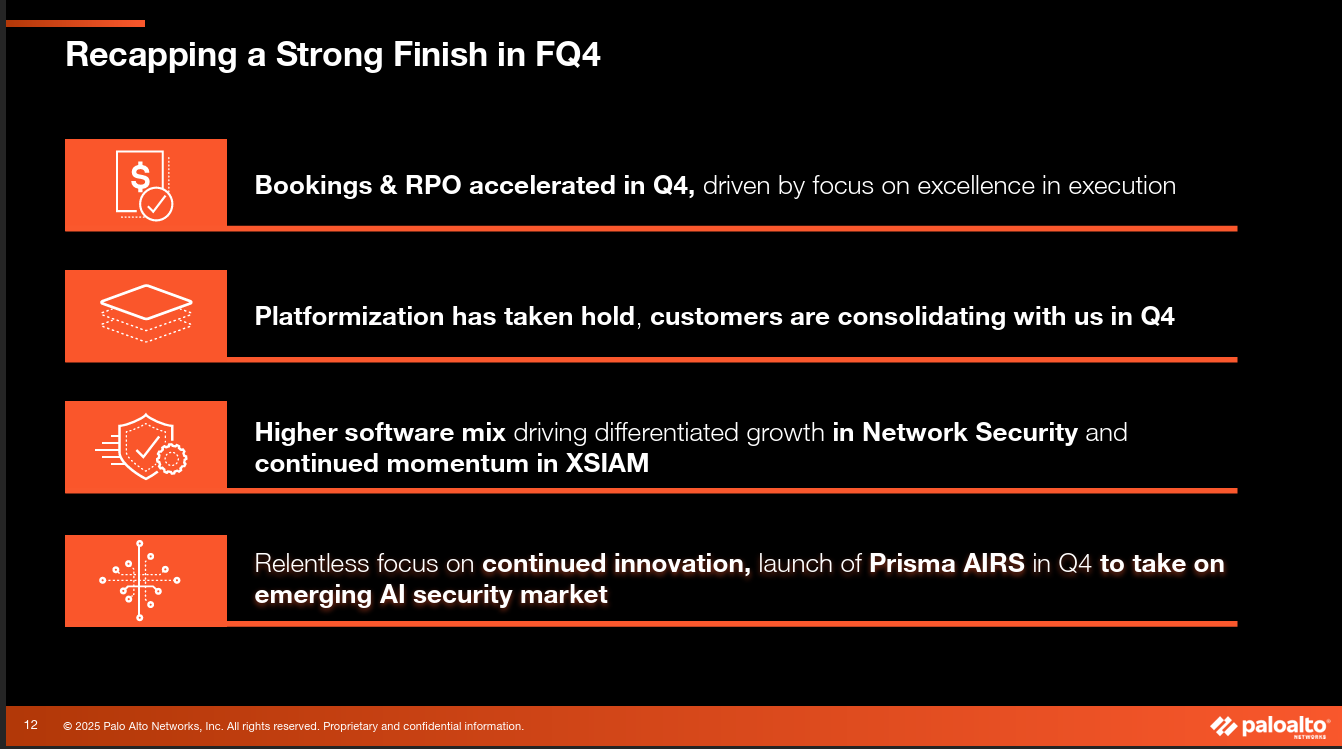
Palo Alto Networks reported better-than-expected fourth quarter earnings and projected revenue growth of about 14% for the fiscal year ahead.

The cybersecurity company reported fourth quarter earnings of $253.8 million, or 36 cents a share, on revenue of $2.5 billion, up 16% from a year ago. Non-GAAP earnings for the quarter were 95 cents a share.

Wall Street was expecting Palo Alto Networks to report fourth quarter non-GAAP earnings of 88 cents a share on revenue of $2.5 billion.

For fiscal 2025, Palo Alto Networks reported earnings of $1.134 billion, or $1.60 a share, on revenue of $9.22 billion.

CEO Nikesh Arora said the company executed well in the fourth quarter and looking for platforms that "are designed to work in concert." Arora said remaining performance obligation (RPO) is accelerating into the new fiscal year and signaling growth.

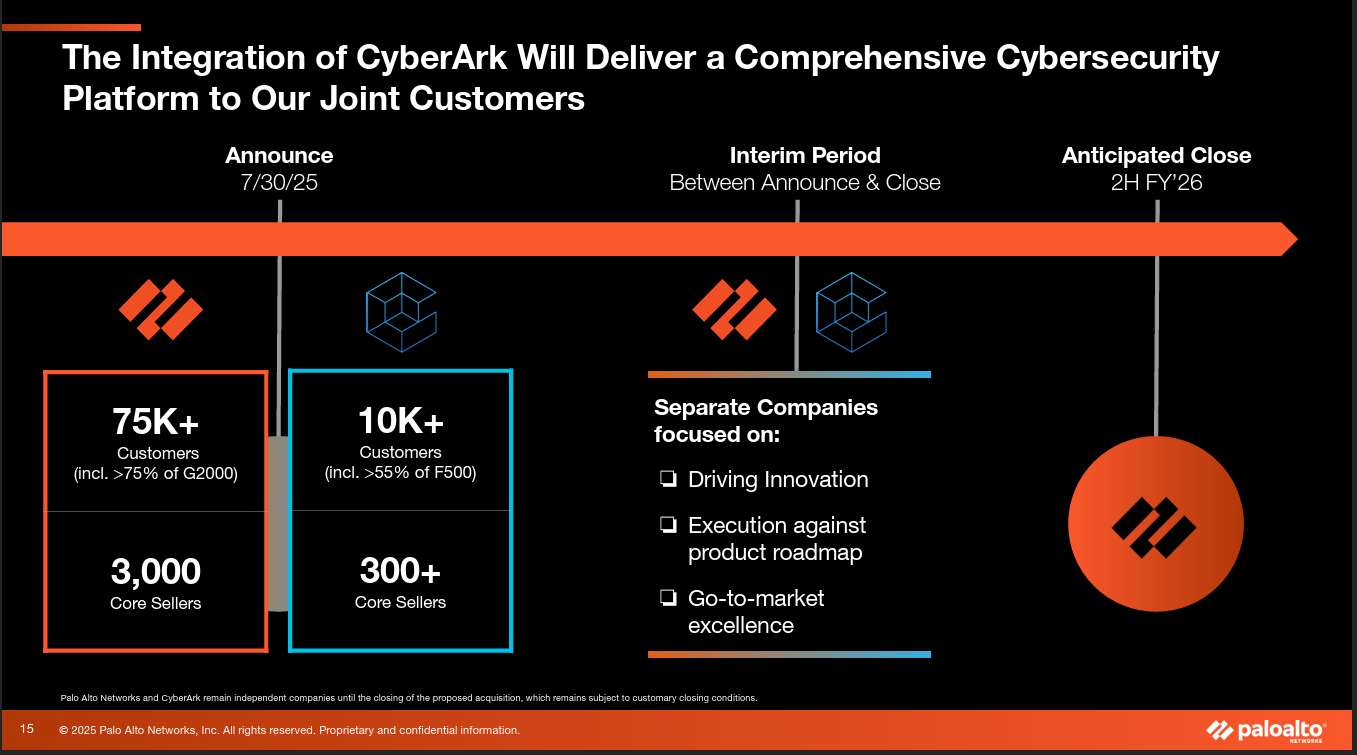
The company has been on a bit of a buying spree with the acquisition of CyberArk for $25 billion.

Separately, Palo Alto Networks said that CTO Nir Zuk will retire. Lee Klarich, Chief Product Officer (CPO), will also take on the CTO role. Zuk founded the company in 2005.

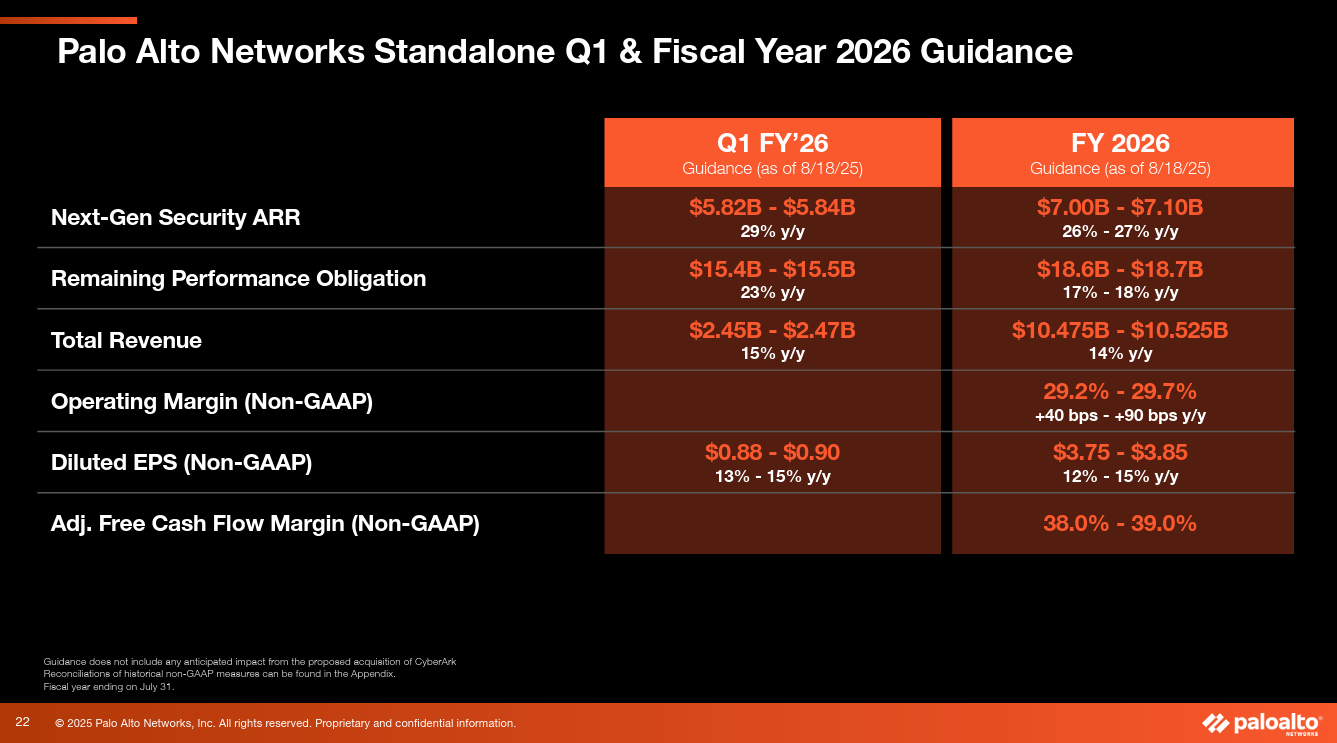
As for the outlook, Palo Alto Networks said first quarter revenue will be between $2.45 billion to $2.47 billion, up 15% with non-GAAP earnings of 88 cents a share to 90 cents a share. Remaining performance obligation is expected to be $15.4 billion to $15.5 billion, up 23% from a year ago.

For fiscal 2026, Palo Alto Networks projected revenue of $10.475 billion to $10.525 billion, up 14% from a year ago. Non-GAAP earnings for the fiscal year are expected to be $3.75 a share to $3.85 a share. Remaining performance obligation will be between $18.6 billion and $18.7 billion, up 17% to 18%.

Key points from Arora on the conference call:

  • "The only way to get near real time is to have some consistency in your platform where data talks to each other and you're able to run agents on top of it. I can't run agents on top of disparate infrastructure. There's no agent out there that understands three different firewall vendors and infrastructure to SASE vendors, a browser vendor, and seven other vendors on top. Agenting is only going to make this worse, because there are agents that bad actors can deploy to try and reach it."
  • "We expect our top line seasonality to continue to be second half and four weighted as we continue to compromise with our customers."
  • "The reason we highlighted a $50 million ARR deal, that's a big number in technology, whether it's cybersecurity, anything else that tells it the art of the possible. If one was able to consolidate the entire security span of a large customer, you can get up to $50 million in ARR."
  • "AI is going to act as an accelerant towards a desire to consolidate customers are beginning to feel the value of consolidated data, not just in security, in other areas, you can see."
     
Digital Safety, Privacy & Cybersecurity Data to Decisions Innovation & Product-led Growth Future of Work Tech Optimization Next-Generation Customer Experience palo alto networks AI GenerativeAI ML Machine Learning LLMs Agentic AI Analytics Automation Disruptive Technology cybersecurity Chief Information Officer Chief Information Security Officer Chief Privacy Officer Chief AI Officer Chief Experience Officer

Oracle adds OpenAI's GPT-5 to its database, cloud applications

Oracle adds OpenAI's GPT-5 to its database, cloud applications

Oracle said it has deployed OpenAI GPT-5 across its applications and database portfolio in what amounts to more choices for Oracle customers and additional distribution for OpenAI.

The database giant said that it is using GPT-5 across its Oracle Fusion Cloud Applications, Oracle NetSuite and Oracle industry offerings such as Oracle Health. GPT-5 will also combine with Oracle Database 23ai and Oracle AI Vector.

OpenAI has been using Oracle Cloud Infrastructure for workloads as well as Google Cloud as it diversifies its Microsoft Azure compute base.

According to Oracle, GPT-5 will be available in three sizes to its SaaS and application customers. Oracle customers could also use ChatGPT Enterprise for GPT-5 access.

Last week, Oracle said Google Cloud's Gemini models and Vertex AI will be available to customers.

Holger Mueller, an analyst at Constellation Research, said Oracle's move to add OpenAI GPT-5 is a natural progression given OpenAI is using Oracle Cloud Infrastructure more. If the training is in OCI, it may be possible to get OpenAI on OCI faster.

Mueller said:

"Oracle is on a roll and has three ways with OpenAI to create value. First it trains OpenAI models on OCI. Now it allowed enterprises to use Chat-GPT 5 to use data from the Oracle Database via Vector search and Model Context Protocol. Those same customers can use that custom ChatGPT-5 result with their Oracle Fusion applications."

Separately, Oracle said it is adding OpenAI's two open weight models--gpt-oss-120b and gpt-oss-20b--to OCI Data Science's No Code Interface.

Data to Decisions Next-Generation Customer Experience Innovation & Product-led Growth Future of Work Tech Optimization Digital Safety, Privacy & Cybersecurity openai Oracle ML Machine Learning LLMs Agentic AI Generative AI Robotics AI Analytics Automation Quantum Computing Cloud Digital Transformation Disruptive Technology Enterprise IT Enterprise Acceleration Enterprise Software Next Gen Apps IoT Blockchain Leadership VR Chief Information Officer Chief Executive Officer Chief Technology Officer Chief AI Officer Chief Data Officer Chief Analytics Officer Chief Information Security Officer Chief Product Officer

LLMs on sale: What happens when OpenAI, Anthropic offer Feds value meal pricing?

LLMs on sale: What happens when OpenAI, Anthropic offer Feds value meal pricing?

The US government is getting good at squeezing technology vendors and foundational model players OpenAI and Anthropic are raising to give away ChatGPT and Claude to the Feds for $1 a year.

It’s quite possible that the race to near-zero for LLM pricing isn’t going to stop with the General Services Administration (GSA) as scale enterprises follow suit.

Anthropic said it will offer Claude for Enterprise and Claude for Government to all branches of the US government for $1 per year. The deal is available for a year. OpenAI’s offer is OpenAI for Government for $1 per agency for the next year.

The deals make sense from a land-expand-perspective, but I can already write the headline when the $1 offers expire. The headlines will go like this: “OpenAI and Anthropic gouge US”. Now maybe none of these deals matter since OpenAI and Anthropic are already in a nice Department of Defense contract.

Headline risk and the race to scale adoption at any cost are the two primary reasons OpenAI and Anthropic are going the value-meal route for LLMs. That headline risk is also giving GSA leverage. In 2025, the GSA announced agreements with AWS, DocuSign, Oracle, Elastic, Salesforce, Adobe, Google and Microsoft. According to the Congressional Budget Office, the US government employees 2.25 million military personnel and 2.25 million civilian workers.

Now what is the risk? Large enterprises may want better pricing too. We already know that LLMs are reaching the good enough stage.
If I’m Walmart, the deals OpenAI and Anthropic gave the US government would have me prepping the “lower the price or else” emails. Walmart has the most workers at 2.1 million followed by Amazon at 1.56 million, according to CompaniesMarketCap. We assume Amazon will optimize LLM costs with Amazon Bedrock and its own Nova models. Walmart could squeeze its LLM providers (and tech vendors in general) just as it does suppliers.

We’ll assume that BYD and Foxconn, two companies with an employee base approaching 1 million, will go with Alibaba’s Qwen or DeepSeek.

Add it up and it’s not a reach to see LLM price pressure accelerating. With value-LLM deals, open-source models and private label models like Amazon Nova commoditization is just going to accelerate.

Data to Decisions Future of Work Chief Information Officer

Watercooler debate: Is it the data or the infrastructure?

Watercooler debate: Is it the data or the infrastructure?

Every day, Constellation Research analysts are swapping takes, headlines, observations and broad themes on our internal watercooler thread. It’s part entertainment and part college class. Here’s a look at Holger Mueller and Esteban Kolsky’s recent debate on data, infrastructure and strategy.

Core Disagreement

  • Mueller’s Position:
    • The foundation of enterprise success is data — "it starts with the data."
    • Data is continuously created (e.g., web searches) and must be the priority before infrastructure or models.
    • Correct and early adoption of technology can be a key differentiator, enabling growth in efficiency and effectiveness.
    • AI changes the game by making it possible to process data at a scale that was previously impossible.
  • Kolsky’s Position:
    • Data matters, but it is not the most important focus in 2025.
    • After decades of investment in data warehouses, CDPs, and models, many enterprises still cannot move from "A to H" because they lack the right infrastructure and business models.
    • Technology alone is no longer a differentiator; the winners will be those who build forward-looking ecosystems and innovative business models on robust infrastructure.
    • Chasing every "new tech" is a resource trap — sustainable success requires a broader, multidisciplinary strategy.

Key Points

  1. Data vs. Infrastructure
    • Mueller: Data is the car; without it, you can’t drive anywhere.
    • Kolsky: Infrastructure is the freeway; without it, even the fastest car (best data) is useless.
  2. Tech as Differentiator
    • Mueller: Early, correct adoption of tech is a differentiator, and with AI accelerating tech’s capabilities, it is more important than ever.
    • Kolsky: Early adoption provides a temporary edge but leads to technical debt; tech is an enabler, not the differentiator.
  3. Enterprise Strategy
    • Kolsky: Enterprises need to think beyond narrow tech or data focus — similar to how industry analysts must avoid siloed perspectives.
    • Mueller: Agrees on interconnectedness but emphasizes continuous cycles of evaluate ? pilot ? adopt ? scale.
  4. Sustainability of Early Adoption
    • Kolsky: Constantly “skating on the edge” isn’t sustainable.
    • Mueller: The key is avoiding the “efficiency trap” and practicing enterprise acceleration.

Common Ground

  • Both agree technology is an enabler and everything is interconnected (data, infrastructure, business models).
  • Both recognize AI’s impact on data processing and enterprise capabilities.
  • Both stress the need for continuous improvement — but differ on whether the starting point should be data or infrastructure.

Recap

  • Mueller: Data = car ? you need the car first to travel.
  • Kolsky: Infrastructure = freeway ? without roads, the best car is useless.
  • Disagreement lies in which comes first and where the main strategic focus should be.
Data to Decisions Chief Executive Officer Chief Information Officer

Workday acquires Flowise to speed up building AI agents, automated workflows

Workday acquires Flowise to speed up building AI agents, automated workflows

Workday said it has acquired Flowise, a platform to create AI agents and automate workflows. Terms of the deal weren't disclosed. 

In a nutshell, Flowise has a low-code platform with modular building blocks ranging from workflows to autonomous agents. The Y Combinator backed company has a free tier, a starter version that runs $35 a month and a pro version for mid-sized companies for $65 a month. There's also an enterprise version.

Flowise appears to have developer cred with high ratings on GitHub and an affiliate program for referrals. Flowise's platform covers AI development from prototyping to building to evaluation and analytics in a flow to move to production.

For Workday, Flowise could give it the ability to more easily turn its data, processes and financial and human capital workflows into AI-powered autonomous agents.

Holger Mueller, an analyst at Constellation Research, said Flowise fills a gap at Workday.

"Workday needs to accelerate its AI roadmap and the acquisition of Flowise brings a key capability to Workday's AI plans. Flowise's strong workflow capabilities should allow Workday to convert many existing workflows into AI agents - a good start for helping customers. Now all eyes are on Workday Rising where the new AI strategy, roadmap and deliverables are likely to be presented."

Workday CTO Peter Bailis said Flowise's open-source foundation will give customers the ability to build, customize and deploy their own AI agents on the Workday platform. Given Workday's reach, the company should be able to scale Flowise, which operates in multiple verticals.

Data to Decisions Future of Work Innovation & Product-led Growth Tech Optimization Next-Generation Customer Experience Digital Safety, Privacy & Cybersecurity workday ML Machine Learning LLMs Agentic AI Generative AI Robotics AI Analytics Automation Quantum Computing Cloud Digital Transformation Disruptive Technology Enterprise IT Enterprise Acceleration Enterprise Software Next Gen Apps IoT Blockchain Leadership VR Chief Information Officer Chief Executive Officer Chief Technology Officer Chief AI Officer Chief Data Officer Chief Analytics Officer Chief Information Security Officer Chief Product Officer

Oracle Cloud Infrastructure to add Google Cloud Gemini models

Oracle Cloud Infrastructure to add Google Cloud Gemini models

Oracle Cloud Infrastructure customers will get access to Google Cloud's Gemini models in a new partnership between the companies.

Google Cloud and Oracle said they have expanded a partnership to give customers access to the latest Gemini models, including Gemini 2.5, via the OCI Generative AI service. Oracle added that it will made a wide range of Google Cloud models available within its Fusion cloud applications.

Oracle has been offering more models including xAI's Grok. Oracle said it will provide a new integration with Google Cloud's Vertex AI to tap into the Gemini models as well as industry models such as MedLM.

In a post, Oracle said the initial model rollout will include Gemini Ultra, Gemini Pro and Gemini Nano.

According to Oracle, OCI customers can use existing Oracle Universal Credits to apply to the Gemini models. OCI customers currently have access to models from Cohere, Meta Llama and xAI.

Oracle's cloud, AI plans are a master class in co-opetition

Google Cloud and Oracle forged a partnership last year to offer Oracle Database@Google Cloud along with deals with Microsoft Azure and AWS. That Oracle Database@Google Cloud has scaled into 2025.

Holger Mueller, an analyst at Constellation Research, said:

"This is an important triple win. It's a huge win for OCI customers as they get access to the leading multimodal LLM with Gemini, a win for Oracle as they can show they are becoming the 'Switzerland' for LLMs and for Google as it gets more mileage for Gemini. Key questions remain as where the training can happen, where the data will reside and more but this is a big win for OCI customers."

Data to Decisions Google Oracle Chief Information Officer

Cohere raises $500 million, hires Chief AI Officer, CFO

Cohere raises $500 million, hires Chief AI Officer, CFO

Cohere raised $500 million in venture funding for a $6.8 billion valuation and hired a CFO and Chief AI Officer.

The funding lands as Cohere North, an agentic AI platform, scales up. The funding round was led by Radical Ventures and Inovia Capital with participation from existing investors such as AMD Ventures, Nvidia, PSP Investments and Salesforce Ventures.

Cohere added that Healthcare of Ontario Pension Plan was a new investor.

As for the new Cohere hires, the company said Joelle Pineau, former head of Meta's Fundamental AI Research, will become Chief AI Officer. Francois Chadwick will become CFO. Chadwick is an alum of KPMG, Uber and Shield AI.

Along with Anthropic, Cohere is one of the leading large language model players focused on the enterprise. "We are at a pivotal moment in accelerating the delivery of secure AI that empowers enterprises worldwide, and we’re excited to enter this new phase of expansion alongside our partners," said Cohere CEO Aidan Gomez.

Cohere said the funding will be used to accelerate agentic AI use cases in businesses and governments primarily through North. The company added that strategic partners such as Oracle, Dell, RBC, Bell, Fujitsu, LG CNS and SAP are using North as a platform.

North uses Cohere's Command A, Command A Vision, Embed 4 and Rerank 3.5 models.

Data to Decisions Future of Work Innovation & Product-led Growth Tech Optimization Next-Generation Customer Experience Digital Safety, Privacy & Cybersecurity ML Machine Learning LLMs Agentic AI Generative AI Robotics AI Analytics Automation Quantum Computing Cloud Digital Transformation Disruptive Technology Enterprise IT Enterprise Acceleration Enterprise Software Next Gen Apps IoT Blockchain Leadership VR Chief Information Officer Chief Executive Officer Chief Technology Officer Chief AI Officer Chief Data Officer Chief Analytics Officer Chief Information Security Officer Chief Product Officer

Five9 integrates platform with Epic EHRs

Five9 integrates platform with Epic EHRs

Five9 said it has integrated its customer experience and contact-as-a-service platform with Epic, one of the top electronic health record providers. The companies will launch Five9 Fusion for Epic in a bid to land more healthcare enterprises.

With the integration, Five9 will be included into Epic's Toolbox. The API integration between Five9 and Epic should enable agents to connect with patients on one screen. Epic has about 42% of the EHR market.

Constellation Research analyst Liz Miller noted that Five9's approach with Epic works well because it combines capabilities for an offering to healthcare. "Five9 has done the hard work around other aspects required of healthcare including security, identity assurance and other requirements," said Miller.

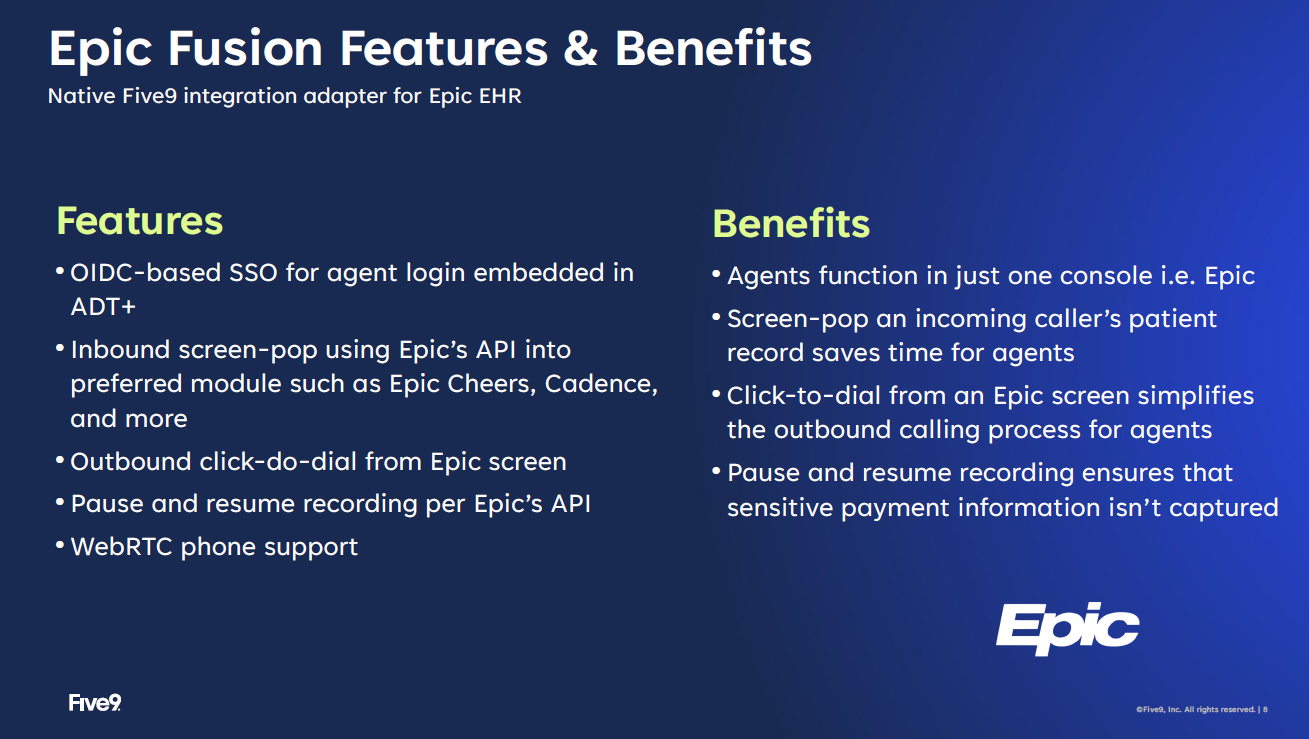
Fusion9 Fusion for Epic, which will be generally available in September, includes the following:

  • Patient context for every call includes relevant data as soon as a call is received.
  • One-click outbound calling to enable agents to initiate calls from Epic modules.
  • HIPAA-compliant call recording controls.

The news lands after Five9 announced second quarter earnings and the retirement of CEO Mike Burkland after a successor is named. Five9 reported second quarter net income of $1.2 million, or a penny a share, on revenue of $283.3 million, up 12% from a year ago.

For 2025, Five9 is projecting revenue between $1.1435 billion and $1.1495 billion with non-GAAP earnings of $2.86 a share to $2.90 a share.

Next-Generation Customer Experience Chief Information Officer

Cisco delivers strong Q4 on AI infrastructure surge

Cisco delivers strong Q4 on AI infrastructure surge

Cisco said it saw strong orders for AI infrastructure as the company reported a strong fourth quarter.

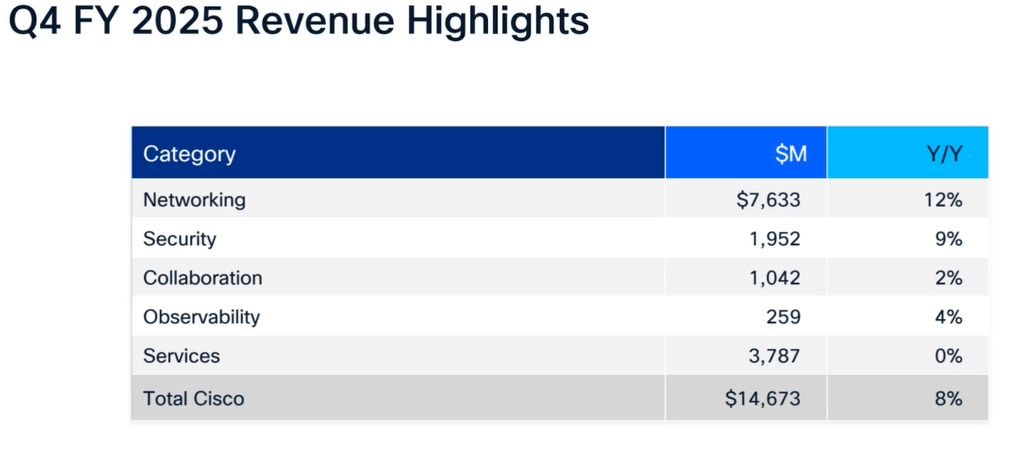
The company reported fourth quarter earnings of $2.8 billion, or 71 cents a share, on revenue of $14.7 billion, up 8% from a year ago. Non-GAAP earnings in the fourth quarter were 99 cents a share.

Wall Street was looking for fourth quarter earnings of 98 cents a share on revenue of $14.62 billion.

Chuck Robbins, CEO of Cisco, said "the AI infrastructure orders we received from webscale customers in fiscal 2025 were more than double our original target." He added that the company expects to see strong demand form sovereign AI deployments and emerging AI cloud providers. Robbins added that Cisco’s sales scale is boosting its Splunk unit and security strategy.

Cisco rival Arista surged last week after it said revenue growth will be about 25% in 2025 to $8.75 billion due to strong enterprise and AI demand. Jayshree V. Ullal, CEO of Arista, said during the company's second quarter earnings call that "we recognize the potential to build a truly transformational networking company." Juniper, another Cisco rival, has been acquired by HPE.

Here's a look at Cisco by the numbers:

  • Fourth quarter orders were up 7% from a year ago, across multiple regions. AI infrastructure orders from webscale customers topped $800 million in the fourth quarter for a fiscal 2025 total of more than $2 billion.
  • Cisco's networking business delivered revenue growth of 12% to $7.63 billion in the fourth quarter.
  • Security revenue was up 9% in the fourth quarter to $1.95 billion.
  • For fiscal 2025, Cisco reported earnings of $2.61 a share on revenue of $56.7 billion.

As for the outlook, Cisco projected first quarter non-GAAP earnings of 97 cents a share to 99 cents a share on revenue of $14.65 billion to $14.85 billion. Fiscal 2026 revenue will be between $59 billion to %60 billion with non-GAAP earnings of $4 a share to $4.06 a share.

Key items from Robbins during the conference call:

  • “Our new smart switches are powered by Silicon One and deliver enhanced performance, quantum secure networking and radically simplified cloud native and AI driven operations, all supporting the new realities as AI changes how it work and collaborate. The introduction of our new switches marks the beginning of a major multiyear refresh cycle opportunity for Cisco's large installed campus switching base.”

  • “AI orders are ramping and we have a growing pipeline in the hundreds of millions of dollars as these customers look to Cisco to provide simple, scalable and secure solutions.”
  • “The Cisco secure AI factory with Nvidia provides a trusted blueprint for building secure AI ready data centers for enterprises, sovereign cloud providers and newly emerging neo cloud providers.”
  • “While we have some clarity on tariffs, we are still operating in a complex component environment. Our Q1 and fiscal year 2026 guide assumes current tariffs and exemptions remain in place for the end of fiscal 2026.”
  • “We're pretty confident that we haven't seen any indication of any pull forwards in AI infrastructure among backend networks of the cloud providers.”
Data to Decisions Tech Optimization cisco systems Big Data Chief Information Officer Chief Technology Officer Chief Information Security Officer Chief Data Officer