


Don't let your vendor's AI strategy become yours
Tom Pagram, Head of AI at Virgin Australia, has a simple message for enterprises: Don't let your vendor pick your AI strategy.
"One of the fastest ways to slow down your AI transformation is to let every vendor solve it for you," said Pagram. "We could get really useful task‑level AI, but we weren’t going to get the step change that comes from connecting work across different systems, teams and customer journeys."
Pagram was speaking at AWS Summit 2026 in New York on a customer panel. Virgin Australia is an AWS shop because the company determined that it wanted one ecosystem and network effect from AI. "We wanted that network effect," he said. "Every time we introduce a new agent or a connector or MCP tool, we wanted it to benefit the whole value chain and customer journey."
Picking a lead vendor is one thing, added Pagram, but you better have your strategy down, think architecture and governance and know the outcomes you're trying to achieve. Pagram said Virgin Australia built a unified ecosystem on Bedrock AgentCore.
A unified strategy is critical given AI is moving so fast. Pagram said one of the biggest risks is allowing the "AI strategy to become the sum of whatever AI features appear in the business applications each of our functions use."
- How to avoid vendor lock-in in the AI age
- AI Forum 2026: There isn’t an easy button for AI
- Constellation Research's Futures Forum: What CEOs are thinking
- SaaS under the microscope: How to evaluate your vendor
- Disruption coming for ERP and not from where you'd think
If fall into that vendor-as AI-strategy theme, it basically means finance will have its own AI so will legal and customer service as well as any other function.
Pagram explained:
"Being an airline, our customer journeys really do cut across a lot of different systems and many teams. A customer changing a flight might touch bookings, finance, payments, loyalty status, disruption policy, consent preferences. And then a staff member that's helping that same customer might need context from their contact center platform, the loyalty platform, the booking platform, a knowledge base, an ops system and a CRM. None of that maps neatly to one department or one or one system, and our customers really couldn't care for how we organize ourselves internally, nor should they."
The broad themes of charting a course that stays out of the muck of various AI offerings go like this:
- Define an enterprise AI architecture and governance layer above individual SaaS products.
- Require extensibility either through MCP or API from vendors so their agents can plug into your ecosystem not the other way around.
- Treat executive sponsorship and risk design as core technical enablers, not process overhead.
Pagram's talk was refreshing since it had an element of architectural control and a solid plan. If you think in terms of functions and get roped into vendor roadmaps, you're going to short-circuit AI progress. See: How to avoid vendor lock-in in the AI age
Virgin Australia rolls with four guiding principles.
- Composable, not centralized. Let vendors and domain teams do what they do best. Complexity is the problem of the enterprise's technology and AI team.
- Own the front door. Keep control of the customer-facing experience, tone of voice, instant routing and brand identity.
- One AI ecosystem. Invest AI integrations that show up everywhere. "We're not in the business of building bespoke AI platforms," said Pagram. "We're in the business of flying planes."
- Standardize the basics and solve for common non-functional requirements instead of each team, agent and tool.
Here's a look at Virgin Australia's AI ecosystem, which revolves around using a platform that has multiple services that can be stitched together.
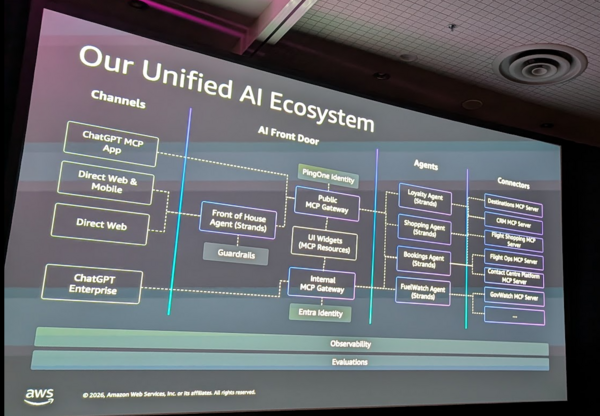
Ultimately, Pagram is going for a strategy that revolves around "expressing an outcome-based intent and having an AI agent do the work for you, identify skills or sub-agents and teams that need to be involved."
Pagram highlighted two use cases, a front-door agent and fuel-saver application.
The front-door agent has its own UI that taps into a gateway that taps into agents and connectors and context. "Some of those connectors and agents are developed by us and others by our vendors," said Pagram. "We set the interface standards and microservices and try to keep our vendors responsible for their own integration complexity wherever we can."
Virgin Australia has six agents and more than 30 MCP tools in production in the last 16 weeks.
The airline's front-door agent has launched in ChatGPT because the reality is a big chunk of consumers is turning to LLMs as the entry point to plan and book trips. The walkthrough highlighted various agents working together behind the scenes to solve customer issues.
Virgin Australia's goal with its AI front-end agents was to deliver the same features and experience delivered through traditional channels.
Pagram's other use case was for an internal application called FuelWatch that used ChatGPT Enterprise as the consumption front end with a team of five sub agents that monitored the Iran war, flow of oil, jet fuel prices and how governments and airlines around the world were responding.
Virgin Australia's internal app went from idea to production in two days and produced a daily briefing for the C-suite. The MCP tools and connectors running in AgentCore will be reused for other use cases. "Our ultimate goal is to reliably take new internal AI solutions from concept to production in two days and customer solutions in six weeks," said Pagram. "We think we're about two to three months away from doing that."
There is a wrinkle worth noting in this AI transformation tale. The secret sauce for Pagram and Virgin Australia was CEO sponsorship. "I believe the number one critical success factor is that we had very active sponsorship," said Pagram, who noted CEO Dave Emerson meets weekly on the AI transformation.
More from AWS Summit 2026:
- Why Amazon Quick could be more strategic than recognized
- AWS Summit 2026: Amazon Quick, Transform, AgentCore Harness, Policy
- AWS sics Transform on technology debt
- QuEra CEO: Quantum moves beyond science project to engineering challenge
Other takeaways from AWS customers
While Virgin Australia's thought leadership stood out, other AWS customers speaking at sessions also had a few key takeaways to ponder.
Netsmart's Ryan Hehan, SVP of Engineering and Principal Archtiect, said the following.
- AI changes engineering work, but it doesn't eliminate engineers. "I look at AI and agentic AI as another chapter in the automation story," said Hehan. "Those individuals didn’t disappear… capacity was returned back to us to go do more things. There's still a critical role to reason on the intent of the system and needs of the individual consumers."
- Governance and observability prevent runaway AI spending while highlighting high-value patterns. "We were monitoring token spend early on. There are certainly team members that consume more tokens than others, but you peel back the onion to see if they're doing really interesting things that produce productivity gains. It hasn't come to the point where we need to pump the brakes.
Avis Budget Group Engineering Manager Sabarikanth Sivaprakasam walked through a contact center modernization project and outlined the following.
- Don't mix replatforming with major feature redesign. "Migrate first and modernize second. We were genuinely tempted during the initial phase of migration to introduce more features. That one decision helped us to avoid the compounding risk," he said.
- Stand up observability and business intelligence before turning on AI and automation. "Measure before you optimize. We deployed our CloudWatch dashboards and our business intelligence dashboards before we turned on a single plug," said Sivaprakasam.
- Start with low-risk areas and earn trust over time. "AI requires permanent trust. We watched other teams rush to AI adoption and erode the customer confidence along the way. Start AI at the lowest area, prove the value, and then scale deliberately," he said.
Larry Dignan is Editor in Chief of Constellation Insights at Constellation Research, where he leads editorial coverage focused on enterprise technology, digital transformation, and emerging trends shaping the future of business. He oversees research-driven news, analysis, interviews, and event coverage designed to help technology buyers and vendors navigate complex markets with clarity and context. ...
Read morePublished
Author
