


Nebius’ Q2 revenue boom: What you need to know
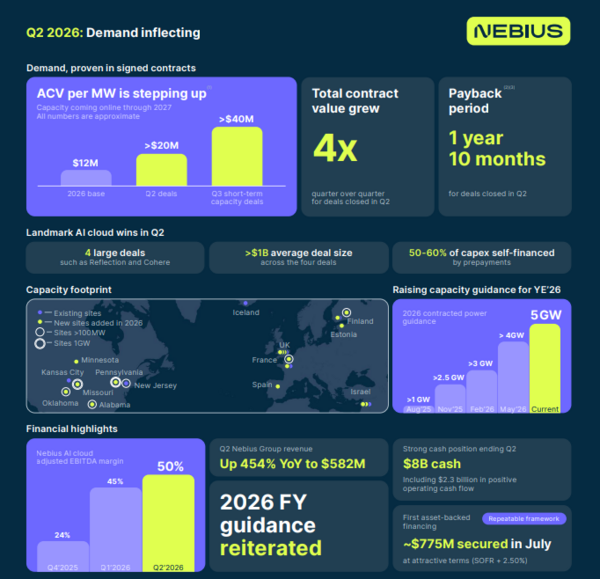
Nebius delivered second quarter revenue growth of 454% and said it could sell all of its capacity if it wanted to. But Nebius said it is landing higher prices by reserving AI infrastructure and auctioning it off to the highest bidder.
The company reported a second quarter net loss from continuing operations of $190.4 million on revenue of $582.3 million. The results were better than expected.
Like CoreWeave, the other publicly traded neocloud provider, Nebius outlined strong growth and the economics behind seemingly neverending capital spending. Nebius grew total contract value by 4x and said it has a payback period of 1 year and 10 months for deals closed in the second quarter.
Here's a look at the takeaways from the Nebius second quarter earnings call:
Demand outpaces capacity. Nebius said it repeatedly sells out new capacity and could already contract all planned 2027 supply. "We could sell today our entire 2027 capacity if we wanted to. But we are not doing this," said Arkady Volozh, CEO of Nebius.
Nebius is savvy about maximizing its economics. The company is intentionally retaining some capacity because it expects better pricing from deals signed closer to deployment. The four major AI-cloud deals signed during the second quarter averaged more than $1 billion each and generate approximately $20 million–$25 million per megawatt. Shorter, urgent engagements are being negotiated at $40 million–$50 million per megawatt or higher.
Given those economics it makes sense to auction off some capacity. "The auction result was a price 15% higher than we’ve ever seen before and 20% higher than our pipeline for Blackwells," said Marc Boroditsky, Chief Revenue Officer.
- Accelerating Physical AI With Purpose-Built Cloud
- Constellation ShortList™ AI Factory Providers
- Constellation ShortList™ AI Clouds with Compute Roots
The company can displace rivals. Boroditsky noted that its strongest deals were competitive displacements. Companies already using hyperscalers selected Nebius in the second quarter based on scale, cluster performance, reliability and support. Nebius is looking to add AI inference services.
Nebius is adding capacity. The company plans to deploy more than 1 gigawatt of new capacity in 2027. Management now expects five gigawatts of contracted power by the end of 2026, with almost all of it expected to come online over the following three to three-and-a-half years. The company still expects 800 megawatts to one gigawatt of connected power during 2026.
This capacity, however, doesn't turn to revenue right away. "You have to commission the data center, build the network, build the clusters, deploy the platform, then onboarding the customers, and then the revenue generation starts," said Andrey Korolenko, Chief Product and Infrastructure Officer.
Nebius executives were asked about a Vineland, NJ project and the company said the project remains on schedule. Microsoft has contracted capacity for the Vineland project.
Customer prepayments are crucial to fund expansion. Nebius said about 70% of the second quarter deals included prepayments. Prepayments through 2026 will cover about half of Nebius' capital expenditures. "Customers’ prepayments will bring in more than $9 billion of upfront funding this year, directly reducing the capital we need from debt and equity," said CFO Dado Alonso.
Nebius also has about $40 billion in committed backlog for asset-backed financing.
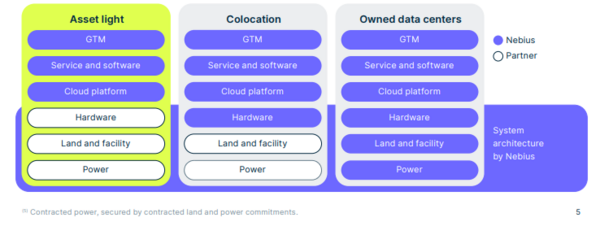
Nebius is exploring an asset light model, but it's still early. Under this model, partners finance and operate infrastructure while Nebius provides the software platform, services and customer demand. It offers a way to add capacity without placing all the capital expenditure on Nebius’s balance sheet.
The company ultimately plans to offer a full AI platform. Chernin said Nebius' Token Factory, an open model inference, post training and agentic AI platform, can boost revenue per customer and margins. "We want to serve customers across the full AI lifecycle," said Chernin.
Larry Dignan is Editor in Chief of Constellation Insights at Constellation Research, where he leads editorial coverage focused on enterprise technology, digital transformation, and emerging trends shaping the future of business. He oversees research-driven news, analysis, interviews, and event coverage designed to help technology buyers and vendors navigate complex markets with clarity and context. ...
Read morePublished
Author
