


CoreWeave Q2 stronger than expected, touts backlog
CoreWeave said it exited the second quarter with a revenue backlog of $104 billion as the company reported better-than-expected results.
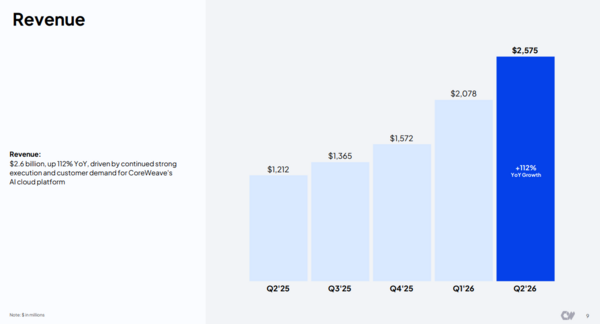
The AI neocloud provider reported a second quarter net loss of $626 million, or $1.14 a share, on revenue of $2.57 billion, up 112% from a year ago.
Wall Street was expecting CoreWeave to report a second quarter non-GAAP loss of $1.20 a share on revenue of $2.56 billion. Analysts were modeling for a net loss of $1.47 a share.
CoreWeave CEO Michael Intrator said the company “reached an important inflection point this quarter as our scale began to translate into expanding operating leverage.” The company said enterprise adoption is broadening.
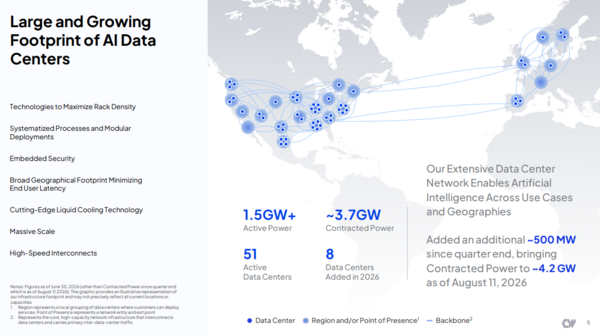
The company said it has 1.5GW of active power and 51 active data centers at the end of the quarter.
Here's what Intrator said on CoreWeave's earnings call:
- "In Q2, the customer contracts we signed came with contribution margins we expect to be five to 10 percentage points above those added in recent quarters."
- "Our near-term capacity remains effectively sold out. That is translating into signed commitments on increasingly favorable terms from a broadening set of customers, and is positioning CoreWeave to gain market share for years to come."
- "We will deploy Nvidia's Vera Rubin platform to support Caterpillar's physical AI training and inference at industrial scale. Using CoreWeave's AI cloud infrastructure as its data factory, Caterpillar will train specialized models that enhance the intelligence and productivity of autonomous construction equipment."
- "Demand now extends beyond our infrastructure as well. Through CoreWeave Omni, we are seeing significant interest from sovereign, enterprise, and cloud customers alike."
- "As AI moves into production, the way applications are built is changing, and the leaders will be those who learn and iterate the fastest. For the last several years, many organizations treated a model like a deliverable: train it, deploy it, and move on. Enterprises no longer operate that way. Training, inference, evaluation, and improvement now form a single continuous loop."
- "Compute is no longer a one-time requirement concentrated at the beginning of a model's life, it becomes an ongoing requirement that grows with every application in production and every cycle of improvement."
- "CoreWeave is monetizing tokens while giving customers flexibility in how they consume our platform."
- "In the past few months since its launch, booked ARR for our managed inference platform has grown from $1 million to more than $100 million. We expect to exit 2026 with at least $250 million of managed inference."
Key developments for CoreWeave this year include:
- CoreWeave ARIA (AI Research & Iteration Agent) launched within its Weights & Biases unit that reads experiment data, uncovers hidden insights and improves model and agents.
- The company was the first to bring up and validate Nvidia Vera Rubin NVL72 systems. See: CoreWeave launches latest Nvidia instances, adds Weights & Biases tools
- CoreWeave integrated training, inference, visibility and optimization capabilities in a closed loop on its platform.
- The company also launched CoreWeave Sandboxes for reinforcement learning, agent tool use and model evaluation.
- CoreWeave passed 1GW of capacity.
- CoreWeave inked multi-year pact with Anthropic and Meta.
The company said it landed customer wings with Caterpillar, Grammarly and others. CoreWeave expanded deals with Cognition, Databricks and Hudson River Trading.
By the numbers:
- CoreWeave spent $9.4 billion on capital expenditures in the second quarter, up from $6.8 billion in the first quarter.
- 40% of CoreWeave’s revenue backlog matures in less than 24 months.
- CoreWeave added more than $25 billion in net new customer commitments in the current quarter.
- CoreWeave ended the quarter with current recourse debt of $6.23 billion and current non-recourse debt of $1.28 billion. Non-current recourse debt was $25.17 billion at the end of the quarter with non-current non-recourse debt of $2.38 billion. Recourse debt allows a lender to seize assets. Non-recourse debt limits the lender to taking only the specific property or collateral to secure the loan.
Constellation Research analyst Holger Mueller said:
"CoreWeave is riding the AI data center curve really hard, further doubling down on its strategy in the inference and agentic phase of enterprise adoption on the enterprise. With debt now north of $35 billion it is all in or disappointment for CoreWeave. A backlog of more than $100 billion puts the focus all on execution. Can Coreweave beat its competition in AI data center build out and more importantly offer the software technology stack it will land enterprise AI workloads."
The outlook: More revenue, more capex
As for the outlook, Intrator said: "CoreWeave enters the second half of the year, with more momentum than at any point in our history."
CFO Nitin Agrawal said CoreWeave has been able to expand its margins and maintain pricing of previous Nvidia systems. The company expects third quarter revenue of $3.35 billion to $3.6 billion with adjusted operating income of $200 million to $260 million. Interest costs for the third quarter will be $860 million to $950 million.
Agrawal added that third quarter capex will be $11.5 billion to $13.5 billion. For 2026, CoreWeave is projecting revenue of $12.4 billion to $13.2 billion. Capex for the year will be between $35 billion to $39 billion. CoreWeave is expected to exit 2026 with an annual revenue run rate between $18.5 billion and $19.5 billion.
"We are being disciplined in how we allocate our scarce cloud capacity. We are prioritizing opportunities that are strategically important, adding new customers while deepening long-term existing relationships and delivering attractive returns," said Agrawal.
Agrawal said that CoreWeave in the second quarter improved margins before a 25% increase in pricing in July.
He made the following points:
- The cost for CoreWeave is front-loaded due to capital expenditures and is funded with a combination of debt, customer prepayments and capital.
- Once a cluster is delivered, contracted revenue ramps.
- Deployments are designed to pay down asset debt and then generate cash flow.
- CoreWeave is passing through component increases to customers.
- "What we are seeing today is that the upside of recontracting is real, as we remain largely sold out of prior generations of NVIDIA GPUs, in addition to the current SKUs, so as our earlier generation fleets roll off their original contracts, they offer the potential to deliver strong returns in the subsequent years," said Agrawal.
- The supply chain remains challenging.
Larry Dignan is Editor in Chief of Constellation Insights at Constellation Research, where he leads editorial coverage focused on enterprise technology, digital transformation, and emerging trends shaping the future of business. He oversees research-driven news, analysis, interviews, and event coverage designed to help technology buyers and vendors navigate complex markets with clarity and context. ...
Read morePublished
Author
